



This week’s analysis highlights some of the most significant geopolitical developments involving America’s adversaries—China, Russia, Iran, and North Korea—between February 14, 2026 - February 21, 2026.
Summary:
Ukraine and Moldova disrupted a major Russian plot to assassinate prominent Ukrainian officials.
New reports highlighted the growing size and capability of China’s nuclear submarine fleet.
The US provided new details of China’s alleged June 2020 explosive nuclear test.
Iran conducted joint naval drills with Russia in preparation for potential conflict with the US.
North Korea highlighted its growing strategic rocket force ahead of the Ninth Party Congress.
1. UKRAINE AND MOLDOVA THWART RUSSIAN ASSASSINATION PLOT
On February 20, Ukrainian and Moldovan officials announced that they had disrupted a major plot to assassinate prominent Ukrainian officials. The announcement followed twenty coordinated raids by law enforcement in Ukraine and Moldova, which led to a total of ten arrests, including seven conspirators in Ukraine and three in Moldova, along with the seizure of caches of weapons, explosives and electronics.
According to Ukraine’s Office of the Prosecutor General, the plot was coordinated with Russian intelligence services and targeted at least five high level government officials, allegedly including Andrii Yusov, a strategic communications representative at Defence Intelligence of Ukraine and Deputy Head of Coordination Headquarters for the Treatment of Prisoners of War. Russian agents promised a bounty of up to $100,000 for each assassination.

Takeaways:
This most recent plot is the latest in a series of Russian-organized assassination attempts targeting Ukrainian officials, carried out through disaffected citizens of Ukraine and surrounding countries. On July 9, 2025, a Russia-linked assailant shot and killed Ivan Voronych, a colonel in the Ukrainian Security Service (SBU), in Kyiv. On August 30, 2025, prominent Ukrainian politician Andriy Parubiy was assassinated in Lviv. On February 3, 2026, Poland sentenced a Polish national known as Pavel K. to three and a half years in prison for his role in a Russian-backed plot to assassinate Ukrainian President Volodymyr Zelensky in 2024.
These plots, relying on poorly trained local proxies acting on their own initiative, can achieve some localized successes as noted above. They are however, far less effective than covert operations carried out by specialists, and as this case demonstrates, more vulnerable to disruption. Russia has not achieved the same level of sophistication in covert actions that Ukraine has evidenced in Operation Spider Web and other attacks, in part because of the SBU’s success in dismantling Russian intelligence networks, and because of added Western intelligence support.
2. NEW CHINESE SUBMARINE CAPABILITIES FURTHER NARROWING GAP WITH US
China Exceeding the US in Nuclear Submarine Production
According to a February 16 analysis by Henry Boyd and Tom Waldwyn of the UK’s Institute for International Strategic Studies, China has decisively surpassed the US in its production of nuclear submarines. According to the authors, China produced greater numbers of submarines as well as greater total tonnage of submarines than the US between 2021-2025. The growth in production has been facilitated by significant expansion of the Bohai shipyard, in the port city of Huludao in Liaoning province.
China Outfitting Attack Submarines with Hypersonic Missiles
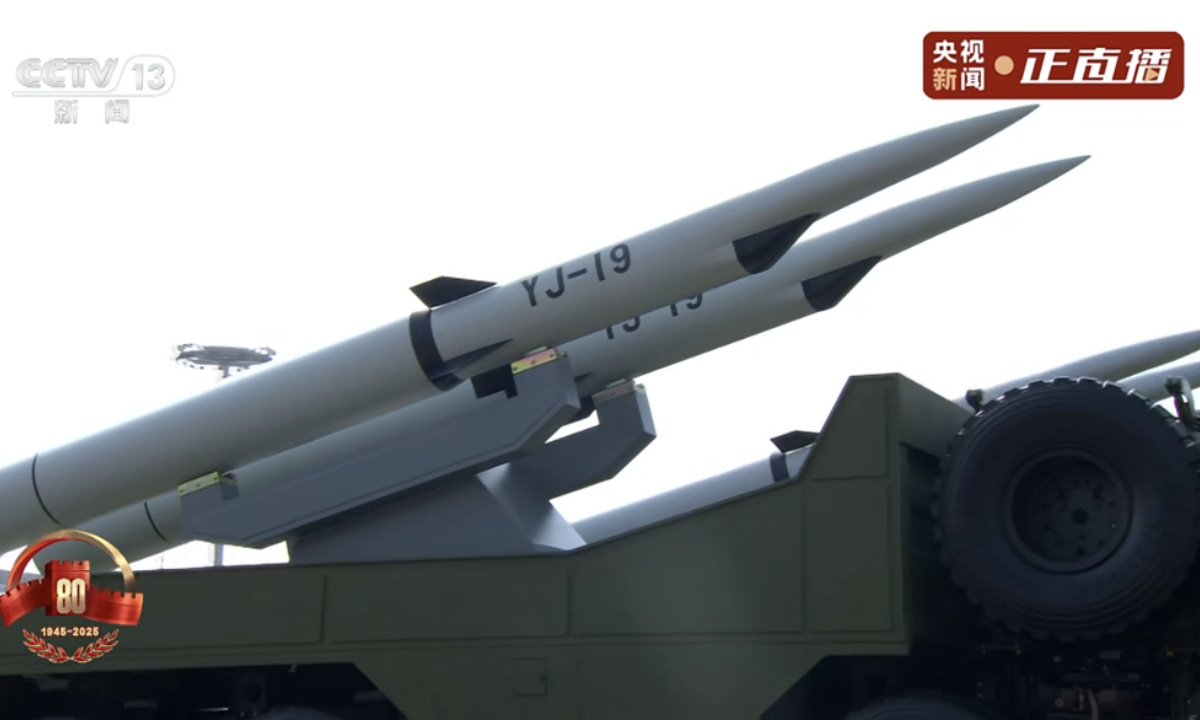
According to a report by Naval News, China has announced that it will soon be equipping its fleet of Type-039B Yuan-B-class submarines with YJ-19 hypersonic missiles. The YJ-19 are a new class of anti-ship missiles first publicly displayed on September 3, 2025 at the 80th anniversary military parade celebrating victory of Japan in the Second World War.
Takeaways:
As noted in Weekly Significant Activity Report - February 14, 2026, China now possesses the world’s second largest fleet of nuclear submarines, with at least 32 boats compared with the US’s 71. China’s rapid pace of development, combined with the US’s own sluggish production, means that the gap will continue to close in the coming decade.
China’s growing fleet of nuclear-powered attack submarines nevertheless is still much less advanced than the US and Russia. The deployment of the YJ-19 is significant in that it represents a major step forward in retrofitting these less advanced subs with modern weapons. The YJ-19 is specially designed to deploy from the antiquated horizontal launch tubes used by China’s fleet of Type 093 subs, thereby greatly expanding the number of hypersonic missiles the Chinese military can bring to bear against the US Navy in a conflict.
3. US PROVIDES NEW DETAILS OF ALLEGED 2020 CHINESE NUCLEAR TEST
Speaking at the Hudson Institute on February 17, US Assistant Secretary of State for Arms Control and Nonproliferation Christopher Yeaw elaborated on accusations first made by Under Secretary of State Thomas DiNanno on February 6, alleging that China conducted secret explosive nuclear testing in June 2020. According to Assistant Secretary Yeaw, seismic monitoring stations in Kazakhstan near China’s Lop Nur nuclear site observed data suggestive of a decoupled nuclear explosion on June 22, 2020.
“Certainly, going back to Under Secretary DiNanno’s remarks in Geneva, we are aware of yield-producing nuclear explosive testing in China. We are aware that they are using decoupling, which is essentially a method to reduce the effectiveness of seismic apparatus to detect this. We’ve been paying very close attention to this. Obviously a very important issue. On June 22, 2020, we are aware that China conducted a nuclear explosive test. The probable explosion occurred right near the Lop Nur nuclear test site. That’s China’s nuclear test site. A few details. I’ve noticed on X, and et cetera, folks are really looking hard for this. I’m going to make it a little easier. Zero-nine-one-eight, 9:18 zulu, Greenwich Mean Time, Kazakhstan station PS23. And it detected a 2.75 magnitude. That is in Makanchi, Kazakhstan.
“Looking at the data, and I’ve looked at additional data since then, there is very little possibility, I would say, that it is anything but an explosion. A singular explosion. It’s not consistent with the ripple fire explosion that you get in mining. It’s also entirely not consistent with an earthquake. It is quite consistent with what you would expect from a nuclear explosive test of some certain yield. That would be obviously super critical, and not sub-critical as the United States tests currently.”
Takeaways:
As noted in Weekly Significant Activity Report - February 7, 2026, a “de-coupled” test occurs when a nuclear device is detonated inside an underground cavern—ideally one created by a previous nuclear test. The open space essentially helps muffle the blast. There is an ongoing debate as to how much seismic activity a small decoupled nuclear explosion in Lop Nur would generate. Some experts have suggested a de-coupled explosion would reduce the seismic signature of the blast by 20-40 times. Other experts have argued that the effect could be even more dramatic, shrinking the signature 70-100 times. Much depends on the size and composition of the cavity the test is conducted in and the yield of the explosion.
Most monitoring stations associated with the Comprehensive Test Ban Treaty Organization may have failed to pick up the test as they are calibrated to pick up seismic events of a magnitude of 2.8 or greater. As arms control expert Jeffrey Lewis of the James Martin Center for Nonproliferation Studies at the Middlebury Institute of International Studies at Monterey notes:
“The 3.4 number, by the way, is for three seismic stations to each have a 90% chance of detection. That's very hight [sic] and many smaller events are detected. That data set above includes events as small as Mb=2.9 or twenty-eight tons. Regional networks can confidently detect down to about that number (2.8 actually) for Lop Nor.”
Under Secretary DiNanno previously suggested, but did not explicitly say that the 2020 test involved an explosive yield exceeding 100 tons of TNT. (His exact words were: “China has conducted nuclear explosive tests, including preparing for tests with designated yields in the hundreds of tons.”) The phrasing suggests the test that took place on June 22, 2020 was smaller than other tests that were being prepared, and may not have exceeded 100 tons after all. Estimates of the planned size of the explosive yield of the tests are likely based on intelligence obtained through other means such as human or signals intelligence, and it is not clear if they correspond with the actual size of the June 22, 2020 test. A fully coupled nuclear test (nuclear explosive wedged into rock) of between 90-220 tons would result in a seismic event of approximately 3.4 magnitude. A de-coupled test of the same yield would result in a much smaller signature.
4. IRAN CONDUCTS JOINT NAVAL EXERCISES
This week Iran conducted a series of naval exercises in the vicinity of the Strait of Hormuz.
Forces of the Islamic Revolutionary Guard Corps Navy conducting maritime security exercises. Source: Islamic Republic of Iran Broadcasting (IRIB News)
Russian and allegedly Chinese naval forces joined the Iranian drills under the banner of "Maritime Security Belt 2026," the seventh iteration of an annual joint maritime exercise.1 On February 19, Russian and Iranian forces carried out joint ship-boarding drills as part of Maritime Security Belt 2026 in waters south of Bandar Abbas, near the Strait.
Naval commandos from Russia and Iran conduct ship-boarding drills. Source: PressTV.ir
Takeaways:
The exercises near the Strait of Hormuz were meant to showcase Iran's readiness to contest the strategic waterway in the event of war with the US. However, the drills appeared highly scripted and called into question Iran's ability to conduct the operations that would ultimately be needed to deny the US Navy access to the Strait. As one Iranian military observer, Iranian Naval Force on Telegram noted:
“The purpose of holding exercises is not just to unload weapons that are nearing their expiration date. Rather, the main goal of conducting exercises should be to create a simulation situation close to real conflict for our forces. Unfortunately, in our armed forces, the procedure for creating exercises has always been based on precise planning programs. They place a boat in a fixed position, have its exact coordinates from the start, deliver them to the missile unit (the missile unit’s position is predetermined), then fire, hit, and that’s it! Such exercises do not result in readiness for war.”
Russia will not intervene to protect Iran in the event of conflict with the US, but its presence at the exercise is meant to display solidarity with Iran and help delay US action.
5. NORTH KOREA DISPLAYS DOZENS OF NEW ROCKET LAUNCHERS AT START OF MAJOR PARTY CONGRESS
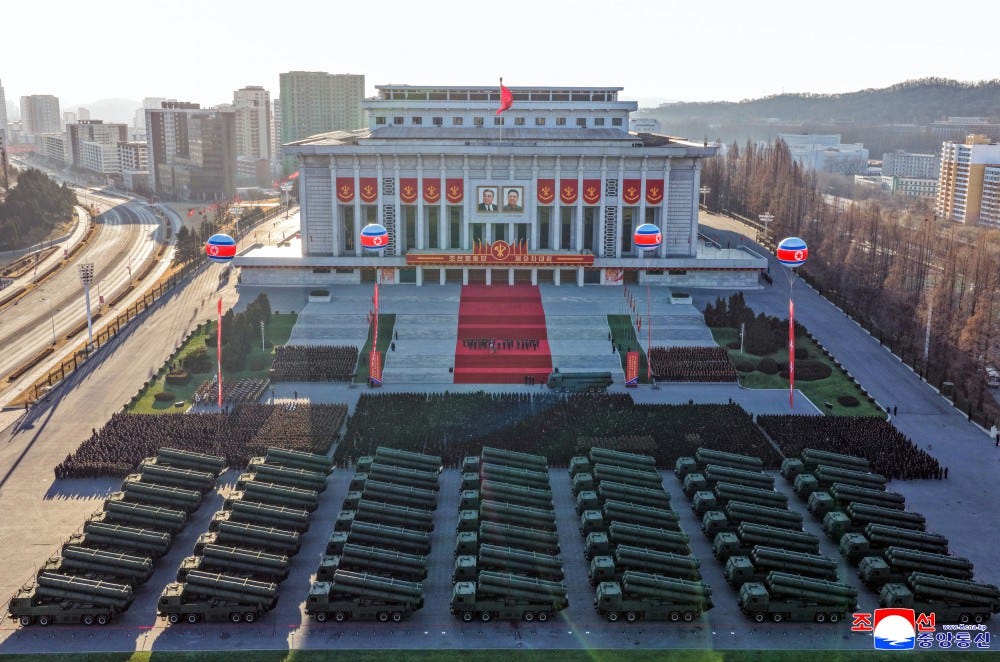
On February 18, North Korea displayed 50 launch vehicles for 600mm rockets in a ceremony at the House of Culture in Pyongyang ahead of the Ninth Party Congress of the ruling Workers’ Party of Korea.
Takeaways:
The large caliber rocket launchers are a new weapon system that was tested in a live fire exercise on January 27, where they hit targets at a range of over 350km.
The display is likely intended to highlight the achievements Kim Jong-un has made in strengthening the ruling Worker’s Party of Korea ahead of its Ninth Party Congress. The Party Congress, occurring once every five years, sets the strategic direction for the country.
The launchers are allegedly capable of deploying rockets armed with Hwasan-31 tactical nuclear warheads. The display of 50 launchers—each fitted with five rocket pods—may signal that North Korea could produce as many as 250 tactical nuclear weapons absent an understanding with the US.
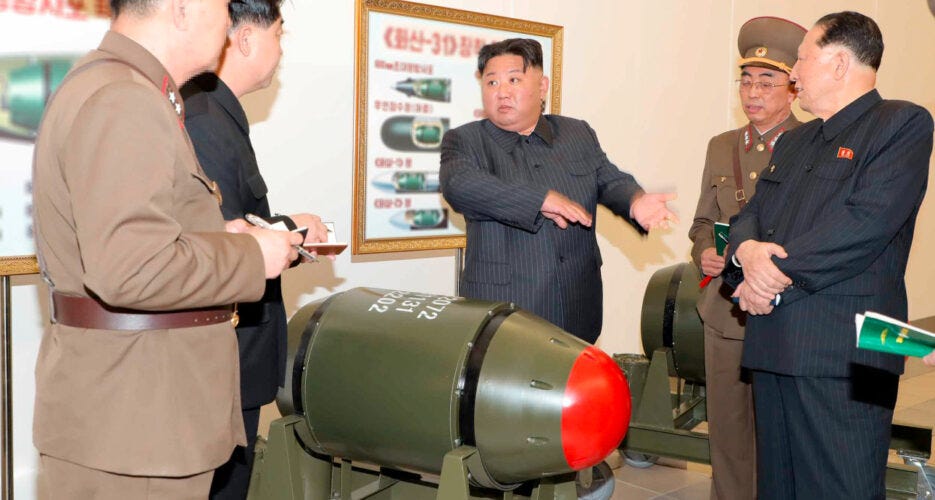
Kim Jong-un standing beside a Hwasan-31 nuclear warhead in March 2023. Source: NK News via KCNA Pyongyang has expressed a willingness to negotiate with the Trump administration on measures to achieve strategic stability on the Korean Peninsula, but has first demanded that Washington recognize it as a nuclear power. The new display may serve as another subtle hint that North Korea is a de-facto nuclear power and that recognition of the fact is a necessary first step toward building a security relationship in which Pyongyang feels secure enough that it need not mass produce nuclear weapons.
-
A growing number of indicators suggest that North Korea may indeed be capable of rapidly expanding its nuclear arsenal to outfit its new rocket launchers and more. The North's main enrichment facility, the Yongbyon Nuclear Scientific Research Center, is currently undergoing expansion. In November 2025, Lee Sang-kyu, Director of the Nuclear Security Research Office at the Korea Institute for Defense Analyses, estimated that North Korea could produce as many as 400 nuclear warheads by 2040.
We were unable to definitively identify Chinese involvement in the exercises aside from a single set of statements made by Russian and Iranian officials, prior to the start of Maritime Security Belt 2026 on February 17. Subsequent statements about Maritime Security Belt 2026 only mentioned Russian and Iranian participation.