



This week’s analysis highlights some of the most significant geopolitical developments involving America’s adversaries—China, Russia, Iran, and North Korea—between January 31, 2026 - February 7, 2026.
Summary:
The New START Treaty, the last remaining arms control agreement limiting offensive strategic weapons between the US and Russia, expired.
Russia resumed trilateral talks with the US and Ukraine in the UAE, but negotiations made negligible progress and remain deadlocked over the fate of the Donbas and Ukrainian security guarantees.
The US accused China of conducting secret explosive nuclear tests in violation of the Comprehensive Test Ban Treaty.
Iran conducted talks with the US in Oman and continued efforts to deter US strikes.
New figures released by Iranian human rights groups show mounting numbers of confirmed protester deaths and arrests.
Ukrainian military intelligence alleged that North Korean troops are conducting artillery strikes on Ukrainian territory, a significant escalation in Pyongyang's involvement in the war.
1. THE NEW START TREATY, THE FINAL US-RUSSIAN ARMS CONTROL AGREEMENT, ENDS
The New START Treaty governing the size and capabilities of the US and Russian nuclear forces expired on February 5. New START, which went into effect in February 2011, followed a succession of post-Cold War arms control treaties between the US and Russian Federation including the START I (signed in 1991), START II (signed in 1993) and SORT (signed in 2002) treaties which capped the number of deployed and non-deployed nuclear warheads and delivery systems for both countries. New START enforced these restrictions through robust verification measures including mandatory data sharing, inspections, and dispute resolution mechanisms.
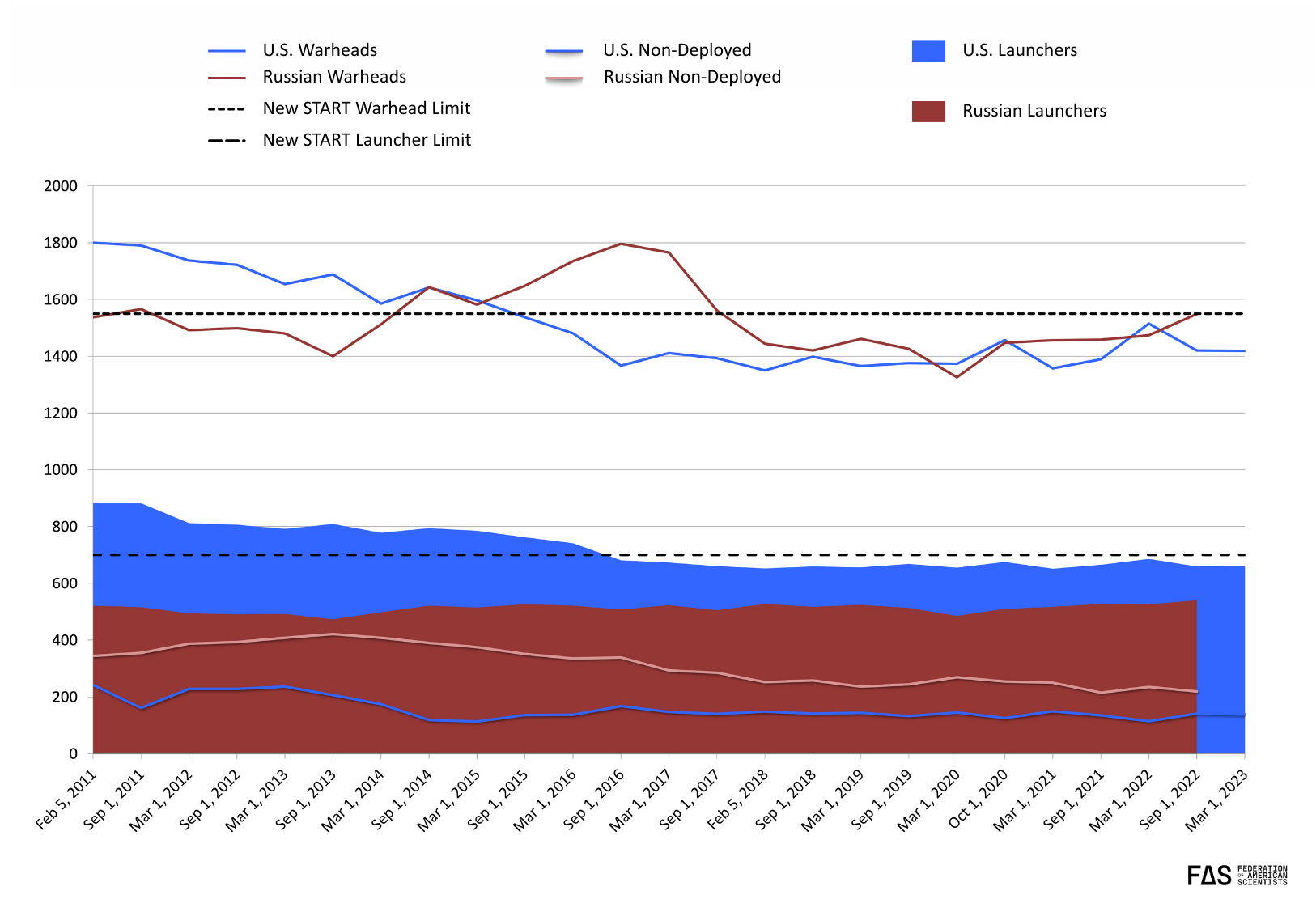
The treaty was the last remaining arms control agreement limiting offensive strategic weapons between the world’s largest nuclear powers after the Intermediate-Range Nuclear Forces (INF) Treaty collapsed in 2019.
In September 2025 Russian President Vladimir Putin offered to continue observing the conditions of New START for an additional year (February 2027) to allow the treaty to either be formally extended or replaced with a new agreement. On February 4, on the eve of the treaty’s expiration, the Russian Ministry of Foreign Affairs released a statement complaining that the US had ignored the offer.
“However, no formal official response from the United States with regard to the Russian initiative has been received through bilateral channels. Public comments from the US side also give no reason to conclude that Washington is ready to follow the course of action in the field of strategic offensive arms proposed by the Russian Federation. In fact, it means that our ideas have been deliberately left unanswered. This approach seems erroneous and regrettable.”
President Trump announced on February 5 that the US would not extend New START and would instead seek a new treaty to replace it.
“Rather than extend “NEW START” (A badly negotiated deal by the United States that, aside from everything else, is being grossly violated), we should have our Nuclear Experts work on a new, improved, and modernized Treaty that can last long into the future.”
Takeaways:
While the Kremlin may complain that the US is disinterested in arms control it is worth noting that it was President Putin who first announced that Russia was suspending participation in the treaty ahead of the first year anniversary of the war in Ukraine in 2023—in an effort to coerce the US to deescalate its involvement in the war.
Despite the expiration of New START, a major new arms race between the US and Russia of the kind witnessed during the Cold War appears unlikely—at least in the near term. Russia currently faces serious budget woes caused by declining oil and gas revenues and heightened war spending, making the development of thousands of new nuclear weapons financially infeasible. These constraints may be at least partially driving Putin's willingness to continue observing the limitations of a treaty he officially suspended. Further, while President Trump turned down the idea of formally extending New START, US negotiators appear to have suggested they are amenable to an informal agreement under which both sides would unilaterally observe the treaty's limitations for another six months while a new agreement is crafted.
2. TRILATERAL US-UKRAINE-RUSSIA TALKS RESUME IN ABU DHABI
US-mediated talks between Russia and Ukraine continued in Abu Dhabi on February 4-5. The talks produced a new prisoner exchange that released 157 Ukrainians from Russian captivity, but made no progress on key issues such as security guarantees for Ukraine and the fate of territories in the Donbas. Russia reiterated its demand that Ukraine cede the entirety of the Donbas region (Donetsk and Luhansk oblasts) as part of a peace settlement.
Takeaways:
Seizing all of the Donbas, the remaining 22% of Donetsk Oblast it does not currently occupy (approximately 2,082 square miles, an area about two times the size of Rhode Island) is critically important for Russia because it is the bare minimum achievement needed to salvage some appearance of victory in a war which has inflicted 1.2M casualties and compromised the country’s economic partnership with Europe.
-
Russia has otherwise not succeeded in demilitarizing Ukraine, which now has a larger, more technologically advanced military and defense industrial complex, which is de facto more integrated into NATO and the broader European and Transatlantic security architecture than it was before the war. Russia has also not succeeded in its other stated objective of “de-Nazifying” Ukraine (i.e. toppling Ukraine’s democracy and imprisoning or killing its nationalist elites).
-
Forcing Ukraine to cede territory through negotiations would provide the Kremlin some plausible basis for claiming it achieved victory in the war by dictating the terms of its settlement. Russia wants to further emphasize this victory (no matter how small or costly) by demanding international recognition of its territorial conquest.Russian negotiators involved in the talks do not believe an end to the war is near, with one telling Russian state-media outlet TASS that developing a final draft of any proposed agreement would take another month and a half under the best of circumstances.
-
Russia is likely inclined to continue dragging out talks over control of the Donbas for the coming months, assuming it will achieve battlefield gains that will ultimately push the Trump administration—eager to notch a major foreign policy win ahead of the midterm elections—to pressure Ukraine to accept.-
But contrary to its confident public posturing, the Kremlin does not have an unlimited window for delay. Russian economic troubles, warned about for months, are coming to a head. The Russian government ran a budget deficit of 1.718 trillion rubles in January alone—almost half the deficit the Ministry of Finance forecast for the entire year. With limited options for raising foreign debt, Russia will likely be forced to print money to cover the mounting shortfall. This threatens to exacerbate inflation and compel the Bank of Russia to maintain its ultratight monetary policy, which will in turn worsen debt burdens on Russian companies and deepen other economic distortions that have been building for years. Conditions have deteriorated enough in recent weeks that Russian economists, including pro-Kremlin officials, have begun warning that the country faces a potential banking crisis by summer.
3. US ACCUSES CHINA OF CONDUCTING SECRET NUCLEAR TESTS
On February 6, Under Secretary of State for Arms Control and International Security Thomas DiNanno claimed that China has conducted secretive explosive nuclear testing since 2020.
“China has conducted nuclear explosive tests, including preparing for tests with designated yields in the hundreds of tons… China has used decoupling – a method to decrease the effectiveness of seismic monitoring – to hide its activities from the world. China conducted one such yield producing nuclear test on June 22, 2020.”
The alleged tests, involving self-sustaining nuclear chain reactions, would violate China’s commitment under the Comprehensive Test Ban Treaty (CTBT).
Takeaways:
While this is the first time the US has leveled specific accusations that China has violated the CTBT (a treaty it signed and claims to adhere to, though like the US, it has never ratified it), there have been a growing number of indications that China has either engaged in or is preparing for nuclear tests that would violate the treaty.
-
In November, the Washington Post reported that China had greatly expanded the infrastructure at its Lop Nur nuclear site in the Western region of Xinjiang, the site of China’s original nuclear tests. The expansion, covered in numerous other reports dating back to 2021, included the drilling of new test shafts inside mountains and boreholes deep underground which would facilitate tests of the kind alleged this week.
The “de-coupling” US Under Secretary DiNanno refers to is a technique for disguising a low-yield nuclear blast by conducting the detonations in a large underground cavern to disperse its seismic effects. As arms control expert Jeffrey Lewis of the Middlebury Institute of International Studies at Monterey describes:
“…decoupling is when one explodes a nuclear device inside a cavity, usually one created by a prior nuclear explosion. This makes the yield look 20-40 times smaller than it really is (assuming rock at a place like Lop Nor).”
An explosion equivalent to 100 tons of TNT (0.1kt) is small in comparison to the yield of much larger nuclear weapons. A 0.1kt explosion is still a weapons test by any standard, as it is roughly three to five times the yield of nuclear artillery shells developed in the early Cold War-era. Modeled in NUKEMAP (a popular nuclear weapons simulator created by Stevens Institute of Technology Professor Alex Wellerstein) a 100 ton nuclear bomb detonated in Times Square would level multiple city blocks and cause tens of thousands of casualties.
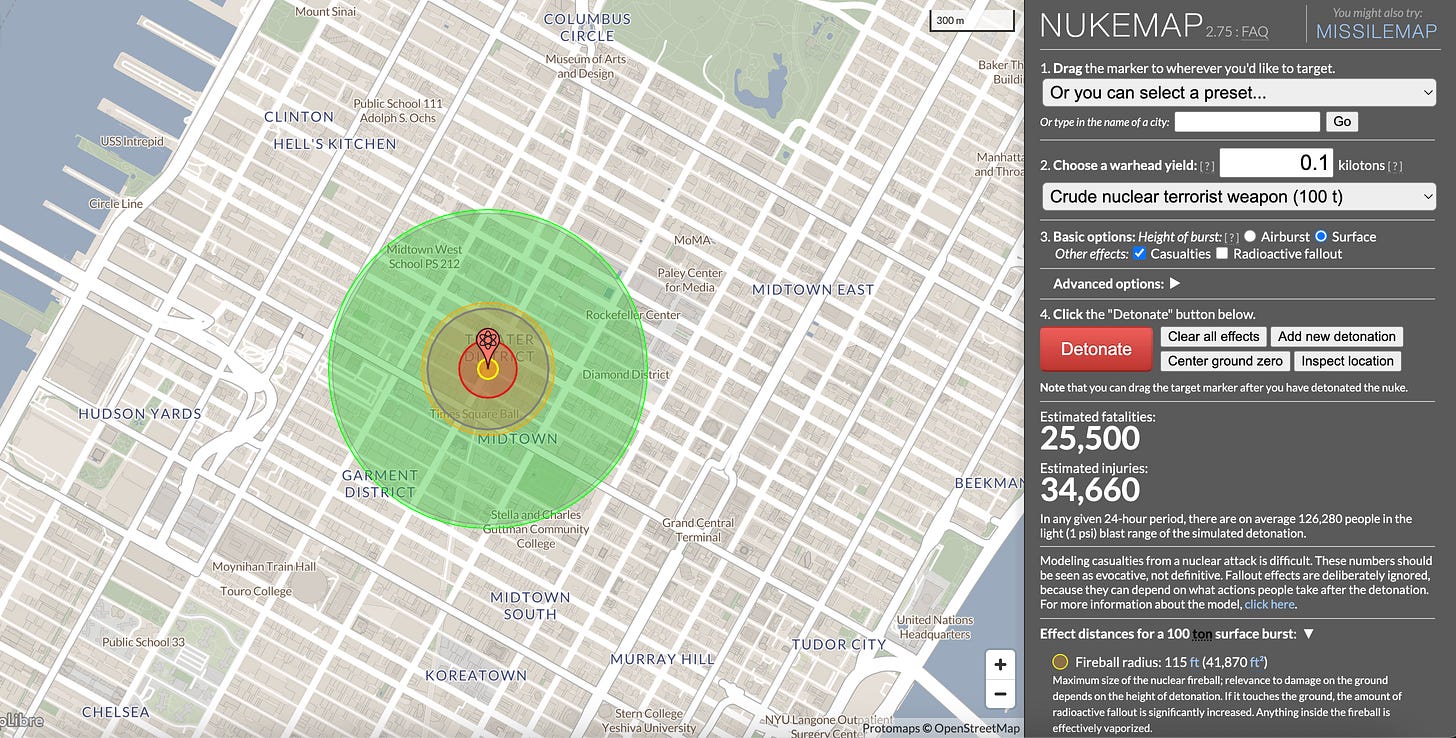
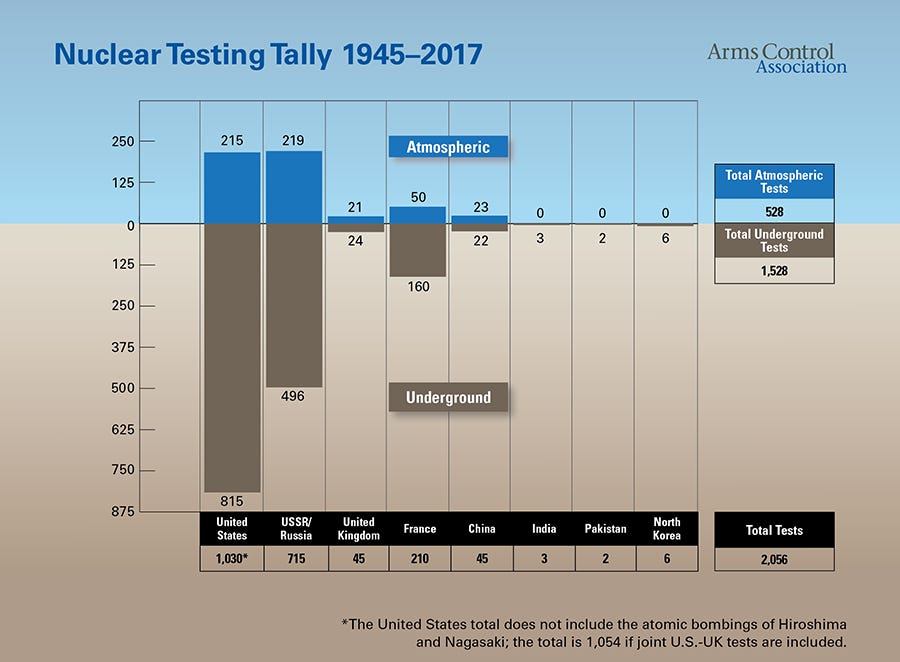
The effects of a 0.1kt surface detonated nuclear explosion in Times Square Source: NUKEMAP v2.75 As noted in Weekly Significant Activity Report - November 22, 2025, China lacks the robust data sets that Russia and the US have accumulated through decades of live nuclear tests. China conducted only 45 nuclear tests prior to the CTBT, while the US conducted 1,030 and Russia (including as the Soviet Union) conducted 715. This empirical data is essential for designing nuclear weapons, and understanding their effects. The data is also used to ensure the long-term reliability of nuclear weapons as they age. Beijing therefore has strong incentives to violate the CTBT and conduct whatever nuclear testing it can get away with, in order to strengthen the credibility of its nuclear arsenal.
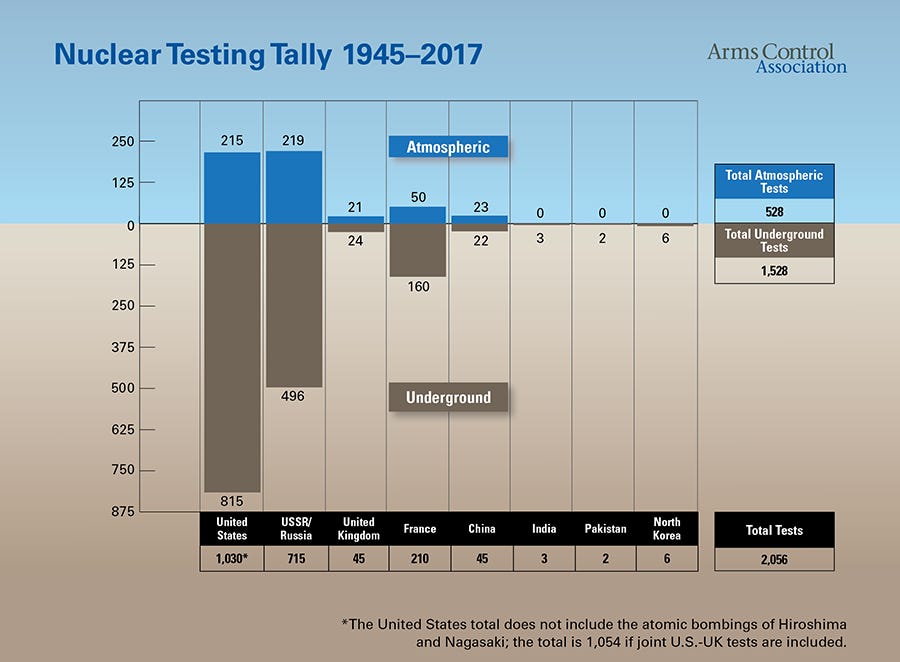
Total number of global nuclear tests through 2017. Source: Arms Control Association The new US allegations come as New START expires and the Trump administration seeks a new arms control treaty involving Russia and China. China has repeatedly rejected offers to participate in arms control negotiations. The latest rejection came on February 3, when China's Ministry of Foreign Affairs reiterated long-held talking points on arms control:
“China’s position on a trilateral negotiation with the U.S. and Russia on nuclear arms control is clear. China’s nuclear strength is by no means at the same level with that of the U.S. It is neither fair nor reasonable to ask China to join the nuclear disarmament negotiations at this stage.”
Fundamentally, Beijing rejects arms control because it believes such treaties would unfairly constrain its military development and prevent it from achieving parity with the US and Russia. China also conceptualizes strategic competition with the US differently than the risk-mitigation framework the US and Soviet Union developed during the Cold War. It has repeatedly turned down using risk-reduction measures in previous crises with the US—such as military hotlines—in part to exploit uncertainty and leverage fear of uncontrolled escalation as a deterrent against US military action.
4. IRAN HOLDS TALKS WITH US IN OMAN WHILE PREPARING FOR CONFLICT
Iran Holds Talks with US in Oman
On February 5, US Special Envoys Steve Witkoff and Jared Kushner held talks with Iranian Foreign Minister Abbas Araghchi in Muscat, Oman, in an effort to negotiate diplomatic solutions to the ongoing standoff over Iran's nuclear program and its recent crackdown on anti-government protests.
Iranian Drone Shot Down Near US Carrier Group
On February 3, a US F-35 shot down an Iranian Shahed-type drone that approached the USS Abraham Lincoln aircraft carrier in the Arabian Sea. Tasnim News, a semi-official mouthpiece of Iran’s Islamic Revolutionary Guard Corps, claimed the drone involved was a Shahed-129, which was on a mission to surveil the US carrier.
Iran Readies Long-Range Missiles
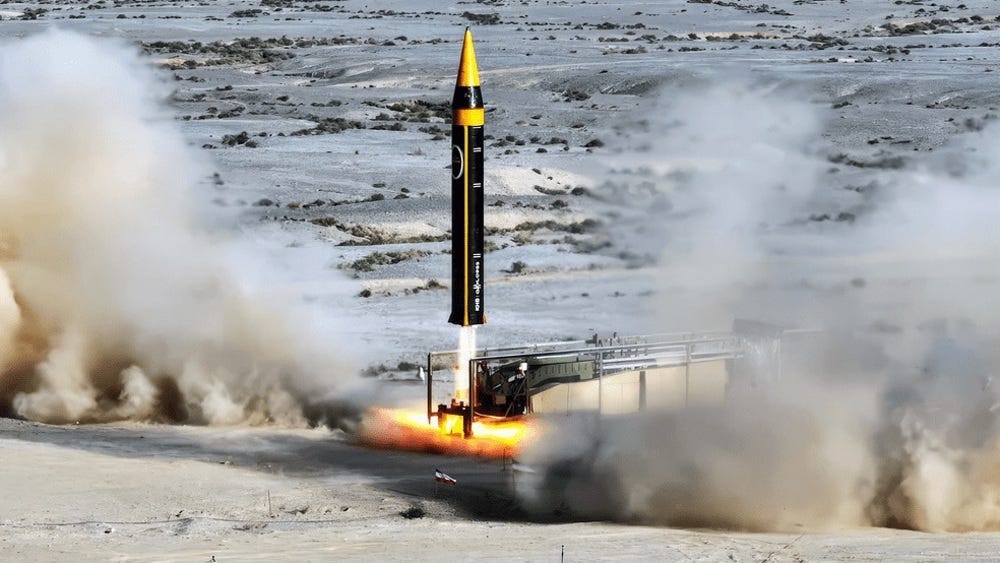
On February 7, Iranian state media outlet PressTV announced that the Iranian Revolutionary Guard Corps has deployed its most advanced ballistic missiles to underground missile facilities for operational use in the event of war with the US. The Khorramshahr-4 ballistic missile allegedly has a maximum range of 2,000km, carries a 1,500kg warhead, and has an accuracy of 30m.
Takeaways:
In an interview with Al Jazeera on February 7, Iranian Foreign Minister Abbas Araghchi suggested Iran could show some flexibility in negotiating lower levels of uranium enrichment in talks with the US but is unwilling to end its nuclear program or place restrictions on its ballistic missiles.
“Our main position is opposition to any removal of uranium from the country, but we are ready to reduce the enrichment ratio.”
Iran's redlines are its ballistic missile program, which it views as a core national security priority, and its right to enrich uranium, as the nuclear program represents a signature generational project (and massive sunk cost) the regime cannot abandon.
Iran, while vulnerable due to mounting social instability, is possibly in a better position to defend itself than it was before the 12-Day War. Israeli strikes in June 2025 caught the Iranian regime off guard and disrupted its response. Iran has likely since prepared for multiple contingencies for a possible renewed conflict that would allow it to launch hundreds of drones and ballistic missiles at US and Israeli bases throughout the region.
-
Iran’s overwhelming repression of protests will likely create long-term vulnerabilities as aggrieved Iranians, including members of the military, may become willing to cooperate with foreign intelligence services to punish the regime. However, such networks of spies and collaborators will take time for the US and Israel to cultivate.
Iran will continue highlighting preparations it has made for war, such as deploying the Khorramshahr-4, to appear as a hard target and deter US strikes. The regime may be inclined to test the limits of US willingness to escalate militarily—as exhibited in the recent drone incursion—in order to frame any future US decision to rule out military action as resulting from its deterrence. Tehran would leverage such a climb-down as a major victory to boost its legitimacy among domestic hardliners disturbed by recent social unrest and deteriorating economic conditions, and to shore up the support of its foreign allies like China and Russia.
5. FALL OUT FROM IRANIAN PROTEST CRACKDOWN CONTINUES
February 7 marked 42 days since the start of mass anti-government protests in Iran. According to Human Rights Activists in Iran (HRAI), the number of individuals killed in the demonstrations reached at least 6,961 deaths. Another 11,630 deaths are being investigated. 6,507 of those killed were protesters. An additional 11,021 civilians are reported injured. The government has arrested a total of 51,465 protesters, and issued 11,048 judicial summonses.
Takeaways:
These new totals represent an additional 248 recorded deaths over the past week as well as an additional 2,395 arrests by regime security forces.
Reporting by Iran International suggests as many as 32 Iranian healthcare workers have now been reported arrested or missing since treating protesters.
6. NORTH KOREAN TROOPS CONDUCTING ATTACKS INTO UKRAINE
Ukraine’s Main Intelligence Directorate (HUR) announced on February 4 that it has observed North Korean troops under the command of the Russian military conducting artillery raids into villages in northern Ukraine.
According to HUR:
“Under Russian command, soldiers of the DPRK army, in particular, fire from artillery and multiple launch rocket systems, perform aerial reconnaissance and artillery reconnaissance tasks, and adjust MLRS strikes.
“The focus on mastering unmanned technologies and gaining experience in conducting modern warfare is a characteristic feature and one of the key goals of the DPRK army’s participation in the Russian-Ukrainian war.”
Takeaways:
This is at least the second time Ukraine has alleged that North Korean troops are directing artillery fire onto Ukrainian territory rather than fighting on Russian soil. While the troops are not believed to have crossed into Ukrainian territory, the attacks nevertheless represent a significant escalation in North Korea's involvement in the war, marking a pivot from defending the territory of an ally to active participation in offensive operations.
As HUR notes, the nature of North Korea's evolving participation in the war suggests it may be rotating troops through positions where they can gain combat experience that could prove valuable in a conflict with South Korea, particularly in fire support operations involving drones and missiles.