



This week’s analysis highlights some of the most significant geopolitical developments involving America’s adversaries—China, Russia, Iran, and North Korea—between November 29 - December 6, 2025.
Summary:
Russian President Vladimir Putin made his first state visit to India since the start of the war in Ukraine. The visit did not include the high profile arms deals that some observers had anticipated.
President Putin met with US special envoys Steve Witkoff and Jared Kushner in Moscow to discuss US proposals for ending the war in Ukraine, but the Russian leader showed little openness to compromise.
Russia’s newest Poseidon-capable special purpose submarine entered the water, anticipating the start of sea trials.
China deployed around 100 naval and coast guard vessels near Japan, Taiwan, and the Philippines over recent weeks in a significant show of force.
French President Emmanuel Macron urged China to drop support for Russia’s war in Ukraine, while China simultaneously sought Russian backing for its pressure campaigns against Japan and Taiwan.
Iran highlighted its growing indigenous naval capabilities with the debut of new ships and live-fire exercises in its nearby waters.
Iran hosted the Shanghai Cooperation Organization’s (SCO) annual joint counter-terrorism exercises.
1. VLADIMIR PUTIN MAKES STATE VISIT TO INDIA
Russian President Vladimir Putin conducted a state visit to India from December 4-5. The trip marked the first visit by the Russian leader since the start of the full-scale invasion of Ukraine.
Putin attended meetings with Indian Prime Minister Narendra Modi and Indian President Droupadi Murmu as well as delivered remarks to the Russian-Indian Business Forum.
Takeaways:
While some Indian observers had anticipated the trip would see new deals for advanced Russian military equipment such as the S-500 air defense system and SU-57 stealth fighter jet, no such agreements appear to have been signed. Instead a joint press release indicates Russia will provide spare parts for Russian-made military equipment the Indian army has already purchased and will allow some Russian military equipment to be made in India in the future in joint ventures. It is unlikely that the systems included in this “Made in India” program will include Russia’s most advanced air defenses or fighter jets.
Agreements reached during the trip focused on increasing trade between the two countries. Notable agreements included continued Russian energy exports (both nuclear materials and fossil fuel) and fertilizer to India, as well as invitations to India to join Russian ventures in the Arctic and Siberia.
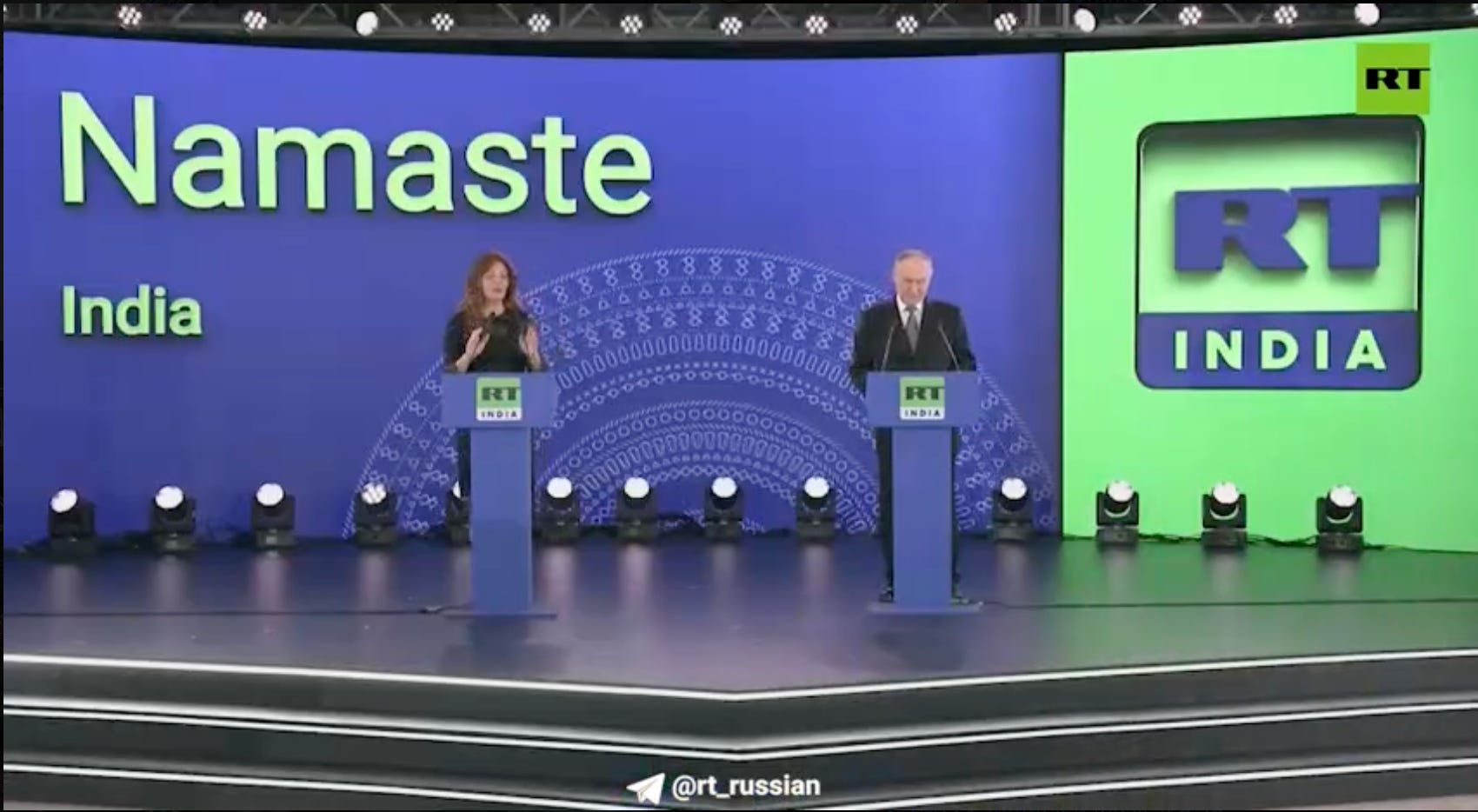
The visit featured the launch of an Indian branch of Russia Today (RT). While Russia already has other pro-Kremlin media outlets operating in India such as Sputnik, RT is primarily a television station, while Sputnik and others operate as web-based wire services. India is the world’s largest media market, with television being the dominant form of media consumed. Sensational 24-hour news broadcasts, of the kind RT provides, are especially popular, suggesting the new channel will have a large ready-made audience.

Debut of RT India Source: Margarita Simonyan (@margaritasimonyan) on Telegram Beyond influencing Indian viewers, the station will broadcast in English, and will likely serve as a means of laundering pro-Kremlin talking points into Western discourse. During the Cold War, the Soviet Union historically used India as a staging ground for active measures campaigns it wanted to export to the US, including most notoriously disinformation about AIDS.
2. PUTIN HOSTS US SPECIAL ENVOYS FOR PEACE NEGOTIATIONS
On December 2 US special envoys Steve Witkoff and Jared Kushner met Russian President Vladimir Putin in Moscow for discussions on a US proposal to end the war in Ukraine. The two envoys were joined by Russian special envoy Kirill Dmitriev and Putin aide Yuri Ushakov. The talks lasted for approximately five hours.
Takeaways:
While not much is known about the exact details of the current US peace plan proposed by Witkoff and Kushner, it can be inferred that the Russian leader is not interested in settling the war on US terms, even if those terms are favorable to Russia.
Russian President Vladimir Putin arrived three hours late to the meeting after delivering a lengthy, incendiary speech at the “Russia Calling!” Investment Forum. The remarks, delivered prior to the start of talks with US negotiators, laid out Putin’s uncompromising stance toward territorial concessions from Ukraine and his purported readiness to go to war with Europe for its interference in peace talks, all while claiming that Russia is not at war with Ukraine “in the literal, modern sense of the word.”
Remarks by Yuri Ushakov following the talks suggested that Russia has rejected several points of the US plan and does not see a compromise possible on key issues such as territorial claims.
Several other insights into the state of peace talks can be inferred from comments made by Ushakov that are worth noting. First, Ushakov told a Kremlin press official that the original, controversially pro-Russian peace plan contained only 27 points rather than 28 points reported in Western media outlets. This is unlikely an error and may imply that Russia has firmly rejected at least one of the points included in the original draft.
Second, in later remarks to pro-Kremlin commentator Pavel Zarubin, Ushakov suggested that Jared Kushner has assumed the leading role of drafting the new proposal. Ushakov stated, “If any plan leading to a settlement continues to be drafted on paper, Mr. Kushner will be the one doing most of the pen-and-inking.”
3. RUSSIA LAUNCHES ITS NEWEST SPECIAL PURPOSE SUBMARINE
Russia’s newest special purpose submarine, the Khabarovsk, entered the water this week at the Sevmash shipyard in Severodvinsk, having completed final construction after its ceremonial rollout of the construction hall on November 1.
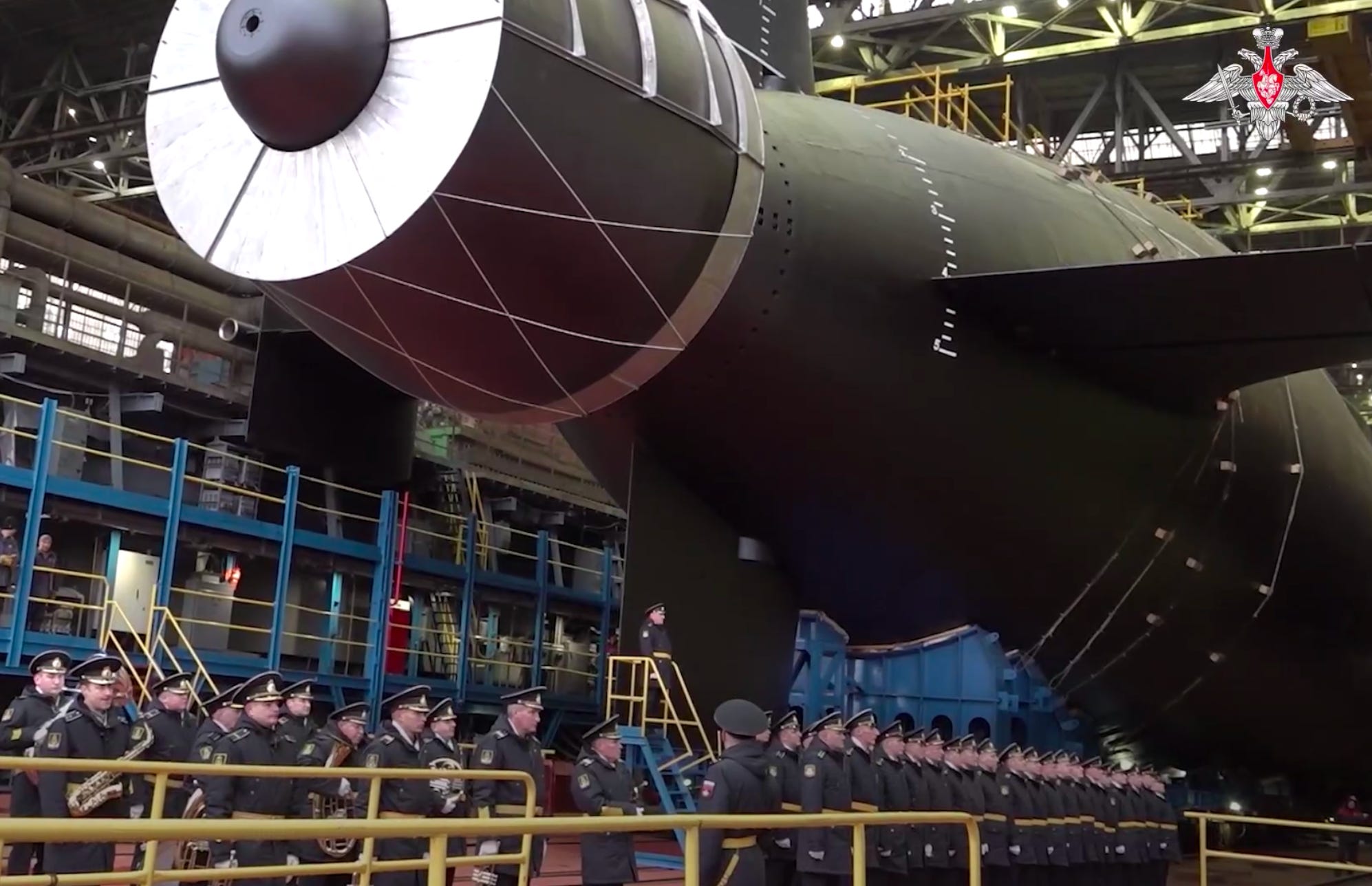
The Khabarovsk is a new model of submarine, the “Project 09851.” The sub is capable of carrying as many as six Poseidon nuclear-propelled nuclear-armed torpedoes as well as deploying underwater robotic systems.
Takeaways:
The official lowering of the ship into the water indicates that sea trials are likely to begin shortly. Recent sea trials for Russian submarines have lasted about two months and if successful are followed by a final cycle of shipyard maintenance before being delivered to the Russian Navy, suggesting the sub could be operational by spring 2026. However, the testing and finishing touches for the Khabarovsk may take longer as the ship is the first of its new class with unique features.
The Khabarovsk will be the third Russian submarine capable of launching its new Poseidon nuclear-propelled nuclear-armed torpedo. The only other submarines with similar capability are the Project 09852 Belgorod special purpose submarine, and the Project 20120 Sarov experimental submarine.
4. CHINA CONDUCTS NAVAL SHOW OF FORCE
China Amassed 100 Ships Near Japan and Taiwan
Over the past several weeks China deployed large numbers of vessels from the PLA Navy and China Coast Guard in the East China, Yellow, and South China Sea in a show of force against Taiwan and Japan. The total number of vessels deployed in the near seas topped at around 100 this week.
Chinese Navy Increases Pressure on the Philippines
Several contingents of Chinese naval vessels including dozens of maritime militia vessels were observed operating in the vicinity of the Philippines this week, including near the disputed Scarborough Shoal and Spratly Islands as well as the Philippine Sea. One of the groupings of ships at Subi Reef in the Spratly Islands shot warning flares at a passing Philippines surveillance aircraft.
Takeaways:
The surge of naval activity is likely spurred, in part, by China’s ongoing feud with Japan, and heightened tensions with the Philippines in the South China Sea. However, broader trends in Chinese naval operations suggest the increased activity may become a new normal.
China has conducted a large number of naval drills throughout 2025 including dual carrier deployments past the first island chain, and carrier deployment past the second island chain into the open Pacific Ocean for the first time ever. China also commissioned its newest and most advanced carrier, the Fujian, and began sea trials for its new Type 076 amphibious assault ship, the Sichuan, the largest ship of its class in the world. China has also expanded its Yulin and Yuchi naval bases over the past year.
The increased ship and base construction, combined with the heightened tempo of naval operations visible this year, suggests that the current 100-vessel deployment may represent a new baseline for naval operations that China will sustain and potentially expand upon in 2026.
5. CHINA CONDUCTS DIPLOMATIC BALANCING ACT WITH FRANCE AND RUSSIA
French President Emmanuel Macron Visited China for New Trade Deals and Support on Ukraine
On December 4, French President Emmanuel Macron met with Chinese President Xi Jinping as part of a three-day visit to the country. While Macron’s visit was intended to improve bilateral ties between the two countries a core issue addressed was the war in Ukraine.
Macron allegedly pressed China to cease providing Russia material support to continue the war and to agree to a ceasefire.
Chinese Foreign Minister Wang Yi Visited Moscow for Support on Japan and Taiwan
This week Chinese Foreign Minister Wang Yi traveled to Moscow to meet with his Russian counterpart Sergei Lavrov as well as Russian Security Council Secretary Sergei Shoigu.
Wang Yi pressed for closer Russian alignment with China’s confrontational policy toward Japan in an effort to diplomatically isolate the new government of Prime Minister Sanae Takaichi amid a deterioration of relations between the two countries. A joint press release from the meeting appeared to link Russia’s support for China’s aggressive policy toward Japan with China’s support for Russia’s war in Ukraine and its aggression against Europe. Both countries agreed to support one another in preventing the “revival of criminal regimes in Europe and Tokyo.”
Takeaways:
The combination of diplomatic events illustrates why China is unlikely to alter its present course on the war in Ukraine.
While France may pressure China to convince Russia to seek peace, it has offered limited incentives for China to do so. With economic growth stagnating, France has limited economic levers for shaping China’s behavior without harming its immediate interests. An underlying purpose of the trip was to increase economic cooperation between the two countries to help bolster the French economy, highlighting a fundamental power asymmetry between the two countries.
Other European countries have struggled to exert their own economic interests against China. The Netherlands recently folded under Chinese pressure to nationalize its semiconductor manufacturer Nexperia in response to serious national security concerns prompted by its Chinese ownership. The limited capacity Europe has shown to protect its own critical industries from Chinese predation underscores its limited leverage in compelling China to get Russia to end the war in Ukraine.
China is willing to endure the limited diplomatic pressure placed on it by Europe because its strategic partnership with Russia offers it diplomatic support in Asia against the US and its allies. Wang Yi’s trip to Russia illustrates that China expects Russia to reciprocate its support for its war in Ukraine by backing its pressure campaign against Japan.
6. IRAN SHOWS OFF NEW NAVAL FIREPOWER
Iran Debuts New Ships
At the Iranian Army Navy Day ceremony on November 29, the Iranian Navy unveiled several new vessels and military systems. The most significant of these new systems were the Kordestan, a floating naval base, and the Sahand destroyer.
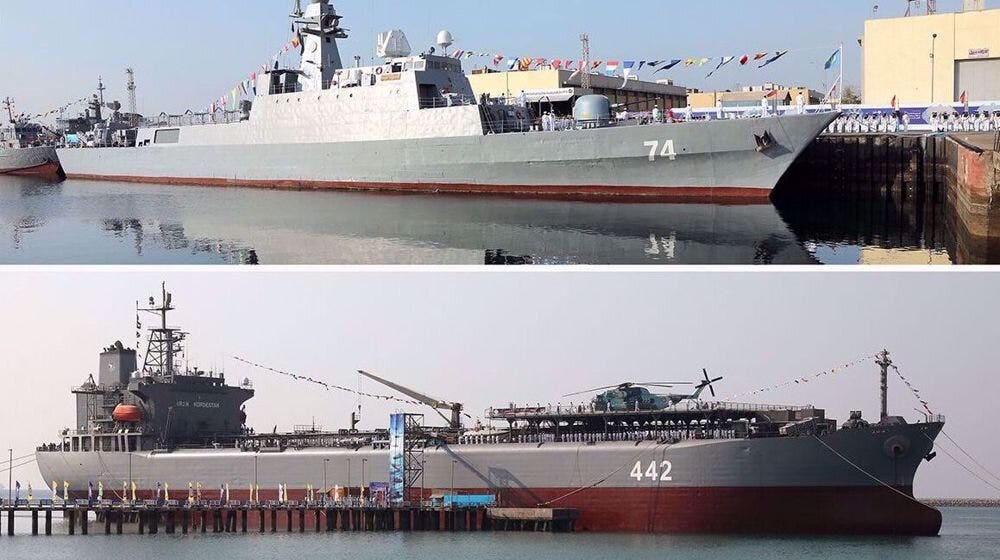
The Sahand is a recommissioned version of a previously launched ship of the same name which capsized during repairs in 2024. The new Sahand has been reclassified by the Iranian Navy as a destroyer, representing an upgrade in firepower and capability from its original classification as a Mowj-class frigate. The ship also allegedly possesses a reduced radar signature due to “stealth” modifications.
The Kordestan is a Makran-class forward base ship converted from a crude oil tanker. According to Fars News, the Kordestan can “offer rescue and relief capabilities, handle the heaviest helicopters, and support up to three destroyers on a three-year, around-the-world mission without refueling stops.”
Iran Conducted Naval Drills Near Disputed Islands
Iran’s Islamic Revolutionary Guard Corps (IRGC) Navy conducted two days of exercises from December 4-5 in the vicinity of the disputed islands of Lesser Tunb, Greater Tunb and Abu Musa, as well as the Strait of Hormuz and Gulf of Oman.
The IRGC Navy tested several different anti-ship missiles during the drills, including the land-based Qadr-110 and “303” ballistic missiles, and Qadr-360 and Qadr-380 cruise missiles, and missiles launched from new fast attack boats.
Takeaways:
While the new Sahand has upgraded arms and equipment, its reclassification as a destroyer is probably more of a branding exercise than an accurate assessment of its capabilities. Destroyers tend to be much larger than frigates to accommodate more weapons and crew members. The new Sahand appears to be roughly the same size as the previous iteration of the ship, about 1,500-2000 tons, which would make it much smaller than the naval destroyers of other great powers.1 Any structural modifications were likely made to support the ship’s existing armament, which is believed to have made the original too top heavy and contributed to its capsizing.
The announcement of the Kordestan floating naval base may be a prelude to an operational deployment for the Iranian navy. According to Maritime Executive, Iran is preparing to deploy two naval task forces from Bandar Abbas to Africa. The Kordestan would provide an important means of sustaining such a deployment. Iran has another Makran-class forward base ship, however, this vessel may be down for maintenance as it was observed leaking oil while returning to port in Bandar Abbas in October.
7. IRAN HOSTS SCO COUNTER-TERRORISM DRILLS
This week the Iranian Islamic Revolutionary Guards Corps (IRGC) hosted the “Sahand-2025” joint counter-terrorism exercise with members of Shanghai Cooperation Organization (SCO) in Iran’s East Azerbaijan province.2
The exercises ran from December 1-5 and featured participation from the IRGC’s Imam Zaman (AJ) Mechanized Brigade, as well as military units from Belarus, China, India, Kazakhstan, Kyrgyzstan, Pakistan, Russia, Tajikistan, and Uzbekistan.
Takeaways:
The IRGC-led counter-terrorism exercises were hosted days after Australia labeled the IRGC a state sponsor of terrorism in response to plots by the group to attack Jewish communities in the country.
The exercise was hosted near Shabestar in northwestern Iran, a region that has experienced sporadic conflict between the Iranian government and armed Kurdish groups. The 2024 SCO joint counter-terrorism exercise was held in the similarly restive Chinese province of Xinjiang, suggesting that a primary goal of these exercises is to demonstrate solidarity among member states toward transnational threats to internal stability. The SCO’s 2026 joint counter-terrorism exercises will be held in Belarus and may feature implied hostility toward Lithuania if these trends hold. Lithuania has hosted Belarusian political exiles, and taken a hawkish stance toward both Russia and China. The country has seen a surge in cross border provocations arising from Belarus in recent months, notably large numbers of smuggling balloons which have repeatedly shut down local airports.
The Sahand ship, and Sahand exercises are both named after a range of mountains in Iran’s East Azerbaijan province.