



This week’s analysis highlights some of the most significant geopolitical developments involving America’s adversaries—China, Russia, Iran, and North Korea—between December 6 - December 13, 2025.
Summary:
Russian President Vladimir Putin held talks with the leaders of Indonesia, Venezuela, Turkmenistan, Iraq, Iran, and Turkey this week in a surge of diplomacy.
China increased its military and diplomatic pressure on Japan and Taiwan this week amid an intensifying feud between the countries.
The Aviation Industry Corporation of China conducted the first test flight of the “Jiutian,” an ultra large unmanned aerial vehicle purportedly capable of serving as a drone mothership.
Top Chinese AI startup DeepSeek is allegedly using Nvidia’s most advanced AI chips to train its large language models, undermining previous claims to be leading China’s domestic self-sufficiency in AI development.
China releases new policy for Latin America and the Caribbean days after US declares a revival of the Monroe Doctrine.
Iran arrests Nobel Peace Prize recipient Narges Mohammadi amid an ongoing crackdown on human rights activists following the 12-Day War.
Iranian Foreign Minister Abbas Araghchi admits that Iran’s nuclear sites remain badly damaged and destroyed six months after the 12-Day War, suggesting that the Iranian nuclear program has been set back much further than early estimates anticipated.
North Korea has installed thermal shielding around a five-megawatt nuclear reactor at its Yongbyon Nuclear Scientific Research Center amid an expansion of the complex, suggesting efforts to conceal advancements in its nuclear program.
1. PUTIN CONDUCTS SURGE OF DIPLOMACY AMID PUSH TO END WAR AND SEIZE RUSSIAN ASSETS
Russian President Vladimir Putin engaged with a large number of world leaders this week:
December 10 - Meeting with Indonesian President Prabowo Subianto in Moscow (second visit in 2025)
December 11 - Phone call with Venezuelan President Nicolas Maduro
December 12 - Meeting with Turkmenistan President Serdar Berdimuhamedov in Turkmenistan
December 12 - Meeting with Iranian President Masoud Pezeshkian in Turkmenistan
December 12 - Meeting with Iraqi President Abdul Latif Rashid in Turkmenistan
December 12 - Meeting with Turkish President Recep Tayyip Erdogan in Turkmenistan
The diplomatic surge comes amid intensifying negotiations with the US over a plan to end the war in Ukraine and preparations by the European Union to permanently immobilize and potentially reappropriate Russian assets for assistance to Ukraine.
Takeaways:
The meetings come a week after Vladimir Putin hosted US special envoys Steve Witkoff and Jared Kushner and made a state visit to India, and appear to be part of a concerted effort to demonstrate that attempts to isolate Russia after the war in Ukraine have been unsuccessful and that Russia is advancing both on the battlefield and in international diplomacy.
The meetings over the past few weeks have been more symbolically valuable to Russia than substantive. The state visit to India last week did not deliver the major new military arms deals that had been anticipated, and the agreements reached mostly appeared designed to salvage existing partnerships in energy and military equipment amid US pressure. The meetings with the Iraqi and Iranian presidents similarly produced few noteworthy announcements. A readout of Putin’s phone call to Venezuelan President Nicolas Maduro was notable for what it omitted—any condemnation of the US, and any promise of continued security cooperation.
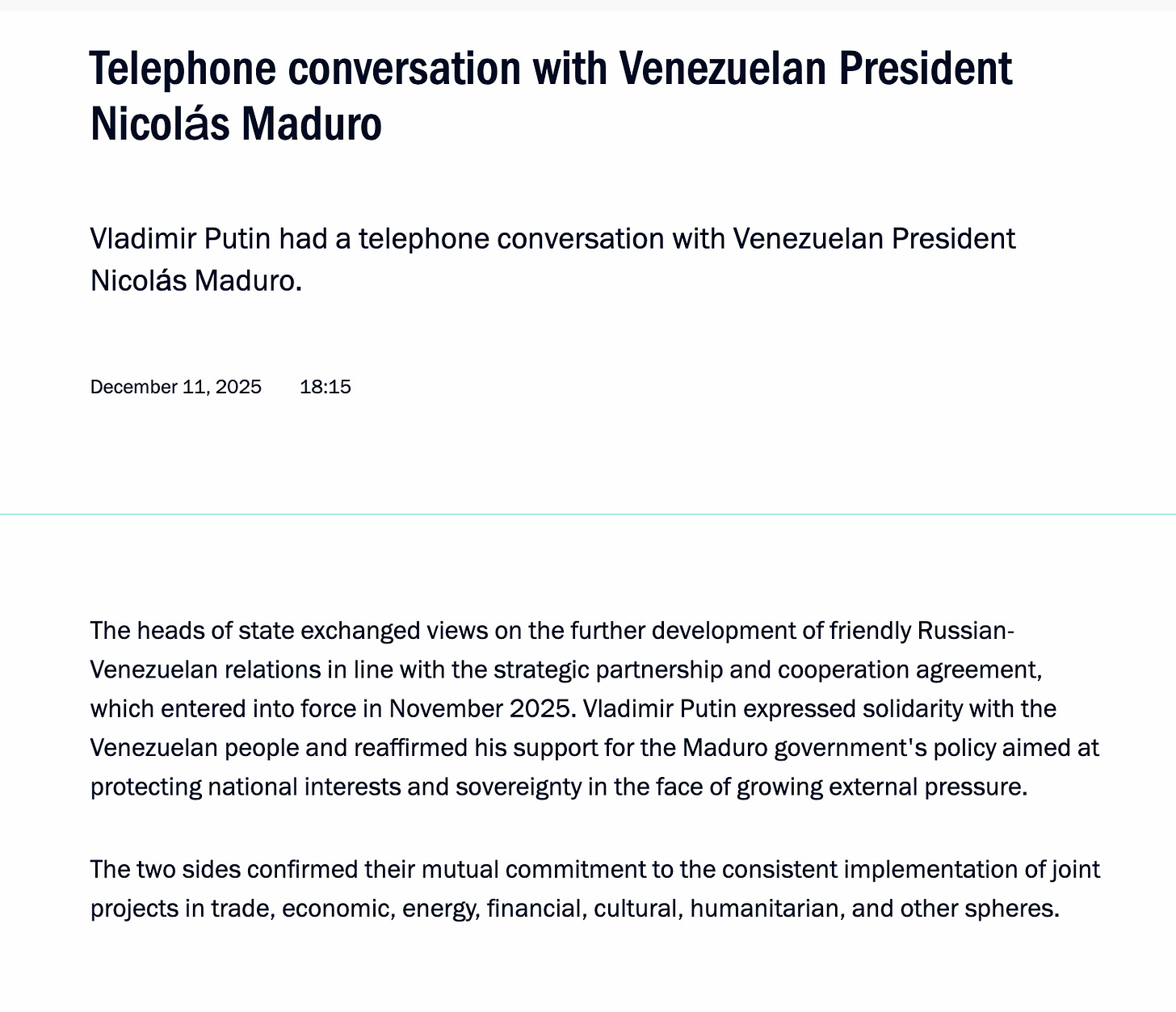
The Kremlin’s official account of the phone conversation between Putin and Maduro “expressed solidarity” with the Venezuelan people but notably omitted any mention of the US and any promises to assist Venezuela with its security. Source: President of Russia Putin’s meeting with Turkish President Recep Erdoğan was the most significant of these diplomatic exchanges. The meeting’s location in the Central Asian country of Turkmenistan underscores a broader geopolitical competition unfolding between the two countries. Historically a sphere of influence for the Russian Empire and Soviet Union, the region also maintains deep ethnic and cultural ties to Turkey. Turkish influence is now poised to expand with the development of the trans-Caspian “Middle Corridor,” trade route connecting Turkey with Central Asia through the South Caucasus.
This “Middle Corridor” linking Europe with China faced years of resistance from Russia and Iran, who pressured Armenia to block the route out of concern it would offer a more attractive alternative to existing trade corridors through their territories. The corridor is now finally coming to fruition amid a US-brokered peace deal between Armenia and Azerbaijan. Armenia’s willingness to participate may have been influenced by Russia’s preoccupation with the war in Ukraine and its failure to fulfill peacekeeping obligations in the disputed territory of Nagorno-Karabakh.
The meeting between Putin and Erdogan took place hours after Russian Shahed drones struck three Turkish ships docked in two Ukrainian ports. While Turkish owned or operated ships have been attacked throughout the war—including recently by Ukraine—this week’s strikes may have been timed to send Erdoğan a warning.
The attacks came amid an unprecedented long-range strike campaign by Ukraine targeting Russian oil fields in the Caspian Sea. Repeated Ukrainian drone strikes on Russia’s Filanovsky field this week have halted production at dozens of oil wells and placed new strain on Russian energy exports. These strikes have been among the longest-distance Ukrainian attacks of the entire war. Reporting this week in The Atlantic that the US has provided intelligence to Ukraine to support strikes on Russia’s oil and gas infrastructure may (along with other factors) have led Russia to suspect that Turkey is either participating in US intelligence transfers or providing its own support to help the drones evade Russian air defenses and reach their targets. Turkey has major incentives to see Russian influence in the Black and Caspian Seas diminished. Turkey has provided significant assistance to the navies of Kazakhstan, Azerbaijan, and Turkmenistan to increase its own regional influence and entered into agreements with energy companies from these countries to construct oil and gas infrastructure.
2. CHINA CONTINUES MILITARY PRESSURE ON JAPAN AND TAIWAN—WITH RUSSIAN HELP
Chinese Fighters Target Japanese Aircraft
On December 6, Chinese J-15 fighter jets from the Liaoning carrier task force twice locked their fire-control radars on Japanese aircraft operating near Okinawa.
China Coast Guard Conducts Drills Near the Taiwan Shoal
On December 8, the China Coast Guard conducted large scale search and rescue exercises near the Taiwan Shoal, a strategically situated chokepoint for maritime traffic through the Taiwan Strait.
China and Russia Conduct Joint Bomber Drills
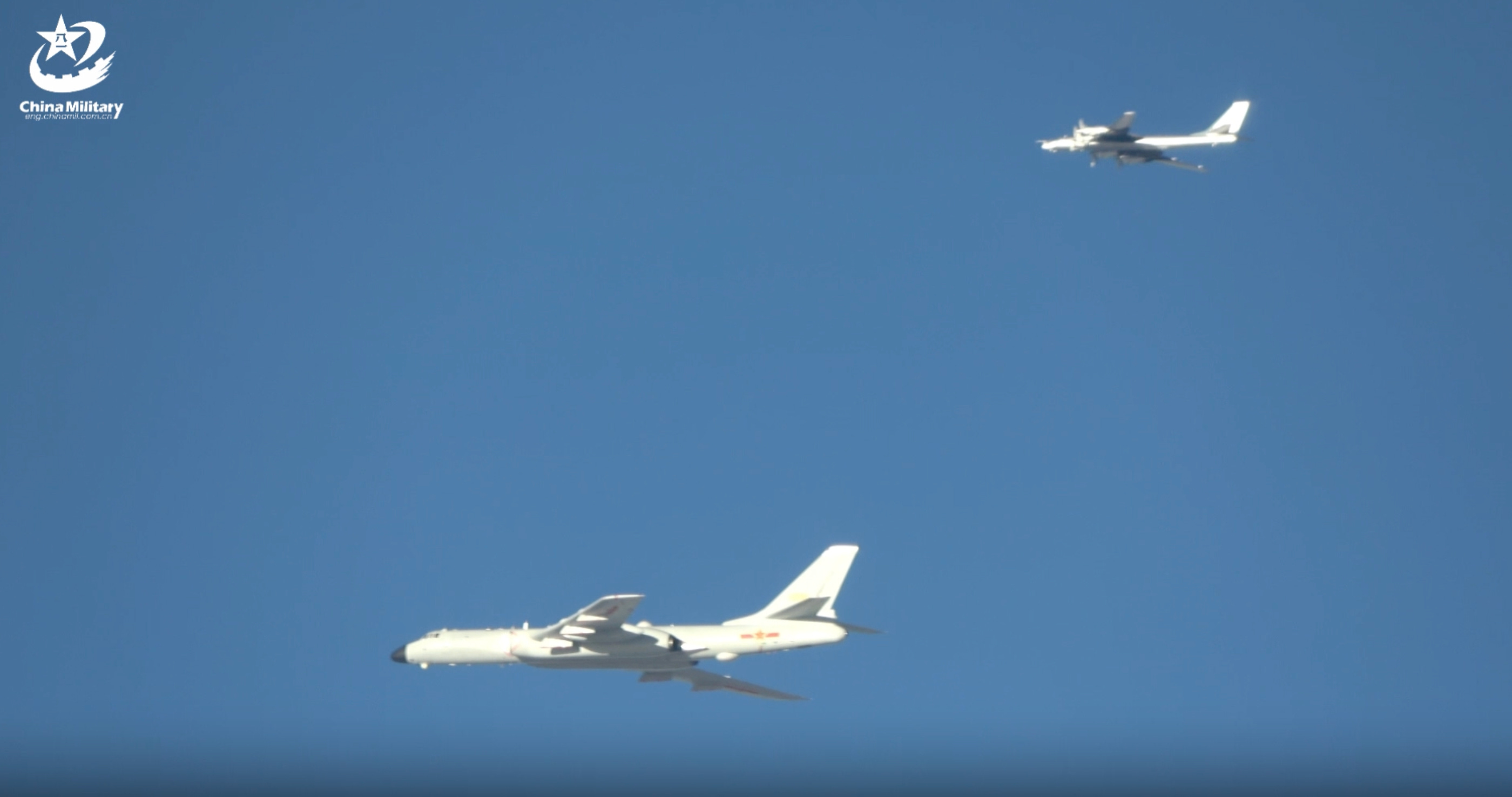
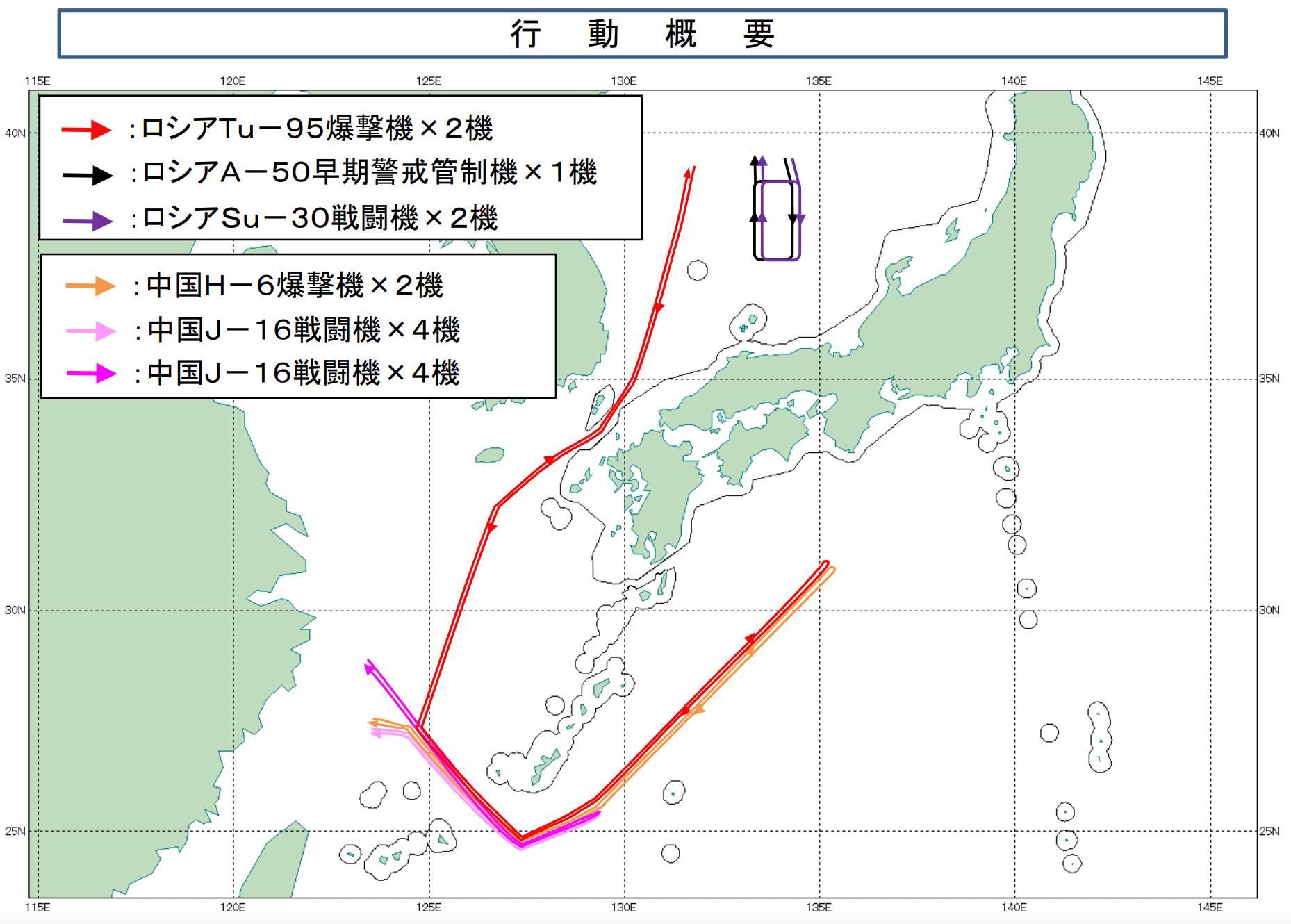
On December 9, bomber aircraft of the Russian and Chinese air forces conducted their 10th joint strategic air patrol over the East China Sea.
Takeaways:
The exercises this week represent an increasingly aggressive stance by China in its weeks-long dispute with Japan and Taiwan. The most serious incident—China’s locking of fire-control radars on Japanese aircraft operating near Okinawa—is an especially hostile act that could precipitate a miscalculation by Japanese and allied pilots amid increasingly bellicose rhetoric from the Chinese government.
While China and Russia characterize this week’s joint bomber patrol as a routine exercise in their strategic military partnership, the flight followed an unusual and highly provocative route apparently designed to intimidate Japanese leaders. The bombers traveled south from the Sea of Japan into the East China Sea, passed through the Miyako Strait, then abruptly turned northeast toward Tokyo before reversing course.
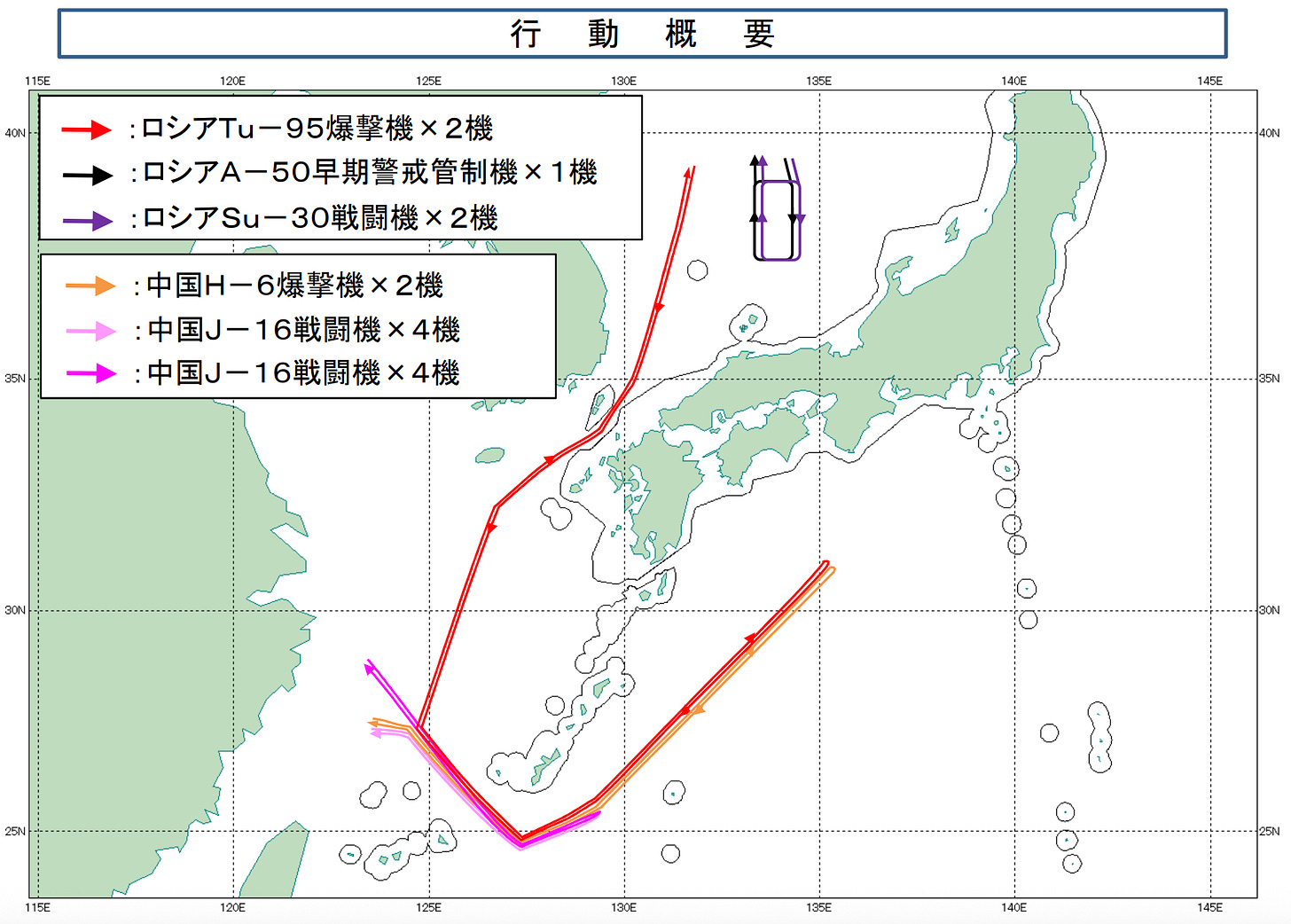
Path of Chinese and Russian aircraft during this week’s joint strategic air patrol. Red and Yellow lines signify the flight paths of Russian and Chinese strategic bombers respectively. Source: Japanese Joint Staff Press Release, December 10, 2025. This is the first time the China Coast Guard has conducted such a large-scale drill near the Taiwan Shoal. While the shoal is a potentially dangerous waterway, the location of the exercise is nonetheless provocative as it lies close to the Taiwan Strait median line, which serves as a buffer zone between Taiwan and the mainland. The China Coast Guard, which performed the drills under the guise of search and rescue, also routinely operates as a paramilitary force in the South China Sea. The participation of the Haixun 06, China’s largest coast guard vessel, with a displacement equivalent to a naval destroyer, in the exercise can be seen as an implicit threat to Taiwanese mariners operating in the area.
3. CHINESE ULTRA LARGE DRONE “MOTHERSHIP” TAKES FLIGHT
This week China conducted the first test flight of its ultra large unmanned aerial vehicle, the “Jiutian,” in Pucheng in China’s northwestern Shaanxi Province. According to the Aviation Industry Corporation of China (AVIC), which is designing the drone, the Jiutian will have a payload capacity of 6,000 kilograms and will be able to fly for 12 hours with a range of 7,000 km.
AVIC has promoted the Jiutian as capable of performing as a “drone mothership” able to deploy large numbers of smaller battlefield drones to conduct attacks and reconnaissance.
Overview of the Jiutian’s projected military capabilities from June 2025 Source: CGTN
Takeaways:
While much attention has been paid to the Jiutian in its potential role as a drone mothership, the current tests are significant because they emphasize China’s broader strategy of civil-military fusion. AVIC is testing and advertising the Jiutian as a cargo drone capable of serving a growing multibillion dollar market for aerial delivery as well as emergency response. This suggests that China will attempt to make mass production of military variants of the Jiutian economically viable through its commercial success in the civilian aviation sector.
4. CHINA’S DEEPSEEK ALLEGEDLY STILL USING SMUGGLED NVIDIA CHIPS
This week investigative journalist outlet The Information reported that prominent Chinese AI start up DeepSeek is training its models on smuggled Nvidia Blackwell chips despite American restrictions on the sale of the chips as well as recent scrutiny of Nvidia by the Chinese government.
Takeaways:
This is noteworthy not only because it raises questions about the effectiveness of the US export controls, but also China’s own claims of rapidly advancing toward technological self-sufficiency.
In September, Chinese commentators hailed DeepSeek as a leader in this push for a fully domestic AI stack when the company released DeepSeek-V3.2-Exp, allegedly optimized for Huawei’s Ascend AI chips and CANN (Compute Architecture for Neural Networks) system. However, the new report suggests DeepSeek’s competitiveness depends on the most advanced US chips. If accurate, this undermines claims that the company has developed an innovative approach to competing with top US firms. It casts doubt on assertions that Chinese chipmakers have developed suitable alternatives to Nvidia chips, and suggests that the competitiveness of Chinese AI companies still depends on elaborate smuggling operations. This dynamic would seem to challenge the wisdom of the Trump administration’s move this week to permit the sale of Nvidia’s second most advanced H200 chips to China.
5. CHINA RELEASES NEW FOREIGN POLICY STRATEGY FOR LATIN AMERICA AND THE CARIBBEAN
On December 10, China released a new policy paper on relations with Latin America and the Caribbean. The 23-page document lists China’s plans to incentivize Latin American and Caribbean nations to participate in its Global Governance Initiative (GGI), Global Development Initiative (GDI), Global Security Initiative (GSI), Global Civilization Initiative (GCI), and Belt and Road Initiative.
The previous foreign policy paper for the region was released in 2016.
Takeaways:
It is notable that China released a new strategy for its foreign policy with Latin America and the Caribbean just five days after the US released its own National Security Strategy which announced the Trump Administration’s return to the Monroe Doctrine. The Chinese policy directly challenges the US’s newly assertive strategy by declaring that “China supports the Proclamation of Latin America and the Caribbean as a Zone of Peace and the Declaration of Member States of the Agency for the Prohibition of Nuclear Weapons in Latin America and the Caribbean. It advocates the peaceful settlement of international disputes and hotspot issues and opposes the willful threat or use of force.”
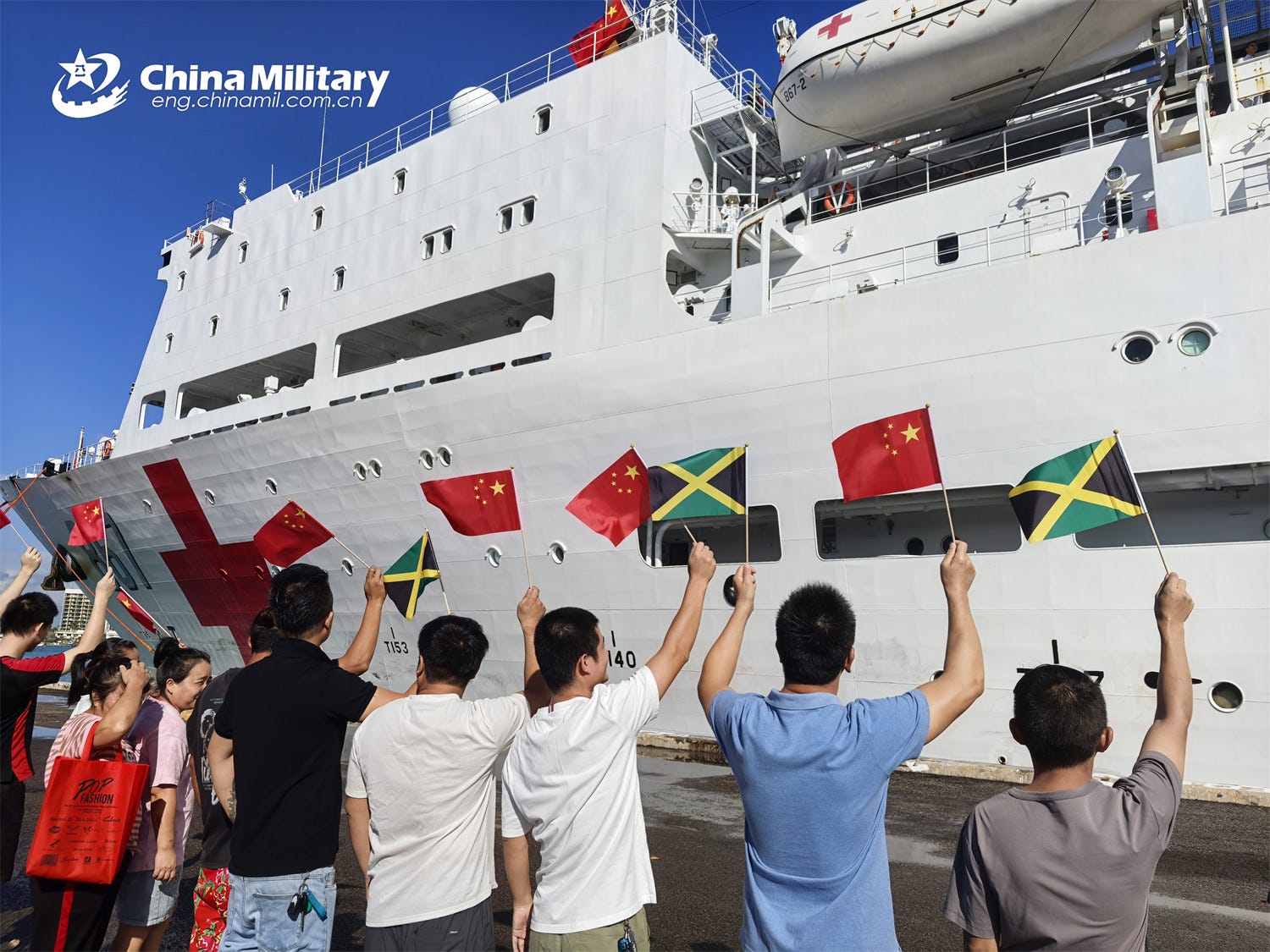
The release of the new policy also coincides with the arrival of the Chinese People’s Liberation Army (PLA) Navy hospital ship Silk Road Ark in the Caribbean from December 4-16. The Silk Road Ark is scheduled to visit Jamaica’s ports of Montego Bay, Kingston, and Falmouth to provide medical services to local residents.
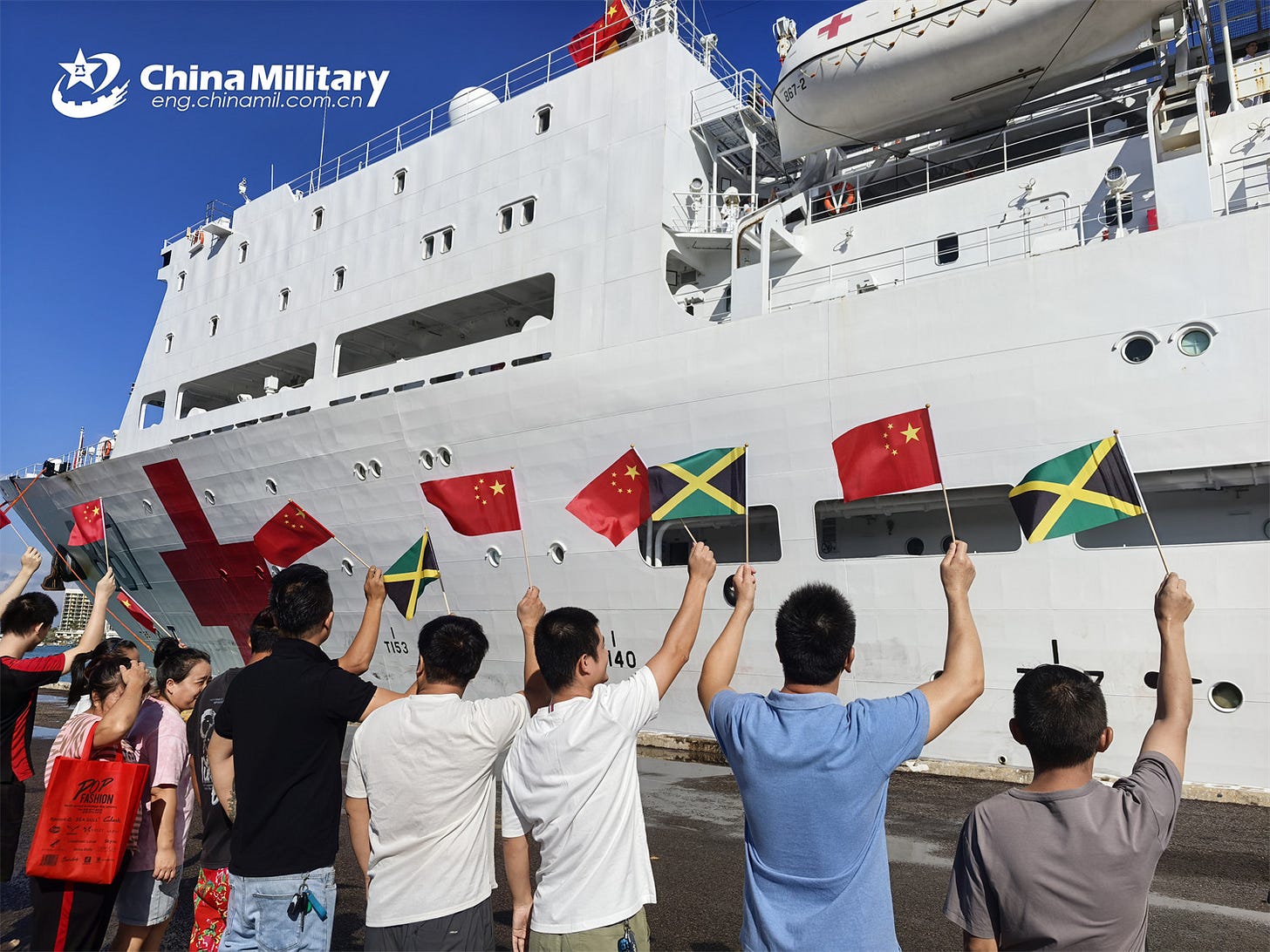
Overseas Chinese in Jamaica welcome the Silk Road Ark with Chinese and Jamaican flags. Source: Ministry of National Defense of the People’s Republic of China This is at least the second time in recent months that China has released a major foreign policy paper after the US. In July, China released its “Action Plan on Global Governance of Artificial Intelligence,” two days after the White House announced its own strategic plan for AI entitled “Winning the AI Race: America’s AI Action Plan.”
The Chinese policy appears to tie participation in China’s various initiatives with recognition of the one China principle. Latin America and the Caribbean are home to 7 of the 11 countries which currently have formal diplomatic relations with Taiwan.1 The new policy is an attempt to further incentivize these countries to break diplomatic relations with Taiwan.
6. IRAN ARRESTS NOBEL LAUREATE NARGES MOHAMMADI
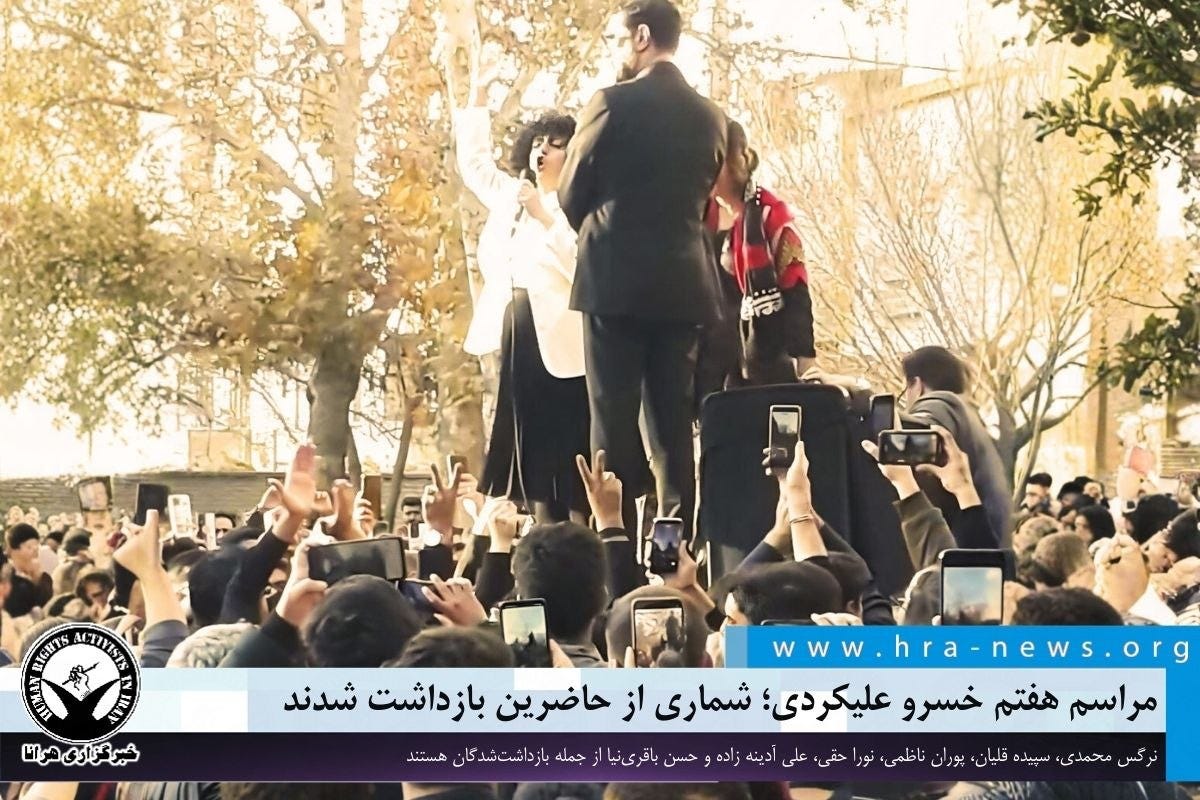
On December 12, Iranian security forces arrested Narges Mohammadi and 38 other human rights activists attending a memorial for human rights lawyer Khosrow Alikordi in the city of Mashhad. Khosrow, another prominent regime critic, died under suspicious circumstances in his Mashhad office on December 5.
Mohammadi was awarded the Nobel Peace Prize in 2023 “for her fight against the oppression of women in Iran and her fight to promote human rights and freedom for all.” For her activism, she has been repeatedly arrested, tortured, and sentenced to lengthy prison terms by Iranian authorities.
She received the Nobel Prize while imprisoned in Iran’s notorious Evin prison, where political dissidents are detained. Mohammadi documented the systematic torture of women activists detained for their participation in the 2022 “Woman Life Freedom” protests, from inside the prison.
Mohammadi was released from prison in December 2024 for medical reasons and quickly resumed her human rights advocacy.
Takeaways:
The arrest of Narges Mohammadi may prove to be a serious miscalculation by regime authorities. The move will inflame growing unrest in Iran caused by deteriorating economic conditions and a worsening quality of life stemming from an ongoing water crisis. November polling by the government-affiliated Iranian Student Polling Agency (ISPA) shows 92% public disapproval of current conditions in the country. The arrest of a prominent activist honored with Europe’s top international prize is also likely to harden the positions of European leaders with whom Iran seeks to negotiate an end to sanctions.
Nevertheless, Iranian authorities may have felt compelled to arrest Mohammadi and other activists to prevent organized protests from emerging amid growing public dissatisfaction. This week’s arrests follow a surge in repression by the Iranian regime in 2025 after the 12-Day War. The UN’s Independent International Fact-Finding Mission on Iran has suggested that the tens of thousands of arrests and hundreds of executions carried out in the months following the war may constitute crimes against humanity. The repression may be accelerating as Iranian authorities have expressed paranoia that the snapback of UN sanctions by France, Germany, and the UK at Washington’s behest was designed to provoke another uprising similar to the 2022 protests.
7. IRAN APPEARS TO ADMIT SERIOUS DAMAGE AND DESTRUCTION TO NUCLEAR SITES
In a December 8 interview with Japan’s Kyodo News, Iranian Foreign Minister Abbas Araghchi admitted that Iran’s nuclear sites were “bombarded, destroyed and heavily damaged” by US and Israeli air strikes. Araghchi appealed to Japan to provide technical assistance in recovering the facilities due to its experiences with nuclear disasters. Araghchi also suggested that Iran would be willing to re-engage in negotiations with the US and Europe in order to pursue another deal to limit but not surrender its nuclear program.
Takeaways:
The interview appears to confirm that US and Israeli strikes set back Iran’s nuclear program much more significantly than some skeptics alleged. The fact that Iran is pursuing foreign assistance to excavate and rebuild its damaged nuclear sites six months after the 12-Day War suggests the country’s nuclear program has been set back by years rather than a few months, as critics originally contended.
Japan is one of the few close US allies that retains significant strategic ties with Iran. Japan initially condemned Israel’s strikes on Iran’s nuclear facilities but later modified its position after the US joined the bombing.
This is the second interview with Kyodo News by a top Iranian diplomat in four months. In August, Deputy Foreign Minister Majid Takht-e Ravanchi interviewed with the news outlet and similarly discussed Iran’s openness to a new deal that permitted a civilian nuclear program. Iran may be taking high profile interviews in Japanese media as a means of signaling to the US that it is looking to resume negotiations to limit its nuclear program to civilian applications like that of Japan. (It should be noted that Iran has systematically violated the limits on its uranium enrichment imposed under the 2015 Joint Comprehensive Plan of Action and stockpiled highly enriched uranium.)
8. NORTH KOREA CONCEALING ITS NUCLEAR ACTIVITIES WITH THERMAL SHIELDING
A December 12 analysis of recent construction at North Korea’s Yongbyon Nuclear Scientific Research Center suggests the North has installed thermal shielding materials around the complex’s 5-megawatt nuclear reactor. The analysis, published by Bruce Songhak Chung in DailyNK, compared thermal images of the facility before and after refurbishment and found that the new reactor building was significantly cooler than its surroundings and much cooler than before the construction.
Takeaways:
As discussed in the Weekly Significant Activity Report - November 29, 2025, North Korea has engaged in significant renovations and new construction at the Yongbyon complex since early 2025, including the construction of a new nuclear reactor for uranium enrichment. The use of thermal shielding around the existing 5-MWe reactor may be used to cloak the effects of unseen modifications going on inside the building and to generally make it harder to assess the North’s nuclear program using satellite imagery.