



This week’s analysis highlights some of the most significant geopolitical developments involving America’s adversaries—China, Russia, Iran, and North Korea—between November 22 - November 29, 2025.
Summary:
Russian President Vladimir Putin announced that Russia will not begin formal peace negotiations until Ukraine withdraws from Donetsk oblast, affirming the Kremlin’s hardline position ahead of a visit by US negotiators.
Russian drones violated Moldovan and Romanian airspace in two separate incidents this week.
A test launch of a Russian “Sarmat” super heavy intercontinental ballistic missile ended in catastrophic failure in Orenburg oblast, the second failed test in a row for the long-delayed system.
Russia’s only launch pad for manned space missions was severely damaged during the November 27 launch of Soyuz MS-28 carrying US and Russian astronauts to the International Space Station.
China released a new white paper on arms control, disarmament and nonproliferation.
A private Chinese aerospace company, Lingkong Tianxing Technology, announced that it is prepared to mass produce cheap hypersonic missiles.
Iran allegedly sought to recruit local spies for attacks on Israeli embassies in Africa.
North Korea may currently possess two to three times as many nuclear weapons as currently believed. An expansion of its refining capability may allow it to develop an arsenal of over 400 bombs by 2040.
North Korea has refortified positions along three-quarters of the demilitarized zone since the spring 2024 as part of Kim Jong-un’s new policy pivot away from reunification toward permanent division of the Korean peninsula.
1. RUSSIA REBUFFS ONGOING PEACE NEGOTIATIONS
On November 27, Russian President Vladimir Putin reaffirmed Russia’s refusal to negotiate territorial concessions and doubled down on his demand that Ukraine fully withdraw from Donetsk oblast before the beginning of any peace negotiations.
Putin’s hardline stance comes just days before a scheduled meeting with US special envoy Steve Witkoff and President Trump’s son-in-law Jared Kushner set for early next week. The discussions will reportedly focus on a revised 19-point plan aimed at ending the war in Ukraine.
Takeaways:
The Kremlin’s position is the same now as it was six months ago during the Trump administration’s push for a ceasefire in May.
Then as now, Putin is not interested in deviating from his maximalist demands for three reasons: First, the Russian government has not yet made a compelling case that it has achieved victory in the war. Second, Putin appears to believe that time will yield a better deal than any currently on offer due to creeping Russian battlefield advances. Finally, Putin is not interested in the economic incentives being offered in negotiations—he is committed to achieving tangible military success regardless of economic cost. These points are elaborated further in OPFOR Journal May 20 “Situation Report: Ceasefire Negotiations with Russia”
The only times there has been any progress in softening Moscow’s stance is on the heels of significant US pressure. Every time the US eases pressure and shows itself eager for a deal, Moscow reverts to its maximalist position. Kremlin officials have previously suggested that the administration’s wavering has only hardened Putin’s resolve to win by force. The eagerness of US special envoy Steve Witkoff to persuade Putin to accept a settlement favorable to Russian interests, as evidenced by leaked phone recordings released this week, will further entrench the Kremlin’s position.
2. RUSSIAN DRONES VIOLATE MOLDOVAN AND ROMANIAN AIRSPACE IN TWO SEPARATE INCIDENTS
On November 25, a total of six Russian drones crossed from Ukraine into Moldovan airspace. One of the Russian drones, an unarmed Gerbera reconnaissance drone, crash landed on a house in the village of Cuhurestii de Jos, in Moldova’s Floresti district. Two of these drones passed through the country into Romanian airspace, where Romanian F-16s were scrambled in response.
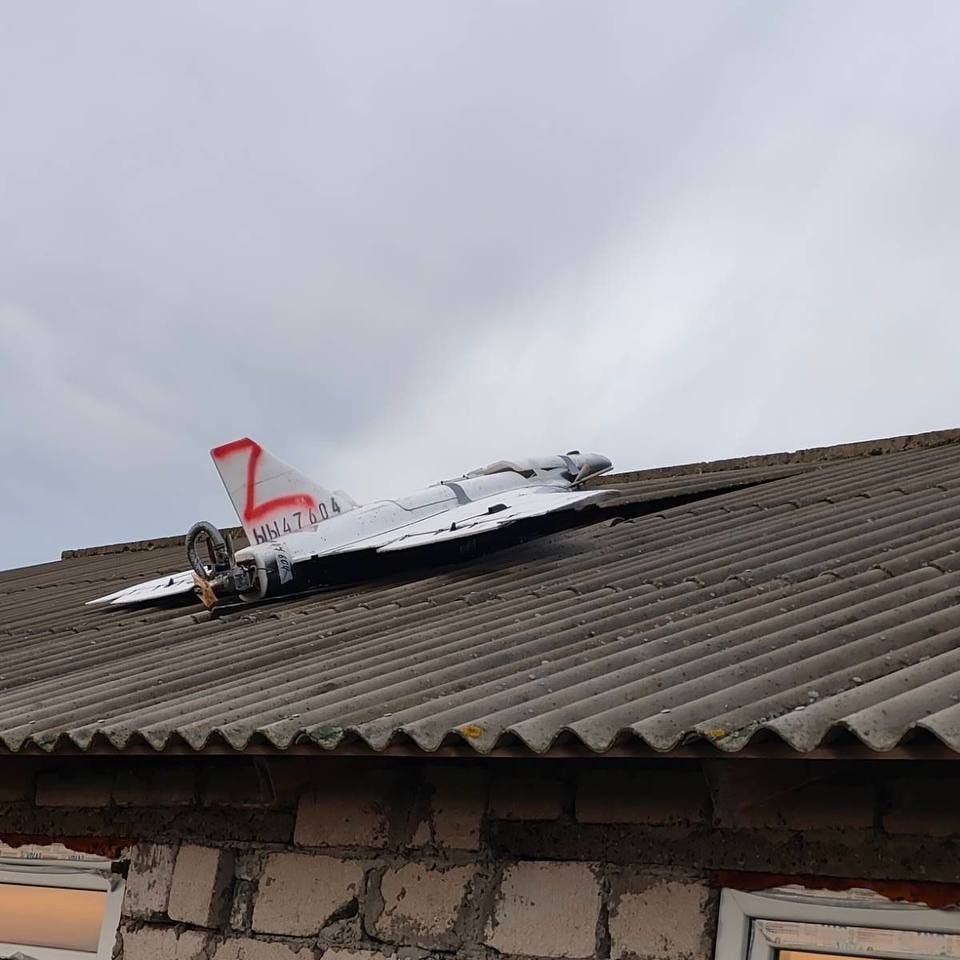
On November 28, Moldovan authorities again reported that two Russian drones had entered its territory and forced temporary airspace closures.
Takeaways:
The November 25 incident is at least the fourth time in three weeks that Russian drones have either entered Romanian airspace or threatened Romanian territory. On November 11, a Russian drone is reported to have landed in Romania’s Tulcea County approximately 5km from the Danube border with Ukraine. On November 17, the Romanian village of Plauru was forced to evacuate after a Russian drone struck a tanker ship carrying liquefied petroleum gas on its Danube river border with Ukraine. Two days later on November 19, a Russian drone was detected on radar entering Romanian airspace in northern Tulcea County before disappearing.
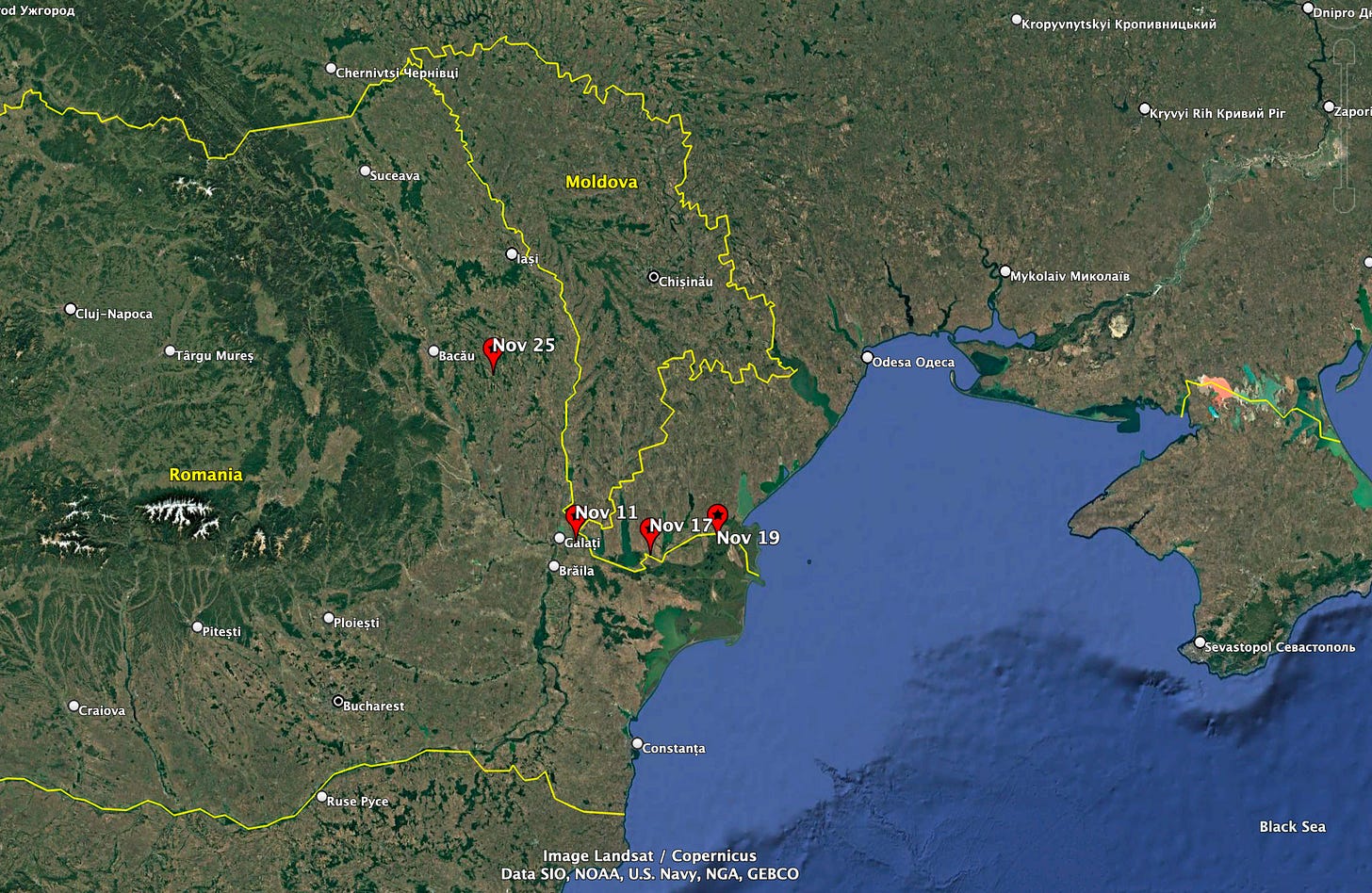
Approximate locations of Russian drone incursions into Romania in November. Moldova has seen even more significant Russian drone intrusions in recent weeks. The incursions on November 28 and 25 were preceded by a similar incident which forced the country to close its airspace on November 20.
3. RUSSIAN STRATEGIC MISSILE TEST ENDS IN FAILURE
A test of a Russian missile near the town of Yasny in Orenburg oblast on November 29 ended in catastrophic failure. The location of the test, at the nearby Dombarovsky Air Base, home to units of the Russian Strategic Rocket Forces, suggests the missile tested was likely an intercontinental ballistic missile (ICBM). According to Pavel Podvig, a prominent analyst of Russia’s nuclear forces, the characteristics of the test, along with other extenuating circumstances suggest the missile was likely Russia’s next generation “Sarmat” super heavy ICBM.
Full video of the failed missile test. Source: MilitaryRussia.Ru (@militaryrussiaru) on Telegram
Takeaways:
This incident marks the latest failure of the long-delayed Sarmat program. The system, which was originally projected to become operational in 2018, has only had a single successful flight test—in April 2022. Since then the system has suffered significant setbacks. The previous Sarmat test on September 21, 2024 destroyed the missile’s launch site at Russia’s Plesetsk Cosmodrome, and likely necessitated the relocation of tests to Dombarovsky.
Russian President Vladimir Putin announced on November 4 that the Sarmat would be put through additional “combat trials” by the end of the year to make it ready for combat duty in 2026.1 This test was likely part of the trials Putin referenced. Its subsequent failure will necessitate new tests in 2026 and delay the program further.
The Sarmat is capable of carrying a payload of 10 metric tons, which according to the Center for Strategic and International Studies’ Missile Defense Project is equivalent to about 10 large or 16 miniaturized nuclear warheads. The video, which shows the missile struggling to take off, suggests the size of the system may be partly responsible for its development woes. Engineers may be struggling to develop a multi-stage engine with sufficient thrust to lift the massive payload without self-destructing during launch, as apparently occurred in 2024.
4. RUSSIA’S ONLY MANNED SPACE LAUNCH FACILITY SERIOUSLY DAMAGED AFTER ISS MISSION
Russia’s Baikonur Cosmodrome was seriously damaged during the November 27 launch of Soyuz MS-28 carrying US and Russian astronauts to the International Space Station (ISS). The service cabin of the facility, a highly complex, retractable structure underneath the launch pad was severely damaged by rocket engine exhaust due to an unknown equipment failure.
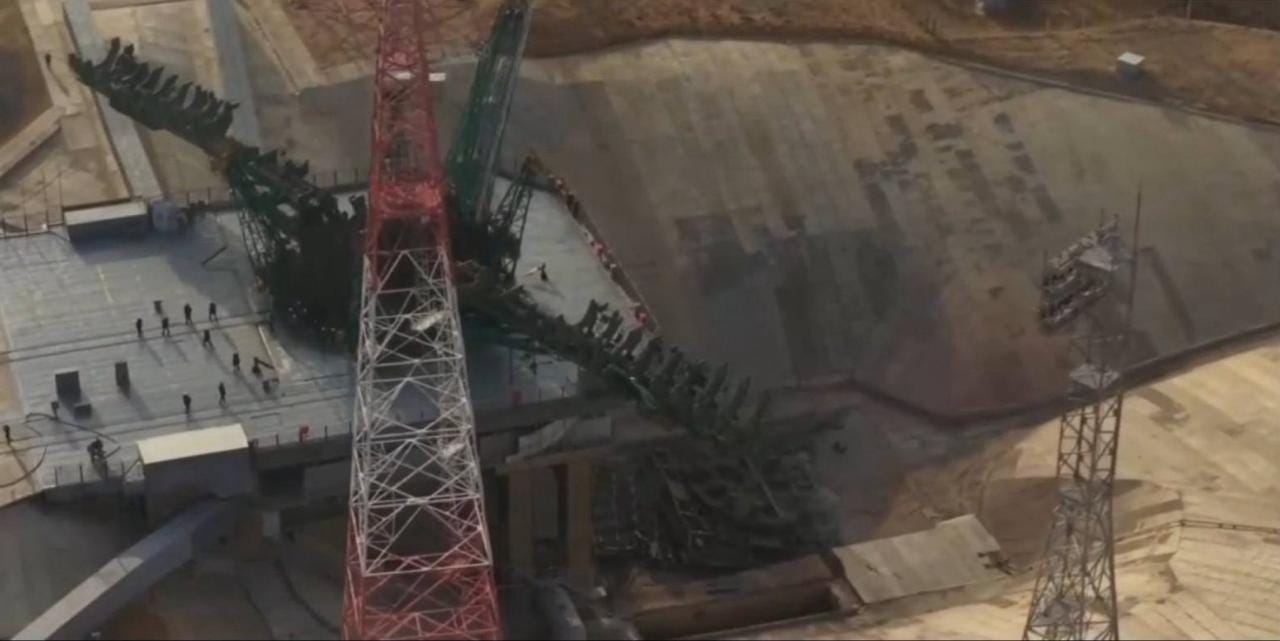
Takeaways:
The damaged launch pad, Gagarin 31, is Russia’s sole remaining facility capable of supporting crewed space missions. All other Russian launch pads are configured for launching smaller unmanned cargo rockets. Repairs could take months or potentially years to complete, leaving Russia unable to launch crewed spaceflights for the first time since the historic 1961 mission by Yuri Gagarin, the namesake of the damaged launch pad. This setback could see US companies lead future missions to the ISS.
5. CHINA RELEASES NEW WHITE PAPER ON ARMS CONTROL
On November 27, China’s State Council Information Office released a new white paper entitled “China’s Arms Control, Disarmament, and Nonproliferation in the New Era.” The paper laid out Chinese positions on weapons of mass destruction, the militarization of space, biosecurity, as well as the regulation of threats from cyberspace.
Takeaways:
China has repeatedly rejected overtures by the US and Europe to join global arms control conventions amid the rapid development of its strategic forces. China has rebuffed arms control as unfairly limiting the size and capabilities of its nuclear arsenal relative to the much larger US and Russian strategic forces. This section of the white paper may represent China’s attempt to preempt pressure from the US and Russia to join formal arms control agreements by outlining conditions it will unilaterally observe. However, unlike the arms control agreements the US and Russia have historically observed, and are now considering to replace the expiring New START Treaty, China’s assurances are ultimately hollow as they lack enforcement and verification mechanisms.
Much of the rest of the paper reads less as a policy document and more as a means of refuting criticism China has received for practices that have raised international concern such as biosecurity, weaponization of space, and state sponsored cyber threats.
China’s position on outer space security is similarly at odds with its current practices and presents significant long-term challenges for strategic stability. China’s claims that it “resolutely opposes offensive space military policies, the creation of space military alliances, the weaponization of outer space, any attempt to turn outer space into a new theater of conflict, and any arms race there,” are contradicted by its expanding arsenal of space weapons. These weapons range from anti-satellite lasers and missiles to co-orbital attack satellites, and most alarmingly hypersonic variants of Cold War-era fractional orbital bombardment system (FOBS).
The new FOBS pose a unique threat to global security as they merge concerns about the militarization of space and nuclear weapons. This hybrid system combines fractional orbit technology with hypersonic glide vehicles, allowing China to deploy nuclear warheads into low Earth orbit before releasing them to strike targets along unpredictable flight paths that could circumvent existing missile defenses systems and early warning radars. FOBS had previously been employed by the US and Soviet Union early in the Cold War but were abandoned following the SALT II agreement due to concerns the systems undermined strategic stability. China’s development of FOBS underscores the urgent need to bring China into comprehensive arms control agreements with other nuclear powers, rather than accept Beijing’s unverifiable claims that it opposes nuclear first strikes and space-based weapons.
6. CHINESE COMPANY SAYS IT IS SET TO MASS PRODUCE CHEAP HYPERSONIC MISSILES
Beijing-based private aero-space company Lingkong Tianxing Technology has announced the mass production of a hypersonic missile, the YKJ-1000, capable of striking targets at 1300km at speeds of up to Mach 7. The company alleges that it will be able to produce the missiles at 10% the cost of existing hypersonic models currently in service.
Takeaways:
The announcement may have been more of a clever marketing ploy to grab international headlines and attract investors rather than an entirely accurate description of the weapon’s cost and capabilities. On November 29, the company walked back claims about the cost of the YKJ-1000 missiles in response to questions by the state-owned China Daily news outlet. The China Daily article also featured what appears to be a subtle dig at the company’s exaggerated claims by government-affiliated military analyst, Wu Peixin. Wu called the YKJ-1000s “less advanced hypersonic missile systems” than the “really sophisticated, mighty missiles like the DF-17.” The slight, wrapped in praise, may have been used to chastise the company for inaccurately claiming it could mass manufacture systems equivalent to the state-developed DF-17 at a fraction of the price.
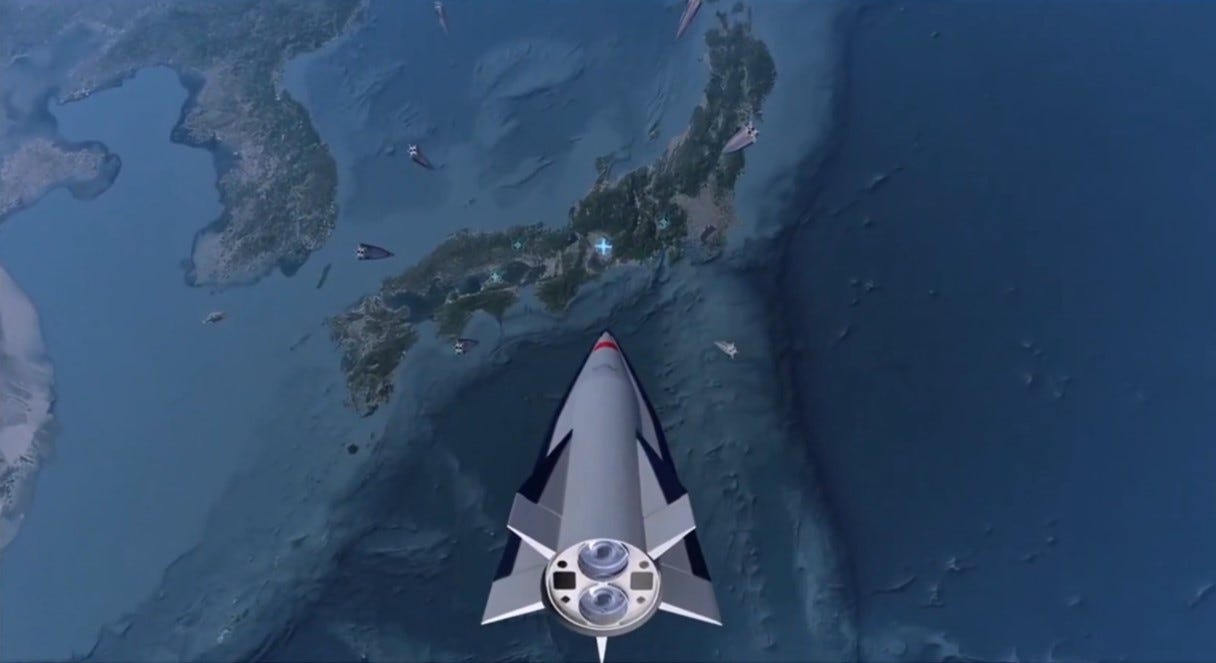
An additional indication the announcement was deliberately sensational can be found at the end of the promotional video for the YKJ-1000, which featured a simulated swarm of the missiles launched at Japan.
7. IRAN SOUGHT SPIES TO PLAN ATTACKS ON ISRAELI EMBASSIES IN AFRICA
A November 26 report by Mojtaba Pourmohsen of Iran International, alleges that Quds Force Unit 840 of the Iranian Revolutionary Guard Corps (IRGC) attempted to recruit locals to surveil Israel’s embassies in Uganda and Senegal in preparation for future attacks. The recruitment was conducted through multiple intermediaries, with a Pakistani national affiliated with the IRGC serving as the handler for local spies.
Takeaways:
Coordinating local attacks through networks of intermediaries is a signature tactic in the IRGC’s ongoing campaign of transnational repression targeting Israelis, Jewish communities, and regime critics worldwide.
Two prominent incidents involving this technique received renewed attention in the past month. On November 25, Australia labeled the IRGC a state sponsor of terrorism after it was determined the group coordinated arson attacks on a synagogue and Jewish-owned restaurant in the country in 2024. On October 29, two American members of the Russian mafia were sentenced to 25 years in prison for their role in a 2022 plot organized by the IRGC to assassinate Masih Alinejad, an outspoken Iranian dissident living in New York.
8. NORTH KOREA’S NUCLEAR PROGRAM IS EXPANDING AND MAY BE BIGGER THAN PREVIOUSLY BELIEVED
North Korea Expanding a Key Nuclear Research Facility
According to analysis published by The Stimson Center’s 38 North, North Korea’s Yongbyon Nuclear Scientific Research Center has seen significant new construction in 2025. Features of the new buildings being constructed suggest they are part of a new uranium enrichment facility at the complex.
North Korea’s Nuclear Arsenal Could Exceed 400 Bombs by 2040
On November 26, Lee Sang-kyu, the Director of the Nuclear Security Research Office at the South Korean government think tank, Korea Institute for Defense Analyses, announced at the 2025 North Korean Military Forum that North Korea may possess as many as 150 nuclear weapons. Lee further forecasted that the North could have 243 nukes by 2030 and 429 by 2040.
Takeaways:
Lee Sang-kyu’s estimate of a 150 bomb North Korean nuclear arsenal is significantly higher than the estimates held by most experts. It is not immediately clear how Lee determined this figure. The Stockholm International Peace Research Institute (SIPRI) assesses that North Korea possessed approximately 50 nuclear weapons as of January 2025.
Nevertheless, Lee’s forecast of a dramatic nuclear expansion by the North is supported by other indicators such as the aforementioned expansion of the Yongbyon Nuclear Scientific Research Center and South Korean President Lee Jae-myung’s August remarks indicating that North Korea has the capacity to produce 10-20 nuclear weapons per year.
9. NORTH KOREA HAS REINFORCED MAJORITY OF THE DMZ SINCE EARLY 2024
North Korea has built new defensive lines and fortifications across 74% of the demilitarized zone (DMZ) since April 2024, according to a new report released this week by NK News. The majority of the construction, covering approximately 54 miles, has been conducted since June 2025. Most of the new fortifications have been constructed near the military demarcation line (MDL) of the DMZ, in violation of the terms of the armistice.
Takeaways:
According to the NK News analysis, the rapid construction is likely an attempt to claim more tactically advantageous terrain within the DMZ ahead of a planned redefining of the country’s official borders. This development is consistent with Kim Jong-un’s recent policy shift away from seeking unification with the South to institutionalizing a permanent separation between the two countries as part of the “Two Hostile States” doctrine announced in late 2023.
Pavel Podvig notes that while the official English language translation is “combat trials,” the actual Russian phrase Putin used translates more closely as “experimental combat duty.” This term dates back to the Soviet Union, when missiles were put into service while continuing to undergo modifications. Putin may be using the phrase to exaggerate the readiness of the system.
Russia’s position is hardly “maximalist”.
They made their position clear in 2024, and stuck by it.
If anything, a return of Ukraine to its status as a neutral, non-NATO country is a minimalist, and quite fair demand.
2: Sarmat has had successful and well as less successful launches, sure, but the next generation American ICBM is of course also… Delayed.
And while Russia is proceeding more slowly with its Sarmat program, it’s important to remember that they have several other types of ICBMs.
All of the older, proven systems in fact newer than America’s SIX decades old Peacemaker ICBMs.