



This week’s analysis highlights some of the most significant geopolitical developments involving America’s adversaries—China, Russia, Iran, and North Korea—between September 12, 2026 and September 19, 2026.
Executive Summary:
US War with Iran - Significant Activity Related to the US-Iran War
China attempted to mediate with Iran to rein in growing Houthi threats to Saudi Arabia and Red Sea shipping.
Iran conducted multiple attempts to seize or destroy US strategic drones in order to degrade the US’s ability to monitor and reopen the Strait of Hormuz.
The Eastern Front - Significant Activity Related to the War in Ukraine and Russian threats to NATO
A months-long Ukrainian counteroffensive named “Operation Vivaldi” has collapsed a Russian salient near Lyman, shoring up the northern flank of Ukraine’s “Fortress Belt” and setting back Russia’s ability to seize the remainder of the Donbas region.
A new report by the Multilateral Sanctions Monitoring Team found that as many as 25,000 North Korean laborers are involved in building Russian drones at the Alabuga Special Economic Zone in exchange for cash to fund North Korea’s own weapons programs.
Western Pacific Flashpoints - Significant Activity in the Western Pacific and Taiwan
The Head of China’s Ministry of State Security, Chen Yixin, published an article highlighting risks to domestic political stability as China’s chief concern in the development of frontier AI.
A China Coast Guard cutter deliberately rammed a Philippine government fisheries vessel near Sabina Shoal.
North Korea’s Vice Defense Minister announced that the country would expand and strengthen its nuclear arsenal at China’s Xiangshan Forum.
US WAR WITH IRAN
Significant Activity Related to the US-Iran War
1. CHINA ATTEMPTS TO MEDIATE BETWEEN SAUDI ARABIA AND IRAN OVER HOUTHI ATTACKS
This week China reportedly made overtures to Iran at Saudi Arabia’s request, to rein in a growing Houthi threat to shipping in the Red Sea. Iran was reportedly non-committal to Chinese mediation, suggesting that regional stability would only be possible if the US war ends.
Takeaways:
To some extent the Iranian position is understandable. Iran can help supplement Houthi capabilities and coordinate its actions with its other proxy organizations to maximize pressure on Saudi Arabia and the US (as seen last week with the Houthi Red Sea coastal offensive combined with the Iraqi-origin drone attacks on the East-West pipeline), but the Houthis ultimately have agency and interests of their own. The Houthi movement has been a force in Yemen for decades and the driving forces of Houthi activities have primarily been Yemeni internal politics and external conflict with Saudi Arabia. The Houthis have also become much more militarily self-sufficient in recent years allowing for greater freedom of action.
Whether Iran is able to effectively rein in the Houthis is largely secondary at this point. Iran’s historic support for the Houthis, combined with previous explicit threats against Saudi shipping in the Bab al-Mandeb Strait, and mounting reports of embedded IRGC advisors within the Houthis, has contributed to increasingly widespread perceptions that it is the chief instigator of the expansion of the war toward the Red Sea. In this sense, the dramatic Houthi seizures of Mokha and Perim, combined with attacks on key Saudi oil infrastructure, and even threats toward Mecca, may amount to a catastrophic success for Iran, which inflicts significant short-term pain on its adversaries but ultimately shifts international opinion against its continued threats toward the global economy. China’s new attempt at mediation this week, coming alongside UN Security Council denunciations of Houthi attacks, is an early indicator that such a shift may be underway.
2. IRAN RAMPS UP WAR ON US DRONES IN EFFORT TO KEEP STRAIT OF HORMUZ CLOSED
Iran Claimed the Destruction of Two More US MQ-series Drones
This week the Iranian Islamic Revolutionary Guard Corps (IRGC) announced the destruction of two US MQ-series unmanned aerial systems, bringing the total number of US MQ-series drones Iran has claimed to have destroyed to 53.
US Destroyed Iranian Ships Attempting to Seize Unmanned Surface Vessel
On September 15, 2026, Axios reported that small ships belonging to the IRGC Navy attempted to seize a US unmanned surface vessel patrolling the waters of the Strait of Hormuz. The Iranian ships were destroyed by missiles fired from a US aerial drone before they could complete the seizure.
Takeaways:
The exact number and type of US MQ-series drones destroyed by Iran are not clear. Reports this month suggest that losses range between 25 and 45 for all US systems, making Iranian claims plausible, though potentially exaggerated. Such losses would represent a significant portion of the US inventory of sophisticated unmanned aerial systems. Nevertheless, the US appears to have largely accepted the losses as an inevitable consequence of operating in contested airspace and is pivoting toward a long-term focus on more affordable and dispensable unmanned systems such as the Air Force’s Massed Modular Aircraft.
Iran has emphasized attacks on unmanned systems in recent weeks (including last week’s seizure of an Anduril Dive-LD submersible) for three reasons. First, Iran’s military capabilities have been severely degraded by the ongoing war, making relatively slow-moving, sophisticated unmanned systems priority targets that are still within reach of its forces. Second, attacks on unmanned systems impose near-term costs on the US that degrade its ability to monitor and reopen the Strait of Hormuz, while also avoiding potential escalation spirals associated with attacks on US personnel. Third, Iran may seek to recover the systems in part or in whole to either reverse engineer or sell the underlying technology.
EASTERN FRONT
Significant Activity Related to the War in Ukraine and Russian threats to NATO
3. RUSSIAN FORCES LOSE KEY POSITIONS IN LYMAN, PUTTING EFFORT TO SEIZE THE DONBAS IN DOUBT
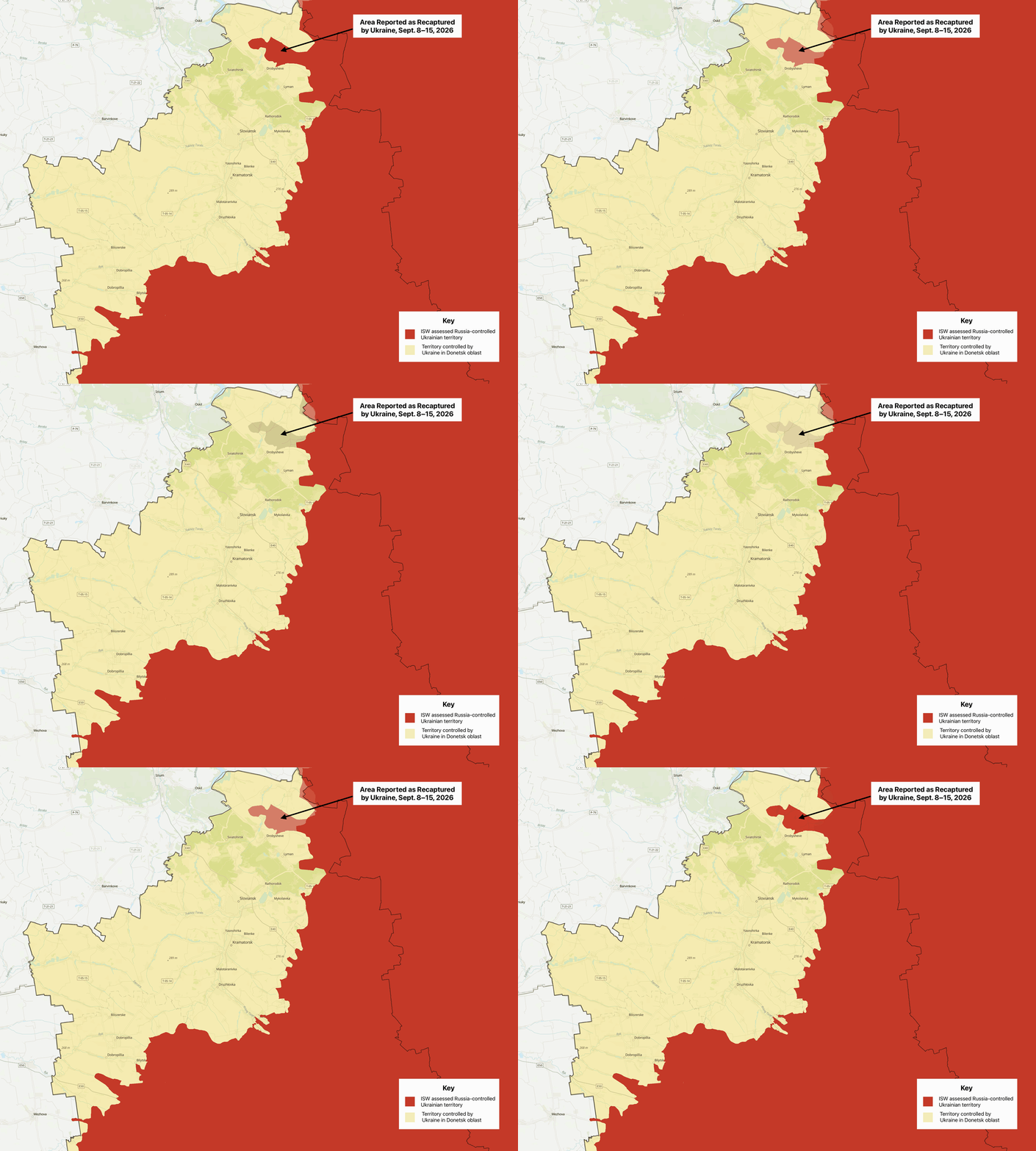
This week, Ukrainian forces announced the culmination of a months-long effort to retake positions north of the city of Lyman in occupied Donetsk oblast as part of “Operation Vivaldi”. The Ukrainian advances have retaken approximately 240 square kilometers of territory since May and effectively reduced a salient around Lyman that the Russian army had spent a year to build.
Takeaways:
Though Russian forces continue to make incremental advances elsewhere along the front (for a net gain of 58 square miles in the past four weeks), the loss of positions around Lyman puts a chief Russian war aim of seizing the entirety of the Donbas region further out of reach. Lyman sits on the northern flank of the Ukrainian “Fortress Belt”, a network of strategically important cities and towns occupying defensible terrain along the H-20 highway running from Slovyansk in the north to Kostyantynivka in the south. The Fortress Belt is Russia’s primary obstacle to seizing the remaining 20% of Donetsk that Russia needs to complete its conquest of the Donbas. Ukrainian gains around Lyman shore up Ukrainian lines around this key territory.
Like Ukraine’s 2024 Kursk Offensive, the latest advances are perhaps most significant in what they reveal about Russian vulnerability. Both surprise reversals puncture Russian narratives that its offensives have been deliberately slow and methodical and driven by irreversible momentum. Ukrainian gains ultimately suggest that Russian logistics and reserves are stretched thin, even in key areas along the frontline.
4. REPORT: TWENTY-FIVE THOUSAND NORTH KOREAN LABORERS ARE HELPING RUSSIA MAKE DRONES
The Multilateral Sanctions Monitoring Team, dedicated to tracking compliance with UN resolutions on North Korea, issued a new report on September 16, 2026, which found 25,000 North Korean laborers are employed in Russia’s Alabuga Special Economic Zone making drones for the Russian military.1 The laborers have been deployed to Russia under fabricated student visas in order to evade UN sanctions monitoring. Compensation Russia has provided for the labor has largely funneled into North Korea’s military industry.
Takeaways:
Alabuga represents the point at which the axis of US adversaries converges to play a decisive role in sustaining Russia’s war against Ukraine. It is where over the past four years Iranian Shahed drones have been transformed into mass-produced jet-powered hybrid drone/cruise missiles through battlefield feedback built on advanced technological components provided by China and cheap labor provided by North Korea (and other foreign nationals).
Pyongyang’s provision of tens of thousands of laborers to support the Russian war effort not only provides the Kim regime with cash for its military programs, but also provides North Korean industry with technical expertise in the mass manufacturing of modern attack drones.
Prominent Russian military blogger Rybar suggested in a September 17, 2026, commentary on the report that the partnership at Alabuga is no longer just about transactional exchanges of labor for technology and cash but represents a more fundamental integration of the Russian and North Korean security structures.
Russian-North Korean ties should no longer be viewed solely as an exchange of money for labor or ammunition for technology. Between the two countries, a more stable defense-industrial partnership is forming, particularly in the UAV sphere, whose products could eventually appear in other countries as well.
WESTERN PACIFIC FLASHPOINTS
Significant Activity in the Western Pacific and Taiwan
5. CHINA’S TOP SPY WARNS THAT UNCONTROLLED AI DEVELOPMENT POSES RISK TO CHINESE COMMUNIST PARTY RULE
On September 12, 2026, Chen Yixin, the head of China’s Ministry of State Security, published a new article in China Cyberspace magazine “Comprehensively Fortify the AI Security Barrier and Promote the Healthy and Orderly Development of AI” (translated here by Bill Bishop) describing the challenge of regulating the development of artificial intelligence.
In the article Chen identified six risks and challenges associated with the development of artificial intelligence. In contrast to recent apocalyptic commentary in the West, the majority of the key risks identified by Chen, were notably focused on threats to internal political stability caused by users and meddling foreign powers, as opposed to hypothetical risks of misaligned Artificial General Intelligence.
Various hostile forces and people with ulterior motives are abusing generative artificial intelligence technologies such as deepfake audio and video, AI-generated text and images, and intelligent bot armies to fabricate political rumors in low-cost, mass-produced fashion, spread harmful information and incite antagonistic emotions, carrying out public-opinion warfare and cognitive warfare against us and directly threatening our political security, system security and ideological security.
Chen proposed that frontier AI models require greater government oversight and an expansion of international cooperation under Chinese global governance frameworks.
Takeaways:
As the official chiefly responsible for maintaining China’s domestic security apparatus, Chen Yixin’s opinion is not inherently surprising. However, Chen’s commentary is nonetheless significant in that it highlights divergent Chinese and American views on the main dangers associated with AI and suggests ways in which these differences in perspective may complicate future talks on safeguards. Washington’s view of AI risks is notably conflicted, with policy makers fearing apocalyptic outcomes from unrestrained development, while on the other hand concerned that a pause in development will irrevocably cede ground to Chinese competition. As Chen’s commentary reveals, Beijing similarly views global governance as a necessity—but primarily as a means of promoting domestic political stability. This dynamic puts fundamental American and Chinese interests at odds, reinforcing arms race dynamics in AI development. In this case, the US attempts to race ahead, while in the process unlocking potentially destabilizing features for AI, a development that in turn causes China to double down on trying to dominate global AI governance to shore up its domestic stability, which spurs increasing US suspicion of China.
Chen’s article was likely timed to lay out China’s national interests and perspectives on AI development ahead of President Xi Jinping’s visit to the US next week in order to frame discussions with US policymakers.
6. CHINA COAST GUARD SHIP RAMS PHILIPPINE GOVERNMENT VESSEL NEAR PALAWAN
On September 18, 2026, a China Coast Guard cutter collided with a vessel belonging to the Philippine Bureau of Fisheries and Aquatic Resources near Sabina Shoal. According to Philippine Coast Guard spokesperson Rear Admiral Jay Tarriela, the incident constituted an act of aggression directed against a Filipino government vessel engaged in humanitarian support to local fishermen within the Philippines’ exclusive economic zone.
The incident occurred approximately 54 nautical miles off the coast of Palawan, well within the Philippines' exclusive economic zone. The BFAR vessel was engaged in a lawful civilian mission to support the livelihood of Filipino fisherfolk when China Coast Guard vessel CCG-21585 repeatedly executed hazardous maneuvers before deliberately making contact with the Philippine vessel, causing damage and placing the lives of its civilian crew at risk.
Takeaways:
As noted in previous Weekly Significant Activity Reports, the China Coast Guard regularly conducts aggressive ramming and water cannon attacks against Filipino vessels as part of an effort to enforce Beijing’s vast territorial claims to the entirety of the South China Sea. These efforts have been amplified in recent months in response to vigorous pushback by the Philippines on the ten-year anniversary of the 2016 Permanent Court of Arbitration ruling that rejected China’s claims. This incident is particularly notable, however, in that it occurred much closer to the Philippines’ main islands than the typical flashpoints of Scarborough and Second Thomas Shoals, suggesting growing Chinese determination to escalate the conflict closer to Philippine shores.
7. NORTH KOREA VOWS TO EXPAND ITS NUCLEAR PROGRAM AT CHINESE DEFENSE FORUM
Speaking at China’s 13th Xiangshan Forum in Beijing on September 17, North Korean Vice Defense Minister Kim Kang-il announced that the country would continue strengthening and expanding its nuclear arsenal. Kim cited the necessity to maintain a robust nuclear deterrent as a response to growing tripartite military cooperation between the US, South Korea, and Japan.
Takeaways:
North Korea’s decision to publicly vow to expand its nuclear program at China’s premier security conference, rather than through a separate press statement issued by state media, is quite remarkable. The statement signals growing confidence by Pyongyang that its nuclear arsenal is not only recognized but tolerated by China and Russia. A tolerance exemplified by the fact that China risked offering North Korea an opportunity to make such an inflammatory statement at its conference, immediately prior to Chinese President Xi Jinping’s state visit to Washington.
Kim Kang-il’s remarks were reinforced a day later by Kim Yo-jong (sister and top deputy of Supreme Leader Kim Jong-un) who condemned joint US-South Korean-Japanese military exercise Pacific Vanguard as preparation for war and attributed North Korea’s continued expansion of its nuclear arsenal to a need for deterrence.
This briefing was compiled by Dan White. Dan is an independent foreign policy analyst based in the New York Metro Area. Dan is a former member of The Wilson Center and The Kennan Institute. Dan holds masters degrees from the Johns Hopkins University School of Advanced International Studies (SAIS), the Naval Postgraduate School, and the University of Washington. Dan is a former officer in the United States Army and a veteran of the War in Afghanistan.
For more information, corrections, or comments, please contact djwhite155@gmail.com.
MLMT is composed of representatives from Australia, France, Italy, Netherlands, South Korea, Canada, Germany, Japan, New Zealand, UK, and US.