


This week’s analysis highlights some of the most significant geopolitical developments involving America’s adversaries—China, Russia, Iran, and North Korea—between September 5, 2026 and September 12, 2026.
Executive Summary:
US War with Iran - Significant Activity Related to the US-Iran War
The US struck multiple Iranian oil tankers in response to continued Iranian threats to shipping and the seizure of a US unmanned submersible, provoking Iranian attacks on a US airbase in Jordan.
Yemen’s Houthi forces, supported and coordinated by Iran’s Islamic Revolutionary Guard Corps (IRGC), consolidated control of Red Sea shipping with the seizure of the port of Mokha and island of Perim.
The International Atomic Energy Agency voted to refer Iran to the UN Security Council for the first time in 20 years over continued noncompliance with UN nuclear safeguards.
The Eastern Front - Significant Activity Related to the War in Ukraine and Russian threats to NATO
According to a new report, a joint Norwegian, UK, and US operation tracked and disrupted a Russian deep sea exercise near the Arctic archipelago of Svalbard testing the deployment of a new weapon to cut undersea cables without a trace.
On September 8, a suspected Russian Shahed-type drone violated Moldovan airspace near the country’s airport as Ukrainian President Volodymyr Zelensky’s plane prepared to depart.
Western Pacific Flashpoints - Significant Activity in the Western Pacific and Taiwan
North Korea launched multiple missiles and rockets into the Sea of Japan in an apparent protest of US-South Korea-Japan “Freedom Edge” maritime military exercises.
US WAR WITH IRAN
Significant Activity Related to the US-Iran War
1. IRAN AND US RESUME RECIPROCAL ATTACKS
Beginning on September 8, 2026, Iran and the US resumed multiple days of limited reciprocal strikes in response to continued Iranian threats to shipping and US warships near the Strait of Hormuz and the seizure of a US autonomous undersea vehicle (later identified as an Anduril Industries LD-Dive drone).
US airstrikes destroyed five Iranian oil tankers, while Iran claimed attacks on at least ten ships near the Strait of Hormuz, resulting in the apparent destruction of a US sail drone. Iran also struck the US’s Muwaffaq Salti Air Base in Jordan, resulting in significant damage to an A-10 and light damage to eight F-15 fighters.
US strikes on Iranian tankers on September 8, 2026. Source: US Central Command
Takeaways:
The US and Iran appear to have competing strategies for using incremental strikes to gain leverage in negotiations.
The US strategy has shifted from retaliatory attacks on military targets in response to continued Iranian threats to shipping near the Strait of Hormuz to inflicting damage on Iran’s ability to export oil as part of Operation Economic Outcast. The strikes have focused on Iran’s fleet of tankers, a vulnerable node in the Iranian oil industry, whose overall capacity can be effectively reduced in repeated limited strikes without risking unrestrained Iranian retaliation against Gulf infrastructure. So far, US strikes have disabled 16 of the estimated 53-64 Iranian-flagged tankers that Tehran relies on to export oil. US policymakers likely assume that repeated attacks against a shrinking fleet will compel Iran to reassess the wisdom of its threats to the Strait of Hormuz. There is wisdom in this approach as US pressure has reduced Iran’s oil loadings in August by nearly 80% year-on-year. However, Iran’s exports are supported by a broader “shadow fleet” of at least 90 tankers, which are harder to track and disable, giving it greater runway for outlasting US pressure than official figures might suggest.
Like the US strategy, Iran’s continued limited strikes on shipping near the Strait of Hormuz are designed to raise economic pressure on the US by perpetuating uncertainty in global oil and gas markets. The strikes also increase pressure on Gulf Cooperation Council (GCC) states to cut separate peace deals with Tehran in an attempt to fragment the US coalition and displace US regional influence. This broader Iranian effort to reduce the US military presence in the region is reinforced by repeated “de-basification” strikes that incrementally degrade US bases and force the US to prioritize the use of its limited air defense interceptors to defend a smaller number of bases farther from Iranian borders.
Iranian ballistic missile attacks on US warships appear to have become substantially more accurate in recent weeks. The Wall Street Journal reported on September 9 that US officials have become more certain that the gains in accuracy are the result of targeting assistance provided to Iran by Russia and China. The officials believe that it is still beyond Iranian capacity to organically collect near-real-time location data on US ships, and that Russia and China are likely providing the intelligence to allow Iran’s most advanced ballistic missiles to home in on targets with electro-optical sensors. A follow-on report by the Wall Street Journal on September 11, 2026, said that US officials believe a series of Iranian ballistic missile attacks on Muwaffaq Salti Air Base in Jordan that killed three American service members on July 17, 2026, was facilitated by Chinese satellite imagery.
2. ADVANCES AND ATTACKS BY IRANIAN PROXIES SQUEEZE SAUDI ARABIA
On September 10, 2026, Reuters reported that the Iranian IRGC provided coordination and support which helped facilitate the rapid Houthi advances this week along Yemen’s Red Sea coast. The offensive by the Iranian proxy led to the capture of the key port city of Mokha and the island of Perim near the Bab al-Mandeb Strait.
The Houthi advance coincided with attacks on Saudi Arabia’s East-West pipeline on September 10, 2026. The attacks damaged multiple pumping stations along the pipeline and led to its shutdown for repairs. Saudi Arabia identified Iraq as the point of origin for the attacks and US President Donald Trump later suggested probable Iranian involvement in the attacks.
Takeaways:
The Iran-backed Houthi offensive appears to represent Iran’s major counterstroke to the ongoing US naval blockade which has strangled Iran’s own oil exports. The seizure of Mokha and Perim allows the IRGC and Houthis to more effectively block Saudi oil exports from exiting the Bab al-Mandeb Strait at the southern entrance to the Red Sea. With both the Strait of Hormuz and Bab al-Mandeb Strait contested, Saudi Arabia is forced to direct its oil exports through the Suez Canal into the Mediterranean, adding considerable time to shipments and driving up the cost of oil worldwide.
The combined Houthi offensive and attacks on Saudi Arabia’s East-West pipeline (presumably by Iran-backed Iraqi militias) indicate growing Iranian coordination across the axis of resistance to raise pressure on Saudi Arabia and the US by attempting to again throttle global oil exports. The operation likely represents Iran’s counterstroke to the ongoing US naval blockade to regain leverage ahead of the US midterm election and ongoing Iranian talks with the GCC.
3. IRAN REFERRED TO UN SECURITY COUNCIL BY IAEA OVER CONTINUED NUCLEAR NONPROLIFERATION CONCERNS
On September 9, 2026, the International Atomic Energy Agency (IAEA) voted to refer Iran to the UN Security Council for continued noncompliance with reporting and inspection requirements for its nuclear program. The vote, championed by the US, UK, France, and Germany, marks the first time the IAEA has elevated the issue of Iranian nuclear nonproliferation concerns to the UN Security Council in 20 years.
Takeaways:
The vote is largely symbolic, as China and Russia have indicated that they will use their veto power on the UN Security Council to block any further UN actions against Iran. However, even as a symbolic gesture, the vote is still a valuable means of refocusing international attention back to Iran’s long history of violating UN nuclear safeguards, an issue that has been overshadowed in recent months by growing distrust of the US over its decision to go to war and the war’s fallout for the global economy.
A new report by the Center for Strategic and International Studies (CSIS) raised new concerns over continued clandestine nuclear activities conducted by Iran. The report identified a significant uptick in construction around the suspected undeclared nuclear site known as “Pickaxe Mountain” (Kuh-e Kolang Gaz La in Farsi) in recent months. Pickaxe Mountain is believed to be a deeply buried nuclear research complex under construction beneath a granite mountain near the Natanz Nuclear Facility. Satellite imagery reviewed by CSIS showed more road activity around Pickaxe Mountain in 2026 than at any other time in its history, suggesting that Iran is rapidly preparing to shift its nuclear research to the site.
EASTERN FRONT
Significant Activity Related to the War in Ukraine and Russian threats to NATO
4. REPORT: RUSSIA ATTEMPTED TO PRACTICE USE OF COVERT TELECOM CABLE CUTTER IN SPRING EXERCISE NEAR SVALBARD
On September 10, 2026, Reuters reported that the Russian military attempted to rehearse the use of a submarine-deployed device designed to covertly cut undersea cables during an April training exercise near the Arctic archipelago of Svalbard. The exercise, conducted by Russia’s Main Directorate of Deep Sea Research (GUGI), was disrupted by a joint operation by Norway, the UK, and the US.
Takeaways:
Russia has used threats to undersea cables as a means of testing the solidarity of the NATO alliance and disrupting European commerce and communications in recent years. The threats have become particularly pronounced since 2022. The Russian invasion of Ukraine was immediately preceded by Russian naval drills near a cluster of transatlantic cables within Ireland’s exclusive economic zone. Since then, vessels of Russia’s “shadow fleet” have been suspected of involvement in more than a dozen instances of damage to undersea cables in the Baltic Sea, though each incident only caused minor disruption. Russia’s attempt to test a clandestine cable-cutting device suggests it is looking for a means to conduct plausibly deniable attacks that leave more lasting damage.
Svalbard represents a potential flashpoint for war between NATO and Russia due to its unique status as both a part of Norway and a territory with visa-free travel to Russia and more than 40 other nations stipulated by the Svalbard Treaty. Analysts have warned for years that the combination of growing Russian military capability in the Arctic and uncertainties regarding NATO’s capacity to defend the region, due to prohibitions on military fortifications under Article 9 of the Svalbard Treaty and enduring ambiguities on the applicability of NATO Article 5 guarantees, has made Svalbard a potential target for Russian provocations designed to test the unity of the NATO alliance.
5. RUSSIAN DRONES VIOLATE MOLDOVAN AND ROMANIAN AIRSPACE AND THREATEN ZELENSKY’S PLANE
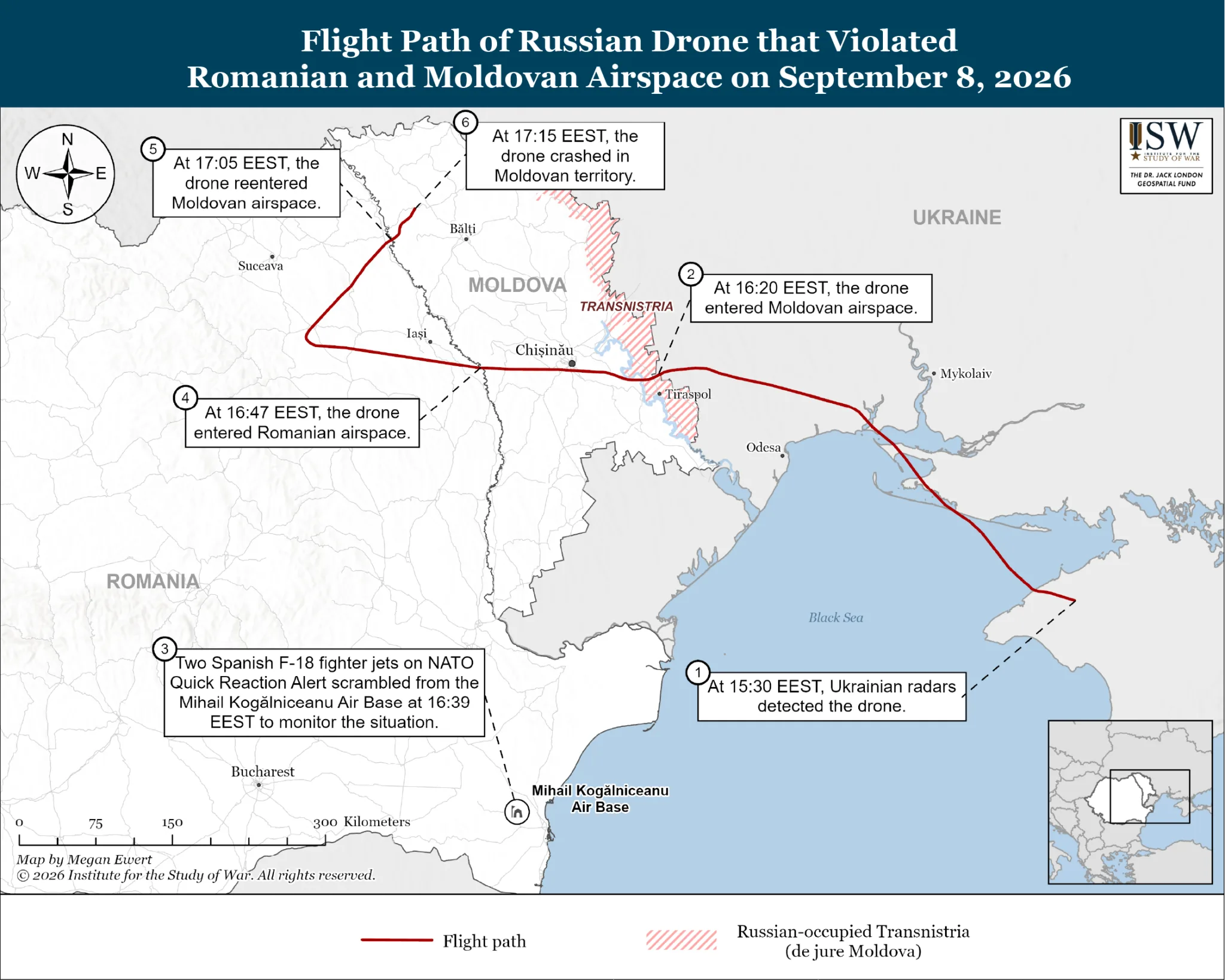
On September 8, 2026, a suspected Russian Shahed-type drone launched from occupied Crimea engaged in a prolonged violation of Moldovan and Romanian airspace. According to Norwegian Prime Minister Jonas Gahr Støre, the drone passed near Moldova’s Chișinău International Airport at approximately the same time Ukrainian President Volodymyr Zelensky’s plane prepared to depart for Oslo.
Takeaways:
Officials from Ukraine, Moldova, and the European Union have subsequently downplayed the risk to Zelensky’s aircraft, suggesting intelligence that the drone was either not armed or not directly targeting the Ukrainian President.
As noted in previous Weekly Significant Activity Reports, the number of Russian drones violating Moldovan and Romanian airspace has dramatically increased in recent months. The drone incursions form part of an intensifying Russian irregular warfare campaign to raise pressure on Moldova through a combination of military threats and influence operations to derail it from its ambitions to join the European Union.
The incursions increasingly involve drones carrying explosives. The most recent example occurred on September 12, 2026, when a Russian attack drone flew through northern Moldova before crashing in a Romanian cornfield and exploding. The growing frequency of incursions has also corresponded with recent Russian attacks on Ukrainian border checkpoints near Moldova, including a September 9 attack on the Starokazache–Tudora border crossing near Odesa. Viewed together, these activities appear to form a concerted effort to erase territorial distinctions between the two countries and incrementally encompass Moldova in Russia’s “special military operation”. Moldovan President Maia Sandu warned of this trend in a September 9, 2026, post on X, stating:
“Yesterday a Russian drone forced us to close our airspace temporarily. Today Russia is striking the points where people cross into Moldova. Russia's frontline is moving further west — which is why air defence for Ukraine is urgent.”
WESTERN PACIFIC FLASHPOINTS
Significant Activity in the Western Pacific and Taiwan
6. NORTH KOREA CONDUCTS NEW MISSILE TEST IN PROTEST OF US-SOUTH KOREA DRILLS
North Korea conducted a new missile test on September 12, 2026, launching multiple projectiles about 250 km into the East Sea (Sea of Japan). The test appeared to involve both Hwasong-11 ballistic missiles and 600mm rockets.
Takeaways:
The missile launches coincided with the end of the five-day “Freedom Edge” maritime military exercise conducted by the US, South Korea, and Japan near Jeju Island, suggesting a North Korean protest of the joint military drills which proceeded despite previous overtures by President Donald Trump to Kim Jong-un in August. North Korea previously declared Freedom Edge to be a threat to the country, given that it unites all three of its principal adversaries.
This briefing was compiled by Dan White. Dan is an independent foreign policy analyst based in the New York Metro Area. Dan is a former member of The Wilson Center and The Kennan Institute. Dan holds masters degrees from the Johns Hopkins University School of Advanced International Studies (SAIS), the Naval Postgraduate School, and the University of Washington. Dan is a former officer in the United States Army and a veteran of the War in Afghanistan.
For more information, corrections, or comments, please contact djwhite155@gmail.com.