



This week’s analysis highlights some of the most significant geopolitical developments involving America’s adversaries—China, Russia, Iran, and North Korea—between May 30, 2026 and June 6, 2026.
Summary:
Update on the war with Iran: US and Iranian forces engaged in multiple armed skirmishes, as Iran launched drones and missiles at its neighbors despite ongoing ceasefire.
New reporting suggests Russia has lost territory in Ukraine for two months in a row amid toughening Ukrainian defenses.
New reports showed Russia and China advancing the development of two powerful and unusual naval vessels.
China escalated maritime disputes with Taiwan, Japan, and the Philippines with new patrols near Taiwan and the construction of two unknown structures on Scarborough Shoal.
Kim Jong-un inspected North Korea’s most advanced naval destroyer and promised to develop newer and more powerful warships in the next five years.
1. IRAN WAR UPDATE
The ceasefire between Iran and the US came under increasing strain this week as the two sides engaged in multiple armed skirmishes after Iranian strikes on the Gulf States.
On June 3, Iran launched dozens of drones and missiles against Bahrain and Kuwait. While most of the weapons were intercepted, one Iranian Shahed drone struck Kuwait International Airport resulting in severe damage to its Terminal 1. Iran denied responsibility for the attack.
Between June 5-6, Iran again launched multiple waves of attack drones and missiles at a variety of targets in Kuwait, Bahrain, and the Strait of Hormuz. The US responded by attacking Iranian coastal radars on Qeshem and Goruk Island.
Source: Vahid Online on Telegram
Takeaways:
On Iran’s Denials of Striking Kuwait International Airport: While Iran denied responsibility for the attack, claiming the damage was caused by a malfunctioning Patriot Missile interceptor, CCTV footage clearly shows an Iranian Shahed-type drone strike the roof of the airport.
On Iranian Regional Retaliation: Iran is using continued attacks on its Gulf State neighbors to keep momentum going for a transformation of regional power away from the US. Hawkish members of the Iranian Islamic Revolutionary Guard Corps and clergy who have grown in influence since the start of the war have become increasingly vocal in their belief that a policy of unrestrained regional bullying is working to reshape control over the Middle East in Tehran’s favor. On June 6, spokesperson for the Iranian Parliament's National Security and Foreign Policy Committee, Ebrahim Rezaei, stated that Iran will retaliate violently against its neighbors for grievances it has about the US presence in the region.
“We are in the process of establishing an Iranian equation in the region, whereby Iran no longer exercises restraint against any mischief or disorder. It will bring some pain and expense for the Americans, but they will get used to it.”
Top cleric and Chairman of Iran’s Expediency Discernment Council Ayatollah Sadeq Amoli-Larijani also stated on June 6, that Iran would use an end to the war to generate a “strategic transformation” of the region, with greater Iranian influence over its neighboring Islamic countries’ security—presumably achieved through threat of violence and coercion.
-
The top grievances Iran has at the moment are the continued US blockade and Israeli offensive against Hezbollah in Lebanon. Iran appears to be using continued attacks against the Gulf States to send the message that regional security is indivisible and that there will be no return to business as usual as long as Iranian interests are threatened. Iran appears to have focused increasing pressure on Kuwait and Bahrain in recent days as part of this strategy to probe for vulnerabilities in the US alliance system.
2. RUSSIA LOSES TERRITORY IN UKRAINE FOR SECOND MONTH IN A ROW
According to analysis released this week by the Institute for the Study of War, May marked the second consecutive month that Russian forces experienced net territorial losses to Ukrainian counterattacks.
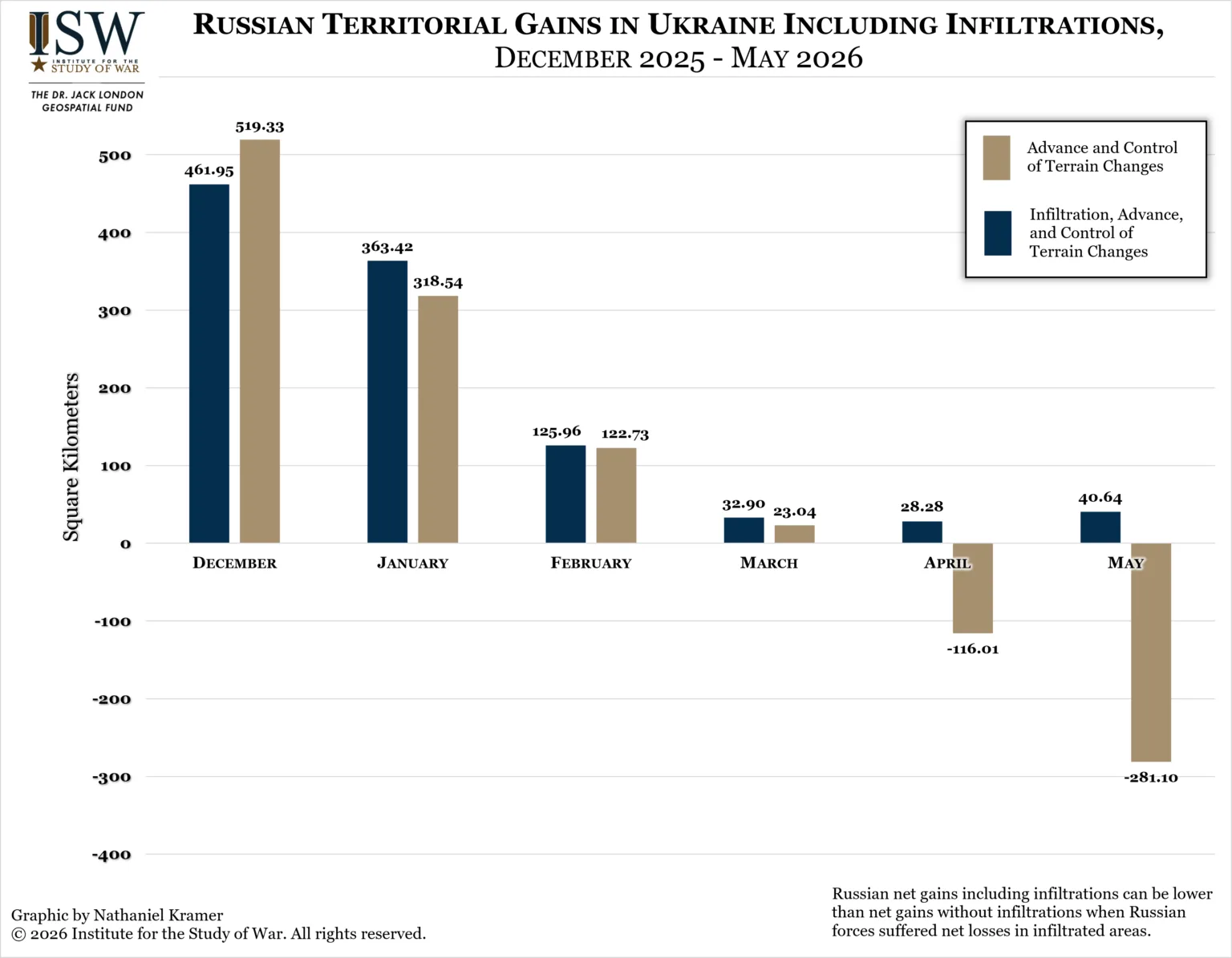
Takeaways:
Russia’s offensive capability has eroded substantially due to months of extremely high casualties that have exceeded replacement rates. Ukraine’s increasingly sophisticated defensive in depth and reconnaissance strike complex, facilitated by overwhelming numbers of surveillance and attack drones, has made even the incremental gains from previous Russian offensives extremely difficult to maintain. Illustrative of these advances in Ukrainian defensive capability, on June 4, Robert “Madyar” Brovdi, the commander of Ukraine’s Unmanned Systems Forces announced that the new unit inflicted 100,000 Russian casualties in the first year of its existence.
Ukrainian defenses have grown so strong that even ardent pro-war Russian military bloggers have begun expressing concerns that further rounds of mobilization may yield increased casualties without major breakthroughs.
3. RUSSIA AND CHINA COMPLETING NEW AND UNUSUAL WARSHIPS
Massive Russian Surface Combatant Begins Final Sea Trials
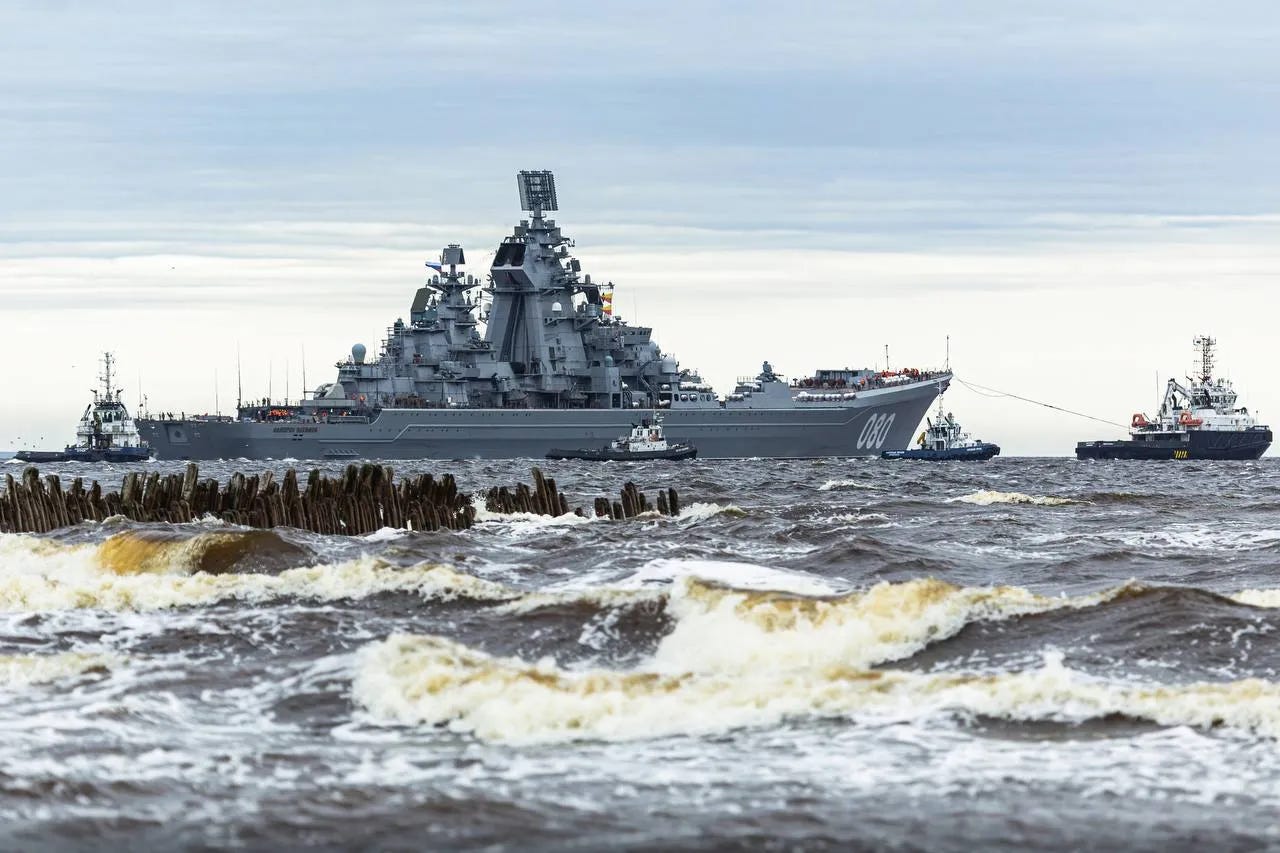
On June 1, Russian state-media outlet Interfax announced that the nuclear-powered missile cruiser Admiral Nakhimov had begun final sea trials. Assigned to the Northern Fleet, the Admiral Nakhimov will be Russia’s largest and most powerful combat vessel when it enters service sometime in 2027.
Unusual Chinese Submarine Seen Under Construction
A June 3 article in Naval News identified a new type of “sailless” submarine under construction at JN Shipyard in Shanghai. Author H. I. Sutton assessed the dimensions of the vessel to be approximately the size of a standard US Virginia-class submarine at 120m long and 10-11m wide, with the distinct difference between the two vessels being the Chinese submarine’s lack of a prominent top “sail.” The author suggests a second vessel of a similar design is under construction at the Huludao shipyard at Bohai.
Takeaways:
On the Capabilities of the Admiral Nakhimov: There is no official confirmation about the ship’s official weapons systems, however, prominent Russian defense publication TopWar.ru, suggests the ship will have capacity for about 192 missiles and torpedoes: “Preliminary reports, as there is no official confirmation, indicate that the ship received 80 UKSK slots for Kalibr and Onyx cruise missiles, as well as Tsirkon hypersonic missiles, 92 (probably) S-300FM air defense missile silos, and 20 533mm torpedoes or Vodopad anti-submarine missiles.”
On the Design of the Chinese Submarine: The concept of a sailless submarine is rare, though not entirely novel, with Chinese, Russian and Western navies previously experimenting with low-profile top sails. As Sutton notes, the design of this particular boat suggests it is a new class of nuclear attack submarine, with the lack of a top sail used to increase its underwater speed and stealth.
4. CHINA ESCALATING MARITIME BATTLES WITH TAIWAN, JAPAN, AND THE PHILIPPINES
Chinese Construction Detected on Scarborough Shoal
On May 30, the Philippine Defense Secretary Gilbert Teodoro Jr. announced on the sidelines of the Shangri-La Dialogue that Manila was investigating new information that China is constructing infrastructure on the Chinese-occupied Philippine waters of Scarborough Shoal (AKA Panatag Shoal or Bajo de Masinloc). Teodoro Jr.’s claims of Chinese construction were quickly validated by satellite imagery that showed two man-made objects located at the southern entrance of a lagoon on the shoal.


Standoff Near Taiwan’s Pratas/Dongsha Island Continues
On June 6, Taiwan’s Coast Guard Administration stated that for the first time a Chinese survey ship “Maritime Silk Road 6” escorted by a Chinese Coast Guard vessel forced their way into the territorial waters of Taiwan’s Pratas/Dongsha Island.
China Launches “Special Law Enforcement Operation” in Waters East of Taiwan
On June 6, China’s Ministry of Transportation announced a “special law enforcement operation” in the waters east of Taiwan in response to recent plans by Japan and the Philippines to delimit the maritime borders of their exclusive economic zones—an action China demands a say in due to its claims to Taiwan and the broader regional waterways.
Takeaways:
On Chinese Construction At Scarborough Shoal: Continued construction on Scarborough Shoal would represent a major escalation in China’s efforts to seize the territorial waters of the Philippines in violation of the 2016 ruling of the Permanent Court of Arbitration (PCA) in The Hague, which denied Beijing’s claims to the region. This latest move follows increasingly aggressive behavior by China near Scarborough Shoal over the past year, including numerous violent incidents against Philippine mariners and a unilateral declaration in September 2025 that Scarborough Shoal would be transformed into a Chinese national wildlife refuge and nature preserve.
On Chinese Patrols Near Pratas/Dongsha Island: This week’s patrol marks the second major standoff between the Chinese and Taiwanese coast guards near the island in just over a week. The recent incidents exemplify the growing frequency and intensity of maritime encounters near the island. On June 1, Taiwan’s Coast Guard Administration (CGA) reported that since 2024, China has increased the number of maritime patrols intruding into Taiwanese territorial waters near Pratas/Dongsha Island to more than 30 annually.
-
As noted in last week’s Significant Activity Report, China views Pratas/Dongsha as part of Taiwan’s weak underbelly. It is using continuous probes of the island to test the broader readiness of the Taiwanese coast guard and military to respond to threats.
On the New “Special Law Enforcement Operation”: China appears to have launched maritime patrols in the region Japan and the Philippines are working to delimit (i.e. negotiating adjustments to borders where there are overlapping claims) because of additional overlap with Taiwan’s exclusive economic zone.1 Because China claims Taiwan, it views actions that impact Taiwan’s territorial sovereignty as an affront to its own. Further, Beijing, which holds expansive claims over the South and East China Seas, is unlikely to accept Japan—whose relations with Beijing have grown increasingly hostile under Prime Minister Sanae Takaichi—setting new maritime rules in the region.
5. KIM JONG-UN INSPECTS NEWEST DESTROYER AND HINTS AT NEW TYPES OF WARSHIPS TO COME
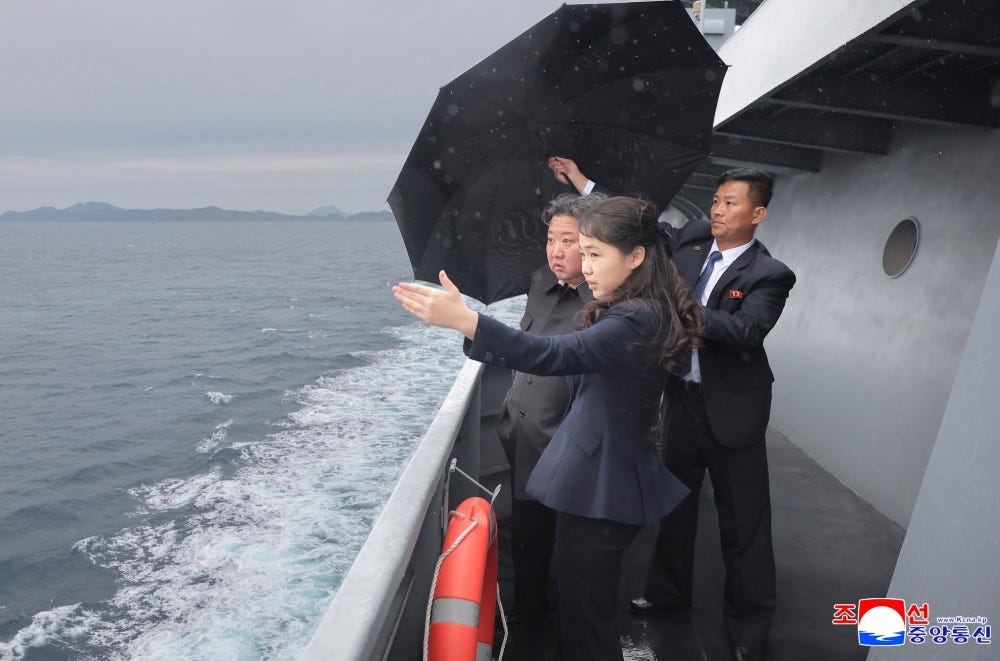
On June 4, Kim Jong-un inspected the North Korean Navy’s 5,000-ton Choe Hyon-class destroyer Kang Kon, the second of two advanced warships Pyongyang launched within the last two years. During the visit Kim suggested Pyongyang would soon embark on the production of more advanced warships. According to Korean Central News Agency:
“Comrade Kim Jong Un expressed great trust and expectation that the vast plans for bolstering up the warship force, including the development and production of underwater secret weapons and the building of 10,000-tonnage destroyers under the five-year plan for modernizing the Navy approved by the Ninth Congress of the WPK, would be surely carried out by our reliable and powerful defence science research group, self-supporting shipbuilding industry and competent and intelligent workers in the munitions industry.”
Takeaways:
The visit to the Kang Kon appeared to roughly coincide with the one year anniversary of the ship’s capsizing during launch, an effort to demonstrate the ship was fully functional. The visit also preceded the upcoming June 8-9 state visit to Pyongyang by Chinese leader Xi Jinping, and may have been an attempt to assert North Korea’s growing capability as a regional power. In this regard, the move to inspect a Choe Hyon-class destroyer may have also been especially symbolic as the ship is widely suspected of being developed with Russian technical assistance.
It is also worth noting that Kim Jong-un’s daughter, and presumed successor Ju-ae, accompanied her father on the inspection.
This briefing was compiled by Dan White. Dan is an independent foreign policy analyst based in the New York Metro Area. Dan is a former member of The Wilson Center and The Kennan Institute. Dan holds masters degrees from the Johns Hopkins University School of Advanced International Studies (SAIS), the Naval Postgraduate School, and the University of Washington. Dan is a former officer in the United States Army and a veteran of the War in Afghanistan.
For more information, corrections, or comments, please contact dan@opforjournal.com.
Taiwan has similarly expressed apprehension about being left out of the negotiations between Japan and the Philippines.