



This week’s analysis highlights some of the most significant geopolitical developments involving America’s adversaries—China, Russia, Iran, and North Korea—between May 23, 2026 and May 30, 2026.
Summary:
Update on the war with Iran: Iran’s internet blackout was lifted; no war-ending deal reached despite repeated US claims of near breakthrough; US and Iranian forces engaged in multiple armed skirmishes despite ongoing ceasefire.
For the third time, Russia launched an “Oreshnik” intermediate-range ballistic missile at Ukraine.
A Russian Shahed-type drone struck an apartment building and exploded in Romania.
Taiwan announced it has observed an uptick in Chinese maritime patrols near the island since the Xi-Trump Summit in mid-May.
North Korea announced the successful test of a new “AI-enabled” missile.
New reporting indicated that North Korea introduced a shoot-to-kill policy to crack down on unauthorized crossings of its northern border with China.
1. IRAN WAR UPDATE
Internet Blackout Ends (Mostly)
According to monitoring organization Netblocks, internet connectivity was broadly restored across Iran on May 26.
Deal or No Deal with Iran
This week featured continual US claims and repeated Iranian denials that a deal to end the war was imminent. As of May 30, no deal to end the war has been reached.
US and Iran Skirmish Despite Ceasefire
US and Iranian forces engaged in multiple armed skirmishes this week despite the official ceasefire.
On May 25, US aircraft attacked several Iranian attack boats and missile sites in the vicinity of Larak island in the Strait of Hormuz in response to threatened Iranian attacks. Between May 27 and 28, Iran launched a ballistic missile at US bases in Kuwait and five additional one-way attack drones at US forces operating near the Strait of Hormuz, resulting in American retaliatory strikes on Bandar Abbas. On May 30, Iran again launched a ballistic missile at Kuwait, striking the US’s Ali Al Salem Air Base. The attack reportedly resulted in multiple American casualties and damage to two MQ-9 drones.
Takeaways:
On Iran’s Internet Restoration: While connectivity has largely returned, Iran’s future internet appears poised to be permanently heavily restricted and censored. In a May 23 interview, Mohammad Sarafraz, a member of Iran’s Supreme Council of Cyberspace, announced that Iran has imported advanced Chinese technology to more closely monitor and control the country’s internet.
On a War-Ending Deal: The White House has repeatedly teased an imminent deal to end the war with Iran for nearly a week. The delay is almost certainly the result of Iran’s unwillingness to cede to any US conditions when it feels that its continuing survival and control over maritime traffic in the Strait of Hormuz positions it to dictate terms. It is also likely that the regime doesn’t trust that the US will honor any deal over the long-term and sees little reason to settle when it has leverage. The repeated drone and missile attacks attest to Iran’s willingness to push the limits of the ceasefire to demonstrate that it is the US that is most interested in preserving the ceasefire to avoid another round of fighting.
-
The White House’s strategy to force Iran to negotiate an end to the war through a prolonged economic blockade may not meaningfully influence the decision-making of the hardline elements of the Islamic Revolutionary Guard Corps (IRGC) and clerical establishment whose grip on power appears to have solidified after US decapitating strikes vacated top leadership positions. Ideological hardliners and members of the regime’s security forces naturally derive power and legitimacy from conflict with the US. Further, the continued closure of the Strait of Hormuz has provided vindication that their preferred policy of unrestrained regional retaliation is an effective tool for countering American aggression. These elements of the Iranian state, responsible for both recently massacring thousands of their own citizens and cutting the entire country off the internet, do not care about the economic well-being of the country as long as they are able to retain their grip on power. The economic blockade by itself is unlikely to loosen that control over a timeline acceptable to the current US administration, as the regime has long experience insulating its core sources of coercive power from US sanctions.
2. RUSSIA LAUNCHES THIRD ORESHNIK MISSILE AT UKRAINE
On May 24, the Russian military launched an “Oreshnik” intermediate-range ballistic missile at Kyiv oblast, amid a massive air assault on the capital and other major cities involving 600 drones and 90 missiles. This was the third use of the new nuclear-capable missile in Ukraine since November 2024.
Re-entry vehicles from the Oreshnik dispersing upon descent. Source: United24Media
Takeaways:
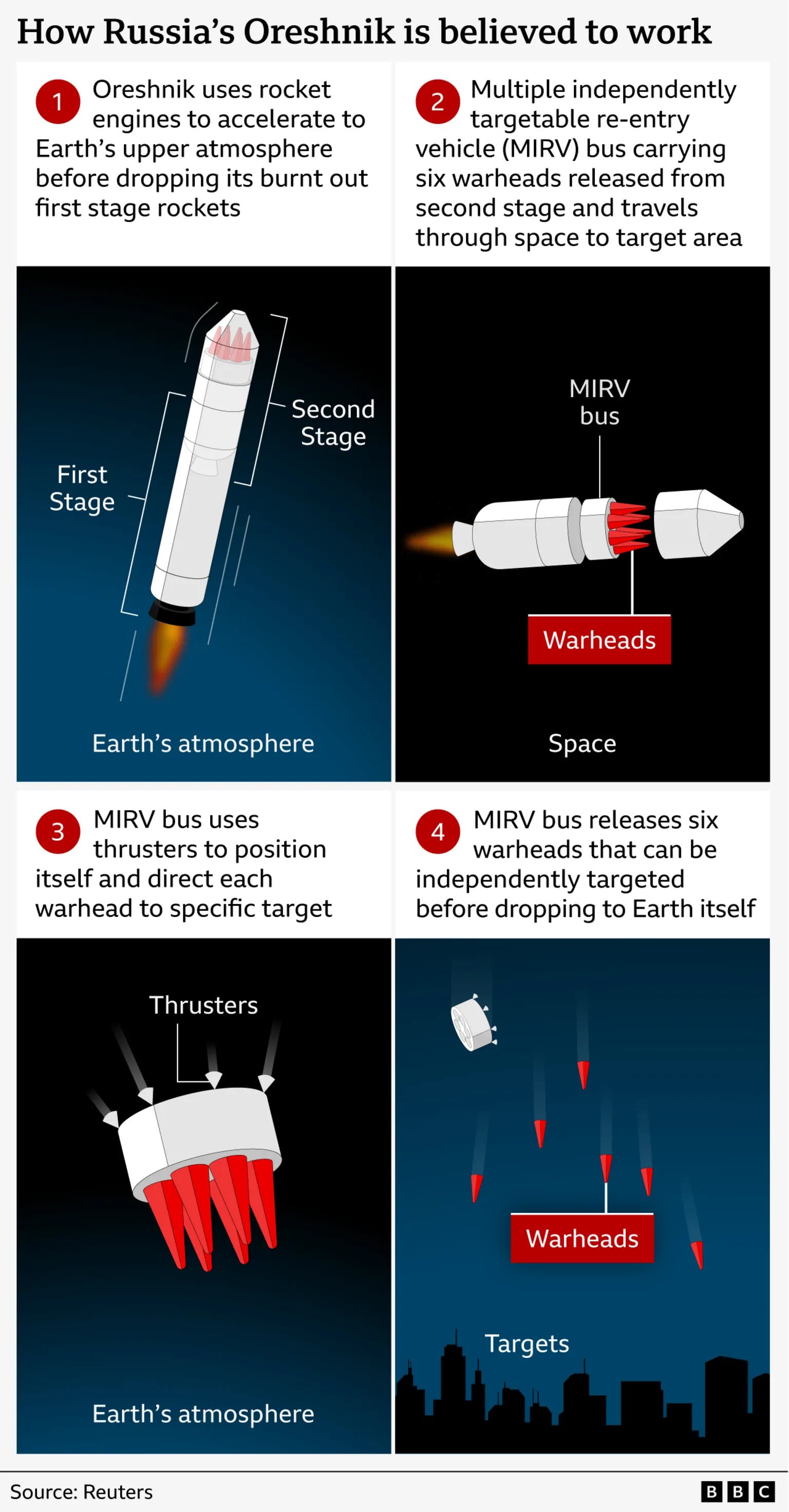
On The Unusual Appearance of an Oreshnik Strike: The individual clusters of projectiles streaking toward the ground in the video above are components of multiple independent re-entry vehicles (MIRVs). When employed as a nuclear weapon, the MIRVs would each carry an individual nuclear warhead. However, in its current setting the MIRVs appear to carry little to no explosive material, relying primarily on kinetic energy to damage infrastructure. The lack of explosive material is possibly due to weight restrictions (nuclear warheads tend to weigh less than large conventional explosives.)
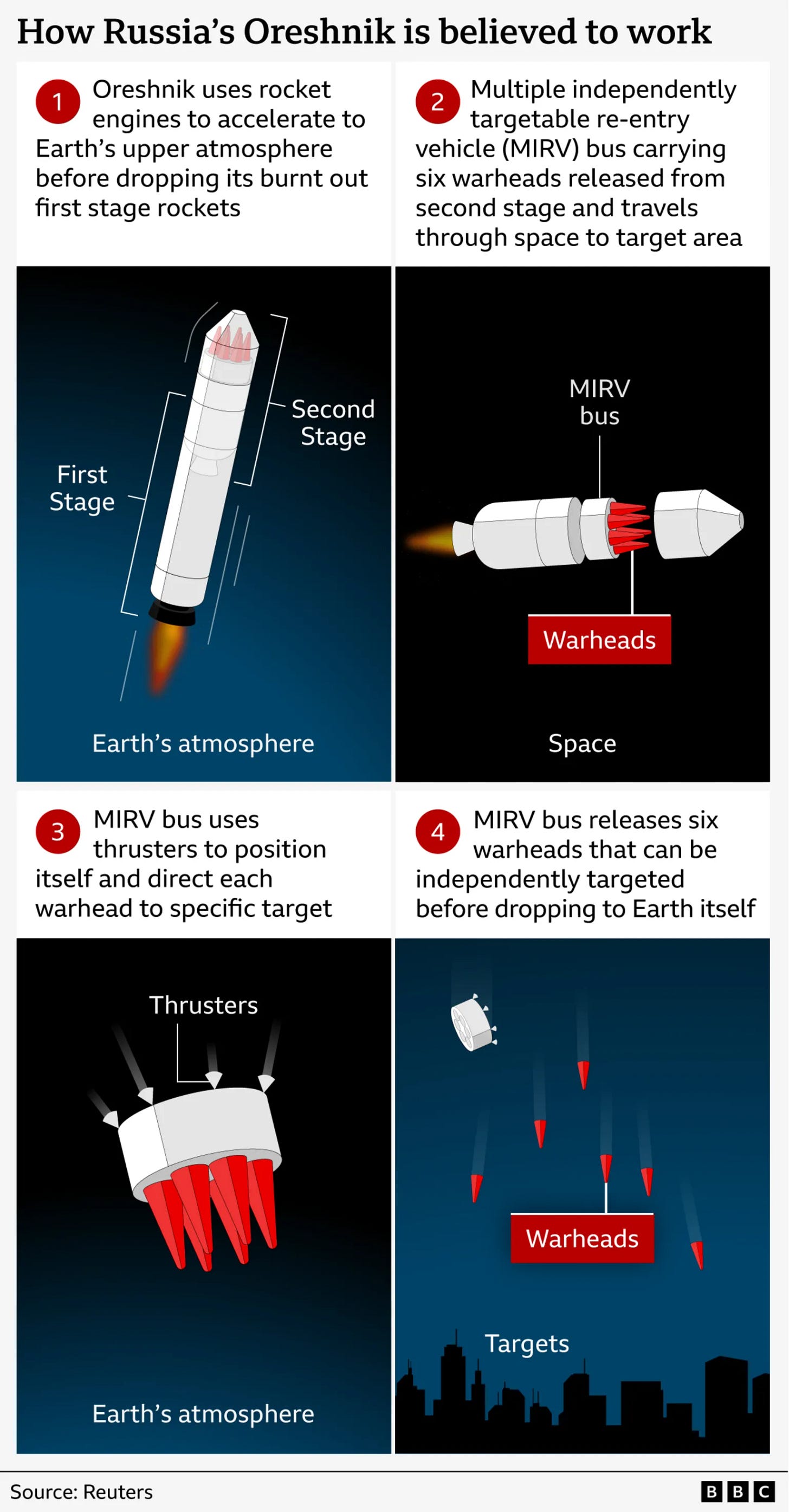
The operation of an Oreshnik Source: BBC via Reuters On a Possible Second Oreshnik Strike: There are numerous indications—one of which being assertions by Ukrainian President Volodymyr Zelensky—that Russia launched a second Oreshnik at Ukraine. The second missile appears to have either failed in flight or fallen short of its target. Multiple reports suggest the missile may have landed in occupied Donetsk.
On the Oreshnik’s Novelty: Ukrainian specialists have found evidence suggesting the “new” Oreshnik missile was manufactured as a modified version of the RS-26 “Rubezh” road-mobile intercontinental ballistic missile in 2017. While this news has been primarily taken as evidence that the Russian wonder weapon is not as cutting-edge as the Russian government portrays, the more significant takeaway from this information is that the weapon—whose range and capabilities violate the Intermediate-Range Nuclear Forces Treaty (INF Treaty)—was developed long before Russia’s August 4, 2025 treaty withdrawal. It is the latest evidence that suggests long-running and systemic violations of arms control agreements by the Kremlin. This revelation is important for US policymakers to consider as both countries seek to restore some bilateral arms control after the collapse of the INF and New Start Treaties over the past year.
3. RUSSIAN ATTACK DRONE STRIKES ROMANIAN APARTMENT BUILDING
On May 29, a Russian one-way attack drone crossed into Romanian airspace during an air assault on Ukraine, striking the roof of an apartment building in the city of Galati and exploding. The strike injured two and caused a fire which forced the evacuation of the building. In response, Bucharest launched Article 4 consultations with NATO allies, closed the Russian consulate in Constanta and expelled its consul general.
Russian President Vladimir Putin declared that it is impossible to know whose drone it was until “objective data” could be obtained and analyzed.
Aftermath of Russian drone strike in Galati, Romania. Source: Intel Slava on Telegram
Takeaways:
On Russian Drone Incursions into NATO Territory: Russian drones have repeatedly violated the airspace and landed on the territory of Romania and nearby Moldova amid attacks on western Ukraine. In one previous instance in November 2025, a Russian reconnaissance drone crashed into a house in Moldova’s Floresti district. However, this is the first time an explosive-filled attack drone struck either country.
-
This is only the most serious of a growing number of Russian drone incursions into the territory of NATO member states over the past year. And these incidents have ticked up amid increasingly provocative rhetoric and posturing by the Kremlin toward the Baltic States and Moldova in 2026.
On How These Incursions Fit in a Broader Context of Increasing Aggression Toward NATO: The previous territorial violations by Russian drones and Russia’s broader campaign of sabotage and intimidation in Europe, including thwarted plots to bomb commercial aviation, mean that this incident should not be assumed to be a one-off accident. As a result, NATO must take the incident as a serious provocation by Russia and strengthen its air defenses, including considering whether to extend an air defense buffer zone into Ukrainian airspace, where drones can be shot down prior to reaching NATO borders.
4. CHINA RAMPS UP MARITIME PATROLS NEAR TAIWAN
Taiwan’s Security Council Chief Says China Has Boosted Maritime Activities Since Xi-Trump Summit
On May 23, Joseph Wu, the Secretary-General of Taiwan’s National Security Council, announced that Taiwan has observed a considerable uptick in Chinese maritime activity near its shores, with 100 vessels deployed in the East and South China Seas since President Trump’s state visit to China.
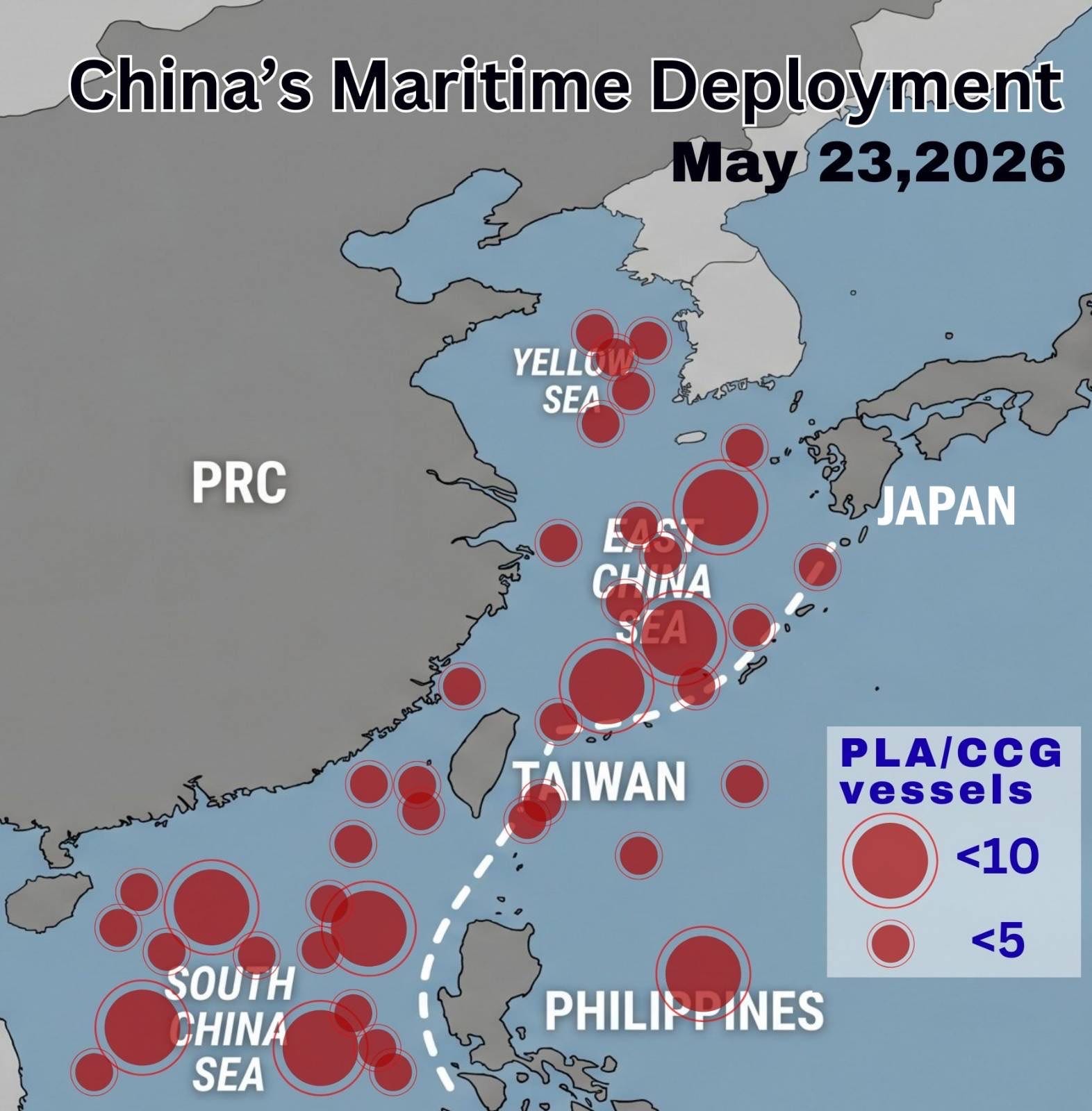
Coast Guards of China and Taiwan Engage in Standoff Near Taiwanese Islands
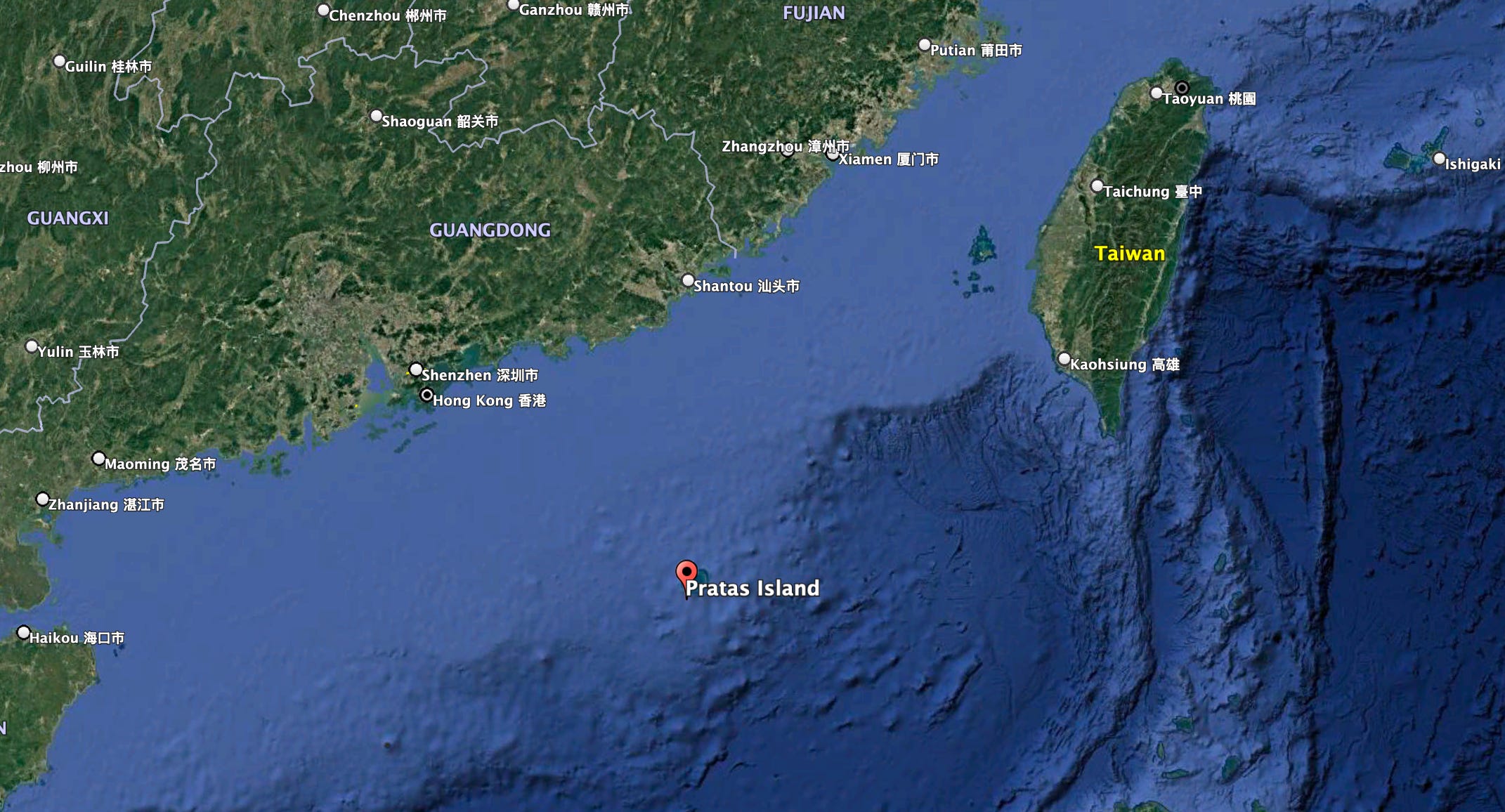
On May 23, ships of the coast guards of China and Taiwan engaged in a prolonged standoff near the Taiwanese Pratas/Dongsha Islands in the South China Sea. A noteworthy radio exchange between the vessels included the Taiwan Coast Guard radioing to its Chinese counterpart: “Please do not destroy peace. You should return and strive for democracy. That is the correct way to serve your country.”
Takeaways:
On Ties Between Increased Maritime Activity and Xi-Trump Summit: It is difficult to say whether the broader increase in Chinese maritime activity is directly tied to President Trump’s visit to China and ongoing refusal to approve a pending arms sale to the island nation. This is because China has been increasing the size of its navy and the operational tempo of its maritime forces for years now and has been conducting a number of significant training exercises so far this spring.
-
However, there is considerable evidence that China has indeed seized upon the US President’s comments casting doubt on US military assistance to Taiwan, incorporating them into its cognitive warfare operations aimed to instill a sense of hopelessness and abandonment in the island’s population. On May 25, Taiwan’s National Security Bureau announced that it has flagged more than 100 social media accounts and 9,000 messages associated with Chinese actors pushing narratives casting doubt on the US’s security commitments since the Xi-Trump meeting.
On Chinese Patrols at Pratas Island: China frequently tests Taiwan’s responses to air and maritime patrols near the Pratas/Dongsha Island. In January 2026, the Chinese People’s Liberation Army’s Southern Theater Command announced that it would begin conducting regular aerial patrols near the island with drones. The constant testing of the island’s defenses is due to its strategic location in the northern reaches of the South China Sea. China wants control of Dongsha to both better project power into the South China Sea and to isolate the Taiwanese main island. Moreover, the island is a Taiwanese national park with limited military presence, and China may be eager to gauge Taiwan’s responses to incursions in the area as a proxy for the overall readiness of the Taiwanese armed forces.
5. NORTH KOREA TESTS NEW MISSILE AND ROCKET SYSTEMS
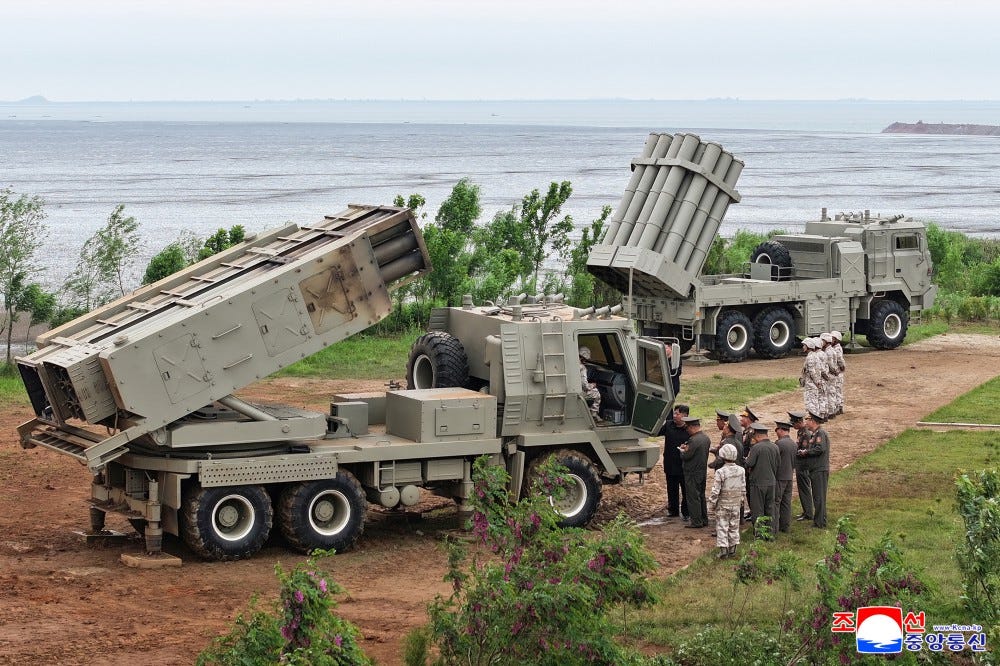
On May 27, North Korea announced that it had conducted a successful test of a new “tactical cruise missile” and lightweight multi-purpose rocket launch system. According to Korean Central News Agency, the tactical cruise missile employs cutting-edge technology including AI for both in-flight navigation and terminal guidance.
“The tactical cruising shell [sic], which has a combination of the ultra-precision autonomous navigation system and the TERCOM (terrain contour matching) navigation system and employed an AI terminal guidance function, is a powerful weapon system that can strike in an ultra-precision way any target 100 kilometers away by multimode flight based on gliding and propelling.”
This is the eighth major missile test by North Korea this year.
Takeaways:
North Korea has made multiple claims to have developed AI-enhanced weapons systems over the past year. In March 2025, North Korea reported the successful test of an “AI-enabled” attack drone. This was followed in September by a major policy announcement by Kim Jong-un that North Korea would make the integration of AI into unmanned systems its top strategic priority. While these supposed breakthroughs in frontier military technology should be received with some skepticism due to North Korea’s economic backwardness, Pyongyang has shown it can effectively direct its limited resources to produce some high-end weapons and technological systems.
Investigations by the Stimson Center’s 38 North have documented extensive efforts by North Korea to develop international networks for gathering technology and know-how on artificial intelligence for years. Many of these networks run through China, where North Koreans have developed elaborate smuggling operations to obtain high-end chips and computers for the country’s military.
6. NORTH KOREA INTRODUCES SHOOT TO KILL POLICY ON NORTHERN BORDER
According to a May 29 report by Daily NK, North Korea’s State Information Bureau has ordered North Korean border security units to violently crack down on attempts to cross the northern border with China through a new shoot-on-sight policy. The crackdown on cross-border movements also includes stepped up coordination with Chinese law enforcement and increased internal surveillance.
Takeaways:
This latest crack down marks a major escalation of Kim Jong-un’s years-long campaign to seal the North Korean border with China. This campaign has included the building of a massive series of border fences since the Covid-19 pandemic, and the mass employment of radio frequency detectors by law enforcement to root out North Koreans attempting to call family members across the Chinese border.
Like many things in North Korea, there is not enough information about the regime’s decision-making to understand the timing of this move, however, it is clear that the Kim regime sees a porous northern border as a major strategic liability. The fear of defection to South Korea however, does not appear to be the dominant fear driving the crackdown, as such defections have dropped dramatically since 2020. Economic opportunity in China instead appears to be the top concern as it is the predominant driver of unauthorized cross-border migration. Income earned in China threatens the regime’s absolute control over the population by giving North Koreans both an alternative source of subsistence independent of the government and exposure to the dramatic contrast in living standards between the countries.
This briefing was compiled by Dan White. Dan is an independent foreign policy analyst based in the New York Metro Area. Dan is a former member of The Wilson Center and The Kennan Institute. Dan holds masters degrees from the Johns Hopkins University School of Advanced International Studies (SAIS), the Naval Postgraduate School, and the University of Washington. Dan is a former officer in the United States Army and a veteran of the War in Afghanistan.
For more information, corrections, or comments, please contact dan@opforjournal.com.
Been reading these updates for moths now -- super-helpful for keeping up with my geopolitical knowledge. Thank you for your ongoing efforts to inform without any spin.