



This week’s analysis highlights some of the most significant geopolitical developments involving America’s adversaries—China, Russia, Iran, and North Korea—between June 6, 2026 and June 13, 2026.
Summary:
Update on the war with Iran: Days of strikes exchanged between the US, Israel, and Iran threatened the ongoing ceasefire and negotiations; however military escalation was controlled after a diplomatic breakthrough was announced suggesting a war-ending agreement could be signed Sunday, June 14.
Russia’s full-scale invasion of Ukraine exceeded the duration of the First World War, with the Kremlin showing no signs of stopping the war.
China intensified its weeks of provocative maritime maneuvers around Taiwan with patrols east of the island to challenge Japanese and Philippine border delimitation negotiations, and a transit through restricted waters around Taiwan’s Taiping island.
China arrested US scholar Min Zin, an expert on Myanmar, on espionage charges ahead of a state visit by Myanmar President Min Aung Hlaing to Beijing.
Xi Jinping made a state visit to North Korea to strengthen ties between the two long-time allies amid years of multi-vector diplomacy by Pyongyang.
1. IRAN WAR UPDATE
Ceasefire Interrupted by Days of Bombing
This week the US, Israel and Iran engaged in multiple days of exchanging long-range strikes despite ongoing ceasefire and negotiations.
On June 7, Iran launched a ballistic missile attack against Israel, in response to the country’s continued offensive in Lebanon against Iranian proxy group Hezbollah. In response, (despite a warning by US President Donald Trump,) Israel conducted multiple waves of air strikes on Iranian missile sites and air defense systems.
On June 8, an Iranian drone struck and downed a US AH-64 Apache attack helicopter near the coast of Oman. The drone allegedly failed to detonate but forced the crew to conduct an emergency landing over water. Both crew members were subsequently rescued by a US Navy drone boat—the first such rescue in US history. In response to the attack, the US launched two days of “proportional” strikes on Iranian missile sites, air defense and communications systems near the Strait of Hormuz. Iran further retaliated with multiple waves of drone and missile strikes on US bases, as well as other sites, in Kuwait, Bahrain, and Jordan.
War-Ending Agreement Announced
On June 11, US President Donald Trump abruptly called off a third day of air strikes on Iran to announce an imminent deal to end the war between the two countries. President Trump later announced that an agreement would be signed on Sunday June 14 in Geneva, Switzerland.
While President Trump has previously claimed (on several dozen occasions) that a deal to end the war was close, Iranian officials and Pakistani mediators similarly voiced optimism that a final agreement had been reached. On June 12, Pakistani Prime Minister Shehbaz Sharif stated that the final text of a US-Iran agreement to end the war has been agreed upon. A sentiment reflected by social media posts by Iranian Foreign Minister Abbas Araghchi.

The announcement of a deal was met with mixed reactions in Iran. Media outlets associated with the Islamic Revolutionary Guard Corps such as Tasnim News, stated that no final decision had been reached on the final text of an agreement.
With less than a day before it is to be signed, the actual contents of the deal remain uncertain. Ongoing reporting has suggested the agreement is a two-page memorandum of understanding consisting of 14 points to end hostilities and begin a 60 day process of further negotiations around more intractable issues such as the status of Iran’s nuclear program and regional security. However, such reports remain disputed as US and Iranian officials have issued denials regarding key points of a supposed agreement.
President Trump has made multiple announcements that the deal to be signed Sunday would include provisions for Iran to open the Strait of Hormuz immediately, renounce (again) the development of nuclear weapons, and begin a process of dismantling its nuclear program, all without the US releasing Iranian assets. Iran’s Foreign Ministry on the other hand has claimed the deal will allow Iran to retain control of the Strait of Hormuz and issue “service fees” for transit, and will give it immediate access to billions of dollars of frozen assets.
Takeaways:
On the Possibility of a War-Ending Deal: Because US and Iranian officials have disputed the terms of the deal, it is difficult to say what the actual terms are and whether an agreement will actually be signed on Sunday. In any case, it seems likely that officials from both sides are trying to pro-actively shape discussions around the deal (including through misleading information) before the actual terms are announced and identify and counter key domestic critics in advance. The actual deal will likely involve some compromise by both sides and may leave key issues such as Iran’s nuclear stockpile to further negotiations.
On This Week’s Flare Up and Climb Down: Even if a deal is reached, this week’s flare up of violence, despite the continued ceasefire, illustrates potential challenges with compliance. Any deal that leaves hawkish domestic audiences unsatisfied could lead to intense political pressure to strengthen military posturing or attempt to extract greater concessions from future rounds of negotiations. The political pressure will likely be greatest in Iran, as the current war has elevated more militant members of the Iranian security forces to key leadership positions, created new grievances against the US to be avenged, and shown Iran’s capacity to wield power through unrestrained military force.
-
In an early sign of the difficulties of selling a deal in Iran, some hardline officials familiar with the contents of the deal have already expressed dissatisfaction with the terms. Upon seeing the agreement, Mahmoud Nabavian, a hawkish Iranian cleric and member of the Iranian Parliament’s National Security Committee, said “After seeing the text of the agreement, I must say that compared with the two previous versions, it is more damaging and Iran’s retreats have also increased.”
2. RUSSIAN WAR AGAINST UKRAINE PASSED BOTH WORLD WARS IN LENGTH
On June 11, Russia’s war against Ukraine entered its 1569th day, exceeding the length of World War I. The war previously surpassed the duration of Soviet involvement in World War II on January 12, 2026.
On June 12, Russian President Vladimir Putin further illustrated his intention to continue the war by issuing a decree increasing the size of the Russian military to 2.399 million, up from 2.392 million in March.
Takeaways:
On Whether Russia Will Seek Peace: Despite its worsening position in the long and intractable conflict, the Kremlin is still unlikely to willingly end the war in Ukraine. Entering into an armistice along the current lines of control would represent a major admission of defeat for Russian President Vladimir Putin who views the seizure of the remainder of the Donbas (the final 20% of Donetsk region under Ukrainian control) as a minimum acceptable war aim. Growing Ukrainian military strength casts doubt on whether even the seizure of the Donbas would be a sufficiently convincing victory given Russia’s original aim to “de-militarize” Ukraine. As a result we should expect that Russia will continue to press its war for months to come and will likely choose escalation, through either attempts at mobilization, nuclear saber rattling or threats to NATO member states, over an indecisive end to the war.
On Ukraine’s Ability to Win: Successive months of Russian territorial losses, coming on top of mounting casualties, and an intensifying Ukrainian long-range strike campaign that has hammered Russian logistics and industrial targets, has sparked growing debate as to whether Ukraine has seized the battlefield initiative and could defeat the Russian military through a cumulative campaign of attrition. While the debate has intensified, the trend lines leading to this moment have been obvious for some time now.
-
In a January 2024 piece for the Wilson Center, entitled “Ukraine Can Win a War of Attrition,” OPFOR Journal’s Dan White argued that given time and continued support from the West, the effects of Western sanctions, Ukraine’s determined defense in depth and intensifying long-range strike campaign, would reach critical mass to give it an advantage over a much larger but less mobilized Russia in a prolonged war. While tactics and technology have evolved since the piece was written, the overall trend of diminishing Russian capability through attrition in manpower and economic capacity has continued. Ukraine, meanwhile, has preserved and even grown its comprehensive national power by developing the world’s most innovative military industrial complex through total society mobilization buttressed by Western military and financial support.
3. CHINA INTENSIFIES PROVOCATIVE MARITIME PATROLS AROUND TAIWAN
China Conducts “Special Maritime Traffic Law Enforcement Operation” East of Taiwan
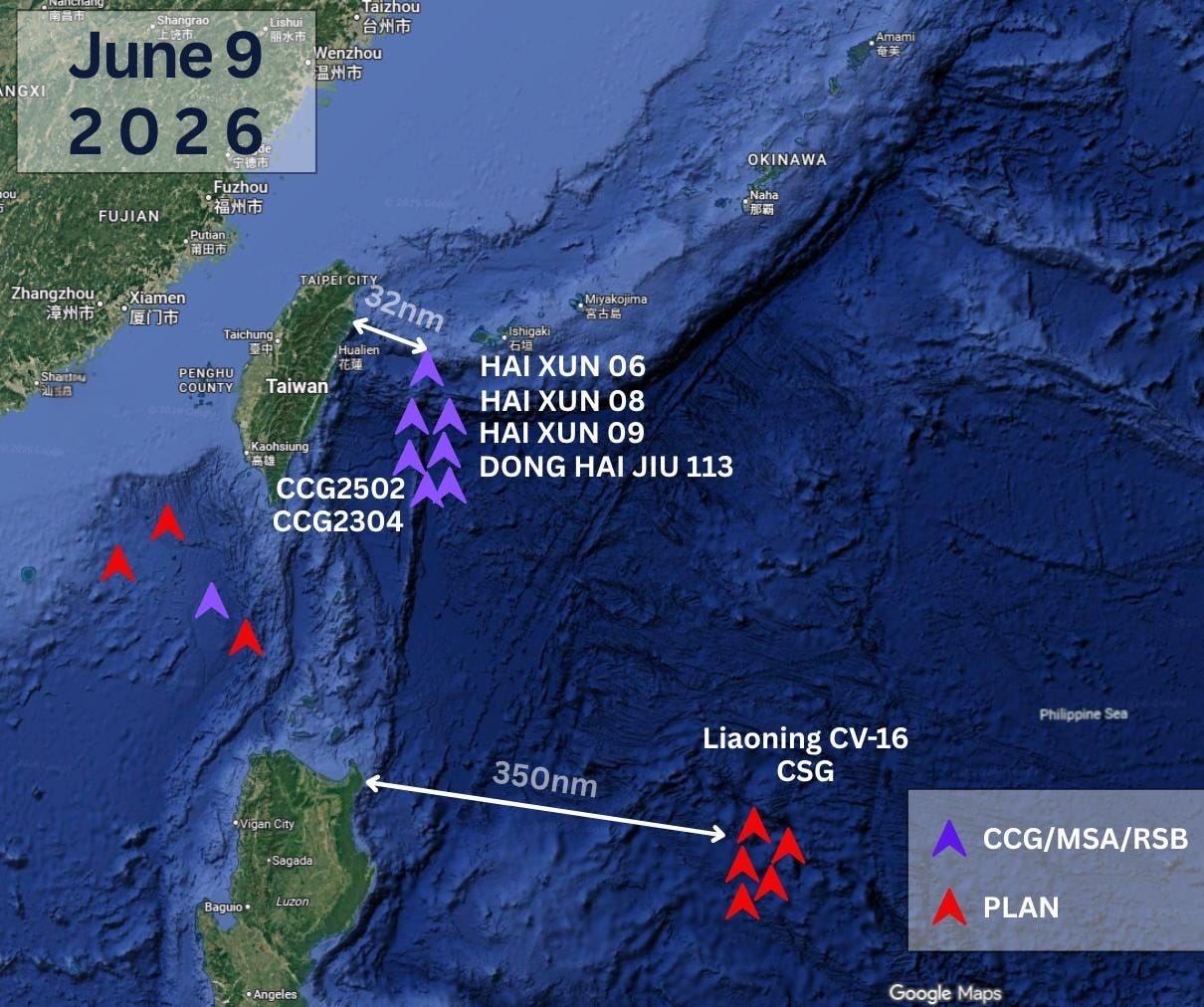
Taiwan's Coast Guard Administration announced on June 7 that multiple large Chinese paramilitary vessels had entered waters east of Taiwan as part of a “special maritime traffic law enforcement operation” announced last week to challenge territorial delimitation negotiations between Japan and the Philippines in the area. The group included three cutters of the Chinese Maritime Safety Administration’s sea patrol “Hai Xun”—including its largest patrol ship, the 10,000 ton Hai Xun 09— as well as a special purpose firefighting ship Donghaijiu 113, and five ships of the China Coast Guard.
On June 9, Joseph Wu, the Secretary General of Taiwan’s National Security Council, announced that Chinese vessels had attempted to hail foreign vessels in Taiwanese waters, direct their movement, and conduct law enforcement inspections. Chinese state media confirmed these activities, stating:
“During the operation, authorities investigated and addressed various illegal and irregular maritime activities to maintain navigational order, inspected vessels’ navigation aid equipment, and verified the identification code information of passing ships. Maritime law enforcement personnel also conducted patrols of key anchorages, offshore construction areas, high-risk vessel collision warning zones, and waters where submarine power and communication cables are being laid.”
China announced the end of the “special operation” on June 10.
Chinese Ships Enter Restricted Waters Around Taiping Island
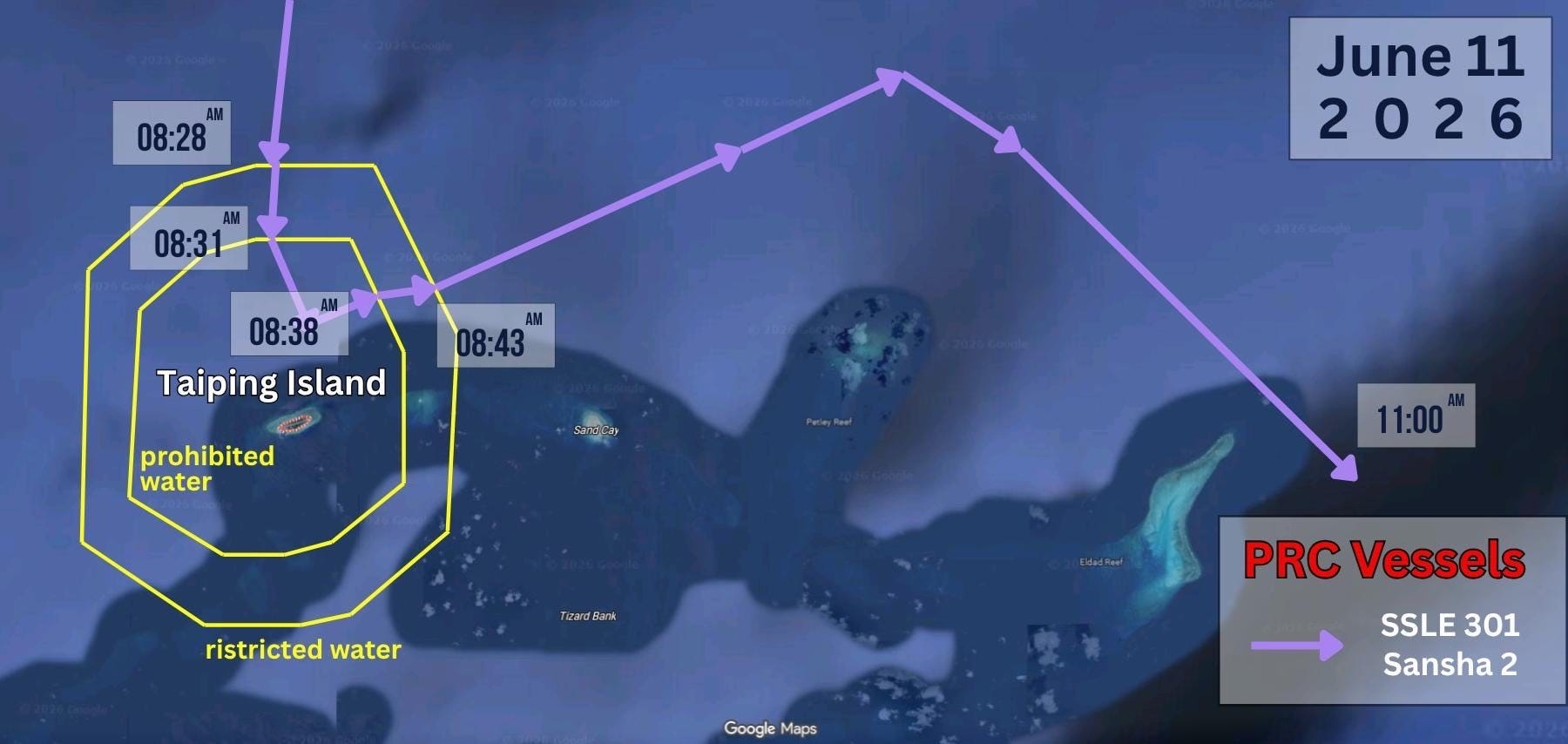
On June 11, Taiwan’s Coast Guard Administration announced that two Chinese vessels entered into prohibited waters around the Taiwanese island of Taiping in the Spratly Island archipelago. The Chinese vessels included the sea patrol ship Sansha Zhi Fa 301 and the supply ship San Sha 2 Hao. The event marked the first time Chinese government vessels entered the restricted territorial waters of the island.
Takeaways:
Both of these moves represent significant steps by China to normalize its control over not only Taiwanese territory, but the broader territorial waters of the South and East China Seas. As noted in the Weekly Significant Activity Report - June 6, 2026, by initiating snap maritime exercises at the site of a border delimitation adjustment by Japan and the Philippines, China is conducting what is effectively its own anti-freedom of navigation patrols. In a sense China is attempting to demonstrate that in the absence of an active US naval presence to challenge its claims, the single prevailing law in the Western Pacific is that of the Chinese Communist Party, with all decisions made on regional maritime issues made in Beijing.
This is not merely conjecture. On May 1, 2026, a new maritime law went into effect in China. The law, initially passed in October 2025, follows a growing push by China’s Supreme People’s Court to settle international maritime disputes in Chinese courts. With an export-driven economy, the world's largest shipbuilding industry, and a rapidly growing navy, China has strong incentives to advance an alternative framework for maritime law that protects its interests and legitimizes its extensive maritime territorial claims that existing international law does not recognize.
4. CHINA ARRESTS US SCHOLAR FOR ESPIONAGE
On June 12, China’s security services announced the arrest of US citizen Min Zin in the city of Kunming on charges of espionage. Min Zin, a PhD candidate at University of California, Berkeley, former Myanmar pro-democracy activist, and founder of the Institute for Strategy and Policy-Myanmar, was arrested on June 3 upon arriving in Kunming airport for an event at an area university.
Takeaways:
It is very unusual for China to arrest US citizens on national security related charges. It is possible Min Zin became involved in research on Chinese policy toward Myanmar that ran afoul of local national security laws. However, the timing of the arrest, coming shortly before a June 15-19 state visit to China by Myanmar President Min Aung Hlaing, suggests Zin may have been deliberately set up to be arrested at the behest of the Myanmar junta.
5. XI JINPING MAKES RARE STATE VISIT TO NORTH KOREA
Chinese President Xi Jinping made a two-day state visit to North Korea from June 8-9. The trip was Xi’s first visit to North Korea in seven years.
Readouts of the trip featured mutual commitments by China and North Korea to strengthen strategic ties, however nuclear issues and peninsula security were notably absent from discussions.
Takeaways:
On the Purpose of the Visit: Overall, the state visit by Xi did not produce any major diplomatic developments, but illustrated China’s enduring interest in keeping constructive relations with North Korea amid Pyongyang’s strategy of diversifying its diplomatic relations. This interest has taken on growing importance in recent years as Kim Jong-un has hedged against dependence on Beijing by forging a new alliance borne of wartime sacrifice with Russia—a bond the North previously shared exclusively with China. The alliance with Russia has helped modernize the North Korean military and contribute to a period of relative economic prosperity. The visit by Xi may have also been used to head off potential diplomatic engagement between the US and North Korea, a goal hinted at in both Washington and Pyongyang since Donald Trump’s return to the presidency in 2025.
On the Lack of Emphasis on Denuclearization: The lack of mention of denuclearization by Xi is a major win for Kim Jong-un who has made the expansion and recognition of North Korea’s nuclear arsenal a central priority. That concession by Xi (which could be retracted at a later date) was likely made to head off talks between the US and North Korea, which Pyongyang conditioned on the US’s recognition of its nuclear arsenal.
This briefing was compiled by Dan White. Dan is an independent foreign policy analyst based in the New York Metro Area. Dan is a former member of The Wilson Center and The Kennan Institute. Dan holds masters degrees from the Johns Hopkins University School of Advanced International Studies (SAIS), the Naval Postgraduate School, and the University of Washington. Dan is a former officer in the United States Army and a veteran of the War in Afghanistan.
For more information, corrections, or comments, please contact dan@opforjournal.com.