


This week’s analysis highlights some of the most significant geopolitical developments involving America’s adversaries—China, Russia, Iran, and North Korea—between January 24, 2026 - January 31, 2026.
Summary:
Russia conducted fresh attacks on Ukraine’s energy infrastructure this week, triggering widespread power outages and contradicting President Putin's pledges to President Trump regarding a week-long ceasefire on Ukrainian cities.
Ukraine announced that it is working with SpaceX to combat Russia’s use of Starlink to increase the range and effectiveness of its long-range attack drones.
Russia and China conducted days of overlapping surveillance missions around Japan.
The death toll from the Iranian government crackdown on protestors continues to climb with many sources now suggesting the total number of dead could range between 20,000 and 30,000.
Iran conducted a flurry of diplomacy this week with regional powers, notably Turkey and Russia as it prepares for a resumption of US-Israeli strikes.
North Korea conducted a test of a new large caliber rocket.
1. RUSSIA CONTINUES ATTACKS ON UKRAINE’S ENERGY INFRASTRUCTURE DESPITE “CEASEFIRE”
On January 29, US President Donald Trump announced that Russian President Vladimir Putin had agreed to a week-long cessation on air attacks on Ukrainian cities on humanitarian grounds due to record cold.
Kremlin spokesperson Dmitri Peskov has confirmed that an agreement was reached between the two presidents, but clarified that the ceasefire commitment regarding civilian infrastructure was far more limited in scope than President Trump suggested,
"I can say that President Trump did indeed make a personal request to President Putin to refrain from striking Kyiv for a week until February 1 in order to create favorable conditions for negotiations."
Russia intensified attacks on Ukraine’s energy infrastructure overnight on January 30-31 triggering cascading blackouts across the country. The attacks, involving 85 long-range strike drones, targeted power substations across the country and severed a major power line connecting Ukraine and Moldova.
Takeaways:
Russia is unlikely to agree to any long-term cessation of attacks on Ukrainian power grid as its theory of victory now largely depends on crippling the country’s civilian infrastructure. Russia hopes to use attacks on civilian targets to create political unrest in the country and new waves of outward migration that exhausts Ukraine’s will to fight, and forces it to accept territorial and political concessions. This strategy was notably articulated by prominent Russian military blogger Rybar in a January 31 post on Telegram:
“The most effective way to create a real and long-term blackout in the territory of so-called Ukraine remains strikes on the substations that feed the NPPs. Against the backdrop of ongoing negotiations, such outages can make the leadership of the Kiev regime more amenable to territorial concessions and other key issues on which it has not yet been possible to agree.”
As discussed in Weekly Significant Activity Report - January 17, 2026, this type of “morale bombing,” to besiege and demoralize civilian populations tends to be ineffective if not accompanied by a successful ground offensive.1 A new report issued by the Center for Strategic and International Studies on January 27, assessed that Russia not only lacks such an offensive, but that its current rate of territorial advances in Ukraine are slower and less decisive than even the disastrous Somme Offensive of the First World War:
“First, Russian forces have suffered approximately 1.2 million casualties (killed, wounded, and missing) and as many as 325,000 killed since February 2022. No major power has suffered anywhere near these numbers of casualties or fatalities in any war since World War II. Second, Russian forces are advancing remarkably slowly on the battlefield. In the Pokrovsk offensive, for example, Russian forces advanced at an average rate of just 70 meters per day. This is slower than the most brutal offensive campaigns over the last century, including the notoriously bloody Battle of the Somme during World War I. Russian forces have gained less than 1.5 percent of Ukrainian territory since the start of 2024.”
2. RUSSIAN MILITARY USING STARLINK EQUIPPED DRONES FOR LONG-DISTANCE STRIKES
This week, numerous reports revealed that the Russian military has begun equipping BM-35 drones as well as Shahed-type drones with onboard Starlink terminals to extend their flight range and enable more effective targeting of Ukrainian logistics.
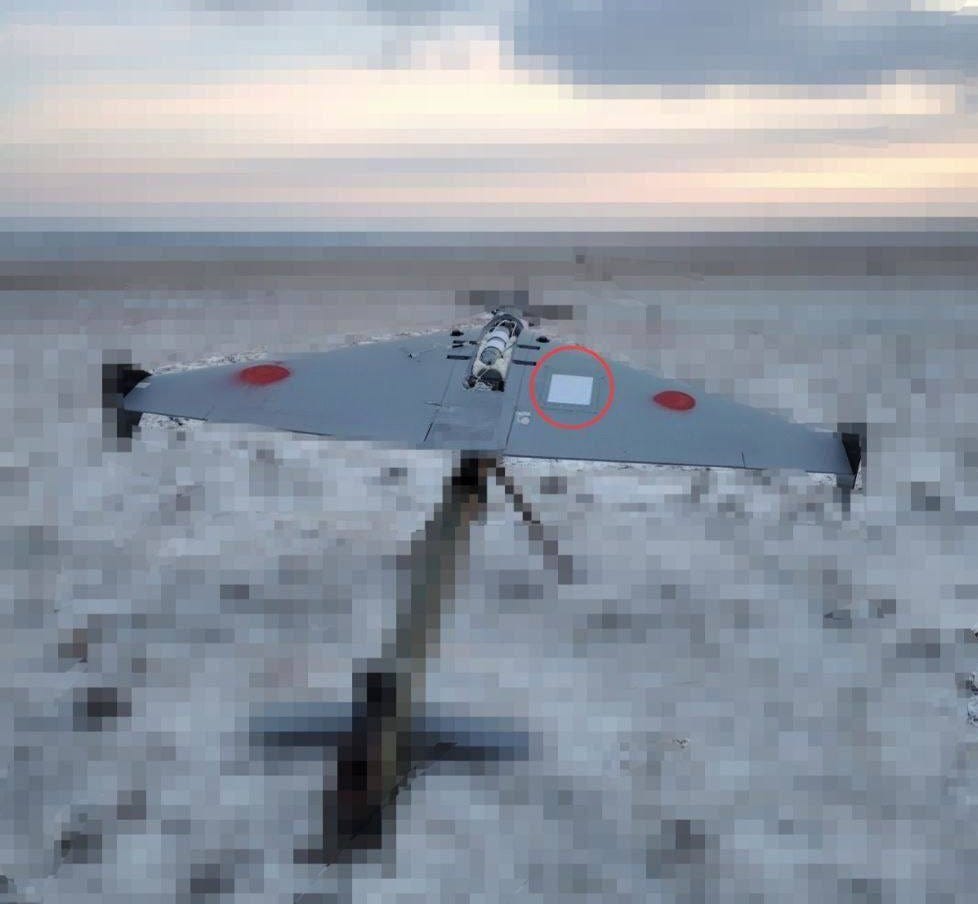
SpaceX CEO Elon Musk, while initially defensive about the allegations after they were amplified by Polish Foreign Minister Radoslaw Sikorski on X, later announced that the company was working with the Ukrainian Ministry of Defense to stop the Russian military from using the technology.
Takeaways:
While Russia is already capable of long-distance drone attacks with its strategic Shahed-type drones, using Starlink extends the range of smaller tactical drones like the BM-35 which lack the Shahed’s robust onboard communications and guidance systems. Starlink connectivity also enhances the ability of Russian drones to adjust flight patterns in real-time and enable them to engage moving targets more effectively. According to Olena Kryzhanivska of Ukraine’s Arms Monitor, several Russian drone strikes on Ukrainian trains and aircraft between January 24-29 were facilitated using Starlink.
SpaceX has not announced what measures it has taken to prevent Russia’s use of Starlink for drone attacks. However, prominent Russian military blogger “Novorossiya Militia Reports” has suggested that Starlink terminals have begun deactivating themselves after short periods of fast movement.
“Today, our sources provided information about the introduction of new restrictions on the operation of Starlink terminals in motion. According to the data received, access to the internet is blocked when moving continuously at speeds of around 90–100 km/h for more than ~2 minutes, and recovery is possible only after restarting the terminal, after which the cycle repeats. It is specifically emphasized that this is about countering the use of Russian UAVs, which use satellite internet for navigation and control.”
3. RUSSIAN AND CHINESE INTELLIGENCE SHIPS SURVEILLING THE JAPANESE COAST
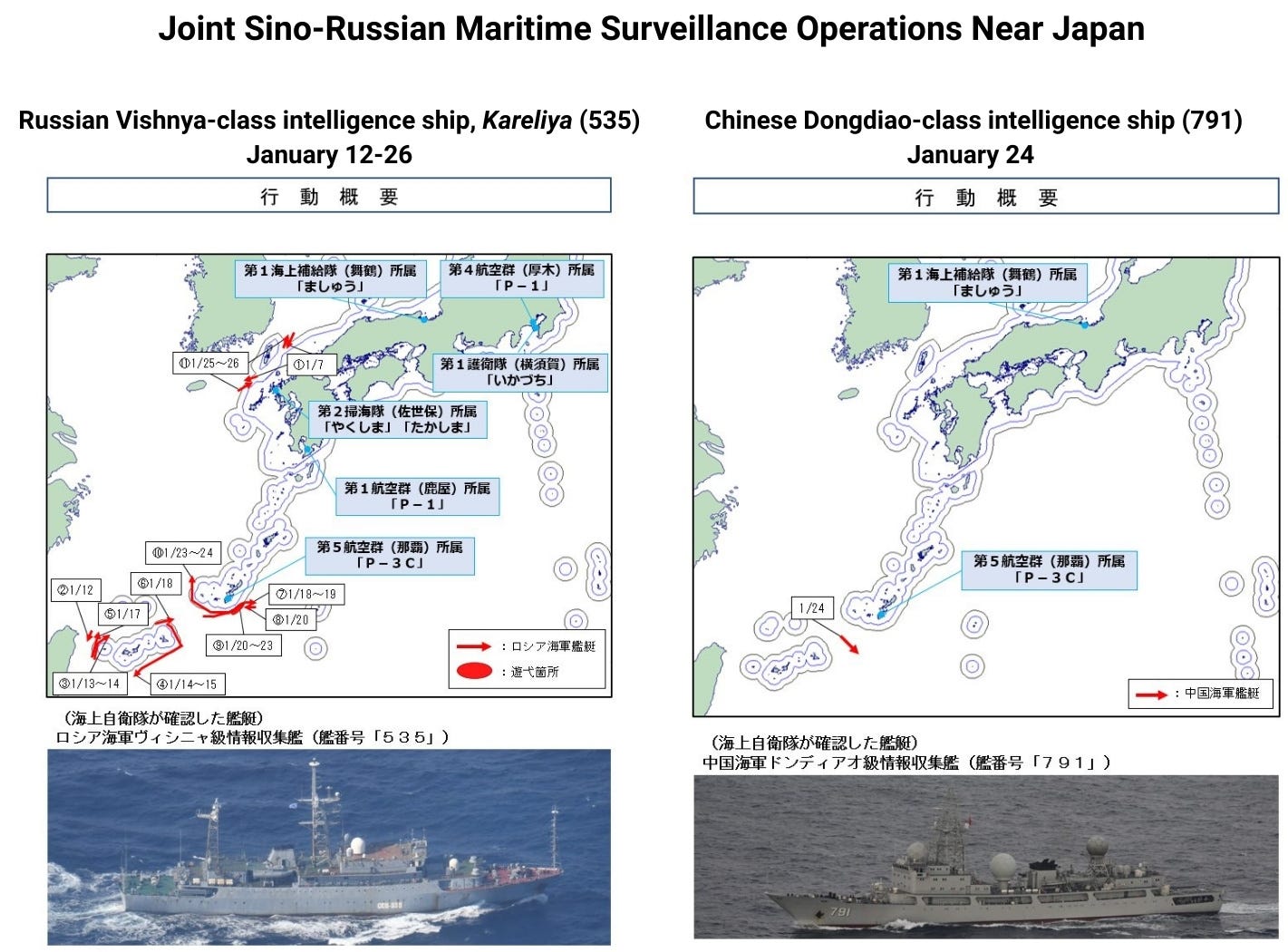
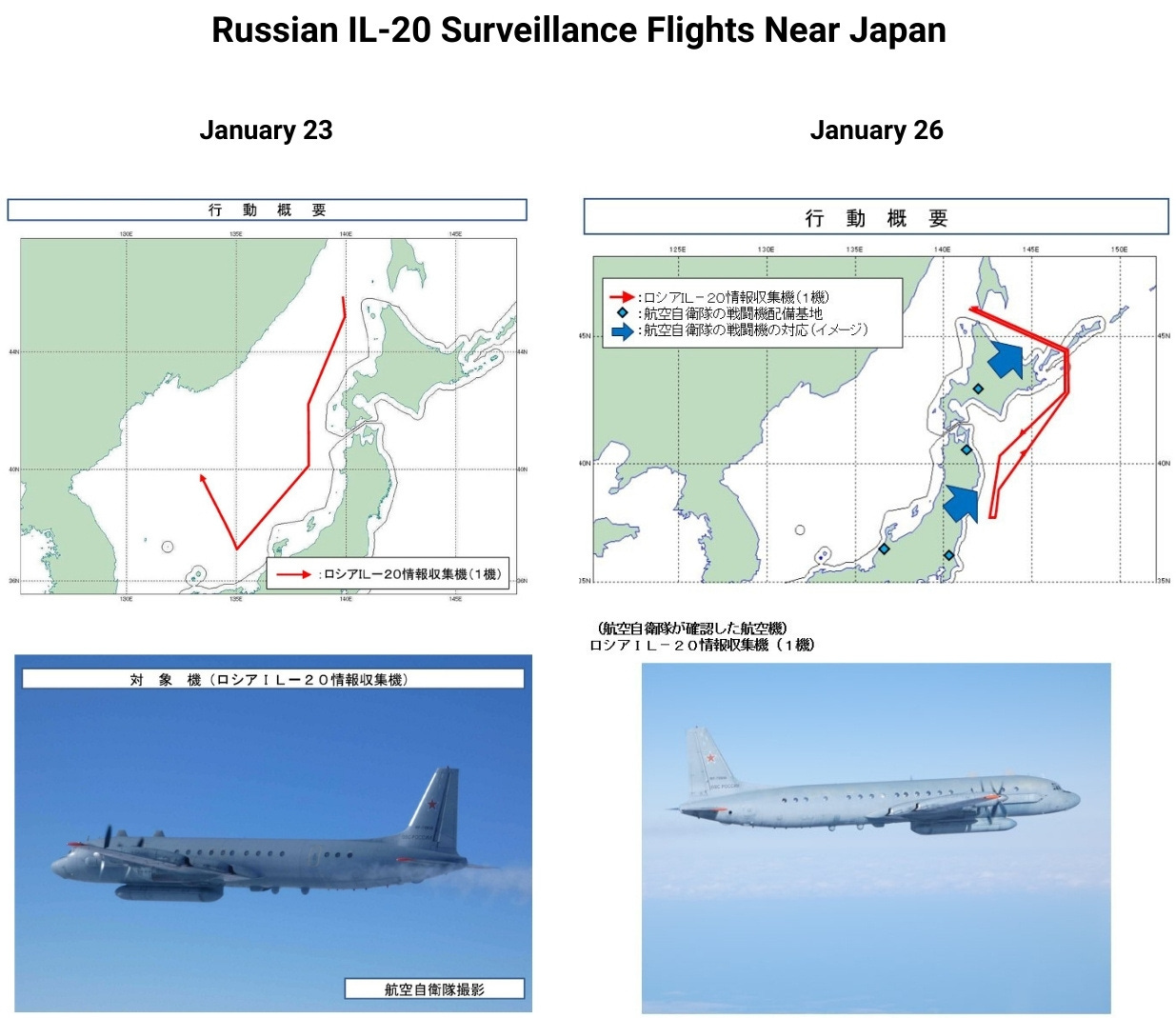
On January 26, the Russian Vishnya-class intelligence ship, Kareliya, concluded a two-week mission conducting maritime surveillance of Japanese territory. According to Japanese Defense Minister Shinjiro Koizumi, the operation was supplemented by additional Russian IL-20 surveillance aircraft on January 23 and 26, and overlapped with the deployment of a Chinese Dongdiao-class intelligence ship.
Takeaways:
The overlapping surveillance missions are the latest instance of joint Chinese and Russian military pressure on Japan, which has intensified significantly since tensions escalated between Beijing and the new Japanese government of Prime Minister Sanae Takaichi in November. Russia and China previously conducted joint bomber patrols around Japan on December 9, 2025.
Russia has its own motives for increasing military pressure on Japan as well. Russia has viewed intensifying Japanese rearmament and security cooperation with the US as a potential threat to its own interests in the Indo-Pacific. Russia joined China in protesting the deployment of US Typhon land-based cruise missiles to Japan in the summer of 2025. On January 20, Russian Foreign Minister Sergei Lavrov alleged that the US had yet to follow through on plans to withdraw the systems from the country. The air and sea surveillance missions may have therefore been carried out to assess whether the missiles were still in Japan.
4. ARRESTS AND DEATH TOLL FROM IRANIAN PROTEST CRACKDOWN CONTINUES TO CLIMB
January 31 marked 35 days since the start of mass anti-government protests in Iran. According to Human Rights Activists in Iran (HRAI), the number of individuals killed in the demonstrations reached at least 6,713 deaths. Another 17,091 deaths are being investigated, suggesting the total number of dead could exceed 20,000. 6,305 of those killed were protestors. An additional 11,021 civilians are reported injured. The government has arrested a total of 49,070 protesters, and issued 11,028 judicial summonses.2
Estimates from other media outlets such as Iran International, Time Magazine, and The Guardian claim the death toll could be much higher, possibly exceeding 30,000.
Takeaways:
The scope of the deadly government crackdown is becoming more clear as internet connectivity slowly returns to Iran. It will take weeks to assess the total numbers of dead.
The most intense killing is now widely believed to have taken place between January 8 and 10 when Iranian police and paramilitary forces led by units of the Islamic Revolutionary Guard Corps (IRGC) opened fire into large crowds of thousands of protestors.
Iranian security forces open fire on protestors from the roof of Police Station 15 in the city of Gohardasht on January 8. Source: Vahid Online (@vahidonline) on Telegram
As noted in previous Significant Activity Reports, the government has acknowledged that thousands of people were killed in the protests but has largely tried to deflect blame by suggesting the deaths were caused by armed “terrorist cells from the Mossad and CIA,” who attacked civilians and security forces alike to spark regime change. The Iranian government has tried to shape this narrative by either coercing families of victims to either remain quiet or to sign documents accepting government accounts of their loved one’s death.
-
There is also extensive reporting from multiple independent Iranian media outlets suggesting that Iranian security forces have similarly threatened, attacked, and in some cases arrested doctors for treating protestors and documenting the injuries they had sustained. On January 29, Director General of the World Health Organization Tedros Adhanom Ghebreyesus, claimed knowledge of at least five doctors arrested while treating injured protestors, and other instances of doctors assaulted while performing treatment. A January 28 open letter by the World Medical Association alleged that Iranian authorities have demanded doctors report any patients they have treated for gunshot injuries, suggesting the arrests may have been driven by a refusal to comply with official demands to identify protestors.
5. IRAN ENGAGES IN FLURRY OF DIPLOMACY AHEAD OF POSSIBLE US STRIKES AND PREPARES FOR POSSIBLE WAR
Iranian Foreign Minister Visits Turkey, while Security Council Secretary Visits Moscow
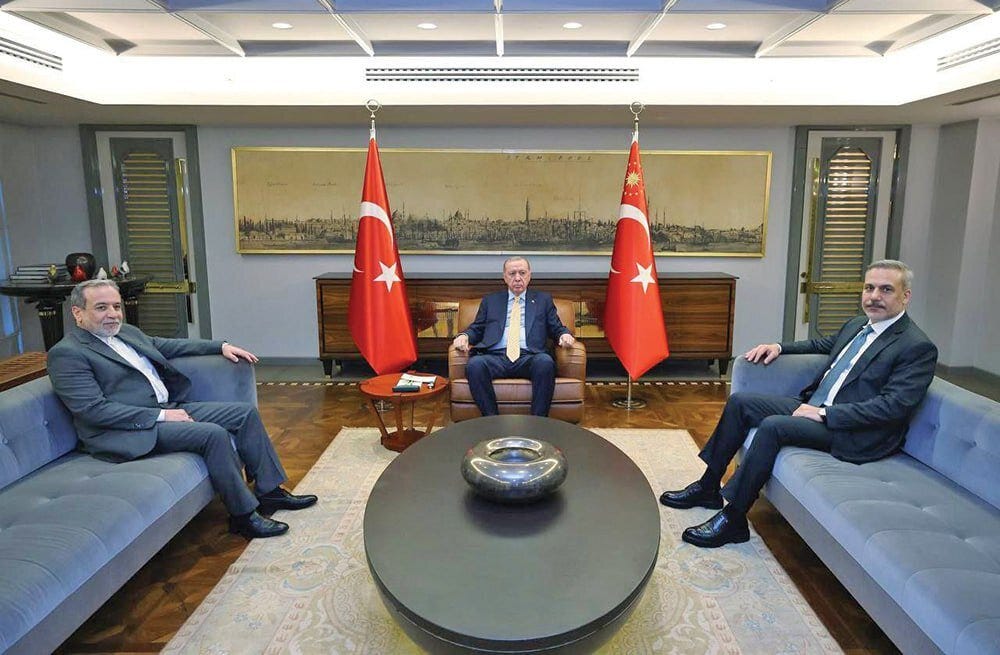
On January 30, Iranian Foreign Minister, Abbas Araghchi, met with Turkish President Recep Erdogan in Ankara. Araghchi suggested that Iran was open to diplomacy with the US but will not surrender its nuclear or ballistic missile programs.
Iranian Security Council Secretary Visits Moscow
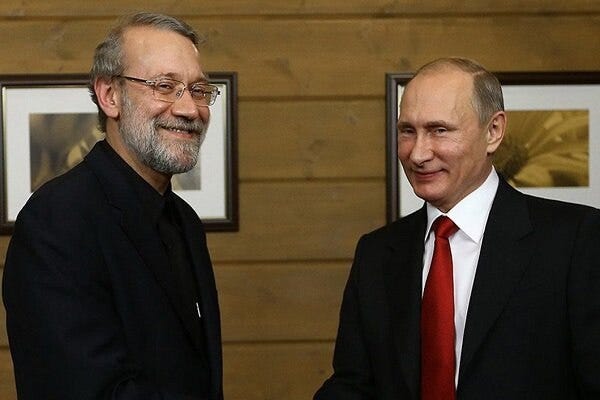
On January 30, Iranian Supreme National Security Council Secretary Ali Larijani met with Russian President Vladimir Putin in Moscow. Describing the visit Iran’s Ambassador to Russia said, "The main focus of the talks was the expansion of bilateral relations, especially economic relations between the two countries, and at the same time, the two sides consulted on important regional and international issues."
Qatari Prime Minister Visits Tehran
On January 31, Qatar's Prime Minister and Minister of Foreign Affairs, Sheikh Mohammed bin Abdulrahman bin Jassim Al Thani, visited Tehran where he met with Iranian Supreme National Security Council Secretary Ali Larijani. The leaders discussed efforts to de-escalate tensions in the region.
Iranian Army Reaffirms its Unity with the IRGC
Iran’s conventional army (the Artesh) issued a statement on January 30 affirming its support for the Islamic Revolutionary Guard Corps (IRGC) after the group was labeled a terrorist organization by the European Union.
Takeaways:
Iran's diplomatic outreach to Turkey, a key U.S. regional ally, appears to be an effort to amplify fears that a US-Iran military conflict could spiral out of control into a broader regional war. Iranian messaging emphasizes the risk that resumed conflict could trigger new waves of migration that could threaten Turkish domestic stability and security. Turkey already hosts the world’s largest population of registered refugees, which poses significant ongoing challenges for the country. Fears of a new wave of migration have been heightened as Iranians have already been streaming into Turkey since the start of the government crackdown in early January. The numbers of Iranians seeking refuge could dramatically jump in the event of war, as the 12-Day War in June 2025 caused thousands of Iranians to flee to nearby countries.
-War, migration, and regime change in Iran could also amplify Turkey’s tensions with ethnic Kurdish populations in the border region shared by Turkey and Iran. Iran will utilize pressure on Turkey to pit its interests against those of the US to deter American military strikes by complicating regional coordination and amplifying tensions within the US-Turkish alliance.
Russia is unlikely to provide any direct military support to Iran despite the comprehensive strategic partnership treaty signed between the two countries in January 2025, and an estimated $2.7B worth of missiles Tehran has provided Russia for its war in Ukraine. During the 12-Day War in June 2025, President Putin denied that the strategic partnership placed any obligations on Russia to provide security assistance to Iran.
-
Security Council Secretary Larijani was likely in Moscow nonetheless to appeal to the Kremlin for what support it could provide, including intelligence on US military plans, as well as to relay messages to the US and Israel, which have been routed through Russian intermediaries in recent weeks.
While Iran might be pressured into additional restrictions on its nuclear program, it won’t agree to completely disassembling its existing nuclear infrastructure. Iran’s ballistic missile program is an even greater strategic priority than its nuclear program that it will not surrender under any circumstances. Iran’s arsenal of long-range missiles is viewed as a core component of its national defense that helps deter conflict by holding US and Israeli interests at risk. The importance of this arsenal has increased as Iran’s network of proxy forces has faced a series of strategic setbacks inflicted by the US and Israel in recent years.
While ostensibly framed as a response to the European Union's decision to designate the IRGC as a global terrorist organization on January 29, the Iranian army's statement of support appears designed to foreclose a key pathway to regime change: a split between the conventional national military and the ideologically aligned military forces defending the theocratic government. The underlying message seems aimed at complicating any assumptions among US policymakers that the Artesh—traditionally composed of poorly trained conscripts from a broad swath of Iranian society and seen as less ideologically committed to the Iranian regime than IRGC members—might be shocked into turning against the IRGC in the aftermath of the recent protest crackdown.
6. NORTH KOREA TESTS NEW LARGE CALIBER ROCKET SYSTEM
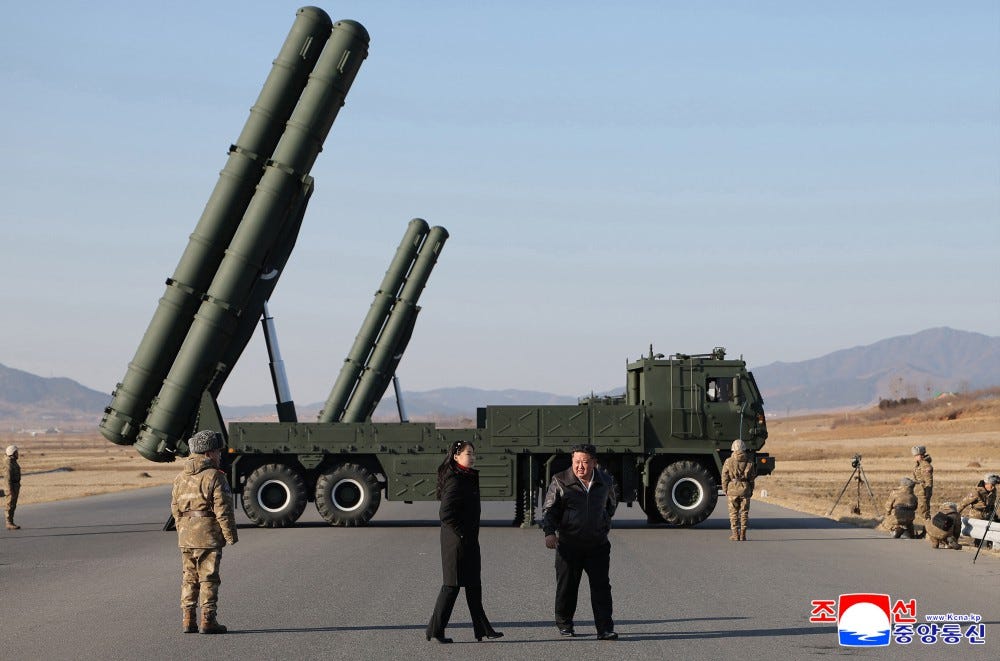
On January 27, North Korea conducted a test launch for a new 600mm rocket system. The launch was observed by Supreme Leader Kim Jong-un and his daughter. The North Korean Missile Administration claimed the rocket system is maneuverable and resistant to electronic interference.
“The self-steered precisely guided flight system, which can neglect any outside intervention, is a major feature that demonstrates the superiority of this weapon system.”
Takeaways:
North Korea regularly conducts weapons tests as a response to actions by the US and South Korea. This week’s test came on the heels of a visit to Seoul by US Under Secretary of Defense for Policy Elbridge Colby. However, the test may have also been triggered as a response to mid-January reports that the South Korean military had officially put into service the Hyunmoo-5, a short-range ballistic missile system, with a massive 8-ton warhead capable of destroying targets deep underground.
The concept of bombing to deplete the “morale reserves” of an enemies civilians was popularized by Italian military strategist Giulio Douhet after World War I. The strategy, practiced at a grand scale by the US and UK against Nazi Germany, delivered mixed results and raised enduring questions about the limits of airpower.
Arrest totals as of January 30.
Comprehensive roundup with solid sourcing throughout. The Starlink piece is particularly interesting, that movement-based deactivation SpaceX implemented feels like a temporary patch at best. The Iran section is chilling, those casualty numbers combined with the army-IRGC unity statement suggest the regime is digging in rather than collapsing despite massive internal pressure. Russia's rate of advance being slower than theSomme is a stat that deserves more attention.