



This week’s analysis highlights some of the most significant geopolitical developments involving America’s adversaries—China, Russia, Iran, and North Korea—between May 16, 2026 and May 23, 2026.
Summary:
Update on the war with Iran: nationwide internet blackout continued; Iranian proxies attacked the UAE’s Barakah Nuclear Power Plant; Iran announced expansive new boundaries for its control over the Strait of Hormuz; Iranian leaders gave multiple indications that they will not compromise on key issues in negotiations with the US; the IRGC issued new warnings that it will launch even more widespread attacks in the event of renewed hostilities with the US.
Russia conducted major military exercises involving its strategic forces which featured the deployment of nuclear weapons on Belarusian territory.
China hosted Russian President Vladimir Putin for a state visit from May 19-20.
A delegation of North Korean officials toured a drone factory in Russia’s far east as part of growing military and economic ties between the two countries.
1. IRAN WAR UPDATE
Internet Blackout Exceeds 12 Weeks
According to the internet connectivity monitoring organization Netblocks, May 16 marked 85 days of a near-total internet blackout in Iran.
Deputy head of the Iranian parliament’s cultural committee, Ali Yazdikhah, asserted this week that the internet shutdown would continue indefinitely, due to ongoing national security threats.
Suspected Iranian Drone Attacks Nuclear Power Plant in the UAE
On May 17, the UAE reported a drone strike on the Barakah Nuclear Power Plant complex in Abu Dhabi. According to senior UAE official Anwar Gargash, the drone, which entered the country from Iraq, is believed to have been launched by an Iranian proxy group.
The Iranian Ministry of Foreign Affairs spokesperson Esmaeil Baghaei rebuffed the assertion, suggesting the attack was a false-flag operation conducted by Israel, and complained of blatant double standards regarding attacks on nuclear facilities.
“The hypocrisy is obvious. Open attacks by the United States and the Israeli regime on Iran’s secured nuclear facilities do not provoke condemnation, but rather excuses and justifications. Yet when a supposed false-flag operation takes place—one whose authorship even the UAE has refused to officially attribute to Iran—those same voices suddenly invoke the solemn language of ‘international law’ and ‘regional security.’”
New Government Organization Announces Expansive Area of Control Over Hormuz Waterway
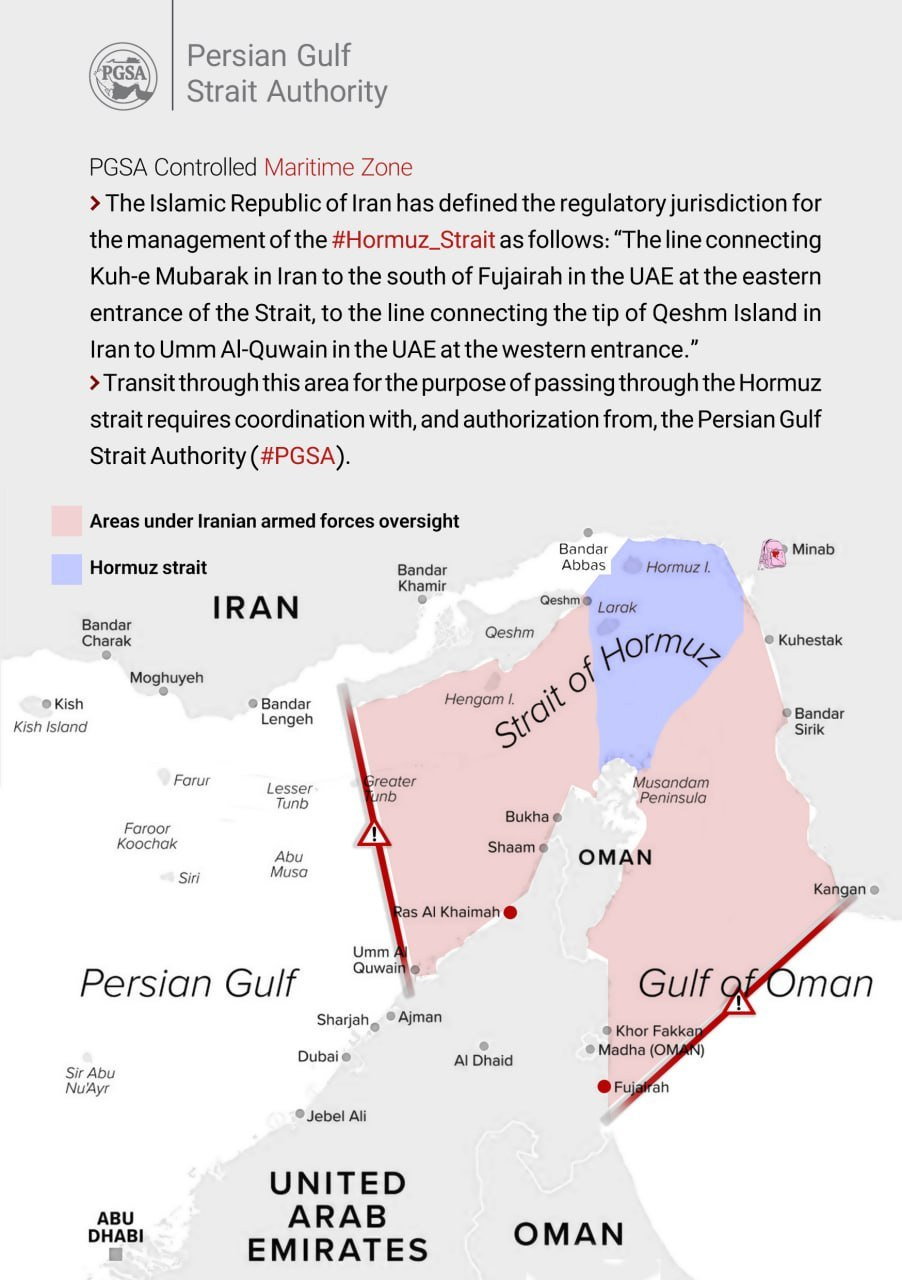
On May 20, a new Iranian government organization, the “Persian Gulf Strait Authority,” dedicated to controlling and extracting fees from maritime traffic through the Strait of Hormuz, issued new definitions for the boundaries of the waterway under the control of the Iranian armed forces.
Top Iranian Leaders Rule Out Compromise with the US
A May 21 report by Reuters states that Supreme Leader Mojtaba Khamenei has ruled out any deal with the US to remove Iran’s stockpile of highly enriched uranium from the country.
In talks with Pakistan’s Army Chief Asim Munir in Tehran on May 22, Iranian Parliamentary speaker and chief negotiator, Mohammad Baqer Ghalibaf, announced that Iran would not compromise with the US on any of its core national interests.
The IRGC Warns New War Will be Transnational
A new statement issued on May 20 by Iran’s Islamic Revolutionary Guard Corps (IRGC) warned that it will expand the war outside the region in the event of a resumption of hostilities.
“The American-Zionist enemy, who has not learned from the repeated major and strategic defeats by the Islamic Revolution and has once again opened its mouth to threats, should know that although they attacked us with the full capabilities of two armies, which are the most expensive armies in the world, we have not yet deployed all the capacities of the Islamic Revolution against them.
“But now, if the aggression against Iran is repeated, the regional war that was promised will this time extend beyond the region, and our crushing blows in places you do not expect will bring you to utter ruin.
“We are men of war, and you will see our power on the battlefield, not in empty statements and social media pages.“
Takeaways:
On Iran’s Continued Internet Shutdown: Iran’s internet shutdown continues to wreak havoc on the Iranian economy with as much as 80% of online businesses in the country suffering sales declines of 50% or more according to the head of Iran’s Electronic Commerce Association, Nima Ghazi.
-
The deliberate self-harm inflicted by the continued internet shutdown, risking as many as 10 million jobs in an already deeply damaged economy, is a telling sign that the Iranian regime remains deeply insecure and is not yet convinced that it has emerged from the war victorious.
On Nuclear Power Plant Attacks: The attack on Barakah by Iranian proxies may have been a means of signaling that Iran is willing to launch dramatic new attacks against its Arab neighbors in the event of resumption of war. Tehran may even assess that such attacks are justified and proportional responses to strikes on its own nuclear facilities. However, it must be noted that attacks on nuclear power plants are qualitatively different and substantially more risky targets than the Iranian enrichment and research facilities that were attacked by the US and Israel in previous rounds of fighting. Iran’s single nuclear power plant at Bushehr has notably been spared by US and Israeli strikes. This is because, while highly enriched uranium is considerably more radioactive than naturally occurring uranium, the radiological hazards from any release of the material remain relatively localized. However, the risk increases dramatically once enriched uranium is converted into fuel rods and used to sustain nuclear fission in a reactor.
-
An imperfect but nevertheless constructive model for conceptualizing the difference in danger posed by attacks on an enrichment facility versus a nuclear power plant involves comparisons between accidents at the Rocky Flats Plant in Colorado, and the Chornobyl and Fukushima nuclear power plants in Ukraine, and Japan respectively. Rocky Flats, a Cold War facility that produced plutonium "pits" for nuclear warheads, suffered hundreds of fires during its existence, including a dramatic six-hour long fire in 1969 that engulfed a storage area containing over 1,400 kg of plutonium.1 That fire, and the 41,000 gallons of water required to extinguish it, spread radioactive material into the surrounding air, soil, and water table. Yet despite occurring within the Denver metropolitan area, the accident did not produce a humanitarian catastrophe. The site has since been largely converted into a popular, publicly accessible wildlife refuge. Accidents at Chornobyl and Fukushima by contrast, resulted in major disasters that required the implementation of large government-mandated exclusion zones.-
This does not suggest that strikes on Iran’s nuclear sites are without risk or should be taken lightly. Attacks on centrifuges and stockpiles of nuclear materials do carry non-negligible risks of localized radioactive fallout, though in Iran these risks are likely mitigated by the fact that such sites are buried deep underground. Nevertheless such actions are far less provocative and dangerous than the recent attack at Barakah, and Russia’s own pattern of attacks on the Chornobyl site and the Zaporizhzhia Nuclear Power Plant in Ukraine.On Iran’s Negotiating Position: It is difficult to assess whether Iran's public declarations of unwillingness to compromise, combined with its tightening grip on the Strait of Hormuz, reflect a negotiating tactic or genuinely irresolvable intransigence. This ambiguity is compounded by conflicting signals from regime officials, including reports refuting the claim that Supreme Leader Khamenei ordered the preservation of all nuclear materials, as well as uncertainty over who holds the authority to make final decisions given the Supreme Leader's prolonged public absence.
-
While the US and Iran have both claimed substantial progress in formulating an “Islamabad Declaration” to end hostilities and pave the way for negotiations on broader issues such as Iran’s nuclear stockpile, the two sides still appear set on achieving fundamentally different outcomes from the war. This dynamic, combined with mixed signals from Iranian officials and continued regional threats by Iranian proxies, raise the likelihood of a return to open conflict. Sunday, May 24 may be a decisive day which could see either a provisional agreement reached or a resumption of military operations.
On Threats to Expand War: According to Iranian independent media outlet IranWire, top Iranian clerics echoed the IRGC’s threats to expand Iranian retaliation beyond the Middle East during Friday prayers on May 22. The increasingly aggressive rhetoric may indicate that the Iranian regime believes that the US is moving toward resuming hostilities and represents an attempt to bolster waning deterrence.
-
It’s not clear to what extent Iran has either the capabilities or strategic interest in expanding the war beyond the current theater of operations. Iranian attacks on its non-Arab neighbors such as Turkey and Azerbaijan in March—likely the result of command and control issues stemming from US and Israeli decapitating strikes—triggered intense backlash from Ankara and Baku. The attacks notably prompted NATO to increase its force posture in southern Turkey. Recent reporting has suggested that Iran’s attacks on members of the Gulf Cooperation Council resulted in the UAE and Saudi Arabia increasing their military involvement in the US-Israeli war rather than backing down. Months of violent incidents by Iranian proxies in Europe have similarly hardened the position of many European countries against the Iranian regime and Islamic Revolutionary Guard Corps. These circumstances taken together suggest Iran could face significant blowback if it follows through on its threats to take a future war global.
2. RUSSIA CONDUCTS MAJOR NUCLEAR EXERCISES
The Russian military conducted major military exercises testing the readiness of its strategic nuclear forces between May 19-21. According to the Russian Ministry of Defense, the exercises involved, “64,000 troops, more than 7,800 units of military hardware, including over 200 missile launchers, more than 140 aircraft, 73 surface ships, and 13 submarines, including 8 strategic missile submarines,” spanning multiple military commands.
A key feature of the exercises was joint training with the Belarusian military on the territory of Belarus involving drills on pre-emptive strikes involving non-strategic nuclear weapons. Live Russian nuclear-armed Iskander-M missiles were deployed to field depots in Belarus as part of the training.
The Belarusian military training alongside the Russian military handling an alleged nuclear-armed Iskander-M ballistic missile. Source: Russian Ministry of Defense.
Takeaways:
On the Timing and Purpose of the Exercises: As prominent analyst of Russia’s strategic forces, Pavel Podvig, notes, the exercises were unusual in both their timing (conducted in the spring rather than in the fall) as well as in their declared objective of preparing a nuclear response “under conditions of a threat of aggression,” rather than in direct retaliation for an attack. The timing may be an aberration, however, as Podvig points out that airspace closures for the exercises were initially planned to coincide with Russia’s Victory Day celebrations between May 9-11. This suggests the exercises may have originally been planned as a show of force to compensate for Russia’s downgraded Victory Parades, but suffered unanticipated delays. This interpretation is further supported by the fact that Russia did conduct a successful test of its Sarmat super-heavy intercontinental ballistic missile (ICBM) on May 12. The test of Russia’s much-vaunted, next generation ICBM may have been conceived as a grand finale for the exercises.
On Belarusian Involvement: Russia has used Belarus to stage its initial invasion of Ukraine, conduct strikes on Ukrainian territory, and threaten the West. Belarusian President Alexander Lukashenko has for years resisted Russian pressure to enter the war and may be coming under additional pressure to do so to open a new front to relieve pressure on beleaguered Russian forces in eastern Ukraine. Lukashenko has good reason to want to avoid becoming engaged in the war as the Belarusian military is far less well equipped and experienced than that of Ukraine. Such a war would also likely become extremely unpopular in the country, and could result in the weakening and disillusionment of its military, conditions which could jeopardize the leader’s grip on power. Statements by Lukashenko to Belarusian state media on May 21 downplayed the risk of conflict with Ukraine and suggest he continues to seek to avoid direct involvement in the war.
3. CHINA HOSTS PUTIN FOR STATE VISIT
Russian President Vladimir Putin conducted a state visit to China between May 19-20. The visit coincided with the 25th anniversary of the signing of the Treaty of Good-Neighborliness and Friendly Cooperation between the two countries. The visit came less than a week after a state visit by US President Donald Trump to Beijing.
Russian President Vladimir Putin’s Arrival in the Great Hall of the People in Beijing. Source: Kremlin Novosti on Telegram
Presidents Putin and Xi held talks spanning a broad range of issues central to their strategic partnership. Russian and Chinese officials signed around 40 documents during the visit, including agreements to expand trade, academic exchanges and joint research, as well as policy frameworks for expanding strategic cooperation.
Takeaways:
On The Growing Number of High Profile Diplomatic Gatherings in China: Chinese state media has used Putin’s visit—coming on the heels of President Trump's state visit a week earlier—to portray Xi Jinping as a paramount figure in global diplomacy, one sought out by the world's most powerful leaders to mediate disputes and counterbalance their rivals. To some extent, this is a reasonable assessment as global leaders have made their way to China in droves to seek more stable and economically advantageous ties amid increasing global economic uncertainty caused by expanding conflicts and protectionism. The US and Russia state visits follow previous major trips by leaders of Canada, the European Union, India, and the United Kingdom among others.
-
However, China has not committed itself to take any major actions to resolve major sources of global instability, including some it has helped foster. Despite these overtures, China is not poised to become more deeply involved in mediating the wars in either Ukraine or the Middle East or in pushing for a denuclearized Korean peninsula.2 It is unlikely to pressure Iran into reopening the Strait of Hormuz unless its own fuel supplies are seriously threatened, and may provide some dual-use materials to the regime that can be used to help rebuild its military capabilities. It will continue to provide some material and—as a May 19 report by Reuters indicated—training assistance to the Russian military, in order to bolster and maintain close relations with the Putin regime. In all cases such support is nevertheless likely to remain limited in scope and conducted through a web of region-level governments and private sector actors to avoid the appearance of direct involvement from Beijing.
On Agreements Reached: Russian state media has drawn particular attention to the signing of a new policy document, the “Joint Declaration of the Russian Federation and the People’s Republic of China on the Establishment of a Multipolar World and a New Type of International Relations,” as a noteworthy achievement during the trip and evidence that China is onboard with Russia’s push to undo the US-led international system. However, this is not a new or particularly significant development. Russia and China have been signing documents of this type for decades. 29 years ago to the day, on May 20, 1997, China and Russia—represented by current Foreign Minister Sergey Lavrov—issued a joint UN declaration announcing the “establishment of a new international system” and “multipolar world”.
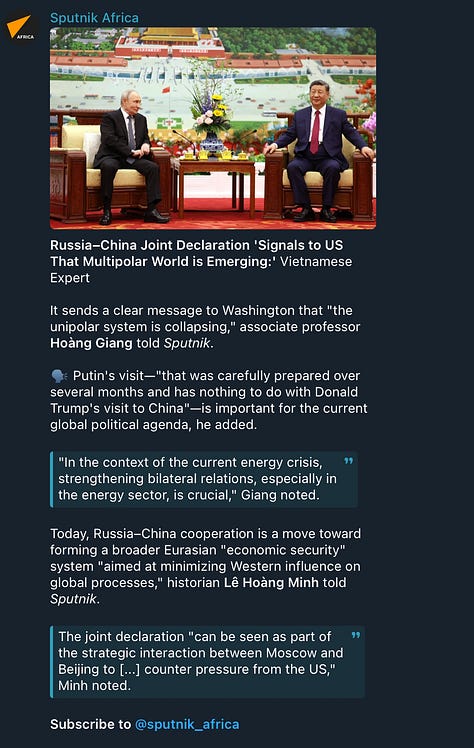
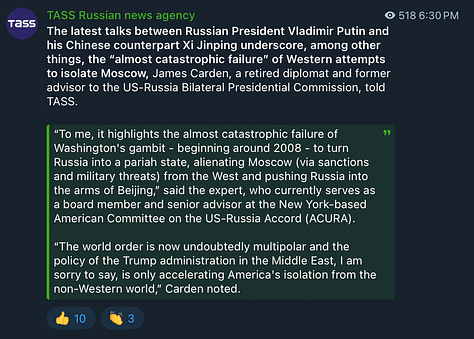
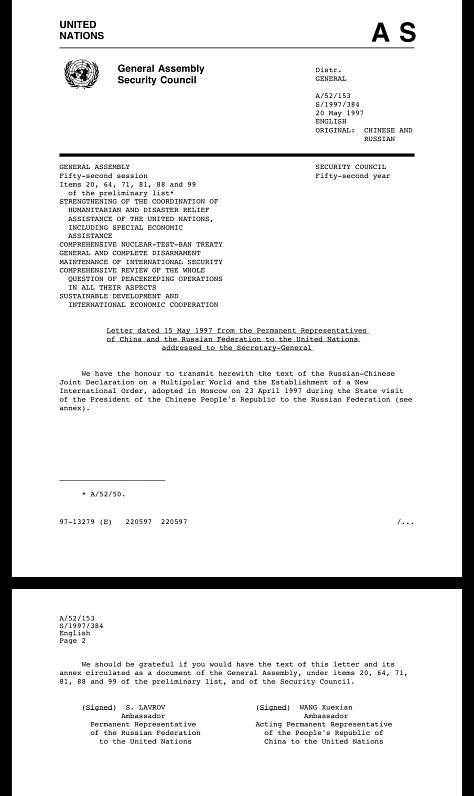
Russia's Sputnik advertises the new joint declaration on the development of a multipolar world to be a groundbreaking development, however closer consideration of historic Russian and Chinese agreements suggests it follows decades of similar, largely hollow declarations. Source: Sputnik Africa, TASS, & the United Nations Digital Library On Agreements Not Reached: Arguably, the most consequential agreement for the trip was the one that wasn’t signed—an agreement to build the Power of Siberia 2 pipeline. It is quite remarkable that China has not yet agreed to green light the new project despite years of negotiations with Russia, massive discounts on Russian natural gas, and growing demand for alternative energy sources given the current crisis with the Strait of Hormuz.


4. NORTH KOREAN OFFICIALS IN RUSSIA INSPECTING DRONE PRODUCTION FACILITY
This week, new reporting by NK News announced that a delegation of officials from North Korea’s South Pyongan province toured Russia’s Center for Drone Competencies in the city of Belogorsk in the far eastern region of Amur on May 15. According to the report:
“The delegation reportedly observed ‘drone operations’ and learned how to control and maintain UAVs, with special attention paid to ‘training specialists in the operation of unmanned systems and developing educational programs for young people.’”
Takeaways:
On Exchanges Between Russia and North Korea: The visit comes amid intensified people-to-people exchanges between the two countries in recent months, aimed at strengthening economic and military ties that have flourished since the signing of the Comprehensive Strategic Partnership Treaty in 2024. Illustrative of the growing ties is an announcement by Pyongyang that a new provincial level delegation from South Hwanghae would travel to Russia on the same day that officials from South Pyongan province returned home.
On the Prospect of Russian and North Korean Drone Cooperation: As previously discussed in the Weekly Significant Activity Report - May 2, 2026, Russia has ample incentive to export some of its drone hardware and know-how to North Korea as part of their expanding military cooperation. Russia has long sought North Korean workers to staff its drone production facilities to compensate for labor shortages, and may see significant strategic benefit from turning North Korea into an external producer of such weapons. Such an arrangement would mirror benefits the Russian military previously derived from buying large amounts of North Korean artillery. Drone factories in North Korea would carry an added benefit of being less vulnerable to Ukrainian strikes, a consideration that has become more pressing as Russian drone manufacturers have come under increasing threat of Ukrainian drone and missile strikes in recent months. Ukrainian forces notably attacked and damaged the Atlant Aero drone factory in Taganrog on April 19.
-
Pyongyang has expressed keen interest in bolstering its indigenous production of drones in recent years. In September 2025 Kim Jong-un declared the development of AI-enabled drones to be a top strategic priority, a field in which Russia is a global leader. This week's visit by North Korean officials to the Center for Drone Competencies is likely one of several ongoing initiatives advancing that goal.
This briefing was compiled by Dan White. Dan is an independent foreign policy analyst based in the New York Metro Area. Dan is a former member of The Wilson Center and The Kennan Institute. Dan holds masters degrees from the Johns Hopkins University School of Advanced International Studies (SAIS), the Naval Postgraduate School, and the University of Washington. Dan is a former officer in the United States Army and a veteran of the War in Afghanistan.
For more information, corrections, or comments, please contact dan@opforjournal.com.
Iran has a total stockpile of approximately 440kg of 60% enriched uranium by contrast.