



This week’s analysis highlights some of the most significant geopolitical developments involving America’s adversaries—China, Russia, Iran, and North Korea—between August 15, 2026 and August 22, 2026.
Executive Summary:
US War with Iran - Significant Activity Related to the US-Iran War
Threats of “Economic D-Day” by US President Trump provoked divided responses from Iranian leaders in a sign of a renewed public rift over government policy between pragmatists and hardliners.
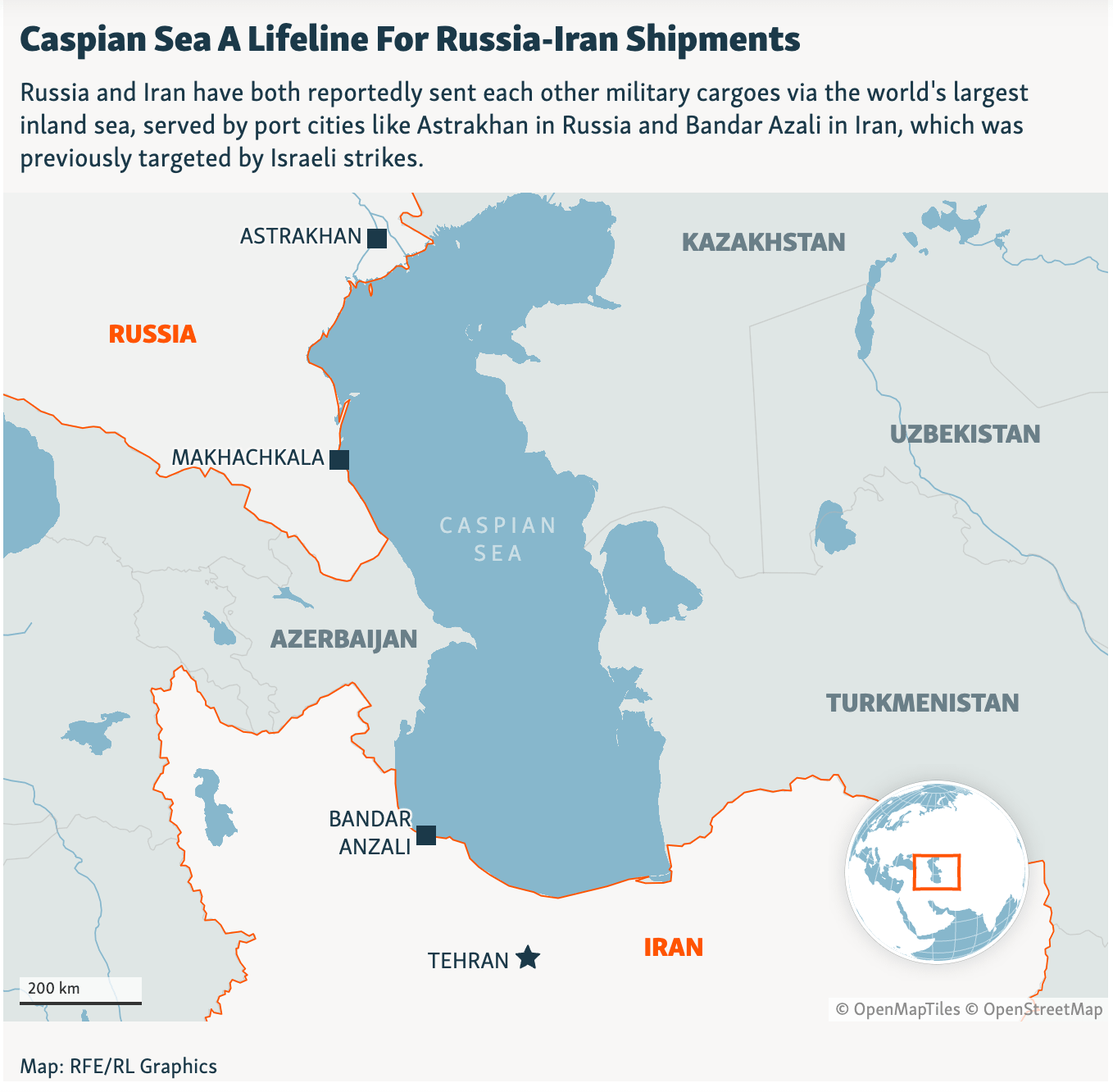
European officials have assessed that Russia is shipping explosives, weapons, and drone components to Iran through the Caspian Sea to help it prepare for renewed fighting with the US.
The Eastern Front - Significant Activity Related to the War in Ukraine and Russian threats to NATO
Multiple suspected Russian drones and one missile landed in Romania and Moldova this week, the latest incidents in an increasingly brazen hybrid warfare campaign directed at both countries.
Ukrainian intelligence has assessed that Russia has received at least 50 ballistic missiles from North Korea, including supplies of new Hwasong-11C models.
Western Pacific Flashpoints - Significant Activity in the Western Pacific and Taiwan
China approved the construction of a new “Marine Ecological and Environmental Field Observation and Research Station” near Scarborough Shoal, in a new measure to wrest the territory from the Philippines.
North Korea responded to dramatic new overtures by US President Trump to resume official talks with a series of ambivalent press releases and missile launches.
US WAR WITH IRAN
Significant Activity Related to the US-Iran War
1. IRANIAN LEADERS DIVIDED OVER RESPONSE TO US “ECONOMIC D-DAY” THREAT
Iranian leaders provided mixed responses to President Donald Trump’s August 19, 2026, Truth Social announcement that the US would impose an “ECONOMIC D-DAY” against Iran with the “MOST CRUSHING ECONOMIC OPERATION EVER TAKEN AGAINST ANY COUNTRY!”
As expected, many Iranian leaders provided defiant responses to the new US threats, with Iranian Foreign Minister Abbas Araghchi claiming the new announcement was ultimately a distraction from the US’s own economic woes, including historic levels of debt.


However, key Iranian leaders voiced concern that a prolonged standoff could inflict lasting damage on the Iranian economy. In remarks to the Islamic Association of the Iranian Medical Society on August 21, 2026, Iranian President Masoud Pezeshkian called for ending the war with the US immediately, “while we are in a position of power and honor.” A day earlier, on August 20, 2026, Parliamentary Speaker Mohammad Bagher Ghalibaf warned that Iranian military power would not save it from collapse if “the people are hungry and we lack financial turnover, economic growth, and national production.”
Takeaways:
The divergent views by top Iranian political leaders reopened a rift between so-called pragmatists pushing for a speedy negotiated settlement to the war on terms favorable to Iran, versus an ascendant group of hawkish officials affiliated with the Islamic Revolutionary Guard Corps (IRGC) pursuing a more radical transformation of Iranian regional influence through unrestrained use of military power. IRGC media outlet, Fars News Agency, issued a public rebuke of Pezeshkian, claiming that the President’s suggestion for peace projected weakness that would encourage new aggression by the US and damage trust in government. Hardline officials similarly castigated Ghalibaf for weakness.
Pezeshkian and Ghalibaf have repeatedly encountered frustration in attempting to rein in what they perceive to be self-destructive actions by the IRGC, including indiscriminate attacks on neighboring countries and continued ceasefire violations. Both men have also reportedly sought to have Foreign Minister Abbas Araghchi removed from his post due to their belief that he was ceding civilian governance to the IRGC. Pezeshkian is believed to have become so exasperated by a perceived takeover of policymaking by the military as to have offered his resignation to Supreme Leader Mojtaba Khamenei in late May.Iran is no stranger to economic pressure. As many analysts have pointed out, Iran has decades of experience coping with US sanctions. However, Iran’s economic resilience is not limitless, and the country may be historically vulnerable to economic pressure. This year’s protest movement was largely motivated by widespread public dissatisfaction with worsening living standards triggered by a collapse of the value of the rial. While the Iranian regime ruthlessly suppressed the protests by shutting down the internet and killing thousands (or even tens of thousands) of demonstrators, conditions remain ripe for a new round of civil unrest.
According to estimates by Iranian officials, the war inflicted over $270B in damage to the Iranian economy, equivalent to about three-quarters of the country’s nominal GDP of $362B. Current US measures have stifled Iran’s ability to recover from that devastation, with the Governor of the Central Bank of Iran, Abdolnaser Hemmati, announcing on August 19, 2026, that sanctions and the ongoing US naval blockade have effectively reduced Iran’s oil exports to zero.Increased vulnerability does not, however, mean that US economic pressure will necessarily translate into either a quick reopening of the Strait of Hormuz or substantive behavioral change by the Iranian regime. As noted in Weekly Significant Activity Report - August 15, 2026, aggressive ideologues have been appointed to top positions in Iran’s military and security apparatus in apparent anticipation of a prolonged standoff with the US. These hardliners may assume that they can simply outlast the Trump administration given coming US midterm elections. However, in the event that pressure is prolonged and leads to a severe economic downturn, the increasingly hawkish regime is likely to double down on aggression and launch threatened offensive operations against neighboring countries to strike back at the US. We should therefore expect the current lull in combat to be a temporary interregnum that is mutually convenient for both the US and Iran, rather than a step toward permanently deescalating the war.
2. RUSSIA IS REPORTEDLY HELPING IRAN REARM
On August 17, 2026, NBC News reported that European officials have assessed that Russia is helping Iran prepare for renewed fighting with the US by shipping it TNT and other explosives, ammunition, and components for drones through the Caspian Sea.
Takeaways:
While Russia’s defense industry is working at a fever pitch to keep up with demand for the War in Ukraine, it is likely that Russia is willing and able to provide some equipment and raw materials to Iran. Russian leaders likely assess that a US quagmire in the Middle East is a win-win situation that boosts global demand for Russian oil and gas, distracts the US and divides NATO, and continues to drain Western stocks of precision-guided munitions and Patriot missile interceptors that could have ended up in Ukraine.
The trans-Caspian route has become a significant corridor for mutual military assistance between Russia and Iran since the start of the War in Ukraine in 2022. Iran is believed to have used untracked cargo ships to transfer hundreds of Shahed-type drones to Russia through the Caspian Sea in 2022 and 2023, providing the Kremlin its first stocks of the now ubiquitous weapon. Ukraine notably attacked an Iranian cargo ship it suspected of involvement in the Caspian arms trade on July 25, 2026.
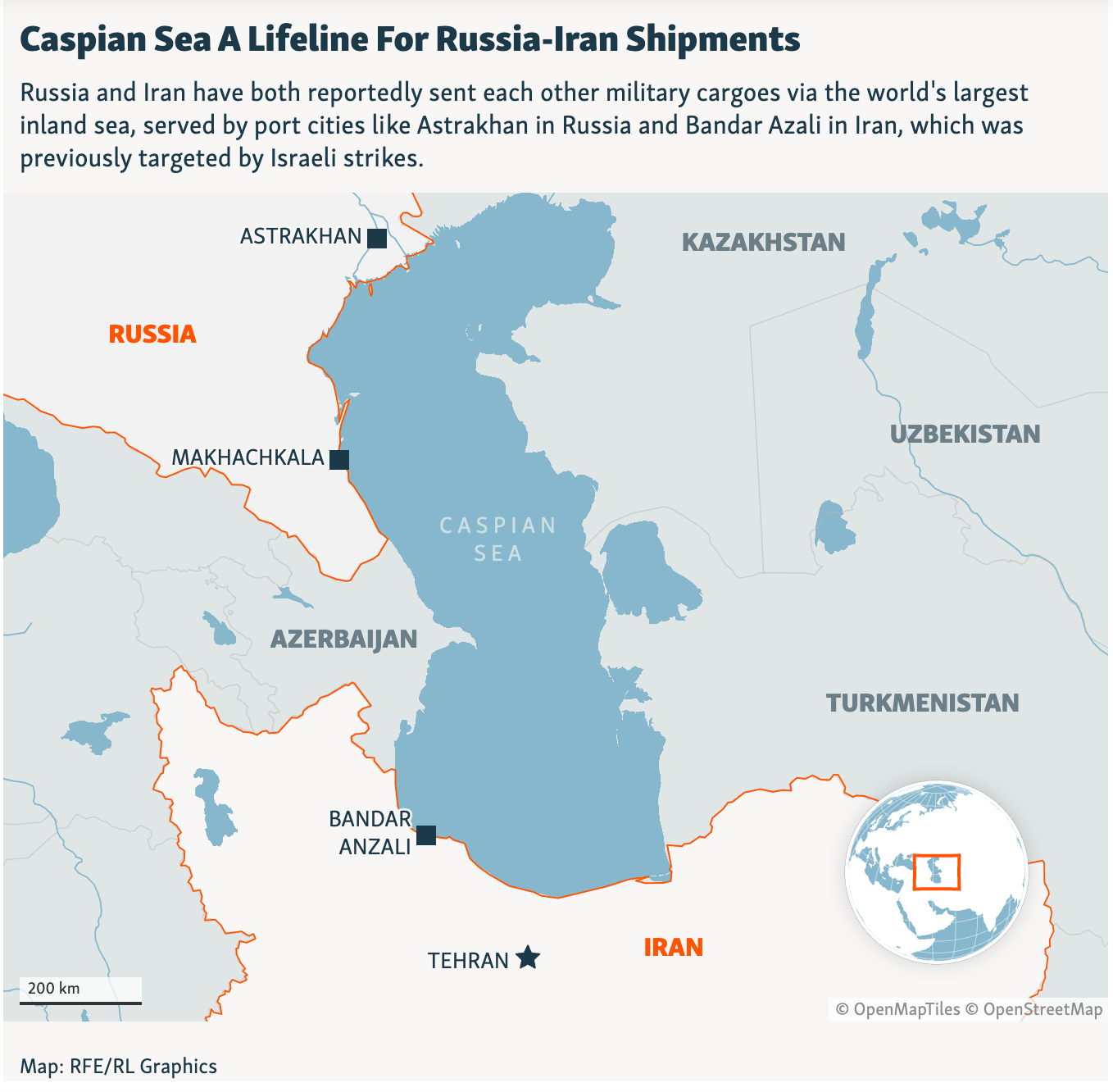
Overview of Russo-Iranian trading ports on the Caspian Sea. Source: Radio Free Europe/Radio Liberty
EASTERN FRONT
Significant Activity Related to the War in Ukraine and Russian threats to NATO
3. RUSSIAN DRONES AND MISSILES MENACE ROMANIA AND MOLDOVA
Suspected Russian Air and Sea Drones Violated Romanian Territory
On August 20, 2026, the Romanian Ministry of Defense announced that a Romanian F-16 destroyed an explosive-laden sea drone near the Neptun Deep gas exploration platform in the Black Sea. The incident followed earlier reports from the Romanian Ministry of Defense that an aerial drone had entered Romanian airspace from Ukraine and crash-landed in an uninhabited area near Tulcea County. Both incidents are under investigation. However, Romanian President Nicușor Dan has implied Russia was behind the recent drone incursions.
Romanian F-16 destroys sea drone near the Neptun Deep platform. Source: Romania Insider
Suspected Russian Missile Exploded in Moldova
On August 17, 2026, an unidentified aerial object crossed into Moldovan airspace from Ukraine and exploded in a corn field near the village of Talmaza, in Stefan Voda district. The Ukrainian Air Force identified the object as a Russian S8000 “Banderol” miniature cruise missile. Moldovan President Maia Sandu similarly attributed the incident to Russia, though she described the offending object as a drone.

Takeaways:
These latest incidents represent escalations in Russia’s grey-zone operations targeting Romania. Romania claims that as many as 23 drones of Russian origin have violated its airspace so far this year, a dramatic increase compared to 18 such incidents recorded between February 2022 and December 2025. The most notable of these incidents was on May 29, 2026, when a Russian Shahed drone struck a 10-story apartment building in Galati, Romania, and exploded, injuring two residents. A drone strike on Neptun Deep, Romania’s largest gas platform, could have been even more devastating.
Still, the seaborne incursion was likely a symbolic demonstration of the Kremlin’s capabilities to threaten European interests well into the future rather than a serious attempt to bring down Neptun Deep. The platform will make Romania the largest producer of European natural gas when it becomes operational in 2027, the same year the European Union (EU) plans to totally phase out imports of Russian gas. The incident is likely a Kremlin signal to European leaders that they should not get too comfortable assuming that they can so easily free themselves from Russian influence over their energy supplies, nor feel that such diversified supply would allow them greater leverage to pressure Russia in the future.The suspected Banderol explosion marks the first time a Russian missile has struck Moldovan territory. The incident appears to be a limited but nonetheless deliberate provocation by the Kremlin to probe responses to increasingly direct attacks on Moldovan territory. The missile explosion follows an August 14, 2026, investigative report by The New York Times which asserted that the Kremlin has made destabilizing Moldova a top priority in order to undermine its accession to the EU.
4. UKRAINIAN INTELLIGENCE: RUSSIA HAS RECEIVED NEW STOCKS OF NORTH KOREAN BALLISTIC MISSILES
Ukraine’s Main Directorate of Intelligence (HUR) reported this week that it has assessed that Russia has received about 50 ballistic missiles from North Korea in recent weeks. Russia’s stocks of North Korean missiles included new Hwasong-11C (KN-30) series models never before used in combat.
Takeaways:
Despite its own robust domestic production of long-range drones and missiles, Russia has several reasons to want to secure North Korean ballistic missiles and launchers:
Russia is trying to seize a window of opportunity to inflict as much damage on Ukraine’s critical infrastructure as possible while its inventory of anti-ballistic missile interceptors is depleted. Every missile counts in this endeavor.
While Russia is ramping up production of its own ballistic missiles (and some Ukrainian estimates suggest Russia is even exceeding its production targets for some systems), its capacity has definite limits. Missiles are far more expensive and difficult to manufacture than drones. Sophisticated Russian ballistic missiles such as the Iskander-M cost as much as $3M per unit. Given a growing state budget deficit and deteriorating economic conditions (which have drawn increased scrutiny from Russian officials), Russia will not be able to scale the production of missiles to the same degree that it has achieved with drones. Even with increased production, Russia is still unlikely to domestically produce sufficient quantities of missiles to keep up with demand for both winning the war in Ukraine and replenishing its stocks to deter NATO.
North Korean missiles will help Russia offset potential reliability issues with its Kh-47M2 “Kinzhal” air-launched ballistic missiles. Ukraine’s HUR has assessed that Russia paused production of Kinzhals in April 2026 to resolve significant problems with the missile’s accuracy.
According to NK News, the Hwasong 11C possesses the following history and characteristics:
Revealed alongside a shortened Hwasong-11A variant at the 2021 8th Party Congress parade, the Hwasong-11C (Hwasong-11Da, KN-30) is a lengthened Hwasong-11-family missile carried in pairs on a 10×10 heavy-duty TEL. First tested a few months later with a depressed trajectory incorporating irregular pull-up flight manoeuvres, it demonstrated a range of at least 600 km. State commentary suggested its warhead had been increased to 2,500 kg, likely to outperform South Korea’s Hyunmoo-4, and it could potentially also carry a smaller Hwasan-31 tactical nuclear warhead to threaten targets in Japan. In early 2024 a ‘Hwasongpho-11Da-4.5’ variant was tested with a claimed 4,500 kg warhead, though state media unusually paired this with a claim that the test was conducted at the type’s maximum range of only 500 km.
WESTERN PACIFIC FLASHPOINTS
Significant Activity in the Western Pacific and Taiwan
5. CHINA GREEN LIGHTS THE CONSTRUCTION OF AN ENVIRONMENTAL RESEARCH STATION NEAR SCARBOROUGH SHOAL
On August 18, 2026, the South China Sea Institute of Oceanology (SCSIO) of the Chinese Academy of Sciences announced that the Chinese government officially approved plans for the construction of a “Marine Ecological and Environmental Field Observation and Research Station” near Scarborough Shoal. The new research station will integrate into a network of similar stations in the disputed Paracel and Spratly Islands to “further improve the comprehensive island reef observation network in the South China Sea.”
Takeaways:
The move is the latest effort by China to use a combination of military and civilian measures to permanently wrest control over Scarborough Shoal from the Philippines. As noted in previous Weekly Significant Activity Reports, China’s determination to seize the Shoal appears to have grown in recent weeks in response to increasing assertiveness by the Philippines and its allies in the wake of the 10th anniversary of the 2016 UN Permanent Court of Arbitration ruling that denied Chinese claims to the territory.
The plan for an environmental station at Scarborough Shoal flows from a September 2025 move by Beijing to designate the Philippine territory a Chinese “nature reserve.” The designation and subsequent plan for installing a monitoring station have themselves been justified by damage inflicted on the Shoal and neighboring waters by destructive Chinese clam fishing practices.
As indicated in the official government announcement, the new station will integrate into a broader network of maritime infrastructure on other disputed territories across the South China Sea, equipped with dual-use sensors capable of supporting Chinese military operations.
6. NORTH KOREA RESPONDS TO NEW OVERTURES BY PRESIDENT TRUMP WITH MISSILES AND AMBIVALENT PRESS RELEASES
In a series of press statements issued between August 19 and August 20, Kim Yo Jong, the sister and top deputy to North Korean Supreme Leader Kim Jong Un, appeared to downplay suggestions of detente with the US. The flurry of messages came in response to the abrupt decision by President Donald Trump to scale back major joint military exercises between the US and South Korea.
The press statements were followed by North Korea’s launch of 10 short-range ballistic missiles into the Sea of Japan on August 20.
Takeaways:
While Pyongyang’s response was not overtly receptive to President Trump’s overtures, it does not appear to have outright rejected warming ties with the US either. As noted in Weekly Significant Activity Report - August 2, 2025, North Korea, through the person of Kim Yo Jong, has been signaling interest in renewed dialogue with the Trump administration since at least July 2025. North Korea, however, has made any sustained dialogue contingent on a change in US policy away from denuclearization and toward an official recognition of its status as a nuclear power.
The US is unlikely to make such a dramatic shift in its approach to nuclear nonproliferation as such a move would potentially undermine its ability to negotiate an end to the war with Iran, where denuclearization remains the central objective. The dramatic curtailing of joint US-South Korean military training may have been a gambit to restart dialogue by offering a different concession. However, North Korea for its part is not likely to rush back to talks with the US, as it has seen both its economy and global prestige grow due to increased cooperation with Russia and China.The week’s exchanges also provided new public insight into intelligence assessments of the current size of North Korea’s nuclear arsenal. President Trump announced that the North possessed 57 “very powerful” nuclear weapons. South Korean Defense Minister Ahn Gyu-back offered a higher estimate to the South Korean Parliament, suggesting the North had between 80 and 120 nuclear weapons.
This briefing was compiled by Dan White. Dan is an independent foreign policy analyst based in the New York Metro Area. Dan is a former member of The Wilson Center and The Kennan Institute. Dan holds masters degrees from the Johns Hopkins University School of Advanced International Studies (SAIS), the Naval Postgraduate School, and the University of Washington. Dan is a former officer in the United States Army and a veteran of the War in Afghanistan.
For more information, corrections, or comments, please contact djwhite155@gmail.com.
Always appreciate your geopolitical insights. Excellent coverage.
Oh, come on! What are you guys peddling today? It’s no secret that Russia said they were going to help Iran but, ‘the world knows’ both N. Korea & China have been aiding Russia. I worked in Intelligence but you do not have to work in intelligence to figure out that when China flys their Xi’ an H6 or their J-16’s fully loaded into Iran with two combat wingmen why would N. Korea or China waste their time diverting equipment through Russia when they have & no doubt will continue to do so? China may not be a super power & they may aspire to becoming a super power but China is distinctly afraid of the USA or Russia.