



This brief highlights significant developments in Chinese, Russian, Iranian, and North Korean defense innovation and defense industrial capacity observed between October 15, 2026, and November 15, 2026.
DEFENSE INNOVATION
Developments in advanced military technologies
I. LONG-RANGE PRECISION STRIKE
Significant developments involving ballistic and cruise missiles, long-range attack drones, integrated fire support complexes, and hypersonic weapons.
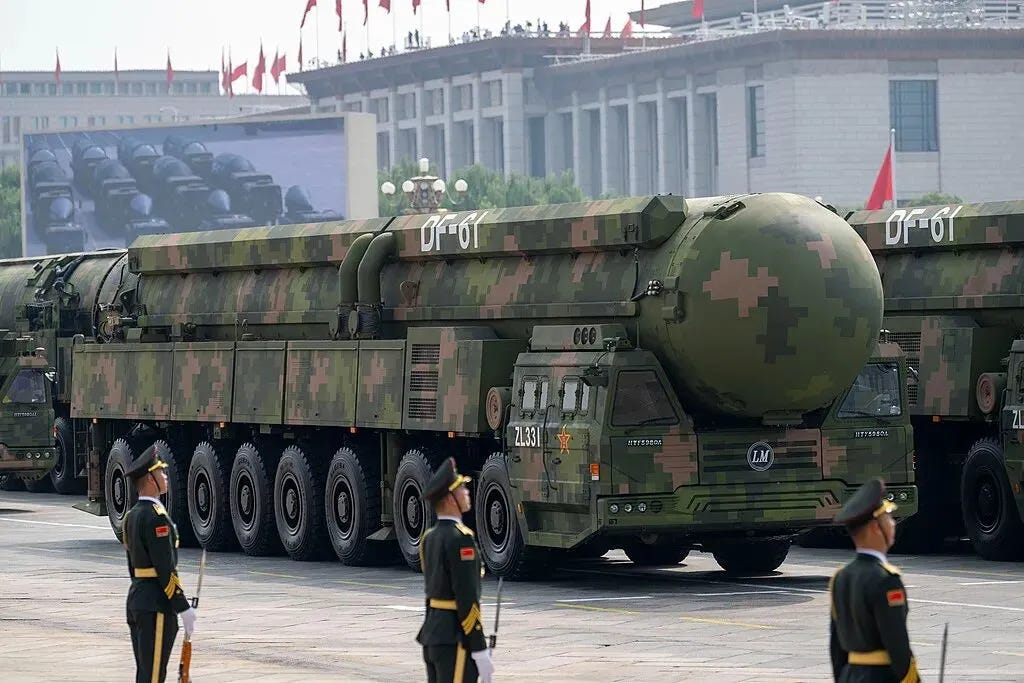
PLA Rocket Force Begins Training with New Road-Mobile ICBMs
On November 5, 2026, the People’s Liberation Army (PLA) Rocket Force announced it had begun training its units with the new DF-61 road-mobile intercontinental ballistic missile (ICBM) system. According to coverage on CCTV, the fielding represents “an iterative strengthening of the country’s land-based nuclear counterattack force, enhancing its mobility, survivability, and penetration capabilities.” The mobility of the DF-61 would complicate US counterforce targeting in the event of nuclear war.
The DF-61 made its public debut at the September 3, 2025, military parade in Beijing commemorating victory over Japan in World War II. The announcement coincided with the 66th anniversary of the launch of China’s first domestically produced short-range strategic ballistic missile.
Ukrainian Intelligence Identifies New Russian Cruise Missile
On October 22, 2026, Ukraine’s Main Intelligence Directorate (HUR) identified a new type of low-cost cruise missile called “Filin” produced by Russia’s Scientific and Production Association “Molniya”. The missile is approximately 3.5 meters in length with a wingspan of 3 meters. It can allegedly reach speeds of 800 km/hour, striking targets at a range of 1,200 km, with either a fragmentation, penetration or thermobaric warhead weighing 50-100 kg. HUR assesses that some components of the missile are 3D printed.


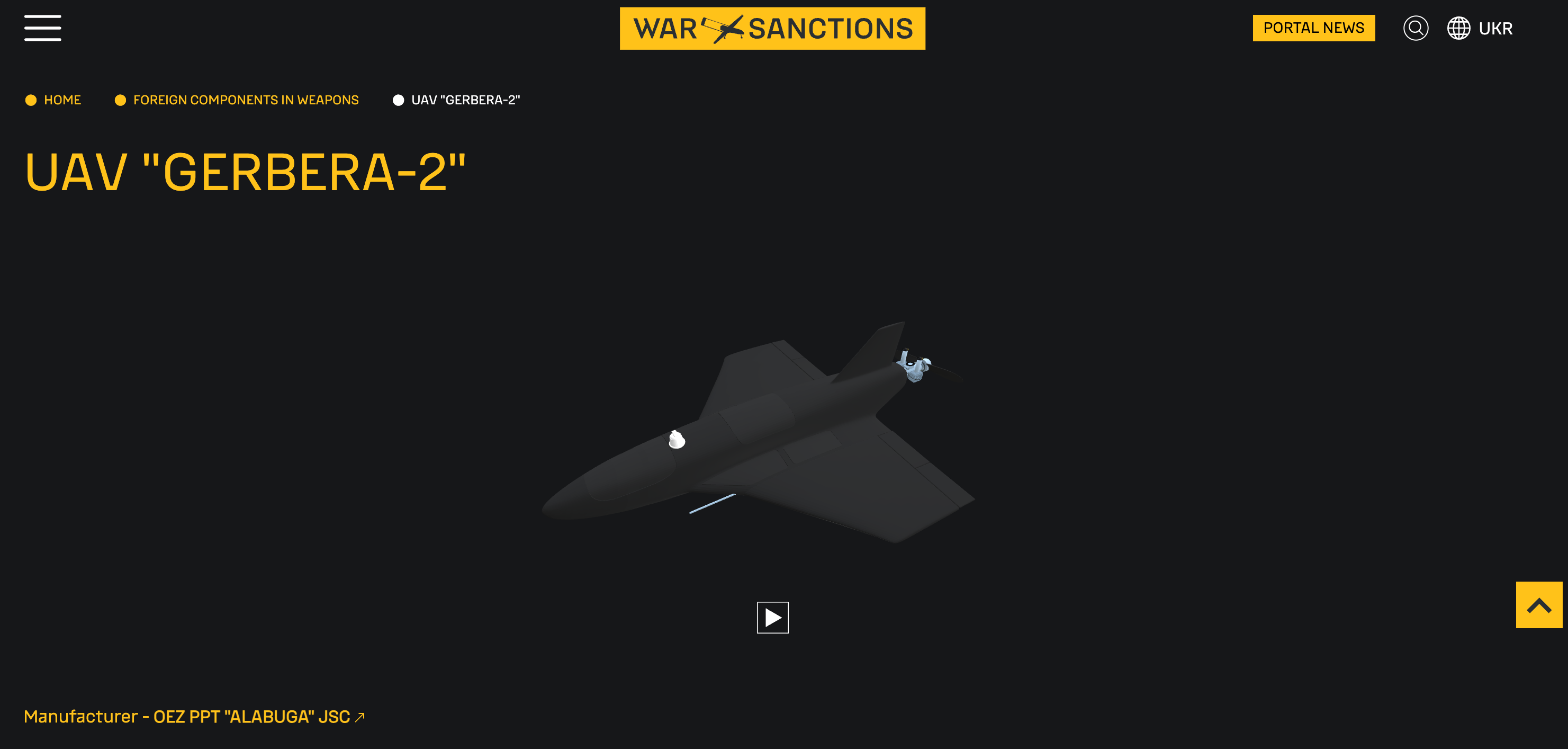
Russia Is Upgrading Its Gerbera Decoy Drone for Long-Range Strikes
On November 2, 2026, Ukraine’s HUR announced on its War&Sanctions webpage that Russia was adapting its Gerbera decoy and reconnaissance drone for long-range attacks. The new Gerbera-2 variant can fly for up to 10 hours at a max speed of 200 km/hour and strike targets at a range of 1,200 km with a 25 kg high explosive warhead. The Gerbera-2 features improvements in electronic jamming resistance and integration into mesh modem networks.
North Korea Announces Test of New Cluster Munition
On November 1, 2026, North Korea announced the test of a new cluster munition for its missiles. According to North Korean state media, the new warhead is capable of “turning into ashes a target area of 12 to 13 hectares with its highest-density power.”
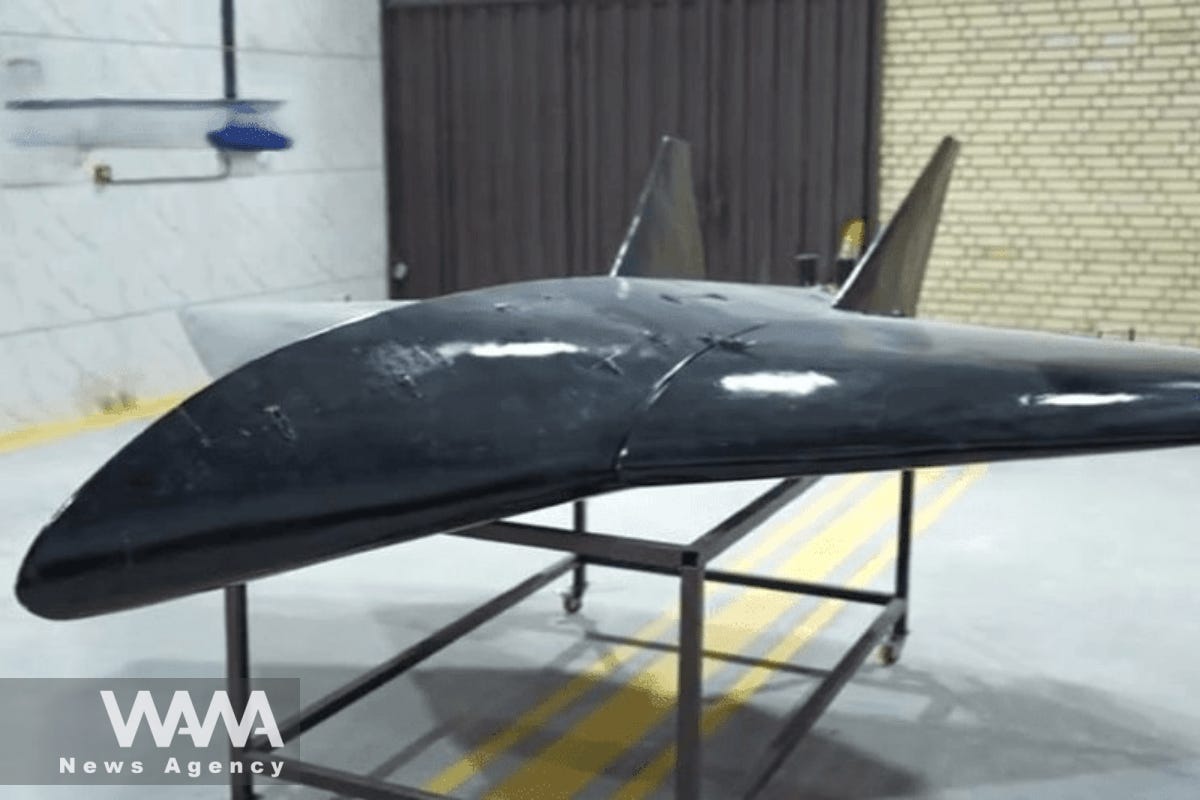
Iran Unveils Upgraded Arash Attack Drone
On October 22, 2026, the Iranian army announced an upgraded variant of its Arash one-way attack drone. Dubbed the Arash-3 by state media outlet PressTV, the drone carries a 100 kg warhead, which is twice the size of those used in earlier versions, and features AI-aided targeting and navigation systems that allow it to find and hit targets without satellite connectivity.
II. AIR DEFENSE
Significant developments involving air and missile defense and counter-UAS systems.
China Announces Successful Interception of New Maneuverable Missiles
On November 2, 2026, the People’s Liberation Army’s Central Theater Command Air Force announced the successful interception of two “new-type” missiles using its HQ-9B air defense system. The announcement suggests, though does not explicitly confirm, that the missiles intercepted were hypersonic glide vehicles.
III. NAVAL SYSTEMS
Significant developments involving advanced manned and unmanned naval surface and subsurface vessels and maritime security systems.
Sighting of Second Possible Chinese Submarine Drone Mothership
An October 18, 2026, article in Naval News by Alex Luck assessed that images circulating on Chinese social media platform Weibo of an unknown People’s Liberation Army Navy auxiliary vessel being towed on the Pearl River in Guangzhou likely represent a “mothership” capable of deploying submarine drones (UUVs). The vessel is the second known submarine drone mothership, with the first ship under construction in Shanghai (covered in the Arsenal of Autocracy - October 2026).
The two ships feature slightly different designs but are both presumably capable of carrying as many as four extra-extra large uncrewed underwater vehicles (XXLUUVs). The ship visible in Guangzhou has a shorter frame with taller lifting pylons than the Shanghai ship. The reasons for the differences in design are not yet clear, though, as naval analyst H.I. Sutton notes, the added height of the pylons likely represents either a deeper hull or a capability to lower its onboard submarine drones deeper into the water.

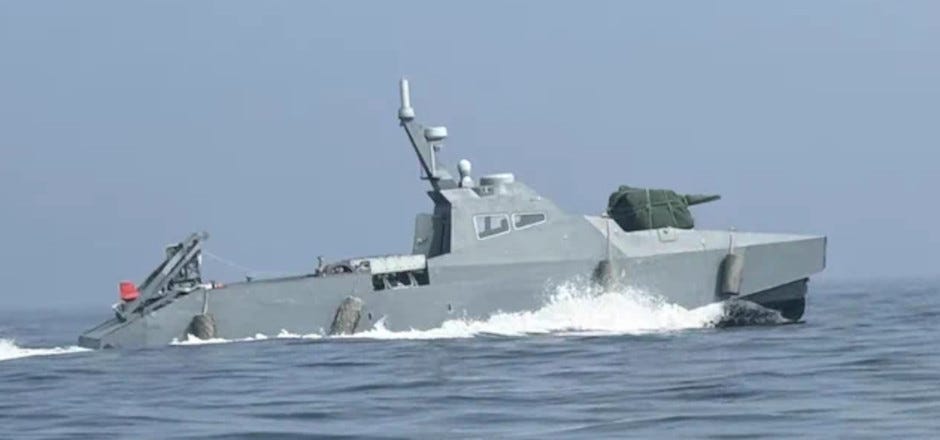
New Chinese Mine Warfare Surface Vessel Spotted
An October 16, 2026, article by H.I. Sutton in the Covert Shores blog provided images of a new unmanned mine warfare surface vessel. The new vessel designed for mine clearance appeared in a recent exercise alongside Type-529 Wonang-class inshore uncrewed minesweeping craft. Sutton assessed the new craft is a likely replacement for the Type-529. Both vessels have similar designs with a cockpit for optional crewed operations, an A-frame for deploying towed instruments and autonomous systems, and a remote-controlled weapon system.
IV. COMBAT AVIATION
Significant developments involving large manned and unmanned military aircraft including bombers, fighters, helicopters, aerial command and control systems, as well as aerial sensors and electronic attack and logistics aircraft.
China Conducts First Carrier-based Launch and Recovery of GJ-21 Stealth Drone
On October 30, 2026, the People’s Liberation Army Navy reported that the Type 076 amphibious assault ship Sichuan conducted its first takeoff and landing drills with a GJ-21 stealth reconnaissance-strike drone. The GJ-21 is the naval equivalent of the GJ-11 Sharp Sword. The news confirmed the long-held suspicion that the Sichuan would serve primarily as a drone carrier, with an electromagnetic catapult and arresting system specifically designed to launch and recover large unmanned aircraft.
North Korea Unveils New Strategic Drones
On October 29, 2026, North Korean Supreme Leader Kim Jong-un attended the “Unmanned Aeronautical Technology Development-2026” exhibition in Wonsan. The event notably featured several large strategic drones including the Saetbyol-4, a high-altitude long-endurance reconnaissance drone, and a new tailless “flying wing” stealth drone.
V. NEXT GENERATION GROUND FORCES
Significant developments involving next generation manned and unmanned military vehicles, fire support systems and other advanced ground-based tactical and operational systems.
Russia Announces New “Titan” Unmanned Mine Clearance Vehicle
On October 22, 2026, Russian state media outlet TASS announced the successful testing of a new tracked unmanned ground vehicle (UGV) called “Titan” equipped with rollers to clear minefields. The vehicle can reportedly operate for 3.5 hours at a speed of 7 km/hour when equipped with mine rollers and clear a path 2 meters wide.
Test of the Titan UGV equipped with mine rollers. Source: TASS
VI. FRONTIER TECHNOLOGIES: MILITARY AI AND SPACE-BASED MILITARY CAPABILITIES
Significant developments involving the military applications of next-generation technologies including artificial intelligence (AI) and space-based systems.
Russian Satellite Hovers Near European Satellite
Since September 2026, a Russian satellite named Kosmos-2612 has been observed maneuvering toward a US-registered, Finland-operated commercial synthetic aperture radar (SAR) satellite, ICEYE X36, that has been supporting Ukraine. Kosmos-2612 approached within 500 meters of ICEYE X36, with some reporting suggesting the satellite came as close as 26 meters. The incident has been seen as a potential test run of future orbital warfare.
Russia Deploying Domestic Competitor to Starlink
According to Ukrainian intelligence, Russia deployed 32 Rassvet-3 satellites into orbit this year in two launches conducted in March and July. The deployment has encountered some difficulties with only 26 of the 32 satellites reaching their intended positions. According to TechRadar, Russia’s Bureau 1440 has already submitted documentation to the International Telecommunication Union (ITU) for a Rassvet-4 constellation with as many as 374 satellites.
The Rassvet satellites are intended to provide dual-use civilian and military communications that are analogous to SpaceX’s Starlink. The two systems are different in that Rassvet satellites orbit much higher than Starlink satellites, 800 km versus 550 km above the earth respectively. This is a trade off which allows the Rassvet system to provide service to an area with far fewer satellites than Starlink but with worse signal strength and connectivity.
US Intelligence Report: China May Deploy Advanced Anti-Satellite Directed Energy Weapons by End of Decade
A new report by the Defense Intelligence Agency released on October 26, 2026, entitled “Challenges to Security in Space,” assessed that China is developing space-based directed energy weapons capable of disrupting or damaging satellites in high orbits, and that such weapons may be deployed by the end of the 2020s.
An October 27, 2026, column in China’s Global Times rejected the DIA assessment. The column cited an official policy paper released by China’s Foreign Ministry on October 23, 2026, entitled “China's Position on Strengthening Outer Space Governance,” that declared opposition to the deployment of offensive military capabilities in space.
INDUSTRIAL CAPACITY
Developments related to the generation of defense industrial production
I. PRODUCTION AND OUTPUT
Significant developments involving the expansion or upgrade in defense industrial facilities and production lines.
Russia Scaling Glide Bomb Production
New report by the Ukrainian think tank Center for Defense Reforms has found that Russia has set the stage for converting as many as 139,000 dumb bombs into long-range precision-guided munitions with the purchase of 278,000 servo drives and other components. Glide bombs use servo drives to control actuators that move flight surfaces.
Russia Producing 6,000 Strike Drones and More Than 200 Missiles Per Month
On October 20, 2026, Ukraine’s HUR provided an assessment to NV Ukraine that Russia is producing approximately 4,000 Geran-4/5 jet drones, 2,000 Geran-2 drones, and more than 200 missiles of all types each month. HUR further assessed that Russia has up to 700 stockpiled ballistic missiles and several thousand cruise missiles of various types. HUR provided the following breakdown for Russian missile stocks and production figures:
9M723 “Iskander-M” missiles: 115 units in stock, 65 new missiles produced per month.
RM-48U missiles for the S-400 air defense system: 400 units in stock, approximately 40 new missiles produced per month.
3M55 “Onyx” anti-ship missiles: 600 units in stock, 55 new missiles produced over the last seven months.
3M22 “Zircon” missiles: Over 120 units in stock, around 30 new missiles produced in the first seven months of 2026.
Kh-101 cruise missiles: No assessment for stock, at least 80 new missiles produced per month.
3M14 “Kalibr” cruise missiles: 450 units in stock, approximately 29 new missiles produced each month.
HUR also assessed that the production of Kh-47M2 “Kinzhal” missiles has been suspended due to issues with the missile’s reliability and accuracy.
Iran Producing 50 Ballistic Missiles Per Month—Half Its Pre-War Output
On November 10, 2026, Bloomberg reported that Western intelligence estimates assess that Iran is producing about 50 ballistic missiles per month. The figure represents about half of Iran’s pre-war capacity, but still suggests significant resilience in Iran’s industry following crippling attacks endured during Operation Epic Fury. Officials further assessed that Iran has approximately 1,700 ballistic missiles remaining after firing 2,200 during 2026 combat operations.
Iran Appoints “Architect” of the IRGC Missile Program as New Defense Minister
On October 18, 2026, the Iranian Parliament confirmed Mehrdad Akhlaghi Ketabchi as the country’s Minister of Defense and Logistics of the Armed Forces, succeeding Aziz Nasirzadeh, who was killed by US-Israeli strikes on February 28, 2026. Akhlaghi has played a key role in the development of the Islamic Revolutionary Guard Corps (IRGC) missile arsenal as head of the Shahid Bagheri Industrial Group, the Aerospace Industries Organization and the Defense Industries Organization.
As noted in Weekly Significant Activity Report - October 24, 2026, Akhlaghi has announced 16 focus areas for the next two years of his term, including “strengthening air defense, continuous monitoring of threats and updating military equipment, rebuilding industrial infrastructure, developing emerging technologies, and increasing the participation of the private sector and knowledge-based companies.” He has further suggested he plans to replenish the country’s missile arsenal, develop new longer-range missiles and create more resilient production systems, all while moving production into new underground facilities rather than rebuilding destroyed factories.
II. RESILIENT SUPPLY CHAINS
Significant developments involving the strengthening of defense industrial capacity to anticipate, endure and adapt to disruptions.
Iran Unveils New Underground Missile City
On November 10, 2026, IRGC media outlet Tasnim News published footage of a visit to a newly operational underground missile city by General Ali Abdullahi, the Chief of Staff of the Iranian Armed Forces and Commander of the Khatam al-Anbiya Headquarters,1 and Brigadier General Seyed Majid Mousavi, the Commander of the IRGC Aerospace Forces.
Prior to the visit, on November 7, 2026, IRGC spokesman Brigadier General Hossein Mohebbi announced that the IRGC was rapidly moving its missile and drone production into the missile cities to create joint production and storage facilities.
Inspection of the new Iranian Missile City. Source: Tasnim News
III. BLOC DEFENSE COOPERATION
Significant developments involving defense industrial cooperation between Russia, China, Iran, and North Korea.
Iran Says It Will Receive Russian Su-35 Fighter Bombers
On November 1, 2026, Iranian military spokesman General Mohammad Akraminia announced that Iran has purchased Russian Su-35 jets and expects to take delivery after the war with the US ends. The number of aircraft purchased has not been announced. However, as Russian independent media outlet The Insider notes, the deal is not new. The Su-35 purchase was completed as far back as 2023, with some suggestions that the aircraft (as many as 24) have not been received due to fears in Tehran that they would be targeted by the US.
Iran Looking to Purchase Russian S-400 Air Defense Systems
A November 6, 2026, report by The Telegraph claims that Iran has appealed to Russia to obtain S-400 air defense systems. The appeal was made during a November 5, 2026, visit to Russia by Iranian Supreme National Security Council Secretary Mohsen Rezaei.
This briefing was compiled by Dan White. Dan is an independent foreign policy analyst based in the New York Metro Area. Dan is a former member of The Wilson Center and The Kennan Institute. Dan holds masters degrees from the Johns Hopkins University School of Advanced International Studies (SAIS), the Naval Postgraduate School, and the University of Washington. Dan is a former officer in the United States Army and a veteran of the War in Afghanistan.
For more information, corrections, or comments, please contact djwhite155@gmail.com.
The Khatam al-Anbiya Headquarters is the equivalent to a joint staff headquarters for the Iranian military. It coordinates operations between the conventional military and IRGC.