



This week’s analysis highlights some of the most significant geopolitical developments involving America’s adversaries—China, Russia, Iran, and North Korea—between September 26, 2026 and October 3, 2026.
Executive Summary:
US War with Iran - Significant Activity Related to the US-Iran War
A suspicious incident near RAF Fairford in England led to multiple arrests and a counterterrorism probe that the UK Prime Minister says points to a suspected Iranian plot against the base.
Iran launched a new wave of attacks on ships near the Strait of Hormuz in order to restore control over the waterway amid new reporting of a rebound in Middle East oil and gas exports.
The Eastern Front - Significant Activity Related to the War in Ukraine and Russian threats to NATO
Russia escalated its drone war against Ukraine with new tactics, targets, and drone armaments meant to destroy critical infrastructure and degrade civilian morale. Multiple suspected Russian drones also crashed and exploded in Moldova during attacks on Ukrainian cities.
The Russian government proposed a new three-year budget that features record defense spending alongside tax increases, benefit cuts, and a growing deficit.
Western Pacific Flashpoints - Significant Activity in the Western Pacific and Taiwan
China conducted joint military and coast guard exercises near Scarborough Shoal in latest show of force to assert Chinese claims to the area.
Seoul blamed Pyongyang for a September 21 mine explosion in the DMZ that wounded three South Korean soldiers, after discovering multiple suspected North Korean antipersonnel mines illegally placed south of the Military Demarcation Line near the site of the blast.
US WAR WITH IRAN
Significant Activity Related to the US-Iran War
1. UK COUNTERTERRORISM POLICE PROBE IRANIAN INVOLVEMENT IN SUSPECTED PLOT AGAINST RAF FAIRFORD
On September 27, 2026, UK police arrested five men near Whelford, a village on the periphery of RAF Fairford. The arrests followed a tip by a concerned local resident about suspicious activity by masked and hooded men operating multiple vans near the perimeter of the air base. The men—all in their early 20s—were found to be in possession of suspected incendiary and explosive materials, a discovery that prompted an evacuation of local residents and a further investigation by counterterrorism officials. Police later clarified that no explosives were recovered but a "quantity of petrol" was found in the suspects’ vehicles. The incident, which could have been written off as a case of attempted fuel smuggling, drew special scrutiny due to RAF Fairford’s role as a hub for US bomber strikes on Iran.
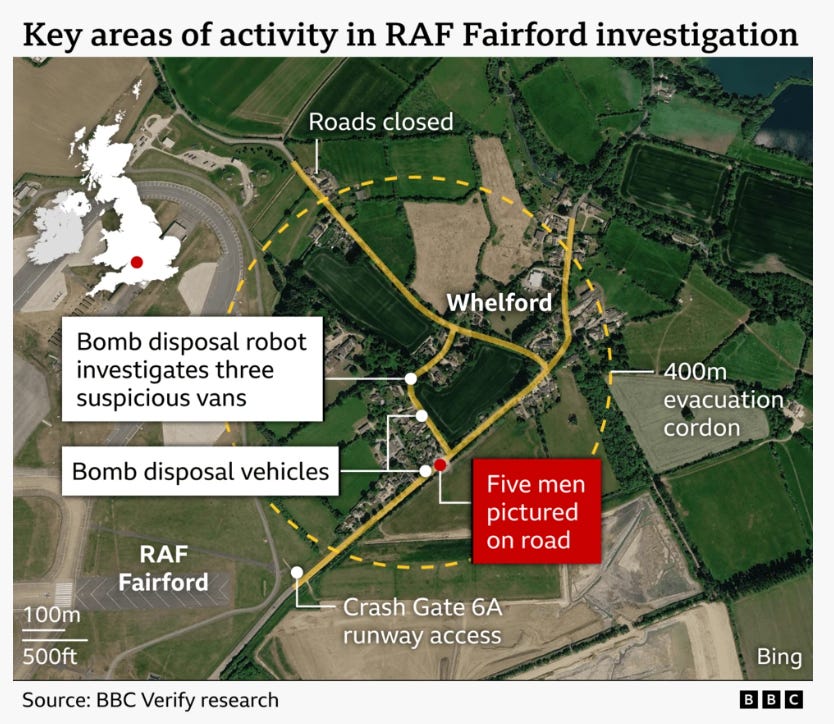
On Wednesday, September 30, 2026, UK Prime Minister Andy Burnham announced that initial findings from the ongoing investigation yielded “strong indications” of Iranian involvement. The following day, October 1, UK counterterrorism police announced the arrest of a 25-year old dual UK-Iranian citizen.
Iran has denied involvement and cast doubt on the credibility of the ongoing investigation.
Takeaways:
While Iran denies any involvement in the incident at RAF Fairford, Iranian officials have made repeated threats to target countries that support the US war effort. Reuters highlighted this ongoing threat with an October 1, 2026, report detailing recent discussions by senior Iranian commanders and officials to directly target US allies outside the Middle East.
As noted in brief OPFOR Journal reports, there is significant evidence to suggest that Iran is already conducting an expansive gray zone campaign of plausibly deniable attacks inside the UK, as well as elsewhere in Europe. That campaign has primarily targeted Jewish communities in order to stir unrest and strike back at perceived Israeli interests. Many high-profile antisemitic attacks reported in the UK since the start of the war have been claimed by Harakat Ashab al-Yamin al-Islamiyya (The Islamic Movement of the Companions of the Right), a self-identified upstart pro-Iranian/pro-Palestinian Islamist group, which a subsequent UK investigation has identified as a front for the Quds Force of Iran’s Islamic Revolutionary Guard Corps. Several attacks claimed by the group have involved arson, suggesting a potential explanation for the “quantity of petrol” located in suspect vehicles outside RAF Fairford, other than fuel smuggling.
The threat by Iranian proxies and disposable agents in the UK continues unabated. On October 2, 2026, UK police announced the arrest of two Iranian nationals charged with plotting to conduct a terror attack targeting Jewish communities in Manchester.
2. IRAN LAUNCHES NEW ATTACKS ON SHIPPING IN THE STRAIT OF HORMUZ
Iran launched a wave of attacks on shipping in the Strait of Hormuz this week. Between September 28, 2026 and October 3, 2026, at least six vessels were struck by suspected Iranian fire.1
Takeaways:
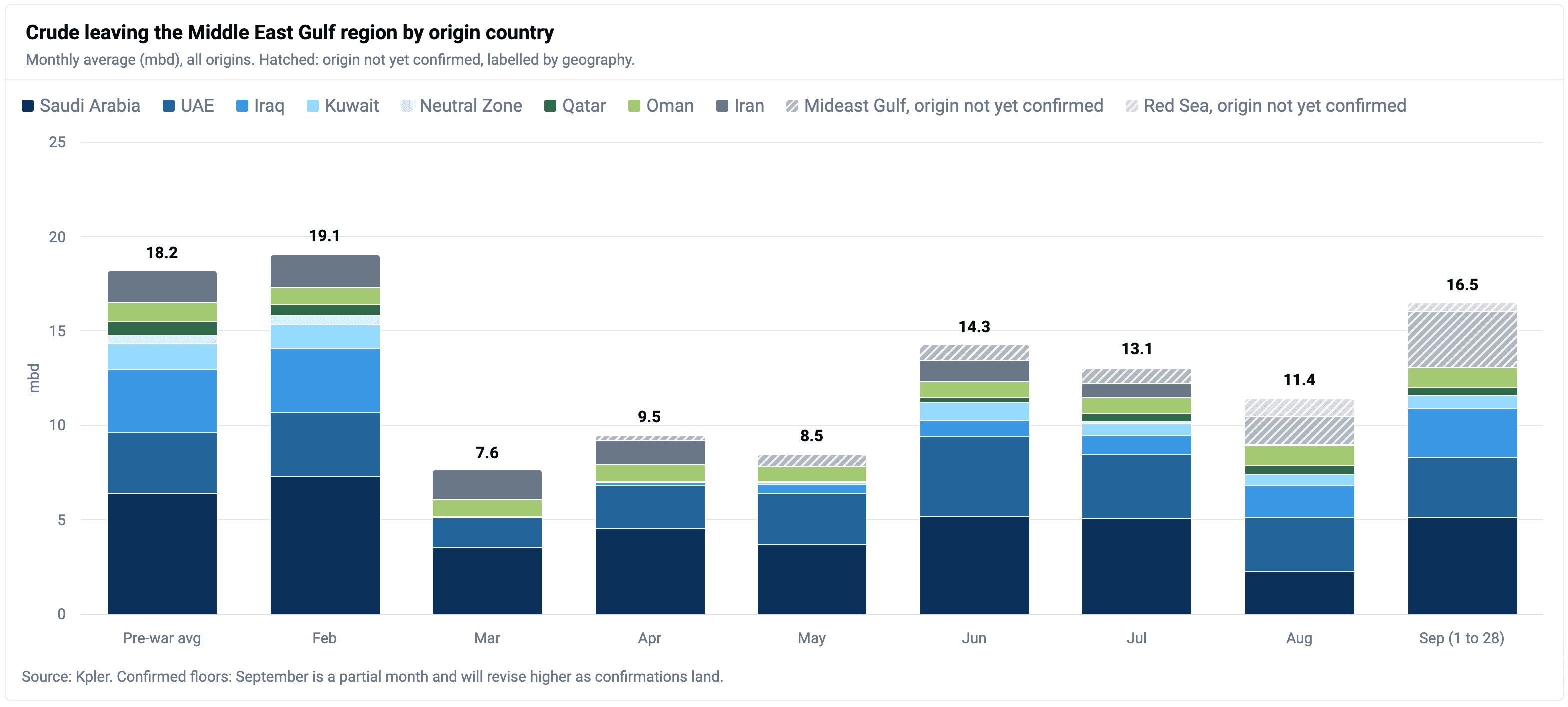
The spate of attacks is likely a response to a recovery in Middle East oil exports in September. According to commodity analytics firm Kpler, Middle East nations exported an average of 16.5 million barrels of crude oil per day in September. September exports still trail pre-war averages, but the continued deficit is almost entirely due to a near total collapse in Iranian trade caused by the ongoing US naval blockade, suggesting exports for the rest of the region have experienced a major recovery. Liquefied natural gas (LNG) shipments also made a significant recovery in September. The recovery in crude and LNG appears to be spurred by a combination of diversified shipping routes and concealed and/or escorted transits through the Strait of Hormuz.
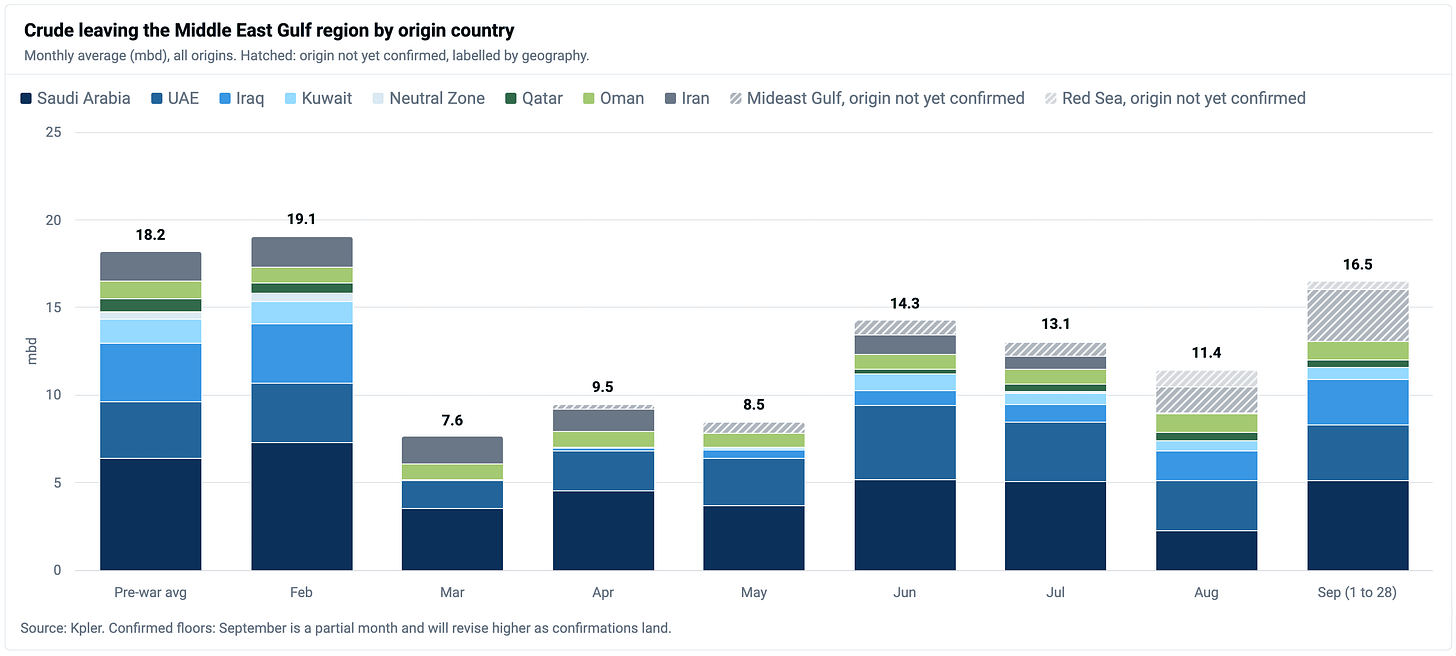
Average daily Middle East crude exports organized by month from February 1, 2026 through September 28, 2026, along with pre-war daily averages. Source: Kpler The ongoing recovery in exports is still tenuous and Iran is likely to redouble its efforts to attack ships near the Strait of Hormuz to ensure it retains leverage in negotiations. If the recovery persists while Iranian exports remain frozen, Tehran may risk a return to major combat operations by launching a new wave of drone and missile attacks on regional oil infrastructure, or a more expansive maritime campaign targeting ships in other regions. The window for escalation may peak before the US midterm elections, as Iranian oil at sea runs out and Tehran struggles to keep global prices for oil and gas elevated.
EASTERN FRONT
Significant Activity Related to the War in Ukraine and Russian threats to NATO
3. RUSSIA ESCALATES DRONE WAR AGAINST UKRAINE, EXPANDS INTO MOLDOVA
Russia Launches New Attack Drone Built to Cripple Infrastructure
On September 30, 2026, Serhii "Flash" Beskrestnov, special adviser to the Ukrainian President, announced that Russia had begun employing Shahed drones armed with a special explosive charge designed to attack critical infrastructure. Beskrestnov described the new weapon as a “cumulative cutting warhead” designed to more effectively destroy thick iron pylons used in high-voltage power lines and bridges.
Russia Repeatedly Strikes Kyiv’s Key Bridges
Between October 1 and 2, 2026, Russian drones struck Kyiv’s Southern Bridge four times. The attacks resulted in damage that forced the temporary suspension of traffic across the bridge. The closure of the bridge, which serves as an artery for traffic across the Dnipro River, effectively paralyzed city transit and logistics networks. On October 3, 2026, Russia followed up the attacks with a drone strike on Kyiv’s Northern Bridge.
Russian drone strike on Kyiv’s Southern Bridge on October 2, 2026. Source: The Insider (@theinsider) on Telegram.
Russian Drones Repeatedly Strike Moldova
Russian Shahed-type attack drones crossed into and exploded in Moldova on two different occasions this week. On September 30, 2026, three suspected Russian drones crashed and exploded on Moldovan territory. Three days later, on October 3, 2026, five suspected Russian drones landed in four different districts in Moldova during overnight attacks on Ukraine.
Video of apparent impact of a Russian jet-drone near the village of Anenii Noi on September 30, 2026. Source: Politia Republicii Moldova (@Politia_Republicii_Moldova) on Telegram.
Takeaways:
Repeated Russian drone strikes, even by specially equipped drones, are unlikely to destroy Kyiv’s main bridges. The primary purpose of these attacks, along with attacks on broader city life, including targeting supermarkets, data centers, power plants, schools and hospitals, is to create a humanitarian crisis that triggers new waves of migration from Kyiv and other cities into Europe. The Kremlin likely hopes that further migration will increase pressure on Ukraine and its allies by degrading Ukraine’s economy and civilian morale as well as inflaming growing anti-migrant sentiments in Europe, a combination of factors that it may hope will ultimately compel Kyiv to settle the war on Russian terms.
The increasingly unrestrained bombardment of Ukrainian infrastructure and population centers comes as Russia faces mounting difficulties achieving its war aim of seizing the remainder of the Donbas region through ground offensives. The Institute for the Study of War recorded net territorial losses for Russia, along with a surge in casualties, in the month of September due to the success of Ukraine’s ongoing Operation Vivaldi campaign near Lyman.
The increased precision of Russian drone strikes in recent days has led to speculation by Ukrainian officials that Russian forces may have covertly expanded the “Mesh” network of repeaters guiding Russian drones into Kyiv with hidden ground-based relays. As Serhii “Flash” Beskrestnov notes, a small number of repeaters in the city would help Russian drones overcome Ukrainian electronic warfare countermeasures that degrade their guidance systems.
As discussed in previous Weekly Significant Activity Reports, Russian drones have repeatedly violated Moldovan airspace throughout Russia’s invasion of Ukraine. Moldova reported 39 drone incursions for 2026 through early September, more than double the 17 incursions recorded in all of 2025. However, eight incursions in a single week represents a substantial uptick in Russian provocations. Another worrying trend is that the incursions this week, along with other recent incidents, involved multiple armed drones that exploded on impact. The growing number of armed drones crashing in Moldova represents a significant escalation from previous Russian provocations that involved mainly unarmed reconnaissance drones.
4. NEW RUSSIAN BUDGET PROPOSES RECORD DEFENSE SPENDING ALONGSIDE BENEFIT CUTS, TAX HIKES, AND GROWING DEFICIT
The Russian government submitted a draft three-year budget for years 2027-2029 to parliament for review on September 30, 2026. A copy of the budget obtained by Reuters showed 17.1 trillion rubles (approximately $203 billion) allocated to defense for 2027, a wartime record that is 27% higher than originally budgeted for the year. The budget also showed a three-year total of 50 trillion rubles (approximately $600 billion) in defense spending.
Takeaways:
The increased defense spending will be financed through growing budget deficits that are projected to run to 2% of GDP each year, as well as through cuts to social welfare programs and tax hikes. If current trends persist, these numbers will have to be amended further, outside the formal budgeting process, in order to account for unexpected revenue shortfalls and spending increases mandated by the war.
The draft budget, along with a newly announced increase in the authorized size of the Russian military to 1,550,500 service members (the fourth such increase of the year), serve as signals that the Kremlin is committed to winning the war in Ukraine at all costs. They also serve as a warning to NATO that Russia intends to remain heavily mobilized for years to come, and aim to dispel notions that losses in Ukraine have fundamentally weakened its military potential.
WESTERN PACIFIC FLASHPOINTS
Significant Activity in the Western Pacific and Taiwan
5. CHINA CONDUCTS LARGE-SCALE MILITARY EXERCISES NEAR SCARBOROUGH SHOAL
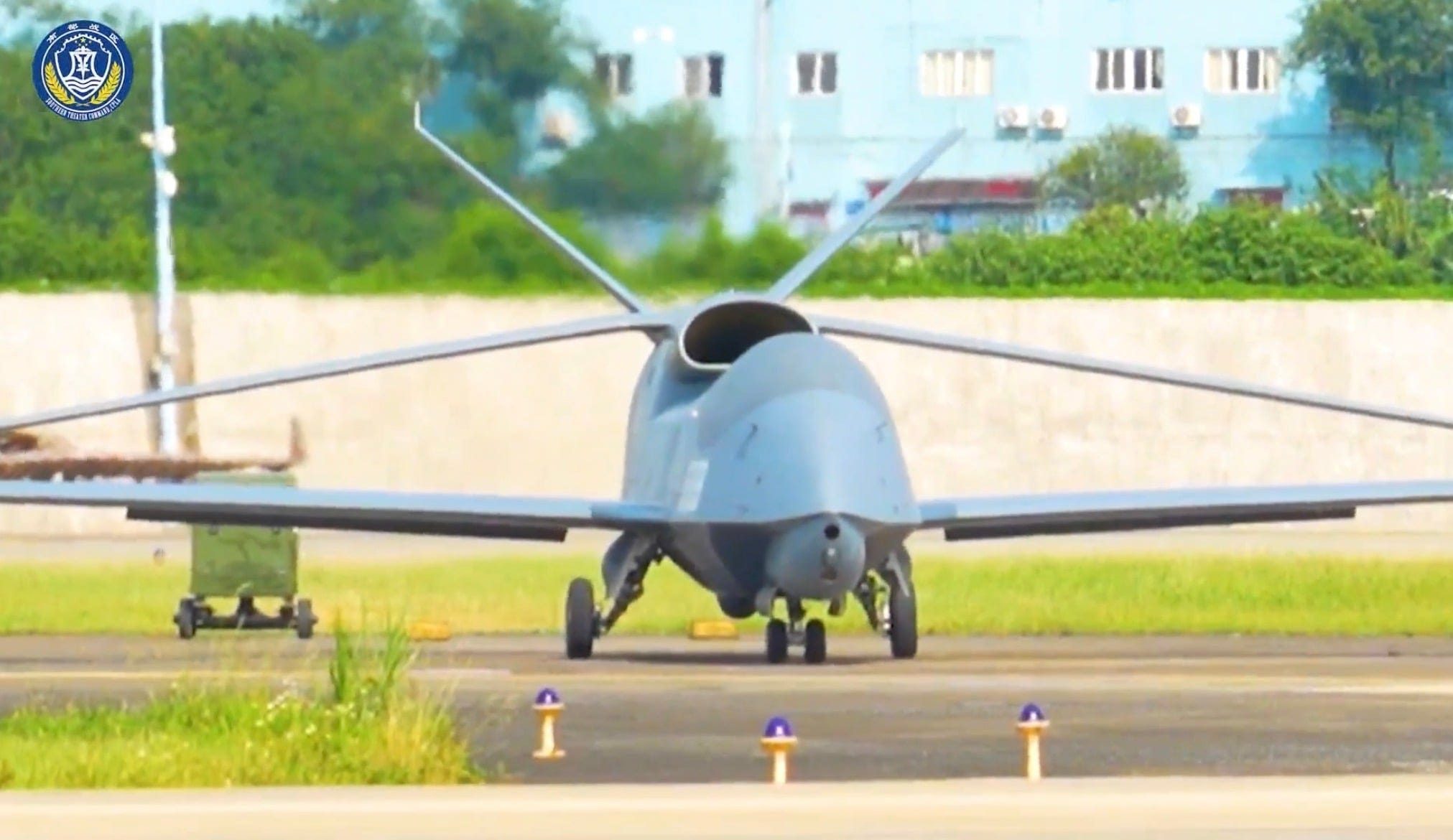
On September 27, 2026, the People’s Liberation Army Southern Theater Command conducted joint air and naval exercises near Scarborough Shoal. The drills, involving at least one Type 054A frigate, a Type 056A corvette, a Type 908 replenishment vessel, and a Shaanxi KJ-500H airborne early warning system, tested naval-air coordination in reconnaissance and search and rescue operations. The exercises featured the first known deployment of the Guizhou WZ-7 Soaring Dragon, a sophisticated high-altitude unmanned surveillance drone.
The PLA exercises took place simultaneously with China Coast Guard drills in nearby waters. The Coast Guard drills tested the blocking, interdiction, and boarding of adversary vessels.
Takeaways:
This week’s exercises represented a major show of force aimed at the Philippines, whose internationally recognized right to the waters surrounding Scarborough Shoal contradicts China’s own claims. As noted in previous Weekly Significant Activity Reports, clashes between Beijing and Manila over Scarborough Shoal and other maritime features have escalated in recent months in a renewed push by both sides to have the legitimacy of their claims over the area recognized. The escalation appears to have been prompted, in part, by international attention paid to the 10-year anniversary of the 2016 Permanent Court of Arbitration ruling which denied China’s expansive claims to the entirety of the South China Sea.
In referencing the exercises, Chinese state media claimed that China’s “legitimate control around Huangyan Dao [Scarborough Shoal] and Ren'ai Jiao [Second Thomas Shoal] has now extended beyond 24 nautical miles”. The statement appears to suggest that China has officially implemented a 24 nautical mile exclusion zone around the Shoals. While not explicitly mentioned, the newly announced controls also imply that China may expand its territorial claims in response to pushback it receives from the Philippines.
6. NORTH KOREA BREACHES ARMISTICE WITH ILLEGAL MINELAYING THAT INJURED SOUTH KOREAN SOLDIERS
The South Korean military recovered at least four North Korean resin antipersonnel mines in the DMZ near the site of an explosion that wounded three South Korean service members on September 21, 2026. The mines were found south of the Military Demarcation Line (MDL), pointing to North Korean attempts to expand its minefields in violation of the armistice. Further investigation led Seoul and the UN Command, which oversees the armistice, to attribute responsibility for the September 21 explosion to North Korea.
North Korea rejected blame for illegally placed mines, and on October 3 launched a ballistic missile into the Sea of Japan in an apparent protest against the accusations.
Takeaways:
The illegal minelaying follows a rapid buildup of North Korean fortifications near the MDL in violation of the armistice. A November 25, 2025 report by Colin Zwirko in NK News indicates that the North built new defensive works across 74% of the DMZ since April 2024, with the bulk of construction conducted between June 2025 and November 2025. Zwirko noted that North Korea’s fortifications appeared to “pro-actively” reject restrictions in the DMZ.
Further investigation will determine whether the minelaying resulted from an overreach in broader North Korean efforts to fortify the DMZ, or a deliberate provocation designed to attract attention from Seoul and Washington. The latter possibility cannot be entirely discounted, as North Korea continues to wait for the US to respond to its overtures for talks. North Korea has made renewed dialogue contingent on US acceptance of its status as a nuclear power, a demand that the Trump administration has thus far rejected despite other concessions such as reduced joint military exercises with South Korea.
This briefing was compiled by Dan White. Dan is an independent foreign policy analyst based in the New York Metro Area. Dan is a former member of The Wilson Center and The Kennan Institute. Dan holds masters degrees from the Johns Hopkins University School of Advanced International Studies (SAIS), the Naval Postgraduate School, and the University of Washington. Dan is a former officer in the United States Army and a veteran of the War in Afghanistan.
For more information, corrections, or comments, please contact djwhite155@gmail.com.