



This week’s analysis highlights some of the most significant geopolitical developments involving America’s adversaries—China, Russia, Iran, and North Korea—between April 18, 2026 - April 25, 2026.
Summary:
Update on the war with Iran: internet shutdown continued with no end in sight; Iran seized and fired on ships to keep the Strait of Hormuz shut; continued uncertainty over negotiations between US-Iran.
Russian Security Council Secretary Sergei Shoigu threatens Moldova over “suffering” of Russian citizens in Transnistria.
Putin tried to address concerns over intensifying crackdown on internet access in Russia.
Chinese pressure on African countries resulted in the cancelation of a planned state visit by Taiwanese President William Lai to Eswatini.
Chinese Navy ramped up operations in the Indo-Pacific amid a US drawdown in the region resulting from the war with Iran.
1. IRAN WAR UPDATE
Regime Imposed Internet Shutdown Passes Eight Weeks
According to internet connectivity monitoring organization Netblocks, April 25 marked 57 days of a near total internet blackout in Iran. The same day member of the Iranian parliament, Mostafa Pourdehghan, told semi-official media outlet ISNA that there is currently no timeline for restoring internet connectivity and that all decisions on the matter rest in the hands of the Supreme National Security Council.
Iran Seizes Vessels in Strait of Hormuz
On April 21, the Islamic Revolutionary Guard Corps (IRGC) Navy announced the seizure of two ships attempting to transit the Strait of Hormuz, the MSC Francesca and the Epaminodes. The IRGC Navy also fired on a third vessel.
IRGC Navy conducting the boarding and seizure of MSC Francesca. Source: Sepah Cybery on Telegram.
Uncertain Future of Negotiations
This week several developments cast doubt on the future of negotiations between the US and Iran in Pakistan. On April 24, reports emerged that Mohammad Bagher Ghalibaf, the Speaker of Iran’s Parliament and leader of the previous round of negotiations with the US in Islamabad, had allegedly stepped down from the negotiating team under pressure from hardline factions within the IRGC. Seemingly confirming this development, Iran dispatched a delegation to Islamabad led by Foreign Minister Abbas Araghchi. The US prepared special envoys Steve Witkoff and Jared Kushner to meet with this team on April 27. However, these plans were scrapped after Araghchi departed Islamabad on April 25 after a brief meeting with Pakistani leaders.
Takeaways:
It’s not clear how much longer Iran intends to continue its current internet blackout without risking serious economic damage. Minister of Information and Communications Technology Sattar Hashemi warned that a continued blackout could imperil 10 million jobs stating, “The continued instability of the internet means a direct threat to the employment of this vast population; an issue that could have profound social and economic consequences.” The fact that the blackout continues despite the growing risk of irreversible harm indicates the Supreme National Security Council is not fully confident that the war is either won or over, and that the regime still faces considerable threats to its rule.
As long as Iran is able to control the flow of maritime traffic through the Strait of Hormuz it will have objectively demonstrated that it has the upper hand over the US and its regional rivals. It will be hesitant to give up this power for two reasons:
-
First, and most obviously, control over the Strait of Hormuz provides Iran with leverage over the US that it can convert into a variety of concessions in negotiations. These may include financial indemnities for war damages—most likely paid in sanctions relief and the release of frozen assets—or an end to demands on its missile and nuclear programs.
-
Second, and arguably the deeper reason why negotiating a de-escalation in the war is so difficult, is that tormenting the US and its allies provides a means of reinvigorating the Iranian Revolution in the wake of serious domestic challenges to its legitimacy and a third and especially difficult succession. After years of setbacks and humiliations, regime hardliners will want to savor the ability to inflict pain on their arch rivals for both their own satisfaction and for the broader purpose of reinforcing the message to domestic audiences that they cannot be driven from power. As a result, the IRGC will continue to push the boundaries of the ceasefire, even at risk of a resumption of hostilities that could further devastate the Iranian economy.
-
The economic and social costs of the war, piled on top of the damage wrought by years of economic sanctions, are real and very severe. But rational economic management or even basic governance are ultimately lower priorities for a revolutionary government than achieving tangible victories against their ideological enemies. This raison d'être appears to be lost on the current US administration which appears to view regime collapse as inevitable over a long enough time horizon of economic and military pressure. But this is a highly uncertain proposition. Revolutionary governments have repeatedly demonstrated incredible resilience in worse economic conditions throughout history so long as they have maintained their devotion to their cause.1 Perversely, a confrontation with the US may impoverish the Iranian people, while helping to consolidate the regime and strengthen its monopoly on violence.
2. RUSSIA THREATENS MOLDOVA OVER TRANSNISTRIA BLOCKADE
In an April 21 interview with Komsomolskaya Pravda, former Defense Minister and current Secretary of Russia’s Security Council, Sergei Shoigu, announced that Russia may be forced to take action—including use of military force—to protect Russians in Moldova’s breakaway province of Transnistria. Shoigu asserted that 220,000 Russian passport holders in Transnistria are currently being deprived of their rights under a “blockade” imposed by Moldova and Ukraine and backed by the European Union.
“These include restrictions on freedom of movement, illegal customs duties, arbitrary deprivation of citizenship, plans to introduce VAT and excise taxes for Transnistrian enterprises, and trade, banking, and transport barriers. It’s also alarming that the Moldovan leadership’s rhetoric regarding Transnistria increasingly resembles the statements made by the Ukrainian authorities regarding Donbas after 2014.”
[…]
“It has also closed Russian schools, banned Russian media broadcasts, repressed dissent, created deep economic problems, and is taking all the necessary steps to exacerbate them, including leaving the CIS.”
Takeaways:
Russian leaders have threatened Moldova on numerous occasions since the start of the Full Scale Invasion of Ukraine in February 2022, and attempted to destabilize the country by spreading disinformation, violating its territorial airspace with drones, and organizing coup plots against the government of Maia Sandu. This latest threat is nonetheless noteworthy as it comes as the Russian State Duma advances a new law (discussed in detail in last week’s Significant Activity Report) authorizing the President to launch military operations to protect Russian citizens facing unjust persecution abroad. It also comes at a time the Russian military faces enormous challenges advancing in Ukraine and may be searching for new fronts it can open to shift the focus of the Ukrainian Armed Forces and its NATO supporters.
Even if the Kremlin has the will to launch a new “special military operation” against Moldova, it will be hard pressed to organize the capabilities needed to do it successfully. The small contingent of Russian forces stationed in Transnistria from the separatist conflict that erupted in the early 1990s after the breakup of the Soviet Union are among the least combat ready in the Russian military and would need significant reinforcing to fend off a Moldovan military supported by the West and likely supplemented by Ukrainian forces. Even with a bridgehead already established in the country, Russia would find it difficult to ferry in the needed supplies or reinforcements due to Ukraine’s sophisticated anti-access area denial capabilities along the Black Sea.
3. PUTIN ATTEMPTS TO JUSTIFY INCREASINGLY UNPOPULAR INTERNET CRACKDOWN
At a meeting with government ministers on April 23, Russian President Vladimir Putin addressed concerns about increasing restrictions on internet connectivity in Russia. Putin framed the months-long, multifaceted campaign to restrict access to websites, VPN’s and social media applications as needed to improve Russian security against Ukrainian drone attacks.
“But I can’t help but notice what people encounter in large cities as well—it’s not often, but unfortunately, it does happen. I’m referring to certain problems and disruptions in the internet in large metropolitan areas.
“Of course, if this is related to operational work to prevent terrorist attacks – and we know that, unfortunately, we sometimes miss such attacks – of course, ensuring the safety of people will always be a priority: our children, our loved ones, every citizen of Russia.”
Takeaways:
The accelerating restrictions on internet in Russia, notably the throttling of Telegram and Whatsapp, and punishment of web hosts that provide services to VPN users, has been a highly consequential story that has gone largely unnoticed in Western media due to the ongoing war with Iran. The fact that Putin felt the need to explain the rationale of the ongoing internet restrictions is indicative of the broad unpopularity of the measures and growing concern that the rollout has been poorly managed. A new poll by the government-owned Russian Public Opinion Research Centre (VTsIOM) published on April 24 shows Putin’s approval rating has dropped seven points since February of this year (when the government campaign to take control of the internet intensified) and has reached its lowest point since the beginning of the war.
Russia's intensifying internet crackdown has expanded beyond previous efforts to push users toward the state messenger app “MAX,” and now appears to be aimed at a full sequestration of the Russian internet under state control. This new policy, while deeply unpopular, appears to be a major state priority that the Kremlin is unlikely to reverse course on. According to investigative reporting by Russian independent media outlet The Bell, the effort is being managed directly by the Second Service of the Russian FSB, the same unit responsible for conducting several of the Kremlin’s most important recent clandestine operations, including the poisoning of Alexey Navalny.
Though framed as a response to Ukrainian drone threats, the new restrictions are expansive enough to raise suspicions that they are being used for broader purposes of population control. The chief concerns about the restrictions are that they are being rapidly imposed to either suppress public discontent over the deteriorating economy, or to set the conditions for a successful new wave of mobilization that avoids the panic that swept Russian social media in the Fall 2022 when a "partial" mobilization was announced.
4. CHINESE PRESSURE CANCELS TAIWAN STATE VISIT TO ESWATINI
This week Taiwan was forced to cancel a state visit by President William Lai to Eswatini—the sole country in Africa with formal diplomatic relations with Taiwan—after three neighboring countries abruptly revoked clearance for Lai’s flight to travel through their airspace. The restrictions imposed by Madagascar, Mauritius, and the Seychelles, are widely believed to have been prompted by overt Chinese diplomatic pressure. The moves were praised by Chinese officials including the spokesperson for the Chinese Ministry of Foreign Affairs who announced that:
“China highly commends relevant countries’ commitment to the one-China principle which is fully consistent with international law and basic norms governing international relations. It’s very clear that there’s no longer a so-called ‘ROC president’ in the world anymore. Anyone who wears that false title is acting against history and will only invite disgrace upon themselves. The one-China principle is where the arc of history bends and public opinion trends, and to uphold it is the right thing to do.”
Takeaways:
This is the latest in an intensifying campaign by Beijing to isolate Taiwan from its remaining diplomatic partners. By demonstrating that it can deny Taiwan access to its partners it hopes to instill a sense of futility among Taipei’s allies in continuing to prefer ties with the island nation over the more powerful mainland.
5. NOTABLE ONGOING CHINESE NAVAL ACTIVITY
Liaoning Transits Taiwan Strait
On April 20, China’s Liaoning aircraft carrier transited the Taiwan Strait, the first crossing of the waterway by a Chinese aircraft carrier in 2026.
Sichuan Heading Out for Sea Trials
The PLA Navy announced this week that its new Type 076 amphibious assault ship, the Sichuan would depart from Shanghai for sea trials in the South China Sea.
PLA Navy Navigates Strategic Waterway Between Japan and Taiwan
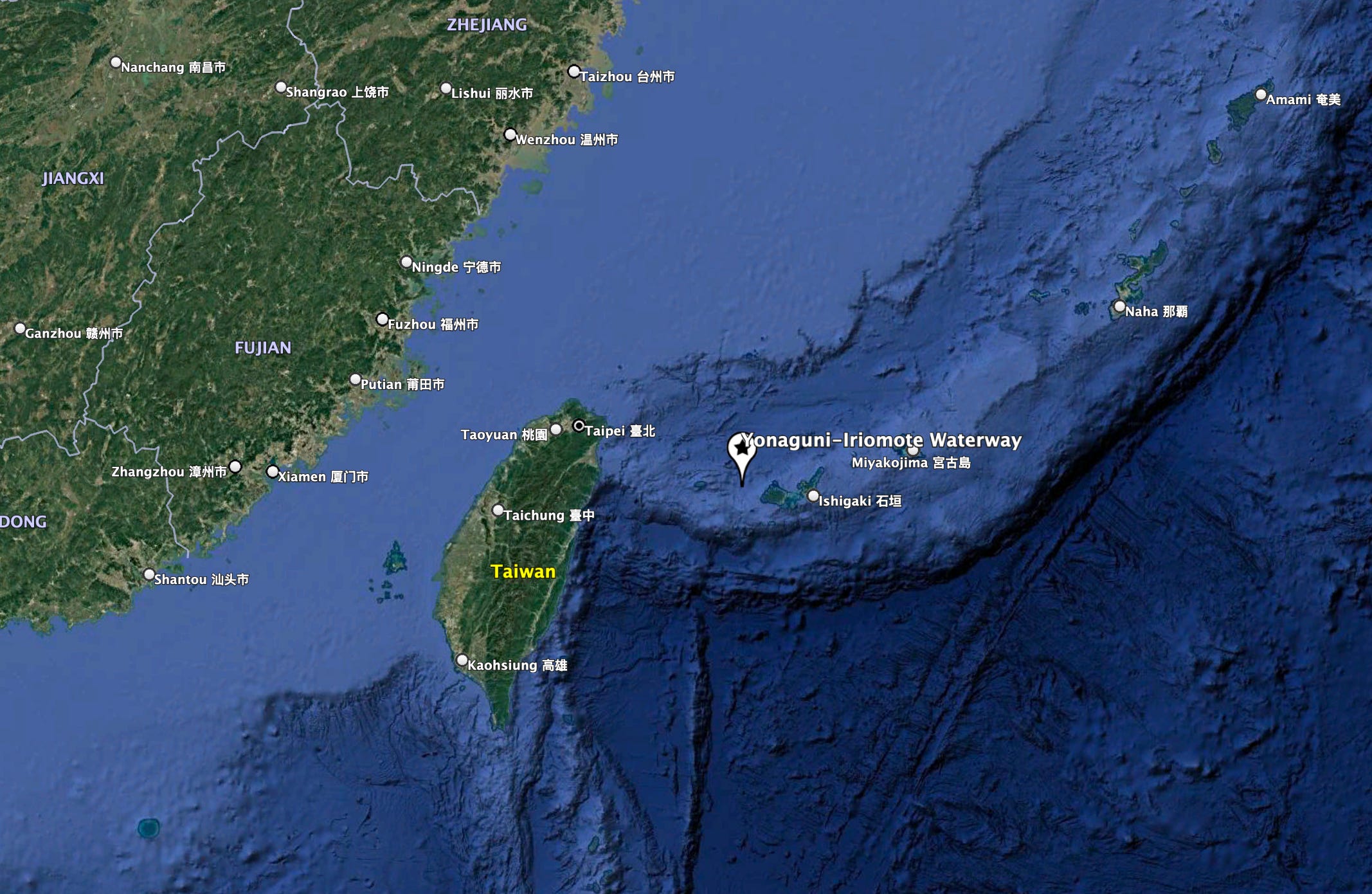
On April 22, the South China Morning Post reported that the PLA Navy conducted the first recorded transit of the Yonaguni-Iriomote Waterway between the Japanese southern islands of Yonaguni and Iriomote near Taiwan.
PLA Navy Task Force Conducts Exercise East of The Philippines
On April 24, The Southern Theater Command of the People’s Liberation Army (PLA) announced that it had organized a task force to conduct training exercises east of the Philippine island of Luzon. The exercises, involving live-fire drills, were held in response to the ongoing Balikatan 2026 joint exercise held by the US and Philippines on Luzon which featured increased participation from Japan this year.
Takeaways:
According to Chinese military analyst Wu Peixin, the sea trials would test the Sichuan’s ability to operate for prolonged periods on the open seas and serve as a “drone carrier” capable of launching strategic aerial drones from its electromagnetic catapult system and deploying large unmanned surface vessels.
Even though the Sichuan is not fully operationally ready, the PLA Navy appears nevertheless to be using its sea trials, timed to coincide with the Balikatan 2026 exercises, as an opportunity to project power. The PLA Navy engaged in a similar tactic last year when it used the sea trials of the Fujian aircraft carrier to impose restrictions on South Korea in the Yellow Sea Provisional Measures Zone.
China may be eager to demonstrate its growing naval strength now amid Balikatan 2026 to contrast its expansive military presence in the region with the US’s own reduced footprint in the Indo-Pacific amid the war with Iran.
This briefing was compiled by Dan White. Dan is an independent foreign policy analyst based in the New York Metro Area. Dan is a former member of The Wilson Center and The Kennan Institute. Dan holds masters degrees from the Johns Hopkins University School of Advanced International Studies (SAIS), the Naval Postgraduate School, and the University of Washington. Dan is a former officer in the United States Army and a veteran of the War in Afghanistan.
For more information, corrections, or comments, please contact dan@opforjournal.com.
The early Soviet Union, Mao’s China, and Castro’s Cuba come to mind among others.