


This week’s analysis highlights some of the most significant geopolitical developments involving America’s adversaries—China, Russia, Iran, and North Korea—between September 19, 2026 and September 26, 2026.
Executive Summary:
US War with Iran - Significant Activity Related to the US-Iran War
Iranian leaders visited New York where the Iranian President Pezeshkian addressed the UN General Assembly and sat down for an interview with Fox News, while Foreign Minister Araghchi held talks with US Special Envoy Steve Witkoff.
The Iranian Basij paramilitary organization opened a new “Jan-Fada” military training facility in Tehran for civilian volunteers as part of an effort to create new “national resistance battalions”.
The Eastern Front - Significant Activity Related to the War in Ukraine and Russian threats to NATO
United Russia, the ruling party of Russian President Vladimir Putin, swept State Duma elections in a vote characterized by widespread fraud, renewing the Kremlin’s mandate to carry on the war in Ukraine.
Russia launched multiple attacks on Ukrainian data centers in an effort to disrupt digital commerce and degrade civilian morale.
Western Pacific Flashpoints - Significant Activity in the Western Pacific and Taiwan
The US hosted Chinese President Xi Jinping for his first state visit since 2015. The mostly symbolic visit continued a US-China trade truce, initiated a strategic dialogue regarding AI, and seemingly saw the US adopt several Chinese positions on key issues affecting US interests in the Pacific.
North Korea announced the test of a new missile that bore the features of a hypersonic glide vehicle.
US WAR WITH IRAN
Significant Activity Related to the US-Iran War
1. IRANIAN LEADERS TRAVEL TO NEW YORK FOR UNGA AND INDIRECT TALKS WITH US
Iranian President Pezeshkian Addressed World Leaders at the UNGA and American People on Fox News
Iranian President Masoud Pezeshkian addressed the UN General Assembly (UNGA) on September 23, 2026. Pezeshkian’s speech decried US and Israeli attacks as terrorism resulting in civilian casualties and pushed back against criticism of Iran’s own indiscriminate attacks on its neighbors and international commerce. Pezeshkian announced that Iran would not surrender in the face of threats but would nevertheless remain open to talks to end the war with the US.
Pezeshkian followed the address to world leaders with a direct appeal to the American people in a September 24, 2026, Fox News interview with Bret Baier. In the interview the Iranian leader reiterated that Iran did not seek the war and would not yield to threats but is willing to end hostilities by returning to the provisions of the Islamabad Memorandum. Pezeshkian deflected questions regarding threats to international shipping in the Strait of Hormuz and Bab al-Mandeb Strait but notably suggested that Iran would be willing to negotiate an agreement to dilute its stockpile of highly enriched uranium and submit to inspections.
Iran’s Foreign Minister Conducted Talks with US Special Envoy in New York to Reopen the Strait of Hormuz
On September 23, 2026, an Iranian delegation led by Foreign Minister Abbas Araghchi met with US Special Envoy Steve Witkoff on the sidelines of the UN General Assembly in New York to discuss a mechanism for reopening the Strait of Hormuz.
The Iranian delegation proposed a plan to reopen the Strait of Hormuz over a seven-day period. The plan would be contingent upon the US resuming its obligations under the Islamabad Memorandum, namely, concluding its naval blockade of Iranian ports, ending hostilities against Iran and its proxies, and providing phased sanctions relief.
The US later rejected this formulation.
Takeaways:
Iran’s diplomatic efforts this week appear to signal that it believes it currently maintains a strong enough hand to secure a return to the previously favorable deal provided by the Islamabad Memorandum. However, a subtext of the Iranian pitch to return to the previous deal is uncertainty about whether such favorable conditions will last and whether the country will be able to secure a better outcome in a prolonged conflict. Even if the Republican Party suffers a rout in the midterm elections, US policy toward Iran will remain adversarial, and it is unlikely that a new Congress will support greater concessions than those already laid out in the Islamabad Memorandum. And if Iran’s advantages begin to erode as a result of deteriorating economic conditions and growing global pressure (like that exhibited in the wake of recent advances by the Houthis), it is unlikely that the increasingly hawkish regime will be able to agree to new compromises either. So a return to the Islamabad Memorandum now represents the best chance for Iran to de-escalate the war on its terms.
The suggestion by Iranian President Pezeshkian on Fox News that Iran would be willing to give up its stockpile of highly enriched uranium was a remarkable comment. While couched with a caveat of adhering to Iran’s responsibilities under international law, the remark undermined assertions that the country’s nuclear program was peaceful in nature and implied that the regime is currently violating the Nuclear Nonproliferation Treaty (NPT). In recent weeks, Iran has vigorously denied charges by the International Atomic Energy Agency that it has violated the NPT.
The assertion that Iran would give up its stockpile of highly enriched uranium also likely overstepped the President’s authority, as responsibility for such decisions is left to the Supreme Leader. On September 25, 2026, Reuters reported that an unnamed senior Iranian official stated that Iran would make no concessions on its nuclear program even if a deal to reopen the Strait of Hormuz was reached, suggesting an effort to walk back Pezeshkian’s remarks.
2. NEW CIVILIAN PARAMILITARY TRAINING CENTER OPENS IN TEHRAN
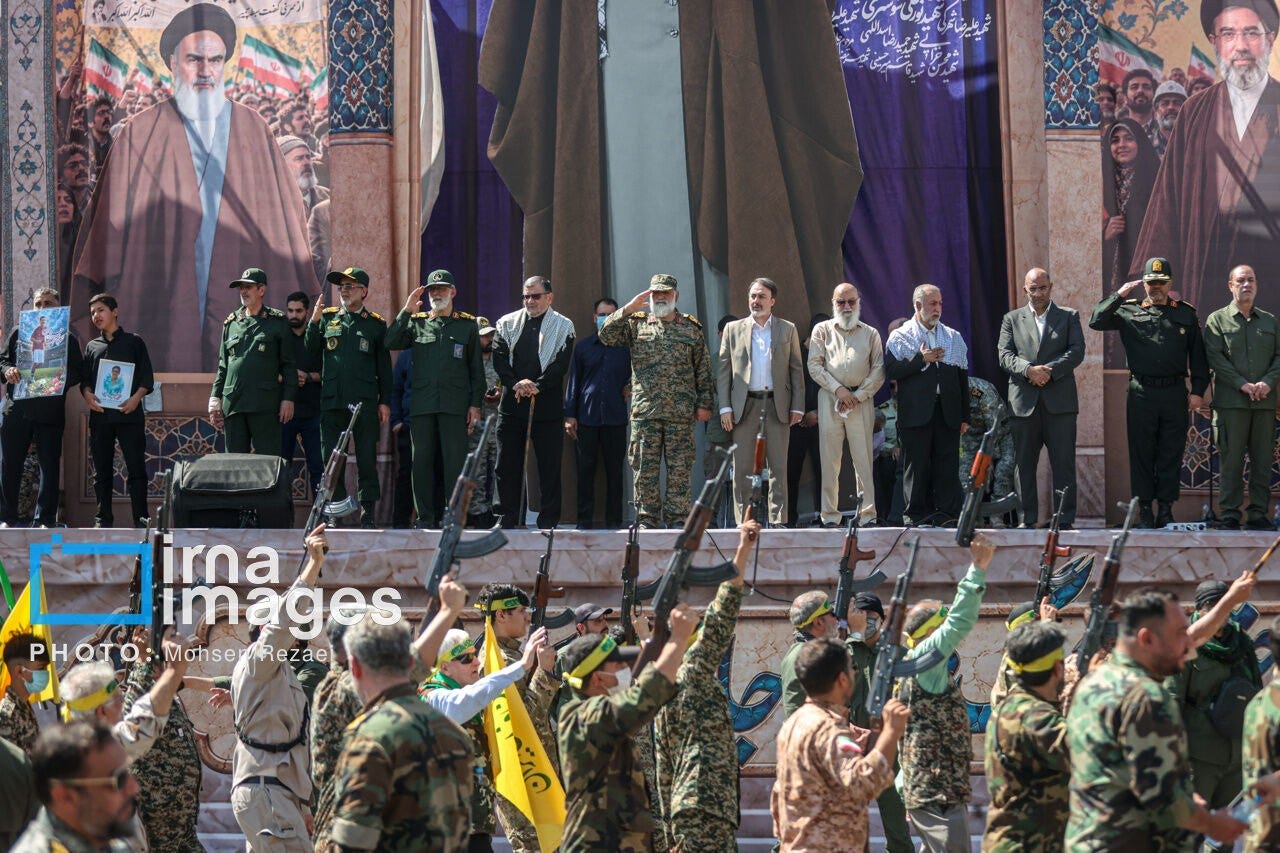
On September 23, 2026, Iranian state media reported the opening of the first “Jan-Fada” military training center for civilian volunteers in Tehran. The Jan-Fada, short for “Jan-Faday-e Iran” (roughly: those willing to sacrifice for Iran), was launched by Iran’s Basij paramilitary in 2026 after the start of the US-Israeli war. The Jan-Fada are envisioned as an expansive irregular force of volunteers that are basically trained in combat skills and can be called upon as “national resistance battalions” to defend Iranian territory in the event of an invasion.
Speaking at the opening of the new center in Tehran’s Imam Hossein Square, Basij commander Hossein Taeb declared the Jan-Fada to be “the largest popular campaign in the history of the world’s wars,” and announced plans to develop 1,000 Jan-Fada battalions.
The opening of the new training center came days after the mustering of 313,000 Jan-Fada volunteers for demonstrations in the greater Tehran metropolitan area on September 18, 2026.
Takeaways:
The claims of a 313,000-strong demonstration in Tehran prior to the opening of the center appear to be exaggerated. PressTV acknowledges the figure as symbolic, stating:
“The number 313 is not accidental. The 313,000 people taking part in the Tehran drill is a direct reference to the number of Imam Mahdi’s (AS) companions in Islamic narrations, the same 313 people who are identified in Shiite texts as the supporters of the Imam of the Age.”
Other claims of widespread support for the Jan-Fada campaign appear to be inflated as well. Independent Iranian fact-checking organization FactNameh has found that evidence provided by Jan-Fada organizers to support claims of 30 million online registrations for the movement suggested millions of fraudulent accounts. FactNameh has suggested the total number of legitimate registrations was well under 4 million.
Though of dubious value as a fighting force, the Jan-Fada provides legitimacy-boosting displays of grassroots support for the Iranian regime that help it undermine narratives of widespread public disaffection. Images of government security forces backed by thousands of armed citizens also help deter the mobilization of future anti-government protests.
Independent Iranian media organization IranWire reports that the Jan-Fada campaign is being viewed skeptically by some members of the Iranian government and security apparatus who consider it an attempt by Hossein Taeb to bolster his image and power. These reports merit close consideration for what they reveal about the internal dynamics of the Iranian regime, because they correspond with reporting by The New York Times earlier in September that Taeb has played an outsized role in subverting negotiations with the US and in continuing unauthorized attacks on shipping in the Strait of Hormuz.
EASTERN FRONT
Significant Activity Related to the War in Ukraine and Russian threats to NATO
3. RUSSIAN PARLIAMENTARY ELECTIONS RESULT IN VICTORY OF PUTIN’S UNITED RUSSIA PARTY
Russia concluded three days of voting for its State Duma elections on September 20, 2026.1 The election resulted in a victory for the ruling United Russia party. With approximately 58% of the vote, the party of President Vladimir Putin expanded its parliamentary majority to 355 of the 450 seats in the Duma.
The result is widely seen as rigged and illegitimate. Statistical models of voting patterns analyzed using the “Shpilkin Method” by Russian independent media outlet Novaya Gazeta Europe estimated that United Russia only secured around 34% of the actual vote.
Takeaways:
Elections in Russia are taken seriously even if the outcome is predetermined, because voting provides valuable data on public sentiment. By weighing criteria such as expected turnout and voting patterns against actual results, Russian leaders are able to understand how different populations feel about government policy. This enables them to better anticipate the potential destabilizing effects of major changes to policy, such as tax increases, spending cuts, or, as is relevant now, major military mobilizations. Elections, even rigged ones, also serve as a collective ritual in validating the legitimacy of the Putin regime.
This election saw the elevation of 46 veterans of the war in Ukraine to the Duma. The move solidifies a pro-war constituency within the parliament that further ensures that the war in Ukraine remains the primary focus of government policy despite growing costs. Promoting military veterans also helps the Kremlin demonstrate tangible social benefits associated with wartime service.
4. RUSSIAN DRONE STRIKES TARGET DATA CENTERS IN KYIV
This week, Russian forces launched multiple attacks on Ukrainian data centers and telecommunications infrastructure. On September 23, 2026, Russian drones struck multiple co-location data centers in Kyiv, resulting in disruptions of internet service to 100,000 households across Kyiv Oblast. On September 25, 2026, Russian drones hit and damaged the Cosmonova data center in Kyiv, disrupting several national TV broadcasts before backups were restored.
This week’s strikes were preceded by attacks on facilities of Kyivstar, Ukraine’s largest telecom provider, on September 11 and 17, 2026.
Russia’s Ministry of Defense has confirmed that it has begun targeting data centers that it claims provide “data storage, processing, and transmission, including intelligence data, as well as the operation of network equipment for the Ukrainian Armed Forces”.
Takeaways:
Whatever its claimed justification, Russia’s true aim in targeting data centers is to disrupt digital commerce and upend the lives of Ukrainian civilians. The attacks are part of an effort by Russian forces to take advantage of Ukraine’s current vulnerability resulting from a diminished supply of air defense interceptors to degrade Ukrainian morale by destroying as much critical infrastructure as possible ahead of winter. Facing a stalemate, and even a growing series of setbacks on the front line, Russia’s strategic bombing campaign likely aims to trigger humanitarian crises in Ukrainian population centers that lead to new waves of migration and pressure Kyiv and its European allies into a settlement on Moscow’s terms.
WESTERN PACIFIC FLASHPOINTS
Significant Activity in the Western Pacific and Taiwan
5. US HOSTS CHINESE PRESIDENT XI JINPING FOR STATE VISIT
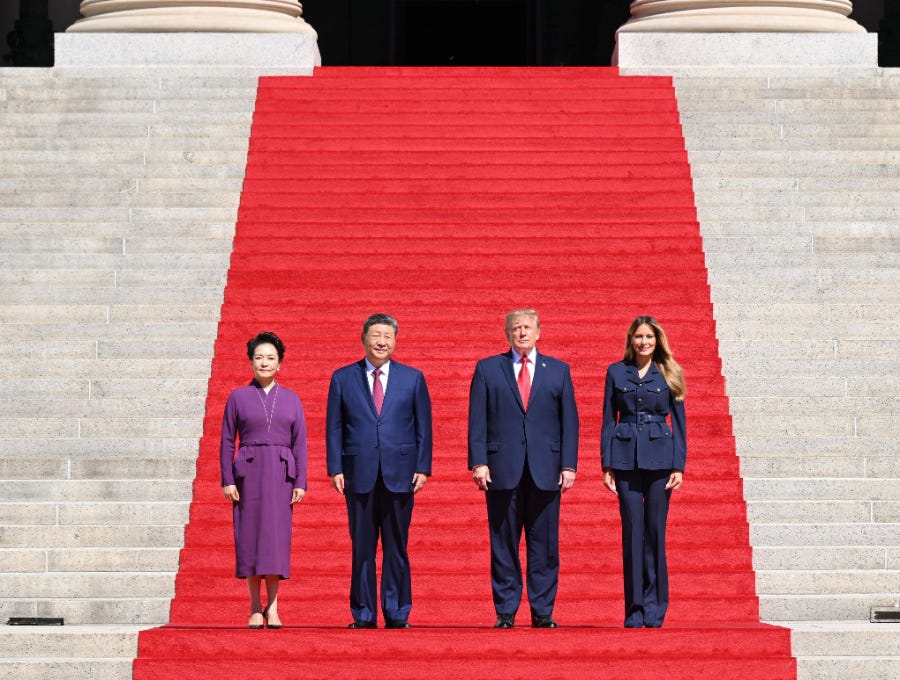
Between September 23 and 25, 2026, US President Donald Trump hosted Chinese President Xi Jinping for a state visit. The visit, primarily held in Washington, DC, featured a banquet that included prominent US business and technology leaders, and a visit to the National Archives. The trip came four months after President Trump’s own state visit to China in May and marked the first time Xi has been in the US since 2015.
China announced eight deliverables resulting from the trip:
1. The two sides agree to build “a constructive China-U.S. relationship of strategic stability on the basis of respect, fairness, and reciprocity.”
2. China and the United States support each other in successfully hosting the APEC Economic Leaders’ Meeting and the G20 Summit. The two heads of state intend to attend each other’s meetings.
3. The two heads of state agree that Iran should honor its commitment to not developing nuclear weapons, and no country or institution can be allowed to impose tolls on international waterways.
4. The two heads of state recall that China and the U.S. were allies in World War II and fought side by side to win the war.
5. The two heads of state recognize the positive role of the China-U.S. economic and trade consultation mechanism, endorse the outcomes of the consultations between the two economic and trade teams, including establishing and taking forward the Board of Trade and other mechanisms, reaching an arrangement for a US$30 billion reciprocal tariff reduction, and the extension of the outcomes of economic and trade consultations in Kuala Lumpur, and give instructions that they be implemented.
6. The two sides note that cooperation between the counter-narcotics and law enforcement agencies of China and the U.S. has produced visible outcomes. Recently, the two sides working closely together have jointly cracked multiple cases involving New Psychoactive Substances (NPS) and precursor chemicals, and apprehended dozens of relevant criminal suspects in the two countries.
7. The two sides agree on the establishment of the China-U.S. AI Dialogue to exchange views on risks and benefits related to AI. The next exchange will occur in November 2026. China and the U.S. also agree to establish a bilateral communication channel for AI incidents.
8. The United States welcomes the arrival of two giant pandas, leased by China to Zoo Atlanta.
Takeaways:
The visit provided an opportunity for the US and China to stabilize economic ties over the near term. The continuation of the current trade truce was a positive development that allowed both leaders to maintain a status quo through a series of major events including the US midterm elections, China’s hosting of the Asia-Pacific Economic Cooperation (APEC) summit, and the G-20 summit in Miami. The announcement of the start of a joint AI dialogue was a similarly positive step that may yield a long-term institutional mechanism for setting guardrails on technological competition.
The visit did little to resolve other major issues inflaming Sino-US relations, such as China’s continued support for Russia’s war against Ukraine, its support for the Iranian regime, its transnational repression targeting US citizens, and increasingly aggressive activities in the Pacific directed at Taiwan and US treaty allies Japan and the Philippines. Official press releases by both sides detailing the outcomes of the visit suggest the US may have inadvertently signaled a lack of resolve on these issues.
Emphasizing China as a key American ally of the Second World War undercut America’s current alliance with Japan at a time when Tokyo is under increasing Chinese pressure over its decision to rearm and play a more proactive role in regional security. The lack of a compelling response to China’s attempts to reframe the official US position on Taiwanese independence from “does not support” to outright opposition may, along with the administration’s current hesitancy to support congressionally-approved military assistance, reinforce doubts about the US commitment to deterring a Chinese invasion of the island. The US’s adoption of China’s preferred framing of Sino-US ties as “constructive relationship of strategic stability on the basis of respect, fairness, and reciprocity,” also signals a significant retreat from a previous US policy of strategic competition that was initially articulated during the first Trump administration.
6. NORTH KOREA TESTS HYPERSONIC WEAPON
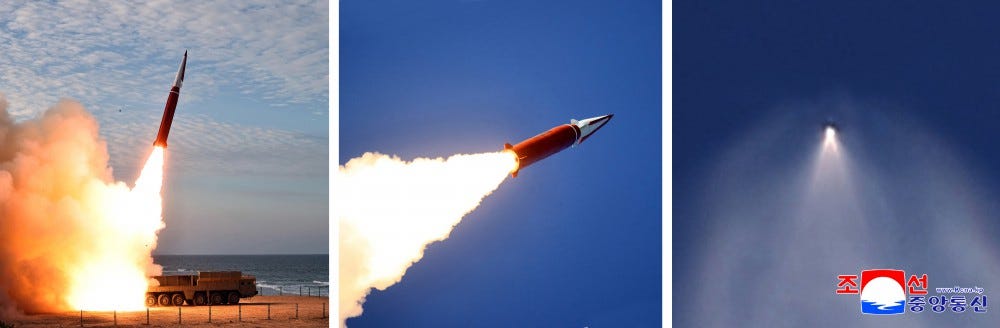
On September 20, 2026, North Korea launched two missiles from Wonsan approximately 450 km and 600 km, respectively, into the East Sea (Sea of Japan). North Korea followed the launch on September 22 with an announcement that the missiles tested represented a “new-type weapon, which is of great significance in the rapid technological development of weapon systems.”
Photos of the launch released by Korea Central News Agency suggest the missile, a Hwasong-11Ma (aka Hwasong-11E-1), was carrying a hypersonic glide vehicle.
Takeaways:
Most sophisticated ballistic missiles travel at hypersonic speeds, but true hypersonic weapons typically fall into one of two categories: hypersonic cruise missiles (HCM) and hypersonic glide vehicles (HGV). HCMs are continuously powered “air breathing” missiles that maintain hypersonic speed throughout their flight. HGVs, on the other hand, are unpowered glide weapons that are launched into the upper atmosphere by an initial rocket booster and use the lack of atmospheric pressure and resistance to maneuver at hypersonic speed toward a target. HCMs and HGVs are extremely sophisticated weapons, whose development has challenged the world’s most advanced militaries. As a result, it is unlikely that North Korea has developed a viable HGV.
 Tal Inbar@inbarspaceEnhancing the original image released by North Korea allows for an excellent view of the HS-11Ma hypersonic glide missile trajectory, providing altitude and speed data. Note: Slight inaccuracies in the numbers may occur due to the use of AI tools.
 7:25 AM · Sep 22, 2026 · 16K Views2 Replies · 43 Reposts · 162 Likes
Even if its progress is exaggerated, North Korea is likely making progress on developing HGVs nonetheless. North Korea has tested prototypes of hypersonic missiles for several years now. The September 15, 2021, launch of a ballistic missile that exhibited an unusual trajectory and flight characteristics represents the earliest known test of a North Korean HGV. That test, well preceding the Comprehensive Strategic Partnership with Russia, suggests North Korean advances in hypersonics have largely been driven by domestic research and development rather than outside technical assistance.

This briefing was compiled by Dan White. Dan is an independent foreign policy analyst based in the New York Metro Area. Dan is a former member of The Wilson Center and The Kennan Institute. Dan holds masters degrees from the Johns Hopkins University School of Advanced International Studies (SAIS), the Naval Postgraduate School, and the University of Washington. Dan is a former officer in the United States Army and a veteran of the War in Afghanistan.
For more information, corrections, or comments, please contact djwhite155@gmail.com.