



This week’s analysis highlights some of the most significant geopolitical developments involving America’s adversaries—China, Russia, Iran, and North Korea—between October 10, 2026, and October 17, 2026.
Executive Summary:
US War with Iran - Significant Activity Related to the US-Iran War
Iran launched what is likely the most intense week of attacks on commercial shipping in its adjacent waters since the start of the war, in an effort to roll back a recent rebound in regional energy exports.
The Eastern Front - Significant Activity Related to the War in Ukraine and Russian threats to NATO
Russia launched a series of drone strikes on commercial ships off the coast of Bulgaria and Romania, including an attack on a ship anchored in Romanian territorial waters.
Russia intensified attacks on Ukrainian critical infrastructure amid US threats toward Kyiv.
Western Pacific Flashpoints - Significant Activity in the Western Pacific and Taiwan
China imposed sanctions on Paraguay’s communications minister Gustavo Villate and Belize’s foreign minister Francis Fonseca, over their countries’ support for Taiwan.
North Korea conducted multiple naval weapons tests including submarine-launched strategic cruise missiles and an alleged AI-enabled torpedo.
US WAR WITH IRAN
Significant Activity Related to the US-Iran War
1. IRAN ESCALATES ATTACKS ON SHIPPING IN THE STRAIT OF HORMUZ
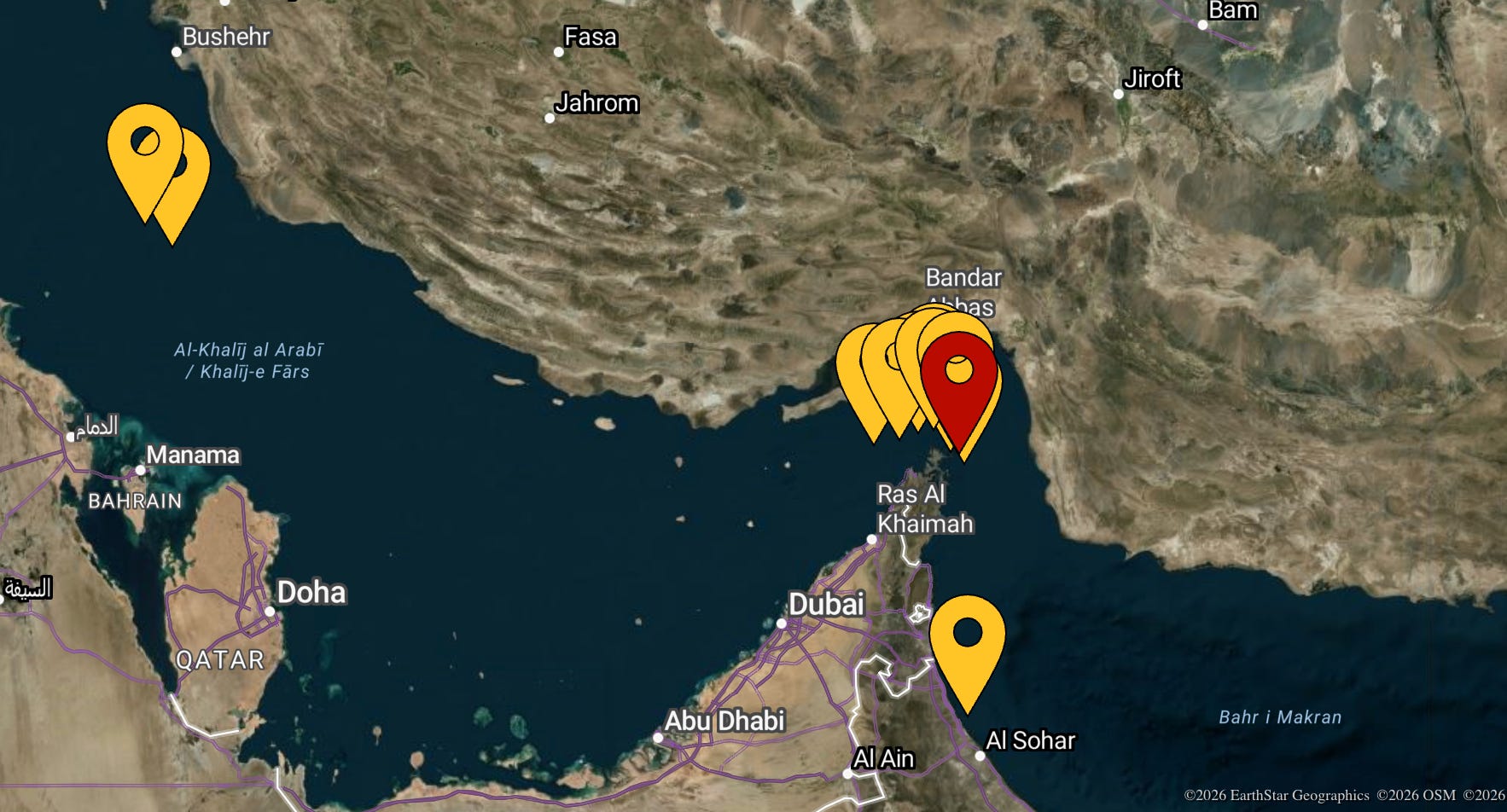
This week Iranian forces escalated their attacks on shipping near the Strait of Hormuz, in a continuation of the most intense days of strikes on commercial ships since the start of the war. The United Kingdom Maritime Trade Operations (UKMTO) Centre, the authoritative reporting body for maritime incidents in the Middle East and Indian Ocean, recorded 12 suspected Iranian attacks on commercial vessels in the Arabian Sea, Strait of Hormuz, and Gulf of Oman between October 10 and October 17, 2026.
Takeaways:
The spike in attacks on shipping follows weeks of growing Iranian threats. As noted in Weekly Significant Activity Report - October 3, 2026, the intensity of recent Iranian attacks appears to be growing in direct response to successful efforts by the US and Gulf Cooperation Council (GCC) countries to restore regional oil and gas exports to near pre-war levels, while simultaneously enforcing a naval blockade prohibiting Iranian trade. Iran is effectively trying to regain leverage by countering narratives that it is on the back foot and once again raise the risk of transit through the Strait of Hormuz to unacceptable levels for commercial shipping firms.
The growing number of successful Iranian strikes, achieved despite significant degradation inflicted on its air and naval forces by the US military campaign, appears to have been facilitated by adaptations toward lower-tech asymmetric capabilities. Among these adaptations are the deployment of forward observers placed on civilian ships, including dhows, around the Strait of Hormuz, as well as the use of speed boats carrying small arms and rockets.
EASTERN FRONT
Significant Activity Related to the War in Ukraine and Russian threats to NATO
2. SUSPECTED RUSSIAN DRONES STRUCK MULTIPLE COMMERCIAL SHIPS NEAR OR WITHIN NATO WATERS
Suspected Russian Drones Struck Multiple Commercial Ships Off Bulgaria’s Black Sea Coast
In overnight attacks on October 12-13, 2026, suspected Russian drones struck the Turkish-owned, St Vincent & Grenadines-flagged cargo ship Azov Concorde, 17 nautical miles off the coast of Krapets, and the Ukrainian-owned, Maltese-flagged Chelsea 3, 15 nautical miles off the coast of Byala. Both attacks occurred within Bulgaria’s exclusive economic zone.
Bulgaria has not yet officially blamed Russia for the attacks, but has taken a number of measures that indicate it believes Russia is responsible, including the summoning of the Russian ambassador, and public statements by Bulgarian Prime Minister Rumen Radev insinuating that Ukrainian responsibility was implausible.
On October 16, 2026, Bulgaria requested NATO military assistance to defend against drone attacks.
Suspected Russian Drones Strike At Least One Ship Within Romanian Territorial Waters
Multiple suspected Russian drones struck four ships off the Black Sea coast of Romania between October 14 and October 15, 2026, resulting in at least eight deaths. One of the ships, the Comoros-flagged tanker Yara, was struck while it was anchored 8-10 nautical miles from shore, placing it well within Romanian territorial waters.
Statements by Romanian leaders insinuated Russia was to blame for the attacks by implying responsibility for causing deteriorating security in the Black Sea, but ultimately stopped short of direct attribution.
Takeaways:
The attacks represent an alarming escalation of previous Russian drone incursions into outright casualty-producing kinetic attacks on NATO territory. The significance of these events was underscored by a Bulgarian request to NATO on October 16, 2026, for increased military assistance to defend against further Russian drone incursions and attacks on shipping near its territorial waters. This represents a remarkable turnabout for the previously Russia-friendly government of Rumen Radev, which is in effect now signaling it believes it faces potential direct military threats from Moscow.
Romanian and Bulgarian officials have both carefully worded their public statements to imply ultimate Russian responsibility for destabilizing the Black Sea and threatening Europe, without directly attributing the individual attacks to Russia. The wording appears intended to assign blame to Russia in order to mobilize allies for collective defense without necessitating an direct response that could escalate into war. Consider the following statements by Romanian President Nicușor Dan and Romanian Foreign Minister Oana Țoiu on X:
These drone attacks are direct consequences of Russia’s war of aggression against Ukraine and endanger not only shipping in our region but also vital agricultural supplies to other continents.
In its war of aggression against Ukraine, against all provisions of international law, Russia is making the Black Sea into a dangerous area for civilian ships. The killing of merchant mariners in the region and all over the world is a crime. Russia bears full responsibility for these developments.
The strikes are likely an effort to not only inflict greater costs on Ukraine’s European allies, but make these countries rethink giving their limited stocks of air defense missiles to Kyiv due to increasing risks of aerial bombardment on their own territory.
3. RUSSIA LAUNCHES MASSIVE ASSAULTS ON UKRAINIAN CITIES AND POWER GRID AMID NEW US THREATS TOWARD UKRAINE
This week Russia continued to hammer Ukrainian critical infrastructure, including its power grid, despite an “ENERGY CEASEFIRE” (unilaterally) announced by US President Donald Trump. Attacks between October 11 and October 14 involving hundreds of drones and dozens of missiles struck three of Kyiv’s remaining thermal power plants as well as energy infrastructure in Kharkiv, leaving 600,000 residents without power. The attacks also caused significant damage to residential areas in both cities.
They were followed by what Ukrainian President Volodymyr Zelensky called "one of the largest strikes on Ukraine's energy infrastructure", between October 16-17. The overnight attacks targeted population centers across the country including in Kharkiv, Sumy, Dnipropetrovsk, Vinnytsia, Odesa, Donetsk, Kherson, and Zaporizhzhia Oblasts, killing at least 7 and injuring 90.
Takeaways:
The Russian drone and missile strikes took advantage of unilateral restraint imposed on Ukraine by US President Donald Trump through threats to cut US military and intelligence assistance to the country. The strikes themselves may have even benefited from curbs imposed on US intelligence sharing and degraded Starlink connectivity which prevented Ukrainian civilians from getting early warnings of incoming strikes, and obstructed opportunities for interceptions. These accusations, reported by American and European media outlets, have been denied by the White House.
This turn in US policy away from its allies and partners toward Russia is not only deeply shameful but extremely dangerous for US national security and the international order. Russia under Vladimir Putin has defined itself on its permanent hostility and antagonism toward the US. Actions which provide comfort or assistance to Russia in advancing its aggressive designs on Ukraine and Europe ultimately compromise the US’s global reputation and power and offer little in return because gestures of goodwill toward the Kremlin will not be reciprocated. The war in Ukraine was launched, and continues, as part of a broader goal by the Kremlin to destabilize the international system in order to provoke a permanent decline of the West (including the US) which allows for the rise of a multipolar system with Russia serving as a prominent pole. The massive costs of the war in Ukraine have further brutalized Russian society and deranged Russian decision making, binding it irrevocably toward achieving this goal, even if it leaves them and the rest of the world permanently worse off.
Russian attacks on shipping near Bulgaria discussed above, in addition to an apparent new threat to a US commercial satellite by a potential Russian space weapon observed this week, provide further evidence that the Kremlin will not respond to positive incentives to moderate its aggressive intentions toward the West.
As noted in previous Weekly Significant Activity Reports, Russia intends to take full advantage of Ukrainian vulnerability resulting from depleted stocks of air defense interceptors and strained relations with the US. This week’s attacks are part of a larger strategy to instigate a humanitarian crisis in Ukraine with overwhelming long-range strikes on Ukrainian critical infrastructure. The Kremlin likely hopes to make Ukrainian cities uninhabitable in order to spur new waves of migration that drain the Ukrainian economy, degrade military morale, and destabilize the European Union, creating a poly-crisis that forces Ukraine and its allies to settle the war on its terms.
WESTERN PACIFIC FLASHPOINTS
Significant Activity in the Western Pacific and Taiwan
4. CHINA IMPOSES SANCTIONS ON SENIOR OFFICIALS OF PARAGUAY AND BELIZE
On October 12, 2026, China’s Ministry of Foreign Affairs announced sanctions targeting Paraguay’s communications minister Gustavo Villate and Belize’s foreign minister Francis Fonseca. According to an official statement in Chinese state media, the rationale for the sanctions was over the officials’ visits to Taiwan amid their countries’ continued formal recognition of the island.


Takeaways:
The new sanctions represent another Chinese move to slowly tighten a multi-dimensional quarantine around Taiwan that imposes physical and political constraints on its sovereignty.
China is incrementally reducing the island’s physical sovereignty through aggressive air and maritime patrols around its territory. A major step forward in this element of the campaign was instituted this summer with newly regularized Coast Guard patrols east of the island.
China is also slicing away at Taiwan’s political sovereignty by increasing the costs for its leaders to travel abroad and for its allies to continue their support. The new sanctions form a part of this effort. Other actions to this effect in recent months include:
pressure on African nations to thwart the travel of Taiwan’s President Lai Ching-te to Eswatini in April;
pressure on Papua New Guinea to close a Taiwan trade representative office in Port Moresby in July;
pressure on South Pacific nations to drop out of the Pacific Islands Forum summit in Taiwan ally Palau in August;
pressure on the Trump administration to shelve Congressionally mandated military assistance to Taiwan.
5. NORTH KOREA CONDUCTS SUBMARINE MISSILE AND TORPEDO TESTS
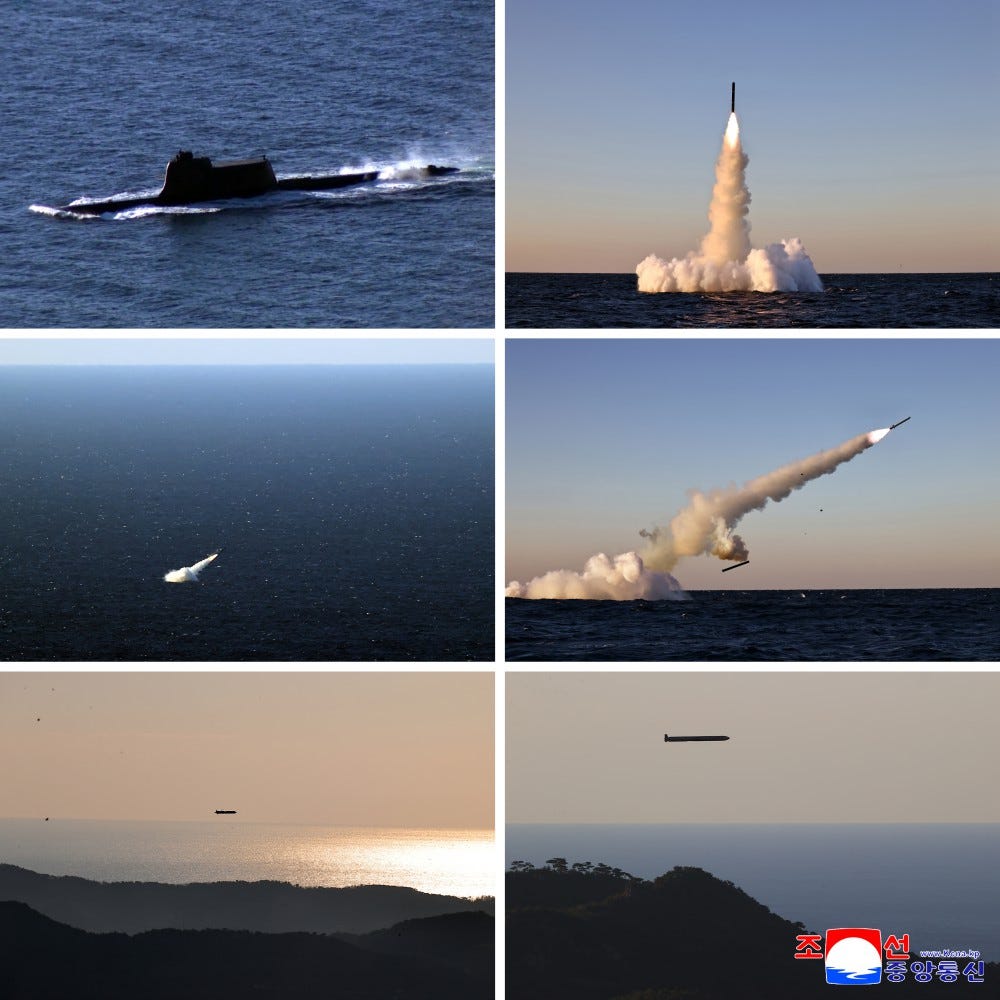
On October 14, 2026, North Korea fired two submarine-launched strategic cruise missiles from its 3,000-ton self-proclaimed “nuclear attack submarine” Hero Kim Kun Ok into the East Sea (Sea of Japan). The state media outlet Korean Central News Agency reported that the test featured two different kinds of missiles. The event was the first submarine-launched missile test North Korea has conducted since January 2024.
A day later, on October 15, North Korea’s Academy of Defense Science announced that it had conducted an underwater test-firing of a “new-type super-speed precisely guided torpedo weapon system”. The new torpedo, called the Zam 2.0, allegedly integrates artificial intelligence into its guidance and target detection systems.
Takeaways:
This week’s submarine missile launch and torpedo test are a part of a much broader and underappreciated geopolitical development— the rapid growth and modernization of the North Korean Navy. The development of a modern navy has been a priority that Kim Jong-un has articulated since at least 2015. Major milestones toward this goal have been the unveiling of the Hero Kim Kun Ok in September 2023 and the launch of two 5,000-ton Choe Hyon-class destroyers.
An October 16, 2026, article in North Korea’s state-media outlet Pyongyang Times contextualized this week’s naval exercises as part of Kim Jong-un’s strategy to make the country a maritime power.
The DPRK’s centuries-old dream of becoming a maritime power is coming true.
For the country which borders the sea both on the east and the west, the maritime sovereignty can be said to be the core of the sovereign rights.
According to the plan and guidance of the Workers’ Party of Korea for building the DPRK into a maritime power that no one can dare provoke, the Navy of the Korean People’s Army is developing into an all-round and powerful Juche-based service with improved combat efficiency and full modern surface and underwater offensive and defensive means.
In recent years alone, the first tactical nuclear attack submarine and two new-type multi-mission destroyers were built, transferred to the KPA Navy and commissioned.This re-envisioning of North Korea as a maritime power coincides with recent moves by Kim Jong-un to formally abandon reunification with the South as a top priority and adopt a new “Two Hostile States” doctrine. As Bomi Kim, Director of North Korean Studies at the Institute for National Security Strategy in Seoul, has noted, this shift away from a national strategy that prioritized control of the territory of the Korean Peninsula would naturally elevate the maritime domain as a field of competition between North Korea and the South and its other neighbors. In effect, by accepting a permanent division of the Korean Peninsula, Pyongyang would have to conceptualize its territory as a geopolitical island that is largely sandwiched between an overbearing China and permanently estranged South Korea. Like any island, maritime resources and seaborne trade would provide the greatest opportunities for North Korea’s long-term economic growth in this conception.
This briefing was compiled by Dan White. Dan is an independent foreign policy analyst based in the New York Metro Area. Dan is a former member of The Wilson Center and The Kennan Institute. Dan holds masters degrees from the Johns Hopkins University School of Advanced International Studies (SAIS), the Naval Postgraduate School, and the University of Washington. Dan is a former officer in the United States Army and a veteran of the War in Afghanistan.
For more information, corrections, or comments, please contact djwhite155@gmail.com.