



This week’s analysis highlights some of the most significant geopolitical developments involving America’s adversaries—China, Russia, Iran, and North Korea—between January 17, 2026 - January 24, 2026.
Summary:
Russia conducted its first series of trilateral negotiations with the US and Ukraine from January 23-24. The talks did not result in a breakthrough.
Russia and China reported worsening demographic trends for 2025.
Two top Chinese military leaders were removed for investigations into serious misconduct, continuing President Xi Jinping's ongoing purge of the military.
New evidence of China’s growing maritime might surfaced this week with reports of massive Maritime Militia maneuvers in the East China Sea and increasing operations in the territorial waters of the Philippines.
After four weeks, Iranian forces curbed the growth of anti-government protests through unprecedented violence, killing at least 5,000 people.
1. RUSSIA CONDUCTS FIRST TRILATERAL NEGOTIATIONS WITH US AND UKRAINE WITH LITTLE SIGN OF A BREAKTHROUGH AHEAD
Russia conducted its first trilateral peace negotiations with Ukraine and the US in the United Arab Emirates from January 23-24. US special envoy Steve Witkoff called the talks “very constructive.” However, Russia showed little sign of backing down from its recurring demand that Ukraine withdraw from the entirety of Donetsk and Luhansk oblasts, territory Russia has struggled to seize after almost four years of war.
Immediately prior to the start of the talks Russian President Vladimir Putin told visiting US Special Envoys Witkoff and Jared Kushner that there was “no hope” of concluding peace without a Ukrainian surrender of the Donbas.
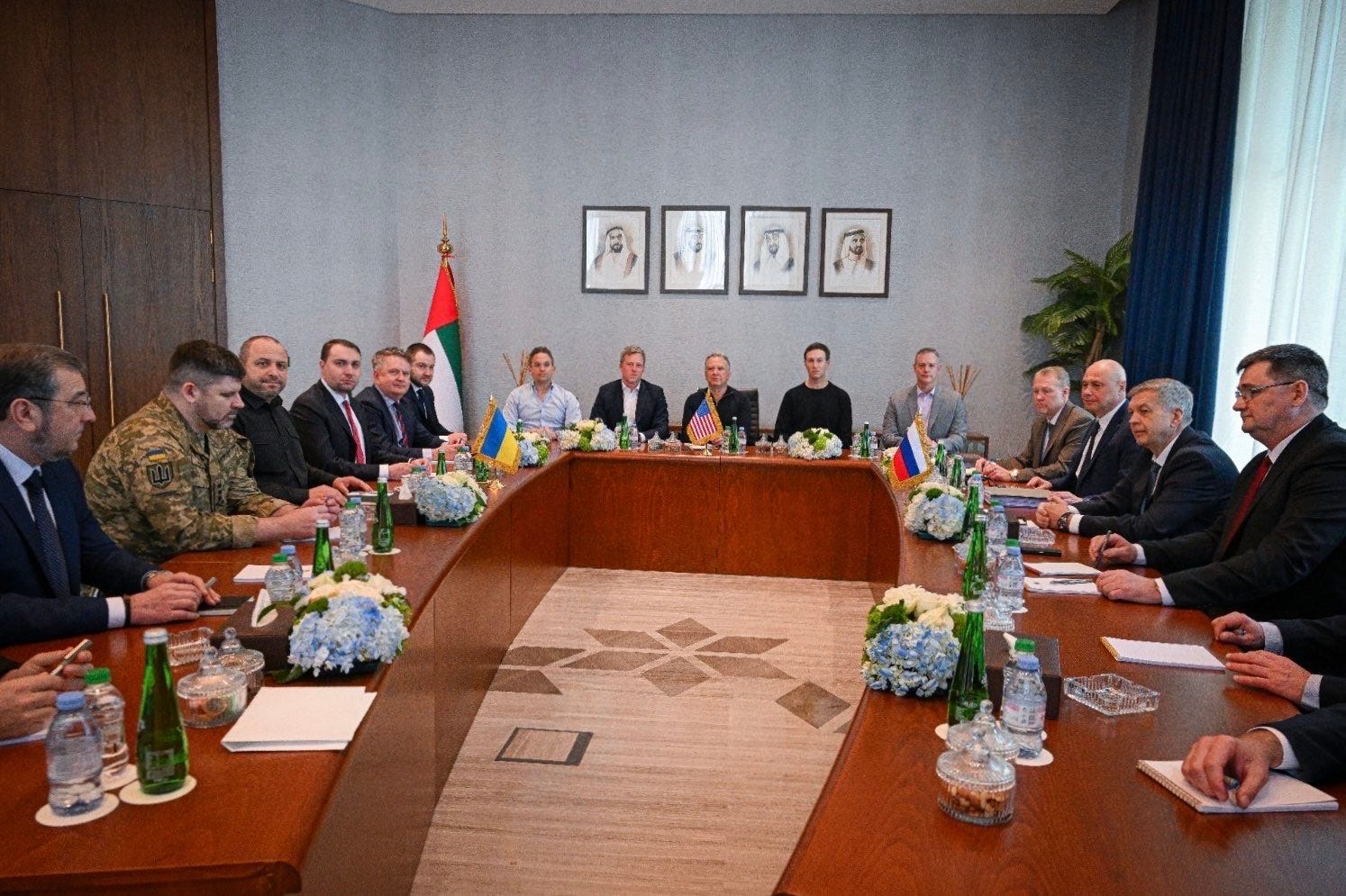
Negotiations are set to resume on February 2.
Takeaways:
Russian President Vladimir Putin cannot end the war under current conditions without appearing to accept defeat. While Putin has offered shifting explanations of the war's objectives—from grandiose plans to rewrite the world order to vague goals of demilitarizing and "denazifying" Ukraine—five key objectives identified in OPFOR Journal's May Situation Report: Ceasefire Negotiations with Russia provide a conservative interpretation of Russia's initial war aims:
“Permanently arrest Ukraine’s societal drift toward Europe. Foreclose paths to EU and NATO membership. Incorporation of Ukraine into Russian institutions such as the Eurasian Economic Union, Collective Security Treaty Organization, and Commonwealth of Independent States. (Not achieved)”
“Establish Russian political control of the country through the installation of a puppet regime in Kyiv, (Not achieved)”
“Resolve outstanding issues resulting from the seizure of Crimea and frozen conflict in the Donbas. These include establishing direct Russian annexation and administration of the Donbas territories of Donetsk and Luhansk, and de facto Russian control of Kherson and Zaporizhzhia oblasts to create a land bridge to Crimea, (Partially achieved)”
“Prevent Ukraine from breaking free of Russian rule again through a systematic suppression of Ukrainian nationalism, resulting from a purge of Ukrainian national elites and institutions. (Not achieved)”
“Leverage quick victory in Ukraine to re-assert Russia as an ascendant great power in contrast to declining West. (Partially achieved)”
Russia still has not fully achieved any of these goals.
While Russia may be able to claim credit for preventing Ukraine from joining NATO, this will not provide a convincing case for victory. Ukraine was not on a clear path to NATO membership before the war, and by the war's end will be de facto more integrated into Western European security infrastructure than it was beforehand.
The war has also likely pushed Kremlin control over internal Ukrainian politics, and Kyiv’s participation in Russian initiatives, permanently out of reach by making the war a core part of Ukrainian cultural identity.
As a result, Russia must achieve some kind of tangible battlefield victory. The seizure of the Donbas is key to this objective for two reasons: First, it appears achievable for Russia's diminished military, though capturing the region could still take many more months at high cost. Second, it directly corresponds with Russia's original justification for starting the war in February 2022, to protect Russian-speaking residents of the Donbas from a fabricated “genocide” by Ukrainian forces.
2. RUSSIA AND CHINA FACE WORSENING DEMOGRAPHICS GOING INTO 2026
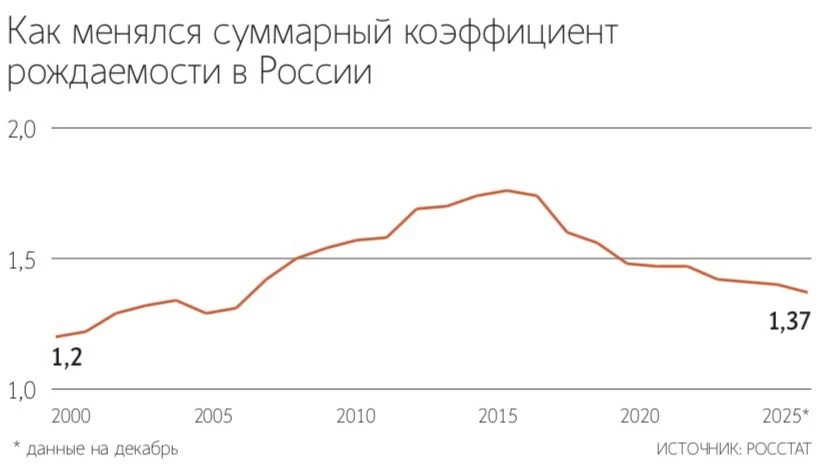
Russia’s Fertility Rate Reaches 20-year Low
According to Russian business journal Vedomosti, Russia’s total fertility rate continued to decline in 2025, reaching a 20-year low of 1.374.
China Records Lowest Number of Births Since 1949
China's birth rate fell for the fourth consecutive year in 2025, reaching its lowest level since 1949.
Takeaways:
To some extent the worsening birth rates in both China and Russia follow broader global trends for developed countries and are not entirely unique. However, what distinguishes these cases is that demographic decline in both countries persists despite significant government interventions (including a new policy in China to impose a 13% tax on condoms.) This suggests that authoritarian decrees cannot reverse population trends, and that illiberal, collectivist policymaking offers no advantage over Western liberalism in encouraging people to have children.
While China’s demographic decline will be especially dramatic due to the generational effects of the One Child Policy and broader societal adjustment to smaller families, the country is unlikely to slip from its status as a superpower. China will remain one of the world’s largest and most economically productive countries for many decades to come in any case.
Declining demographics pose a much greater threat to Russia. The declining birthrate drains Russia of economic potential it will need to recover over the long-term from what has become one of the largest wars in Russian history. The temporary boost in economic growth provided by the war in Ukraine is beginning to wear off. The war will leave the country with economic headwinds that could hold back its growth for a generation, including hundreds of thousands of disabled war veterans exiting the workforce permanently to become pensioners (estimated at 376,000 by the end of 2024 alone), reconstruction costs, and permanently strained relations with its biggest potential trading partners.
3. NEW ROUND OF TOP CHINESE MILITARY OFFICIALS PURGED
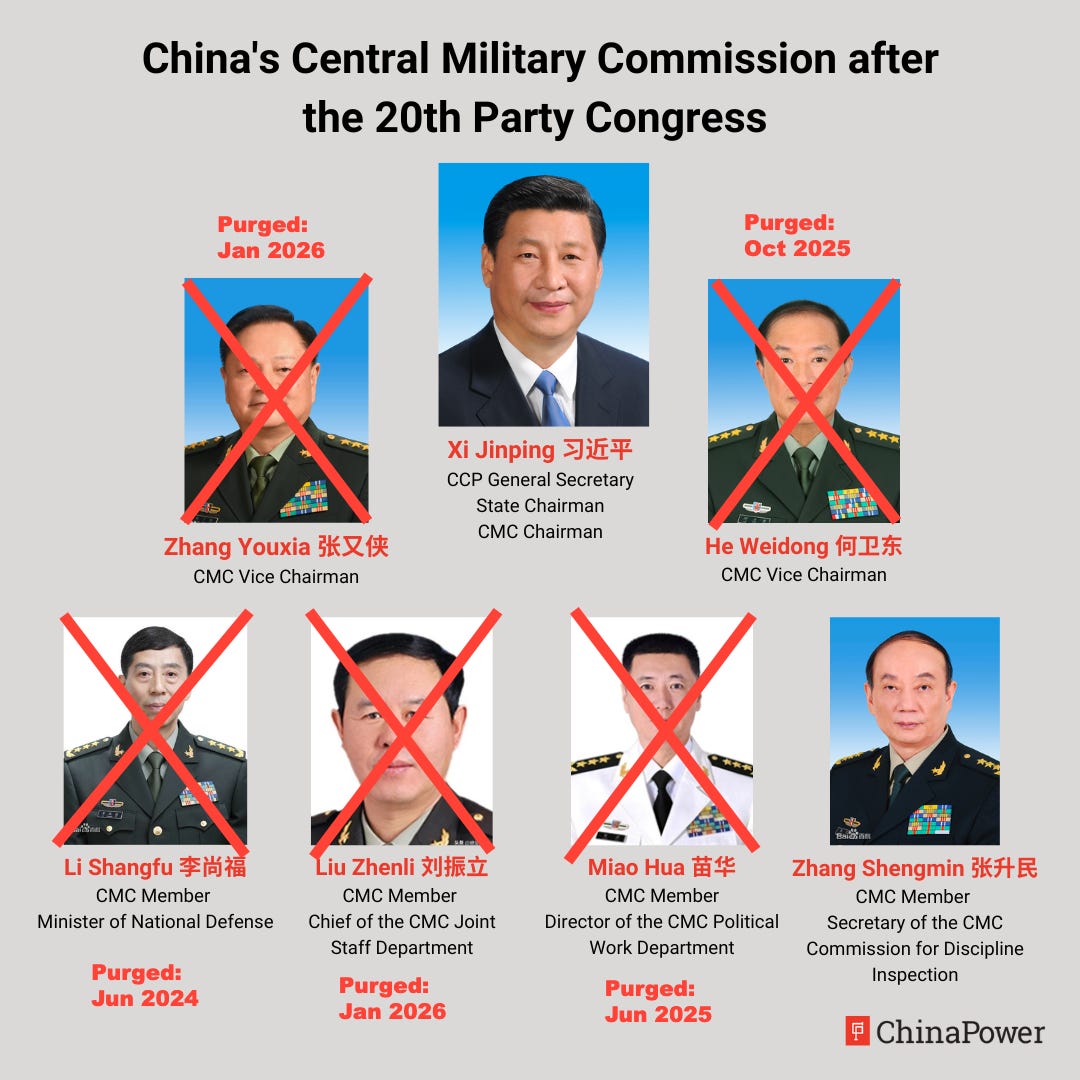
On January 23, China’s Defense Ministry announced investigations into top members of China’s Central Military Commission (CMC) Zhang Youxia and Liu Zhenli for “suspected serious discipline and law violations.” The order for the investigations came directly from the Central Committee of the Chinese Communist Party.
Takeaways:
The investigation means both men will be removed from their positions on the CMC. The newly announced investigations follow a purge of nine top Chinese military officials in October. The takeaways included in the Weekly Significant Activity Report - October 18, 2025 for that purge remain largely the same for this one:
The secretive nature of politics within the CCP’s top echelons makes it difficult to fully understand the rationale behind this purge. Throughout his tenure as CCP leader, Xi Jinping has initiated numerous purges targeting the People’s Liberation Army and Chinese officials more broadly. Xi has wielded allegations of corruption—both real and fabricated—to remove potential rivals, disloyal subordinates, and ineffective or genuinely corrupt officials as part of an ongoing campaign to strengthen party discipline and eliminate alternative sources of power and influence.
While Xi Jinping already commands the People’s Liberation Army as the Chairman of the CMC, the General Secretary of the CCP, and the country’s President, the recent purges further consolidate his ideological control over the military. The removal of Zhang Youxia and Liu Zhenli leaves Xi as one of only two members remaining on the Central Military Commission. The only other current member of the CMC is Zhang Shengmin, who was promoted to the Commission in October and is believed to be closely ideologically aligned with Xi.
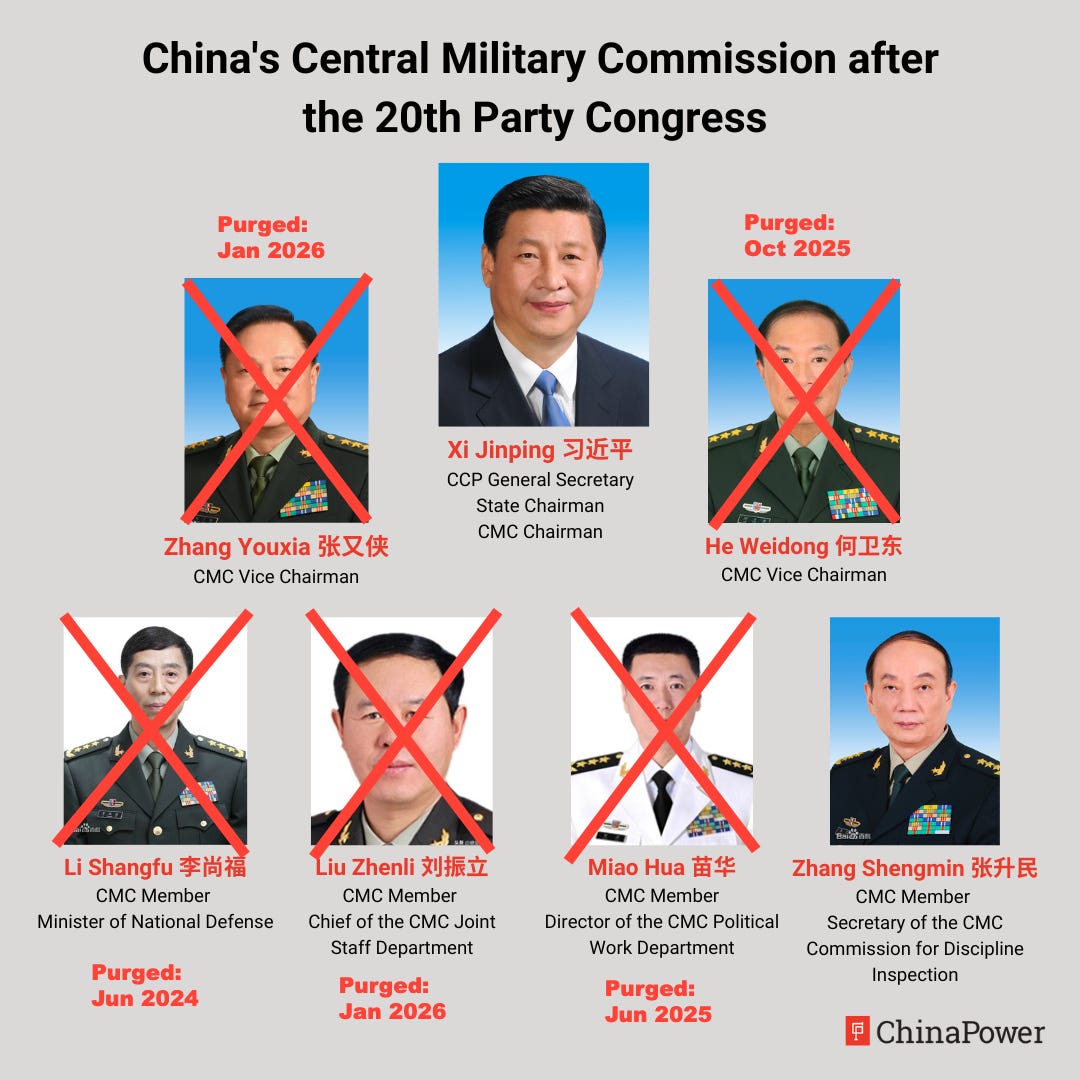
Current Central Military Commission Organization Chart. Annotations: OPFOR Journal. Original Source for Graphic: Center for Strategic and International Studies - ChinaPower The purge of Zhang Youxia is especially shocking due to his status as a CCP “princeling,” (son of a founding leader of the party) his previously close relationship with Xi, and his impending retirement in 2027 (which had been extended multiple times so he could continue serving on the CMC.)
4. CHINA FLEXES ITS MARITIME MUSCLES
Chinese Fishermen Conduct Massive Naval Maneuvers
A January 16 investigative report by The New York Times showed that the Chinese government had coordinated multiple maritime shows of force involving thousands of fishing vessels off the coast of Japan. The largest of these were on December 25 in which 2,000 vessels formed a 290-mile L-shaped formation in the East China Sea and were followed by similar drills on January 11 involving 1,400 vessels, forming a 200-mile rectangular formation. According to the Times reporting, the formations were so dense that cargo ships were forced to adjust course around them.
China Conducted Record Numbers of Patrols In Philippine Territorial Waters
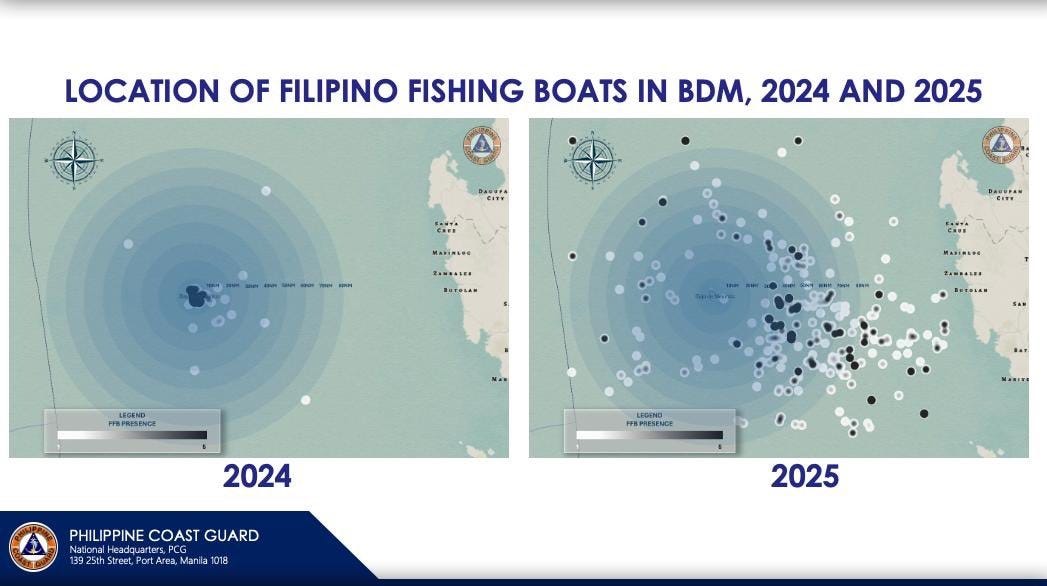
This week, the Philippine Coast Guard announced that People’s Liberation Army (PLA) Navy, China Coast Guard, and Maritime Militia engaged in a record number of patrols within the territorial waters of the Philippines near Scarborough Shoal.
According to Jay Tarriela, a spokesman for the Philippine Coast Guard, the patrols have not only increased in frequency and size but are pushing closer toward the Philippine coastline.
“In addition to this overall increase, CCG vessels conducting illegal patrols have been operating progressively closer to the Luzon coast, from Ilocos down to Mindoro. The closest recorded approach occurred on 08 April 2025, when a CCG vessel reached 23 nautical miles from the coast off Dasol, Pangasinan.”
Takeaways:
China operates the world’s largest fishing fleet with as many as 16,000 large distant water fishing (DWF) ships and hundreds of thousands of smaller vessels. Many of these vessels operate as part of a seaborne law enforcement and military auxiliary force called the Maritime Militia.
The Maritime Militia is composed of regional fleets of vessels coordinated by local committees of the Chinese Communist Party. In its civilian capacity, it augments state response to emergencies including law enforcement, search and rescue, and disaster recovery. The Maritime Militia also functions as a "third sea force" alongside the PLA Navy and China Coast Guard. Under the direction of regional PLA commands, Maritime Militia vessels conduct operations ranging from local blockades to harassment and direct attacks on foreign mariners to enforce China’s claims of sovereignty to “blue national soil” across the South China Sea, and other near seas.
The Maritime Militia often acts with the backing of the China Coast Guard, which uses fights instigated by the civilian fleet as a pretext for taking aggressive action against foreign mariners. The most aggressive of these encounters have been against the Philippines.
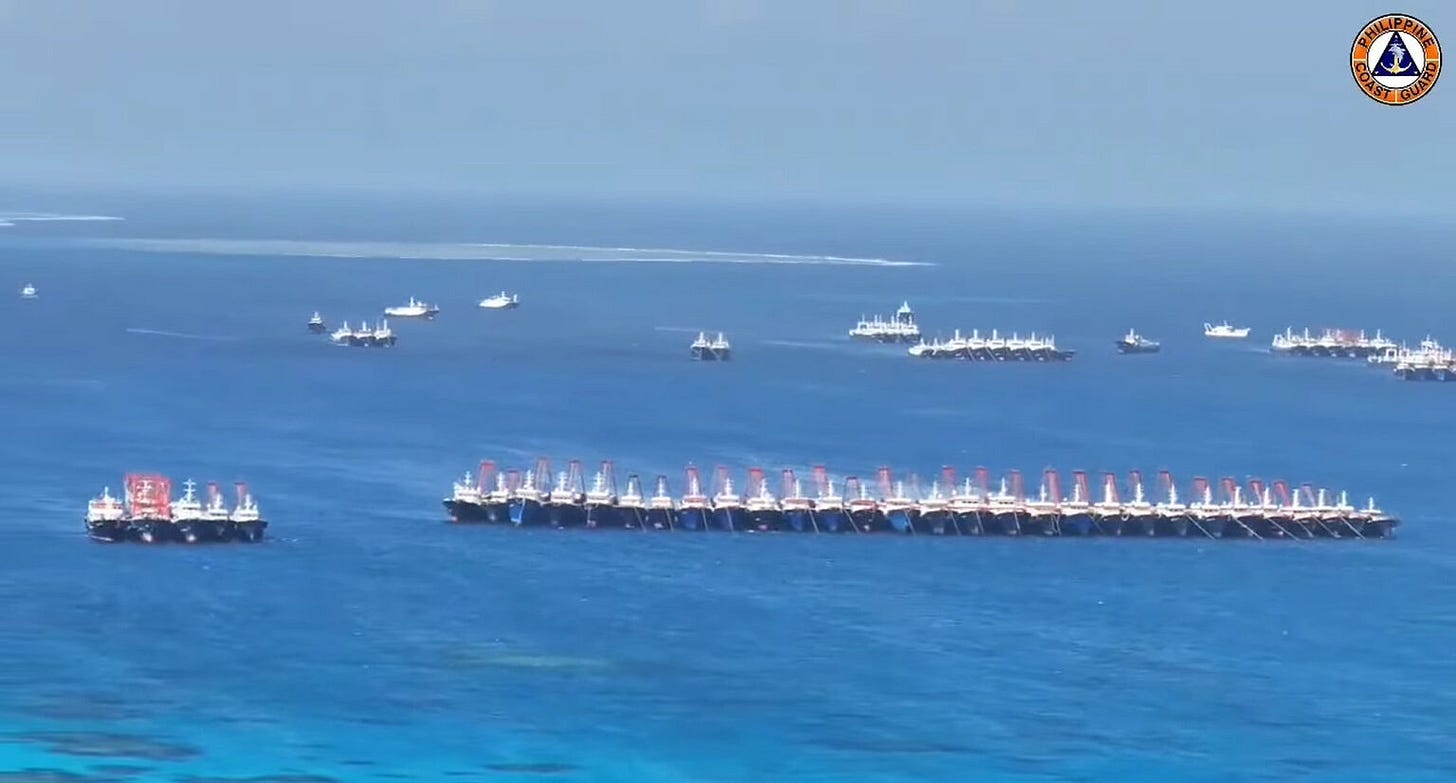
Over one hundred Chinese Maritime Militia vessels occupying Julian Felipe Reef in the West Philippine Sea in fall 2023. Source: Philippine Coast Guard via The Manila Standard As much as the Maritime Militia exercises are a warning to Taiwan of China’s capacity to strangle sea lanes of communication to the island, they are also a signal to Japan amid an ongoing feud with the government of Prime Minister Sanae Takaichi. The maneuvers show that China can make life very difficult for Japanese mariners and inflict significant pain on the Japanese economy short of war.
5. DEATH TOLL FROM IRANIAN PROTEST CRACKDOWN CLIMBS TO OVER 5,000, COULD EXCEED 20,000
Saturday January 24 marked the 28th day of mass anti-government protests in Iran. According to Human Rights Activists in Iran (HRAI), the number of individuals killed in the demonstrations reached at least 5,459 deaths, with another 17,031 deaths being investigated. All but 250 of these deaths come from protesters and other civilians. The government has arrested a total of 40,887 protesters.
Iran’s state-affiliated Legal Medicine Organization has acknowledged that 3,117 people have been killed over the four weeks of protests. The government has claimed, however, that 2,427 of these victims were either civilians or members of the internal security forces killed by Zionist-organized rioters.
Takeaways:
The brutal crackdown by the Iranian regime, the worst case of state violence in the country since the Islamic Revolution in 1979, appears to have largely halted the protest movement for now.
The violence is unlikely to bring long-term stability, however. The regime still faces destabilizing economic decline and environmental degradation that will continue to embitter the population for the foreseeable future. Moreover, the extreme repression of demonstrators virtually guarantees that future anti-government movements will be more overtly violent, better armed, and more willing to cooperate with foreign governments. This dynamic may make the coming succession of the 86-year-old Ayatollah Khamenei even more difficult for the regime to accomplish.