



This week’s analysis highlights some of the most significant geopolitical developments involving America’s adversaries—China, Russia, Iran, and North Korea—between December 27, 2025 - January 3, 2026.
Summary:
China, Russia, and Iran condemned US military operations against Venezuela but do not appear poised to intervene to support the ailing Venezuelan regime.
Russia claimed Ukraine attempted to assassinate President Vladimir Putin at his residence in Valdai, hours after a meeting between top US and Ukraine leaders, in an attempt to stoke distrust between Washington and Kyiv.
Russian cargo vessel Fitburg detained by Finland after attempted sabotage of Baltic undersea communications cables.
China hosted large-scale military exercises entitled “Justice Mission 2025” around Taiwan.
Anti-government demonstrations spread to over 60 cities in Iran.
1. CHINA, RUSSIA, AND IRAN CONDEMN US CAPTURE OF VENEZUELAN PRESIDENT NICOLAS MADURO
China, Russia, and Iran, three strategic partners of the Maduro regime in Venezuela, quickly moved to condemn the January 3 US military operation “Operation Absolute Resolve” against the country and subsequent capture of President Nicolas Maduro.
Chinese Foreign Ministry Response:
“China is deeply shocked by and strongly condemns the U.S.’s blatant use of force against a sovereign state and action against its president.
Such hegemonic acts of the U.S. seriously violate international law and Venezuela’s sovereignty, and threaten peace and security in Latin America and the Caribbean region. China firmly opposes it.
We call on the U.S. to abide by international law and the purposes and principles of the UN Charter, and stop violating other countries’ sovereignty and security.”
Russian Foreign Ministry Response:
“This morning, the United States committed an act of armed aggression against Venezuela. This is deeply concerning and condemnable.
“The pretexts used to justify such actions are untenable. Ideological hostility has triumphed over businesslike pragmatism and a willingness to build relationships of trust and predictability.
“In the current situation, it is crucial, above all, to prevent further escalation and to focus on finding a way out through dialogue. We believe that all partners who may have grievances against each other should seek solutions through dialogue. We are ready to support them in this.
“Latin America must remain the zone of peace it declared itself to be in 2014. And Venezuela must be guaranteed the right to determine its own destiny without any destructive, let alone military, outside intervention.
“We reaffirm our solidarity with the Venezuelan people and our support for the course of their Bolivarian leadership, aimed at protecting the national interests and sovereignty of the country.”
Iranian Foreign Ministry Response:
“The Ministry of Foreign Affairs of the Islamic Republic of Iran strongly condemns the military attack by the United States against Venezuela and the egregious violation of this country's national sovereignty and territorial integrity.
“The military attack by the United States against Venezuela is a flagrant violation of the fundamental principles of the United Nations Charter and the basic rules of international law, particularly paragraph 4 of Article 2 of the Charter, which prohibits the resort to force, and constitutes a complete example of an "act of aggression" that must be immediately and explicitly condemned by the United Nations and all governments that are concerned with the rule of law, peace, and international security.
“The military aggression by the United States against an independent state and member of the United Nations is an egregious violation of regional and international peace and security, the consequences of which affect the entire international system and will further expose the system based on the United Nations Charter to erosion and destruction.
“The Ministry of Foreign Affairs of the Islamic Republic of Iran, while recalling Venezuela's inherent right to defend its national sovereignty, territorial integrity, and right to self-determination, reminds all governments and international organizations, especially the United Nations and its Security Council, of their legal and moral responsibility to immediately halt the illegal invasion by the United States against Venezuela, and emphasizes the necessity of taking the necessary measures to hold accountable the designers and perpetrators of the crimes committed in the course of this military aggression.”
Takeaways:
This is a rapidly evolving situation. Beijing, Moscow, and Tehran are likely still assessing developments before formulating official responses. While the Maduro regime counts Russia, Iran, and China as nominal allies, these powers face significant constraints on responding to US actions. The US military operation concluded swiftly and successfully, Russian and Iranian forces have demonstrated limited capacity to support more immediate military partners (including each other), and Beijing has few compelling strategic interests at stake in Venezuela. As a result responses will likely be limited to diplomatic pressure unless the US demonstrates significant weakness.
The US operation will likely spur Iran to seek new assurances of support from China and Russia in coming days amid concern the US President will make good on its threats to launch military intervention to support the latest round of anti-government protests in the country.
Moscow will watch these events carefully for signs the US may become emboldened to take more aggressive action to resolve the war in Ukraine. The Kremlin will also be monitoring its own nationalist influencers for signs of disaffection resulting from the US operation. Several prominent Russian milbloggers have begun drawing unflattering comparisons between the speed and effectiveness of the limited US operation in Venezuela and Russia's protracted special military operation in Ukraine.
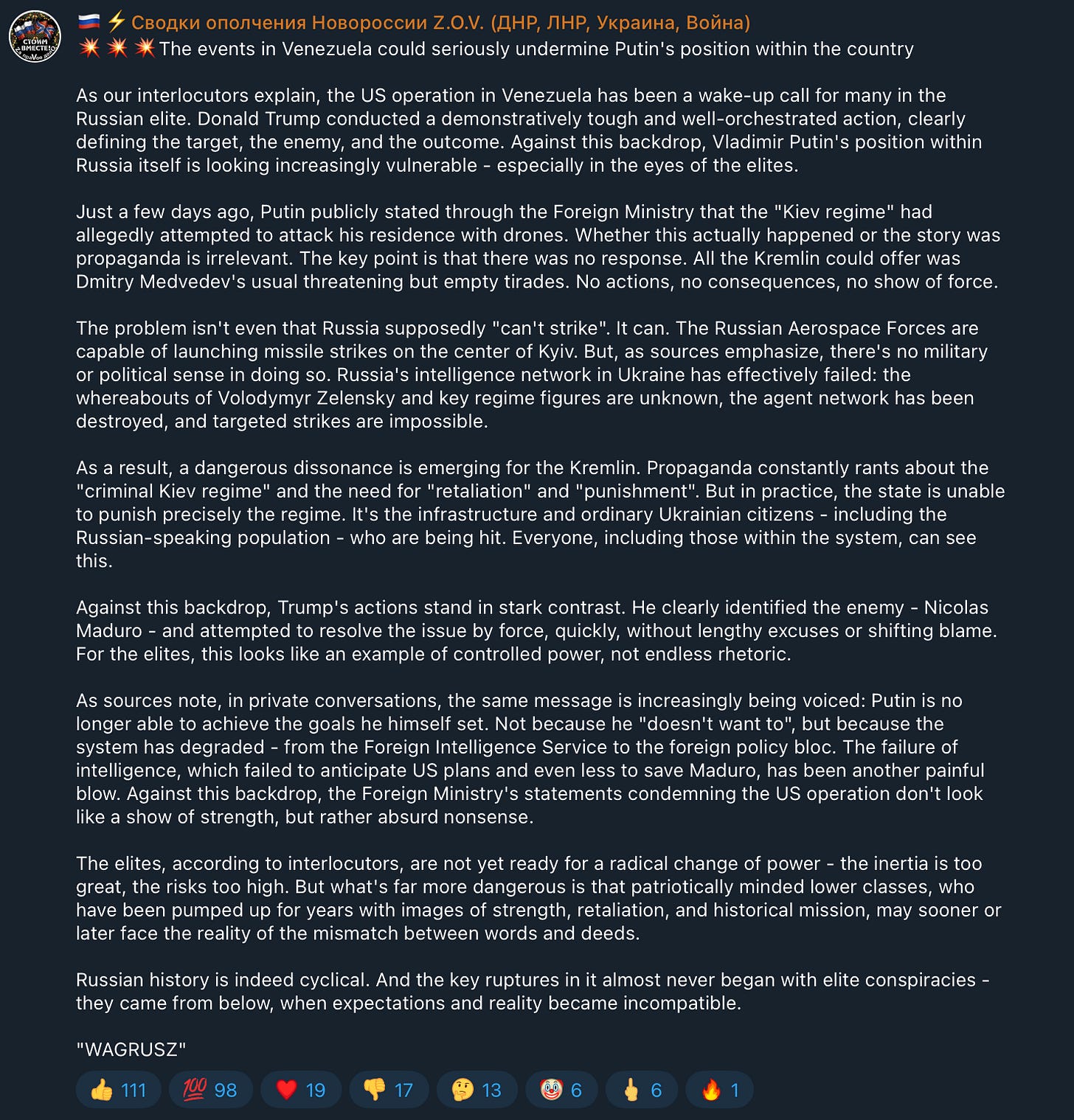
Russian milblogger “Novorossiya Militia Reports” hypothetically suggests that Russian nationalists will view the US operation as a sign the current Russian government is incapable of delivering victory in Ukraine. Source: Novorossiya Militia Reports (@swodki) on Telegram
2. RUSSIA CLAIMS ASSASSINATION ATTEMPT ON PUTIN IN APPARENT BID TO DERAIL PEACE NEGOTIATIONS
On December 29, the Russian government claimed that Ukraine launched an assassination attempt on President Vladimir Putin by launching 91 drones at Putin’s mansion complex in Valdai in Novgorod oblast.
Russia has offered limited evidence to support its claim. The Russian military has provided maps of the purported flight paths of the drones before they were intercepted hundreds of kilometers from Valdai, as well as an internal guidance system recovered from a downed drone that allegedly lists Putin’s Valdai mansion as its destination.
Ukraine has denied targeting Putin’s residence, a claim backed by the US Central Intelligence Agency.
Takeaways:
The allegations of the attack on Putin’s mansion came hours after talks between top US and Ukrainian leaders in Mar-a-Lago on December 28. The timing of the claim—raised during a follow-up call between Putin and President Trump on December 29—and flimsy evidence to support it, suggest a Russian effort to undermine relations between Washington and Kyiv.
The Russian disinformation effort initially appeared successful, prompting President Trump to rebuke Ukraine for endangering the peace process during a December 29 press conference with Israeli Prime Minister Benjamin Netanyahu. However, this success proved short-lived, as Trump appears to have reversed his position following the CIA's determination.
3. RUSSIAN SHADOW FLEET VESSEL DETAINED BY FINLAND
On December 31, the Finnish Coast Guard seized the Russian cargo ship Fitburg, due to its suspected involvement in damage to an undersea cable owned by Finland’s Elisa telecom company. The Fitburg was spotted near Finland’s exclusive economic zone (EEZ) in the vicinity of the damaged cable with its anchor lowered at the time of the reported fault.
Takeaways:
The activities of the Fitburg are consistent with ongoing Russian efforts to use civilian vessels to damage undersea fiber optic communications cables with dragged anchors. While civilian vessels occasionally damage undersea cables accidentally, there have been over a dozen suspicious incidents involving ships linked to Russia in recent years in the Baltic Sea which point to a deliberate sabotage campaign.
4. CHINA HOLDS LARGE MILITARY EXERCISE AROUND TAIWAN
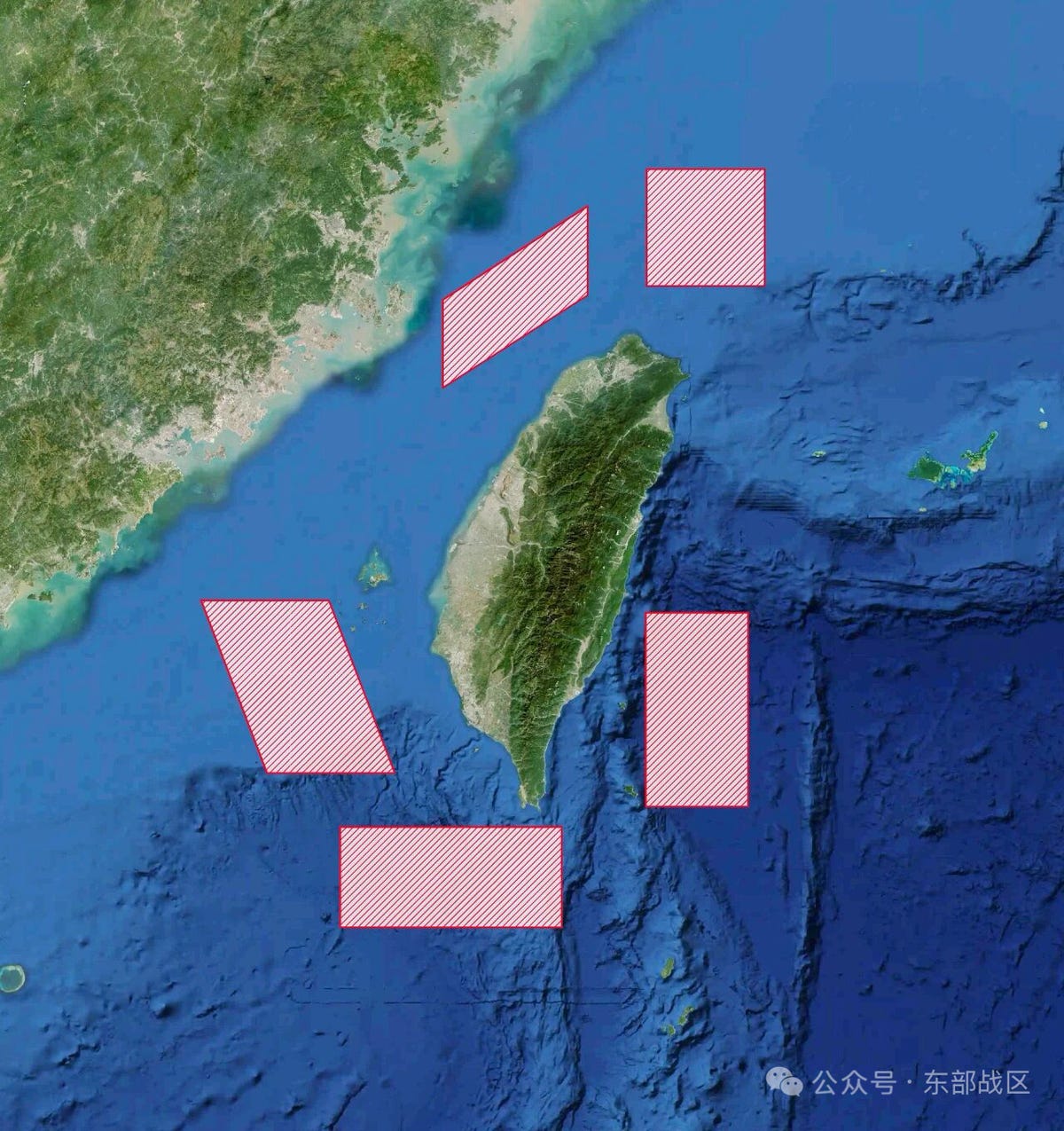
From December 29-30, the Chinese military conducted large-scale military exercises named “Justice Mission 2025” around Taiwan. According to the People’s Liberation Army’s Eastern Theater Command “Justice Mission 2025” simulated the PLA’s ability to conduct “all-dimensional force projection, breaching and raid by elite forces, as well as seizure of key ports. The drills tested capabilities of task force coordination, systemic operations, and precision strikes on key targets”
Taiwan’s Ministry of National Defense reported observing 201 sorties of PLA aircraft around Taiwan (with 125 crossing the Taiwan Strait Median Line) taking part in the exercises as well as 14 vessels of the PLA Navy, 11 vessels of the China Coast Guard, and four additional Chinese government ships. PLA ground forces also participated in live-fire exercises, launching 27 rockets into multiple training areas.
Takeaways:
Justice Mission 2025 appears to be a response to multiple Taiwan-related developments that Beijing finds unacceptable. These include a perception that Taiwan’s ruling Democratic Progressive Party (DPP) is becoming too brazen in asserting the island’s de facto independence, as well as more immediate issues such as Japanese Prime Minister Sanae Takaichi's November comments suggesting potential military intervention to defend Taiwan, and the record $11 billion US arms sale announced in December.
Statements by the Chinese Foreign Ministry suggest that the US arms sale was the immediate precipitating factor for the exercise:
“The spokesperson of the PLA Eastern Theater Command has made an announcement of the military drills. The drills are a punitive and deterrent action against separatist forces who seek “Taiwan independence” through military buildup, and a necessary move to safeguard China’s national sovereignty and territorial integrity.
“Let me stress that to advance their separatist agenda, the DPP authorities are turning Taiwan into a powder keg. Their massive and desperate arms purchase further reveal their true nature as provocateurs, saboteurs of peace and war-mongers. Anyone who tries to arm Taiwan to contain China will only embolden the separatists and push the Taiwan Strait closer to the peril of armed conflict.
“The Taiwan question is at the very core of China’s core interests. Nothing will deter China from defending national sovereignty, security and territorial integrity. Anyone who crosses the line or makes provocations on the question will be met with China’s firm response. All attempts to hold back China’s reunification will invariably fail.”
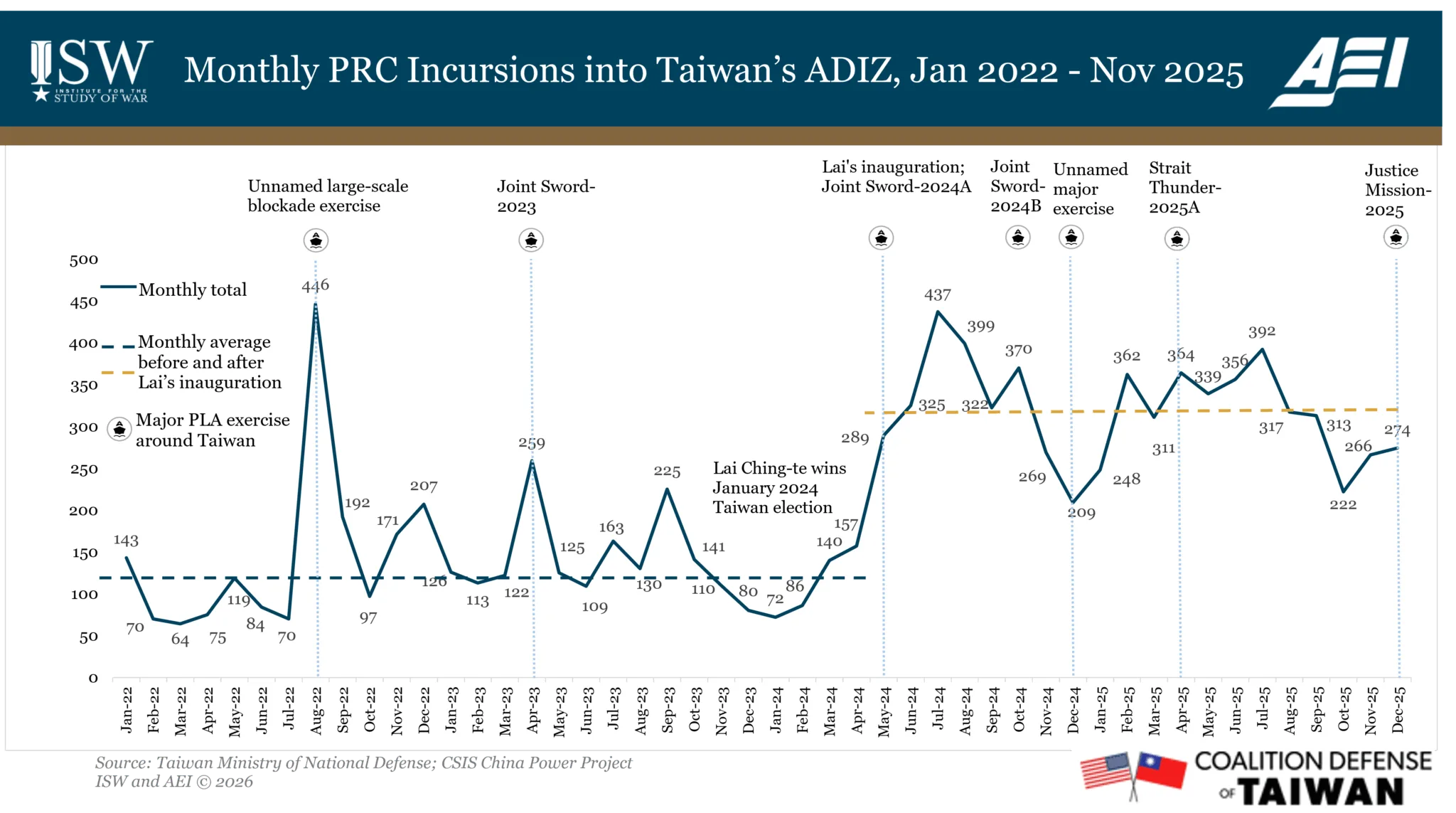
China routinely conducts major military exercises threatening Taiwan in response to developments on the island it finds overly provocative in order to deter similar activity. One such example was PLA exercises held in August 2022 following a high-profile visit by then US Speaker of the House Nancy Pelosi to Taiwan. Nevertheless, observers should not assume China will forgo aggressive action around Taiwan in exchange for restraint by the US and Japan. While Justice Mission and similar high-profile exercises represent spikes in military activity, the baseline level of PLA operations around Taiwan continues to grow year over year. According to the Institute for the Study of War, China has nearly doubled the number of monthly incursions into Taiwan’s air defense identification zone (ADIZ) over the past two years.
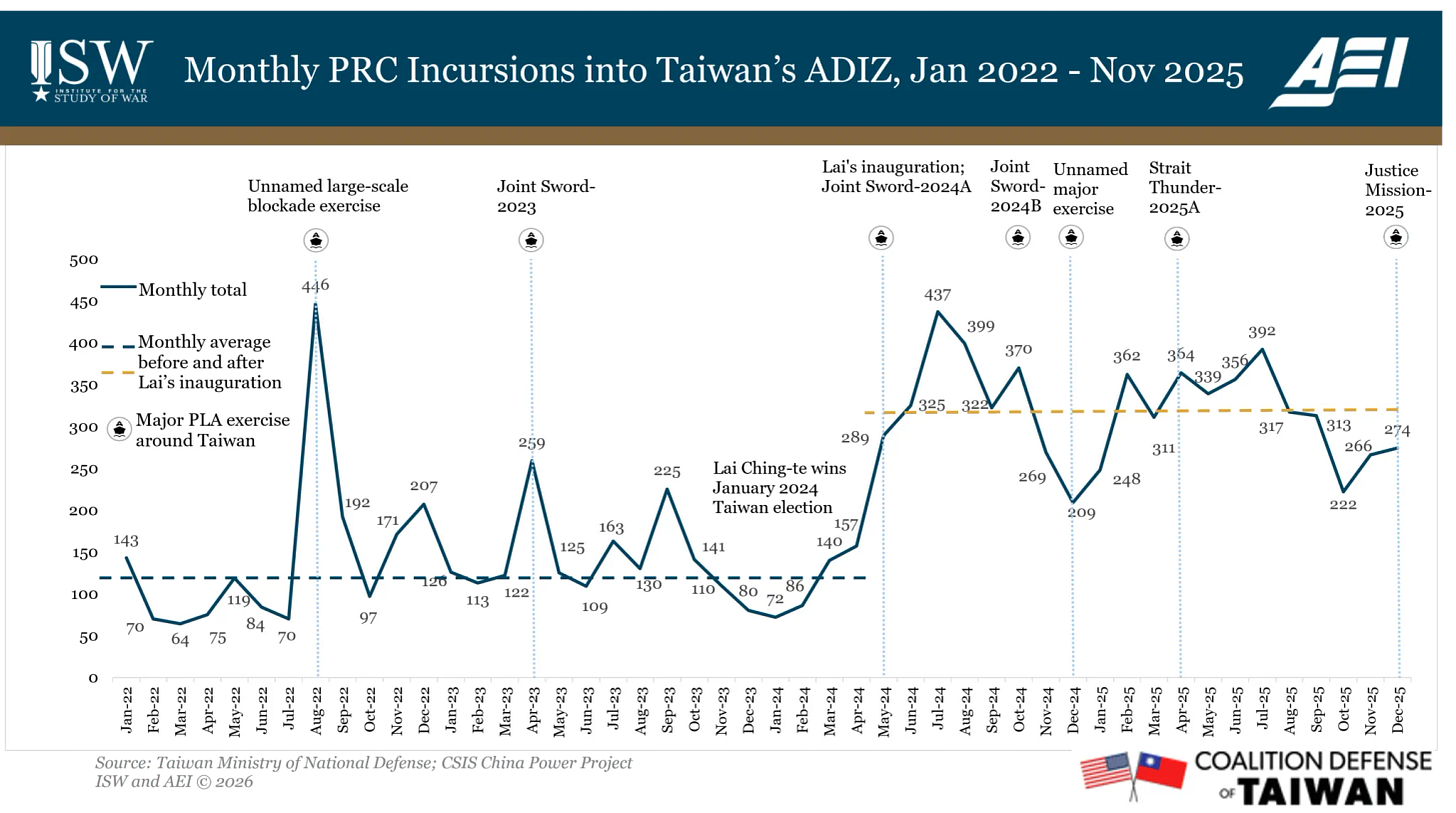
Monthly incursions into Taiwan’s ADIZ by the PLA between January 2022- November 2025. Source: Institute for the Study of War John Dotson, the Director of the Global Taiwan Institute notes that Chinese military operations conducted in Justice Mission 2025 were broadly consistent with previous exercises around Taiwan in recent years focusing on encirclement and blockade operations aimed at deterring foreign intervention. However, Dotson also suggests that Justice Mission 2025 was conducted closer to Taiwan’s shores than previous exercises and caused greater disruption of regional trade and travel.
“Arguably, the most significant aspect of the exercise was the declaration of exercise zones that were closer to Taiwan’s coastline, and which in some cases appeared to cross over into Taiwan’s contiguous zone (12-24 nautical miles from the coast). However, it is unclear whether any PLA units actually crossed into the contiguous zone around the main island of Taiwan (a prospect suggested, but not confirmed, by the MND’s comment on PLA units that ‘entered the adjoining zone’).
“In connection with this, the PRC authorities also displayed a willingness in this exercise to be more disruptive of routine economic and travel activity: the declared exercise areas cut across major civil aviation corridors in Taiwan, and Taiwan’s government indicated on December 30 that 941 civil aviation flights had been affected, with media outlets reporting on disrupted flights and anxiety among many passengers.”
5. ANTI-REGIME PROTESTS SPREAD ACROSS IRAN
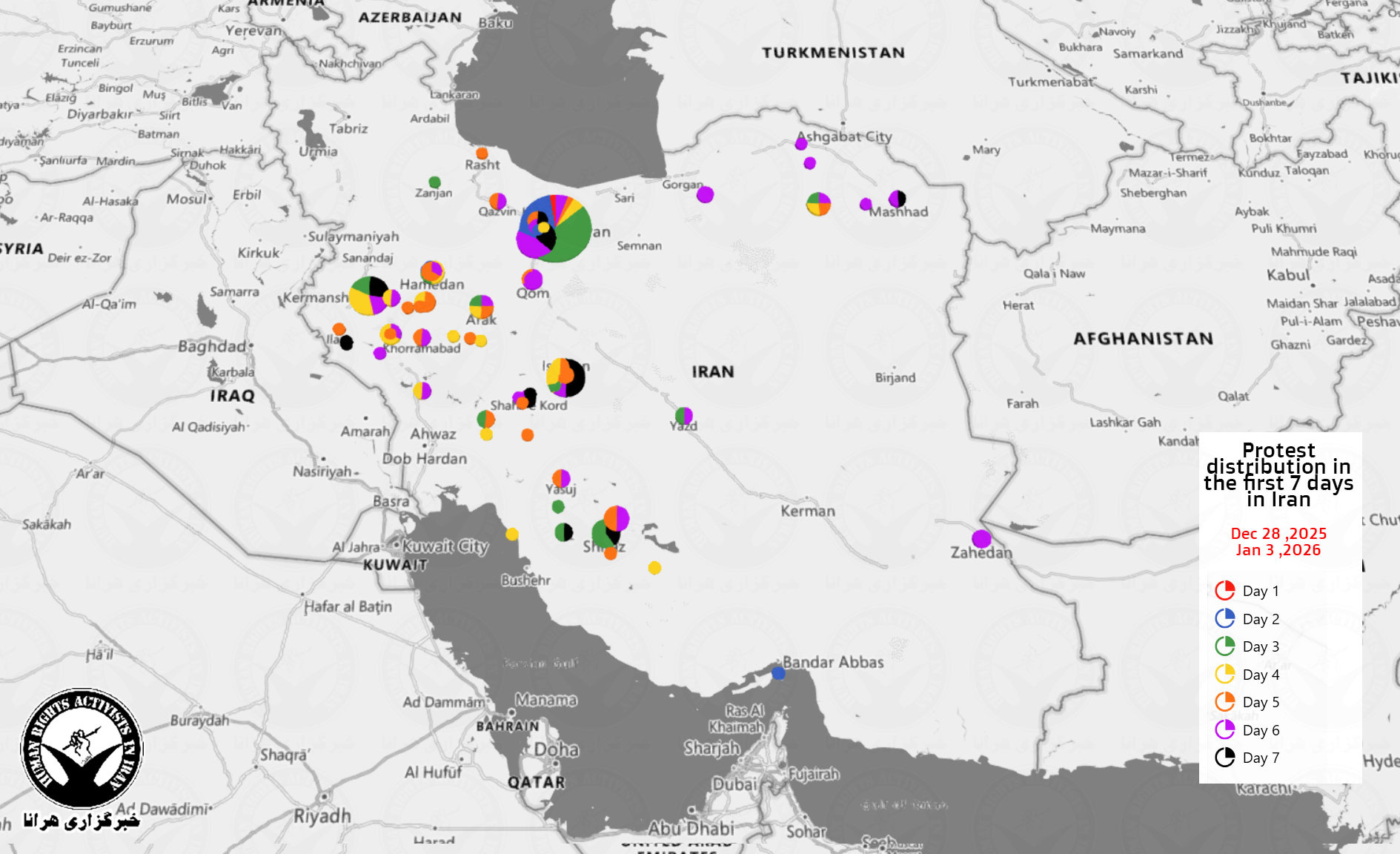
This week, anti-government demonstrations broke out across Iran. According to leading independent Iranian human rights group, Human Rights Activists in Iran (HRAI), the protests have spread to over 174 locations in 60 cities across Iran since beginning on December 28. At least 15 protesters and one member of Iran’s security forces have been killed in the unrest, and over 582 people have been arrested.
HRAI reports that the protests have centered on deteriorating quality of life and dissatisfaction with the current regime.
“Based on reviews of videos and verified reports, the slogans chanted were largely centered on livelihood, economic, and political demands rooted in citizens’ fundamental rights. These slogans included criticism of the power structure, objections to restrictions on individual and social freedoms, demands for justice, and opposition to the prevailing economic and living conditions.
“At the same time, in some gatherings, slogans with more diverse themes were also heard, reflecting the heterogeneous range of views and tendencies among protesters. Within the framework of its human rights mission, HRANA focuses its reporting on slogans and demands that are directly related to violations of, or demands for, human rights, fundamental freedoms, and civil rights.
“On the sixth day of protests, scenes of dissent extended to cemeteries, where citizens chanted protest slogans during the burial ceremonies of two individuals killed in the protests. In the streets as well, protesting citizens held gatherings while chanting slogans.
“The persistence and repetition of these slogans across different cities indicate an overlap between labor, livelihood, and political demands within the context of the ongoing protests, and reflect the depth of accumulated grievances in Iranian society.”
Takeaways:
Although the Iranian regime has become vulnerable in recent months due to a collapse in its military prestige, worsening economic conditions, and an endemic water crisis, it still maintains a formidable internal security apparatus capable of managing the current levels of social unrest.
Threatened US military strikes against Iranian leaders responsible for violence against protesters could undermine the reliability of Iran’s security forces and embolden demonstrators, but risk fracturing the political opposition between those welcoming Western intervention and nationalists opposed to any foreign interference.
Both the intensity of the protests as well as regime repression are growing with time. Iran’s Supreme Leader Ayatollah Ali Khamenei has taken a hard line against the demonstrations declaring the protests to be riots instigated by foreign mercenaries which must be put down with force.
“Protest is legitimate, but protest is different from rioting. We talk to protesters, but there is no use in talking to rioters. Rioters must be put in their place.”
Opposition outlet Iran International reports that Iranian security forces have shot at least 44 protesters, a figure likely to rise as clashes between demonstrators and government forces continue. The deadliest single incident occurred on January 3 in Malekshahi in Iran’s western province of Ilam, where Islamic Revolutionary Guard Corps forces opened fire on protesters, killing 4 and wounding at least 30.