



This week’s analysis highlights some of the most significant geopolitical developments involving America’s adversaries—China, Russia, Iran, and North Korea—between November 14, 2026 and November 21, 2026.
Executive Summary:
US War with Iran - Significant Activity Related to the US-Iran War
The US and Iran resumed limited reciprocal strikes as Iran seeks to offset deteriorating leverage over the Strait of Hormuz.
CNN reported an assessment by US intelligence officials that Iran is plotting a possible dirty bomb attack targeting Washington DC.
The Eastern Front - Significant Activity Related to the War in Ukraine and Russian Threats to NATO
Long-range attacks between Russia and Ukraine escalated, marked by a successful Ukrainian operation disabling the Kerch road bridge to Crimea and subsequent Russian retaliatory strikes targeting Kyiv’s bridges as well as broader European interests.
Western Pacific Flashpoints - Significant Activity in the Western Pacific and Taiwan
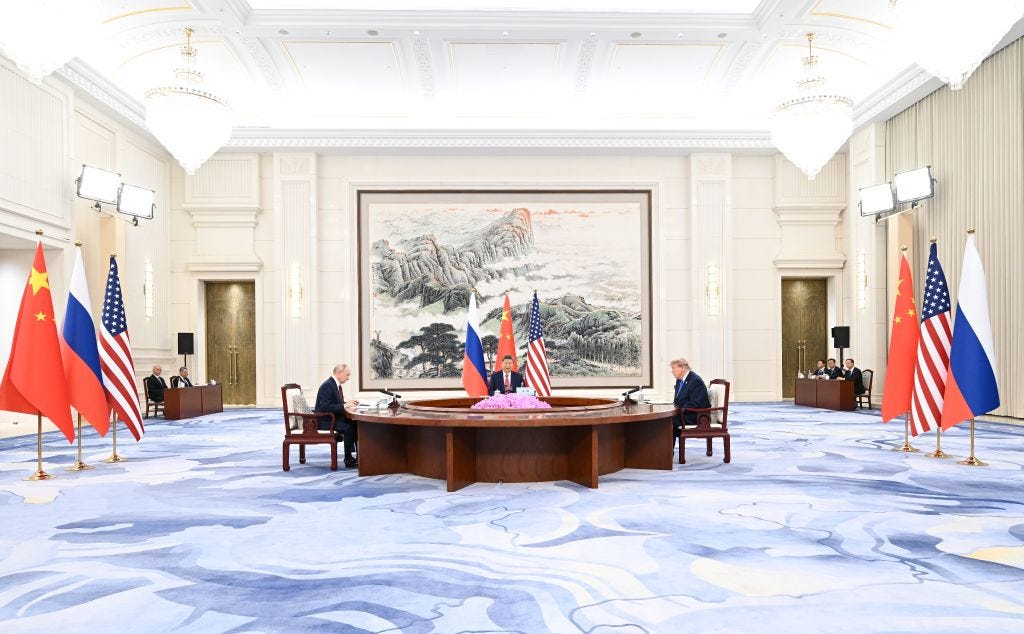
China hosted the 33rd APEC Economic Leaders Meeting and a special trilateral discussion between Chinese, Russian, and American presidents.
US WAR WITH IRAN
Significant Activity Related to the US-Iran War
1. US AND IRAN RESUME LIMITED STRIKES IN BATTLE OVER CONTROL OF THE STRAIT OF HORMUZ
Iran and the US resumed limited reciprocal strikes over multiple days in a continued battle for control of the Strait of Hormuz. The reignited conflict was initiated by an Iranian drone attack on US forces in Bahrain on November 15, 2026. According to the Islamic Revolutionary Guard Corps, the attack was prompted by US efforts to escort commercial shipping through the Strait of Hormuz, which it claims amounts to “oil smuggling.” Iran struck Bahrain again on November 17, 2026, which prompted US forces to carry out attacks on Iranian missile sites on Qeshm Island. Subsequent Iranian strikes targeted Kuwait’s Ali Al Salem Air Base on November 18, 2026.
The latest round of reciprocal strikes came amid continued Iranian attacks in the Strait of Hormuz. The United Kingdom Maritime Trade Operations (UKMTO) Centre reported at least seven suspected Iranian attacks on shipping in the Strait of Hormuz during the week.
Takeaways:
The renewed Iranian provocations suggest Iran sees the current status quo of “no war, no peace” as steadily eroding its strategic position, as the US and its regional allies have seen recent success in restoring Middle East oil exports to pre-war levels while denying Iran the ability to export its own oil. Iran may hope to bait the US into a major new bombing campaign in order to inflame bipartisan skepticism of the war and raise political pressure on the White House to end military operations in the Middle East.
Iran may also hope to trigger US attacks to rally nationalist sentiment and distract from deteriorating economic conditions. In a sign Iranian leaders fear the strategic effects US economic strangulation is having on public morale, President Masoud Pezeshkian warned a gathering of business and political elites at the Capital Market Conference in Tehran on November 21, 2026 that “We are engaged in a silent economic war, a struggle that is much harder than a war in which missiles are fired and destruction takes place.” Iran has suggested it will attempt to break the US naval blockade in coming days. Since Iranian tankers have had little success in passing the blockade line, the move can be seen as part of a broader effort by the Iranian regime to initiate a new cycle of violence that eases political pressure at home while raising it on the US.
2. REPORT: IRAN PLOTTING DIRTY BOMB ATTACK IN WASHINGTON DC
According to a November 17, 2026 report by CNN, US intelligence officials see evidence that Iranian operatives are making plans for a potential “dirty bomb” (a conventional explosive laced with radioactive materials) or chemical weapon attack in Washington DC. The officials interviewed suggested the plot was still in the planning phase and had not been green-lit for execution, but nevertheless featured an alarmingly specific selection of targets and locations.
Takeaways:
A dirty bomb attack that irradiates a section of Washington DC is almost certainly beyond Iran’s ability to successfully conduct at this time. Iranian operatives in North America and Europe have thus far only demonstrated capability in executing acts of arson and vandalism. Their plots to conduct more sophisticated operations such as high-profile assassinations or attacks on US military or government targets have to date almost entirely been thwarted. It seems extremely implausible that Iran could pull off the far more complex coordination required to smuggle radioactive material into the US to use in a dirty bomb. Iranian operatives could conceivably execute a less sophisticated chemical weapons attack using commonly available materials. However, the effectiveness of such an improvised weapon would be doubtful and the attack would risk inciting global outrage.
EASTERN FRONT
Significant Activity Related to the War in Ukraine and Russian Threats to NATO
3. UKRAINE SEVERELY DAMAGES RUSSIA’S KERCH BRIDGE; RUSSIA RETALIATES WITH MASS STRIKE ON INFRASTRUCTURE
Ukrainian Strikes Collapse a Span of the Kerch Bridge
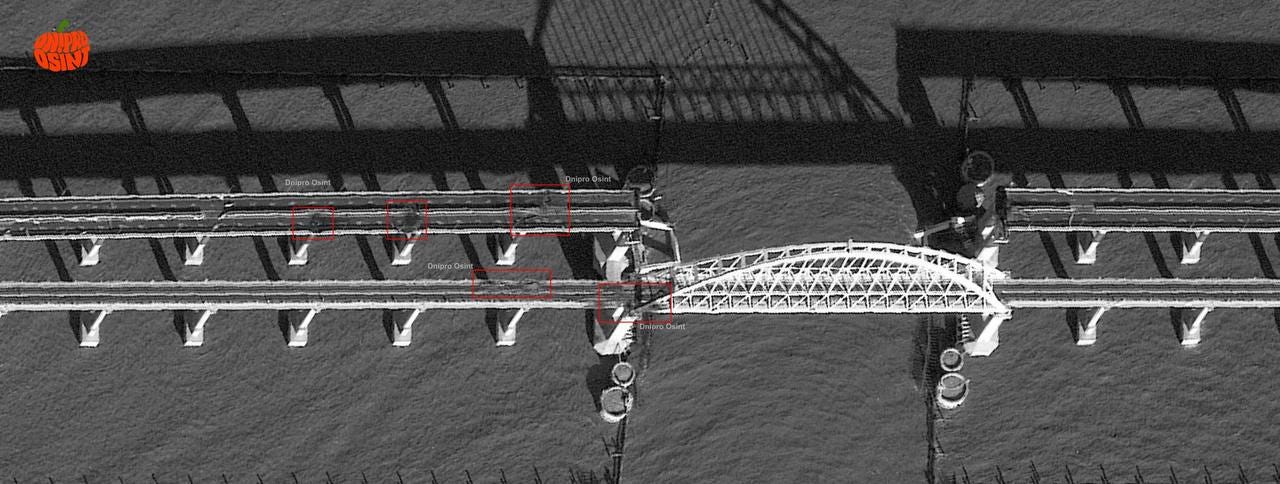
In a series of attacks conducted between November 17 and November 19, 2026, Ukrainian forces struck the Kerch Bridge with waves of drones and domestically manufactured missiles. The attacks collapsed a span of the road bridge and damaged the rail bridge connecting the Crimean peninsula with the Russian mainland across the Kerch Strait separating the Black Sea and the Sea of Azov.
Russia Launches Massive Retaliatory Strike Damaging Kyiv Bridges and Targeting European Interests
After Russian President Vladimir Putin promised “far more painful” strikes on Ukraine in response to the damage inflicted on the Kerch Bridge, the Russian military launched 84 cruise missiles and 404 drones in a mass attack on Ukrainian cities on November 20, 2026. The attacks killed nine people and damaged Kyiv’s Podilsko-Voskresenskyi, Southern, and Darnytskyi bridges. The attacks also notably appeared designed to threaten Europe, with explosions in Kyiv causing damage to the embassies of Austria and the Netherlands, and two Russian cruise missiles and a drone landing in Poland.
Takeaways:
The damage to the Kerch Bridge is severe and will likely take a very long time to fix. Engineers told The New York Times that fixing the span of the road bridge could take up to two years in wartime conditions. Ukrainian Defense Minister Yevhenii Khmara has assessed that just clearing the debris from the collapsed bridge, which is currently obstructing maritime traffic through the Kerch Strait, could take several months to a year.
The crippling of the Kerch Bridge further isolates Crimea, making it more difficult for Russia to militarily reinforce the peninsula. Ukraine’s “Middle Strike” drone campaign launched this spring has already severely constrained Russian efforts to supply the peninsula by road and rail networks through occupied southern Ukraine, and by sea. The Kerch Bridge was one of the remaining dependable lifelines for Crimea due to its distance from the frontlines. The downing of the Kerch Bridge now means that Ukrainian strikes have effectively transformed the peninsula from a once-powerful geopolitical asset into a liability the Kremlin must use significant resources just to sustain.
While the Ukrainian attack on the Kerch Bridge had clear strategic value as a military target, Russian attacks on Ukrainian bridges and critical infrastructure are primarily part of a Russian campaign to terrorize the Ukrainian population. As discussed in previous Weekly Significant Activity Reports, the rationale behind Russia’s terror bombing campaign is to make Ukrainian cities uninhabitable in the winter. The Kremlin hopes to trigger massive waves of migration that deplete the Ukrainian economy, shrink available military manpower, and inflame populist sentiments in Europe, factors that all combine to generate renewed pressure for Kyiv to capitulate. Rybar, a prominent military propagandist affiliated with the Russian Ministry of Defense, made the strategy explicit in a post this week on Telegram:
The idea of destroying bridges across the Dnipro River sometimes faces arguments that it is useless from a military point of view, and that the resulting traffic jams do not seem like a critical factor. But let’s look at the situation from a different perspective.
For the population, the collapse of bridges means a physical division into two parts, which will affect all aspects of life. Add to this problems with energy and heating, and ask yourself how many people will want to leave, even without a complete collapse, further worsening the already catastrophic demographic situation.
The picture will also be seen by Eurobureaucrats. It is unlikely to scare them, but it will remind them that the costs of maintaining the so-called Ukraine are only increasing, and finding money is already difficult. And the further we go, the more useless all past investments will become, and the more popular the position of their political opponents within the EU will be.
Even for the Kyiv leadership, the sight of destroyed bridges in the capital has a stronger effect than it seems. The realization that you can no longer drive from a villa in Koncha-Zaspa to the left bank will lead to thoughts along the lines of “what will happen in a couple of months?”
In any case, the strategy of “war of cities,” as we have written many times, works in the long term. Turning the so-called Ukraine into a maximally useless asset for sponsors is a sure way to reduce the threat it poses in the future.
And the destruction of bridges in Kyiv may not significantly affect the supply of the Ukrainian Armed Forces. But with a high probability, the effect will be greater than simply depriving the enemy of logistics.
WESTERN PACIFIC FLASHPOINTS
Significant Activity in the Western Pacific and Taiwan
4. CHINA HOSTS APEC AND TRILATERAL MEETING WITH US AND RUSSIAN PRESIDENTS
On November 18-19, 2026, China hosted the 33rd Asia-Pacific Economic Cooperation (APEC) Economic Leaders Meeting in the city of Shenzhen. The summit, whose annual theme was “Building an Asia-Pacific Community to Prosper Together,” brought together leaders from 21 economies to discuss priorities related to economic “openness, innovation, and cooperation.”
The most consequential portion of the APEC summit occurred on its sidelines, with Chinese President Xi Jinping, Russian President Vladimir Putin, and US President Donald Trump conducting trilateral negotiations. The event was the first-ever formal face-to-face meeting between the three leaders. Official statements by the US and China framed the meeting as primarily focused on addressing UN reform, increasing the flows of energy products and energy security, limiting the jurisdiction of the International Criminal Court, and reducing the risk of nuclear war.
Takeaways:
The APEC summit overall was a huge political win for China, and the optics of the trilateral leaders meeting were especially favorable for Beijing. Of the three leaders pledging cooperation toward achieving world peace, only Xi Jinping leads a country not at war. Structurally, the appearance of both the US and Russia appealing to China for assistance in ending their respective inconclusive wars powerfully reinforces narratives of US global leadership being supplanted by a rising and responsible China.
The summit was also a major success for Russia. While the summit didn’t turn out to be a “Yalta 2.0” agreement and Xi did not show Putin the same level of visible respect as Trump, the trilateral meeting nevertheless effectively affirmed Russia’s status as one of three core global powers. Putin also scored a major public affirmation of his power from Trump, who called him a friend. This is arguably more important than the treatment by Xi, as Russia has for decades measured its status as a great power against that of the US. And as Mikhail Zygar notes, positive signals from the US President cement Putin’s grip on power by demonstrating to Russian elites that, no matter how poorly the war goes, Putin is immovable and the best leader they can hope for.
The biggest losers of the meeting were the US and Europe. The very premise and structure of the trilateral meeting combined with the disordered behavior of the US President effectively diminished the appeal of US global leadership by positioning China as a capable and rational alternative leader. The meeting reinforced the narrative advanced by both Xi and Putin that their efforts to usher in a new multipolar world are not only working but are being actively aided by the US President. The meeting also effectively saw the tables turned on years-long European efforts to isolate Russia, with Kremlin participation and European exclusion from key discussions of global governance.
With the exception of generating potent political imagery, it’s not clear that the trilateral leaders meeting actually accomplished anything. The “Declaration toward Peace” signed by the three leaders, which reaffirmed that “a nuclear war cannot be won and must never be fought,” just reiterated promises already made by all three countries. Further dialogue has been promised, but a meaningful arms control agreement that reduces the risk of a nuclear arms race between the US, Russia, and China seems far off.
This briefing was compiled by Dan White. Dan is an independent foreign policy analyst based in the New York Metro Area. Dan is a former member of The Wilson Center and The Kennan Institute. Dan holds masters degrees from the Johns Hopkins University School of Advanced International Studies (SAIS), the Naval Postgraduate School, and the University of Washington. Dan is a former officer in the United States Army and a veteran of the War in Afghanistan.
For more information, corrections, or comments, please contact djwhite155@gmail.com.