



This week’s analysis highlights some of the most significant geopolitical developments involving America’s adversaries—China, Russia, Iran, and North Korea—between December 20 - December 27, 2025.
Summary:
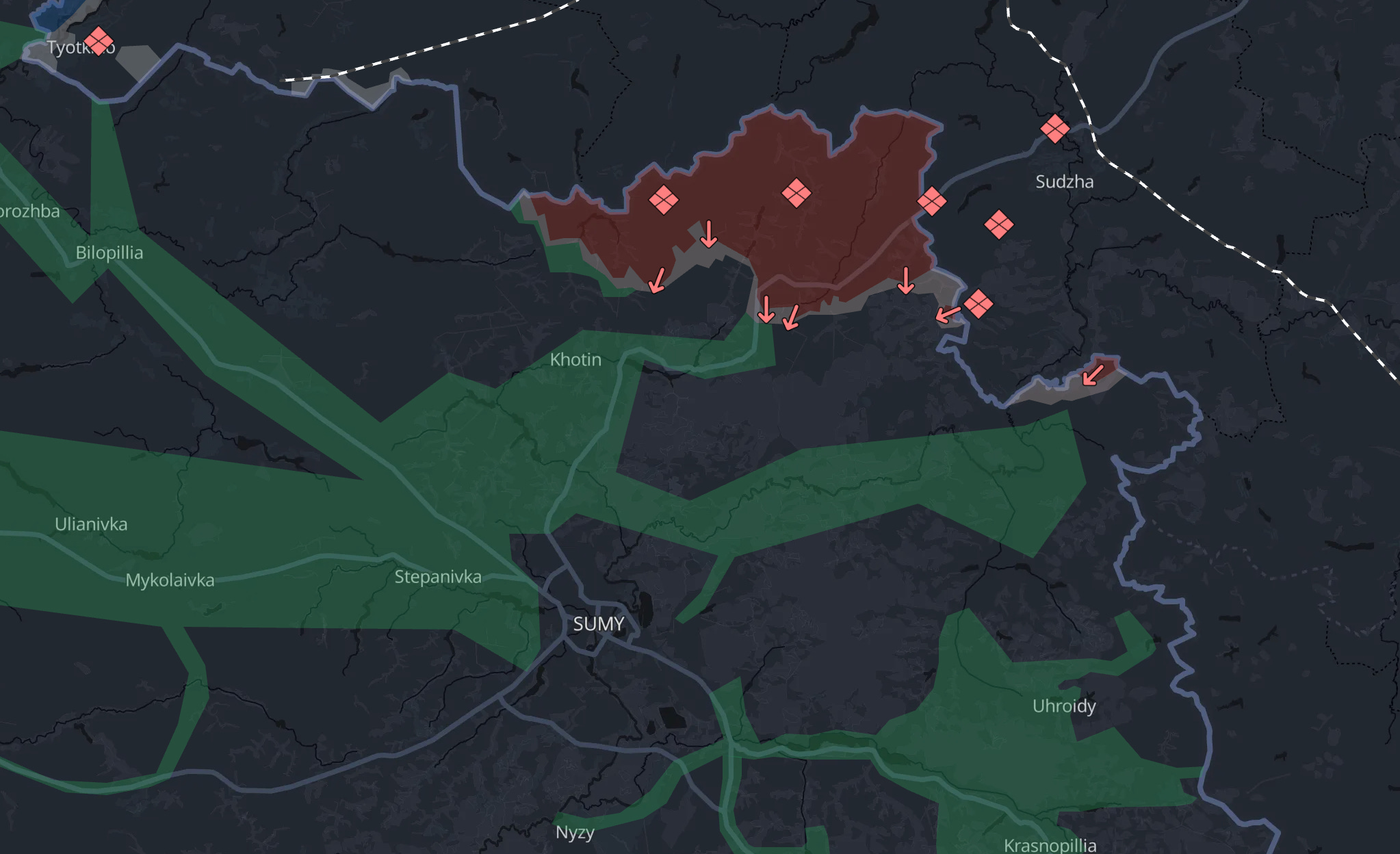
Russia made incremental advances in Sumy Oblast while suffering significant battlefield losses in Kupyansk.
Researchers located the probable deployment location of Russia’s Oreshnik medium-range ballistic missiles in Belarus.
Annual Pentagon report on the Chinese military provided significant new insights into the evolution of Chinese nuclear strategy, including a the development of low-yield nukes and “launch-on-warning” capability.
A new missile-laden Chinese container ship was spotted in Shanghai suggesting China’s experimentation with militarizing its civilian shipbuilding capability.
The Iranian Navy deployed two naval flotillas for forthcoming naval drills in the Indo-Pacific.
North Korea announced progress in developing its first nuclear submarine, which may have been aided by Russian technical assistance.
1. RUSSIA CONDUCTS RAIDS INTO SUMY AND FACES SETBACK AT KUPYANSK
Russian Forces Advance in Sumy Oblast
This week, the Russian military conducted multiple incremental advances into Ukraine’s Sumy Oblast, expanding a small foothold in the region. The advances included raids of small border villages such as Hrabovske, in which at least 50 civilians were captured and forcibly removed to Russia.
Russian Forces Neutralized in Kupyansk
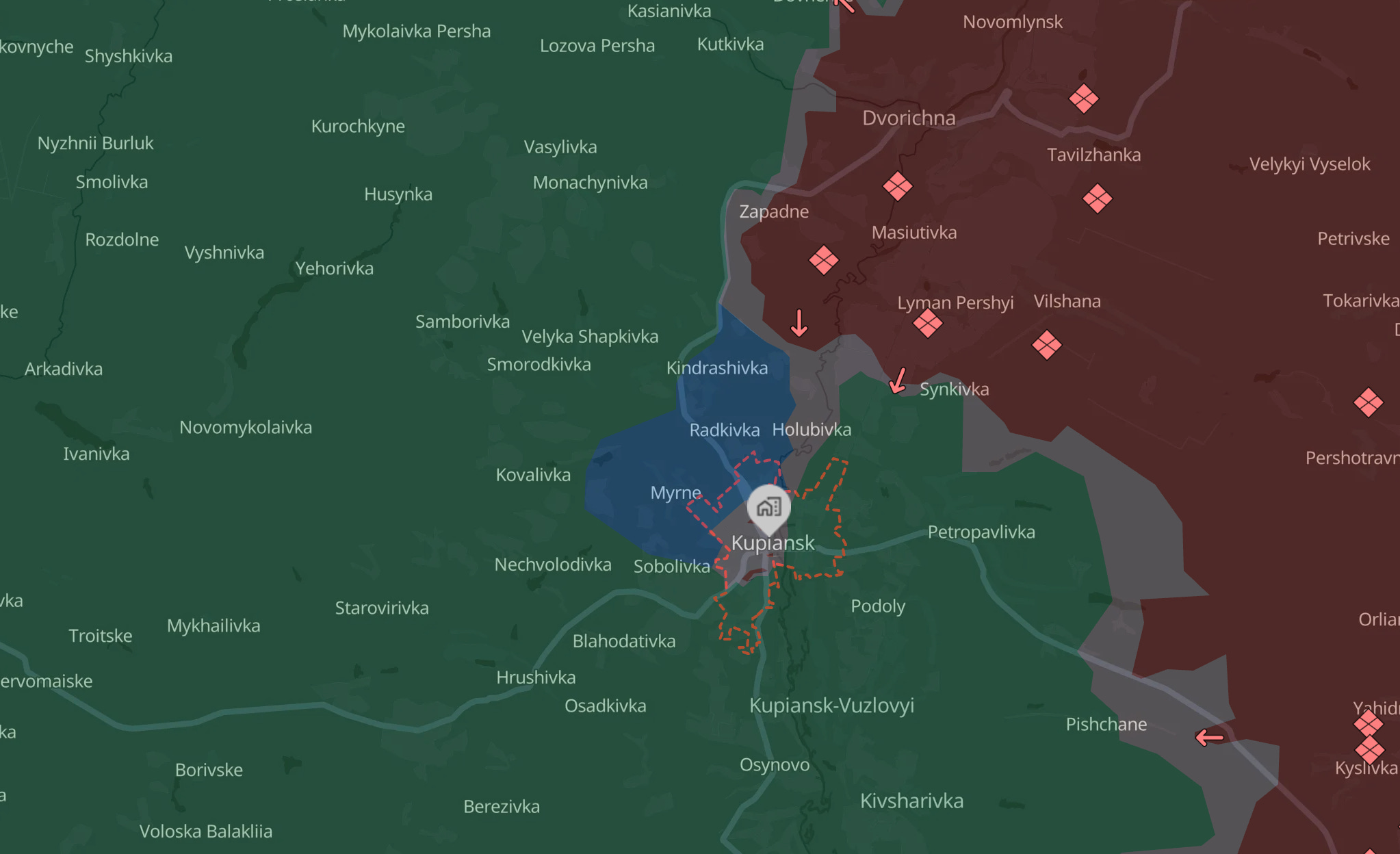
This week, several Ukrainian and international news reports asserted that Russian forces, which had recently seized the frontline city of Kupyansk in Kharkiv Oblast, had themselves become encircled and were facing irretrievable collapse. The overextension and defeat of Russian forces in the city has been acknowledged by some pro-Kremlin Russian military bloggers.
Takeaways:
The raids by Russian forces in Sumy are both a means to probe more thinly defended parts of the border for follow-on advances that can be used as bargaining chips in negotiations and to relieve pressure on Russian forces in Kupyansk.
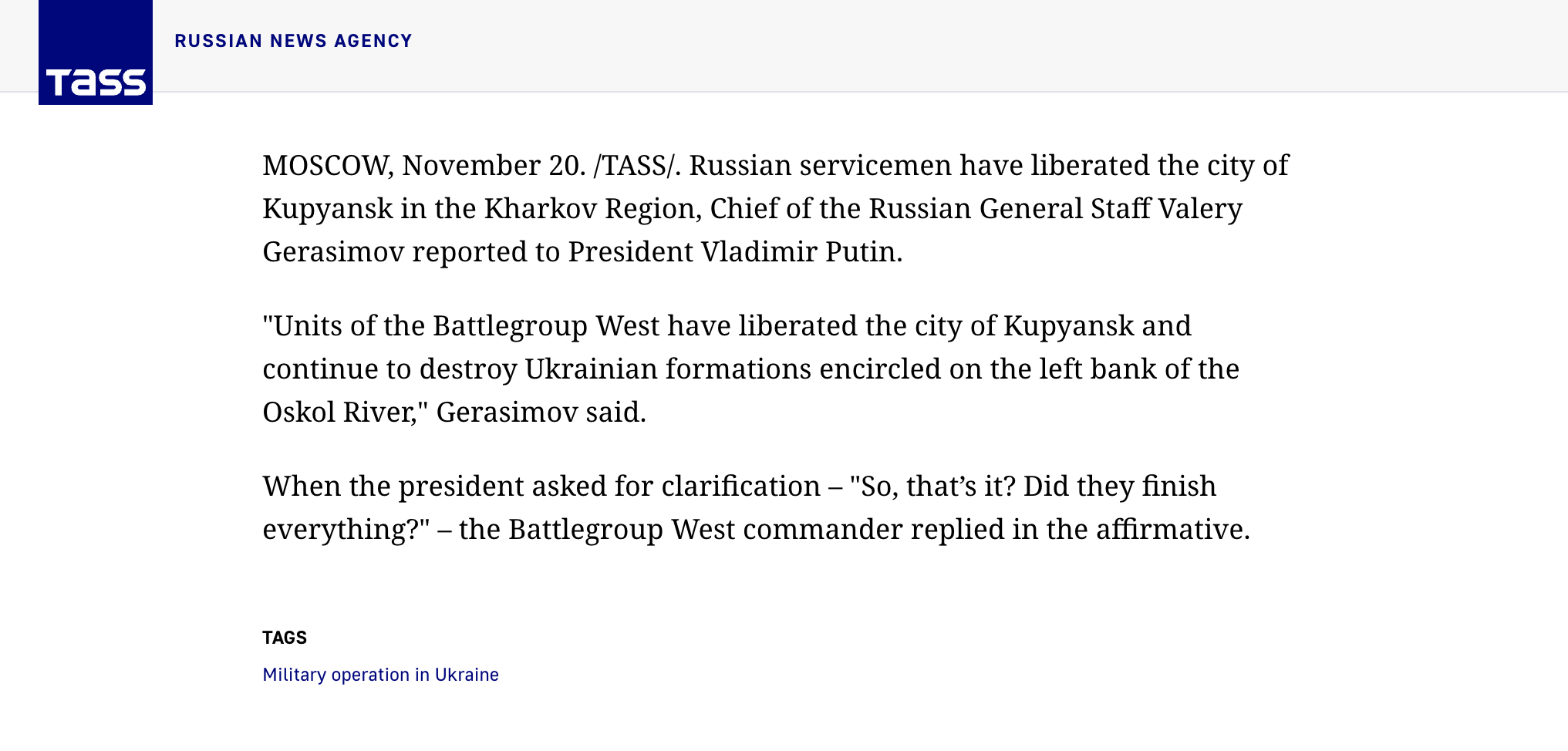
This is the second time Ukrainian forces have recaptured Kupyansk since the start of the full-scale invasion. This reversal is especially significant because it follows just over a month after Russia’s top military officer, General Valery Gerasimov, announced a decisive victory over Ukrainian forces in the city. Putin repeatedly touted the capture afterward, including during his annual "Direct Line" telethon, despite mounting evidence that Russian forces were struggling to hold it—most notably Ukrainian President Volodymyr Zelensky's December 12 visit to Kupyansk's city center. The public setback seems to confirm recent Financial Times reporting that Russia's General Staff has misled Putin about the progress of the war with overly optimistic assessments of recent battlefield gains.
2. POTENTIAL DEPLOYMENT OF RUSSIAN ORESHNIK MISSILES OBSERVED IN BELARUS
This week, US researchers Michael Duitsman, Decker Eveleth, Jeffrey Lewis at the Middlebury Institute of International Studies at Monterey announced that they had located the probable deployment location of Russian Oreshnik medium-range ballistic missiles in Belarus. The possible deployment site is located at the former Krichev-6 Aerodrome near the border between Belarus and Russia.
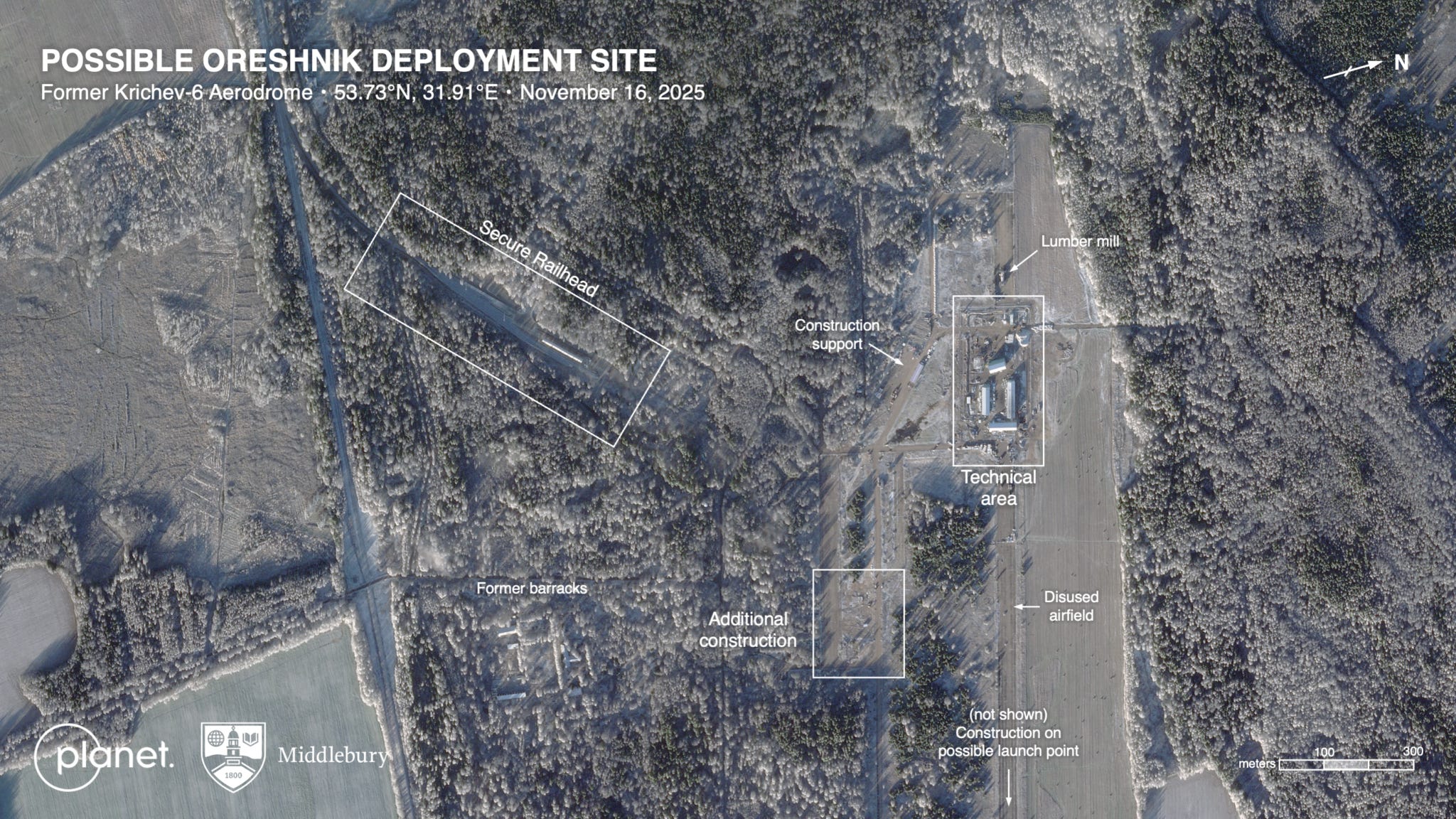
The geolocation comes days after Belarusian President Alexander Lukashenko announced that the missiles were officially on combat duty in the country.
Takeaways:
If Krichev-6 is indeed the deployment site, it would arguably be the least provocative place for the missile to be stored, only a few kilometers from the Russian border. The dissonance between Russia’s history of aggressive rhetoric about the Oreshnik to threaten cities in Ukraine and Europe and its conservative operational posture suggests potential pushback from Alexander Lukashenko, who may want to avoid antagonizing the West amid a thaw in relations while continuing the country’s minimum commitment to support the Russian military.
Ukrainian President Volodymyr Zelensky has suggested that Russia deployed the missiles to Belarus to bypass Ukrainian air defenses and target Ukrainian cities. This is likely untrue if the missiles are at Krichev-6, which offers no strategic advantage over other potential Russian launch sites. A Krichev-6 deployment would instead serve a mostly symbolic purpose of linking Belarus and Russia's strategic security and placing Belarus literally under Russia's nuclear umbrella.
Some experts have expressed doubts that Oreshnik missiles are ready for deployment at Krichev-6. Pavel Podvig has suggested Russia may not yet have operational Oreshnik missiles in the first place. Podvig has noted that details about the Oreshnik’s development have been unusually murky by the standards of the Russian military, and preparations for the missiles’ eventual deployment may be politically convenient.
3. PENTAGON’S ANNUAL REPORT ON THE CHINESE MILITARY PROVIDES INSIGHTS INTO CHINA’S EVOLVING NUCLEAR STRATEGY
On December 23, the Pentagon released its Annual Report to Congress: “Military and Security Developments Involving the People’s Republic of China 2025.” The report highlighted China’s progress toward preparing the People’s Liberation Army for a war to defeat the United States and seize Taiwan in coming years.
“The PLA continues to make steady progress toward its 2027 goals, whereby the PLA must be able to achieve “strategic decisive victory” over Taiwan, “strategic counterbalance” against the United States in the nuclear and other strategic domains, and “strategic deterrence and control” against other regional countries. In other words, China expects to be able to fight and win a war on Taiwan by the end of 2027.
“In pursuit of these goals, the PLA continues to refine multiple military options to force Taiwan unification by brute force. Those options include, most dangerously, an amphibious invasion, firepower strike, and possibly a maritime blockade. Over 2024, the PLA tested essential components of these options, including through exercises to strike sea and land targets, strike U.S. forces in the Pacific, and block access to key ports. PLA strikes could potentially range up to 1500-2000 nautical miles from China. In sufficient volume, these strikes could seriously challenge and disrupt U.S. presence in or around a conflict in the Asia-Pacific region.”
Takeaways:
Some of the most interesting and novel insights from the report lie in its description of China’s development of its strategic forces, information that is generally not accessible through open sources.
First, the report assessed that China has likely advanced an early-warning counterstrike (EWCS) capability by expanding its network of early-warning infrared satellites and loading 100 intercontinental ballistic missiles (ICBMs) into newly completed missile fields in western China. While China's rapid nuclear buildup has been widely documented (including by this journal) the report's framing suggests the US believes China intends to adopt a "launch-on-warning" nuclear posture. Launch-on-warning is the ability to launch a nuclear strike within minutes of detecting incoming ICBMs. This is essentially a hair-trigger response. The posture, while technically consistent with China's stated "no first use" policy, appears to diverge from that doctrine in substance given China's rapid nuclear expansion and refusal to join US-Russia arms control agreements. The growing size and responsiveness of China's nuclear forces, combined with its unwillingness to accept arms limitations, suggest the Chinese military aims to eventually achieve a disabling first-strike capability, regardless of what unverifiable policies it declares.
The second significant development involving Chinese strategic forces was the suggestion that China is developing low-yield nuclear weapons.
“The PLA is probably pursuing nuclear weapons with yields below 10 kilotons. Such weapons address long-held PLA desires to be able to conduct limited nuclear counterstrikes against military targets and control nuclear escalation. Of China’s currently fielded systems, the DF-26 IRBM and the H-6N’s ALBM are both highly precise theater weapons that would be well suited for delivering a low-yield nuclear weapon.”
China could use low-yield nuclear weapons to destroy US bases across the Indo-Pacific, such as in Guam, but more appealing targets for the weapons may be US carrier groups. Attacks on naval task forces would be among the most effective and least escalatory means of employing low-yield nukes. Such strikes would rapidly degrade the US’s ability to project power and carry lower risks of collateral damage and fallout in populated areas.
4. ARMED CHINESE CARGO SHIP SPOTTED IN SHANGHAI ON CHRISTMAS
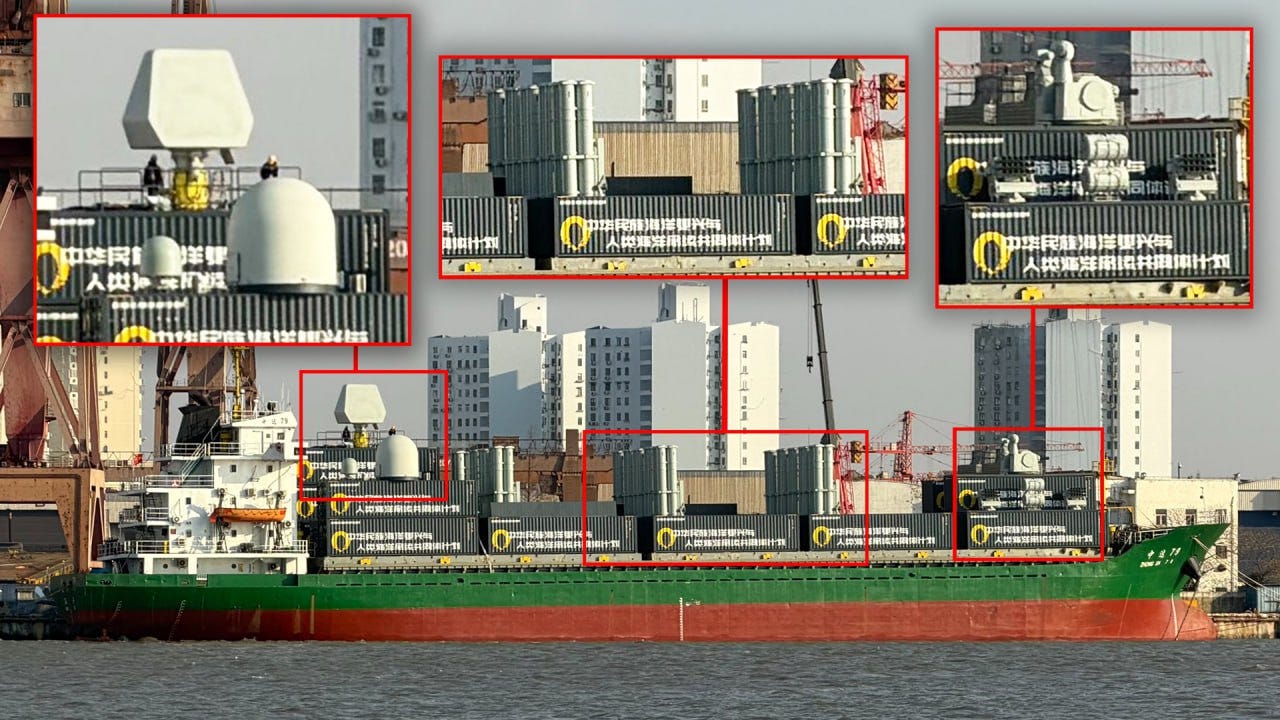
Photos circulated on the Chinese social media on December 25, appear to show a container ship, the Zhong Da 79, outfitted with an arsenal of missiles, radars, and defensive countermeasures docked in Shanghai.
Takeaways:
Much of the initial public reactions to the photograph have fixated on an incorrect perception that weapons deployed from shipping containers are a novel development. Container-based weapon systems have been experimented with for decades now. An earlier pioneer in the field was Russia’s Klub-K cruise missile system developed in the late 2000s. China is alleged to have adapted the Klub-K design for its own YJ-18C system in 2019. Other militaries, notably Israel and Iran, have also developed their own variants of containerized missiles. The US military is currently developing its own containerized missile systems as well. Demand for container-based weapons appears to be growing as norms of freedom of navigation have eroded and distinctions between civilian and military vessels have diminished with civilian ships becoming targets in regional conflicts in the Black and Red Seas.
The more serious signal China has sent with this (likely staged) photo is that it can rapidly scale its already world-leading shipbuilding industry to counter the Trump administration's newly announced "Golden Fleet" project. While China currently has more naval vessels than the US, its navy is still composed disproportionately of smaller, less powerful ships. The "Golden Fleet" would help the US maintain its lead in larger, more sophisticated warships, with plans for new nuclear submarines, frigates, and battleships. However, China could shift the balance of power at sea in its favor if it developed a means of rapidly militarizing its massive fleet of over 8,300 merchant marine vessels. Individually, refurbished civilian vessels like the Zhong Da 79 are qualitatively inferior to conventional warships in speed, survivability, and armament, but at scale they provide redundant capability for China to sustain sealift operations to Taiwan and fend off the US and allied navies.
Maritime Executive assesses that the conversion of the Zhong Da 79 into a military auxiliary vessel likely took several months and is a probable test run of China’s capability to convert similar vessels in the event of war.
5. IRAN ANNOUNCES IMPENDING TRILATERAL NAVAL EXERCISE
This week, the Iranian Navy Commander Rear Admiral Shahram Irani announced impending trilateral naval exercises. Irani did not announce when the exercises would take place or with whom. The announcement came days after two Iranian naval flotillas, the 103rd and 104th naval task forces, departed the harbor of Bandar Abbas for South Africa. The timing suggests the exercises could be held in early 2026 and potentially involve the South African navy and partners of both countries such as Russia or India.
Takeaways:
Iran has recently emphasized the development and power of its navy, announcing new naval exercises, the development of new warships, and seizures of numerous foreign tanker ships accused of smuggling Iranian oil. The renewed focus on the navy in recent months may reflect a shift in Iranian strategy amid significant pressure from multiple fronts.
A capable navy could help Iran break out of international isolation by asserting its right to international trade. The top-down embrace of a seafaring culture may also prepare the country for a potential shift in national priorities if environmental pressures force a permanent resettlement of Tehran and other major cities toward the southern coastal regions of the country.
6. NORTH KOREA SHOWS OFF NEW SUBMARINE DESIGN
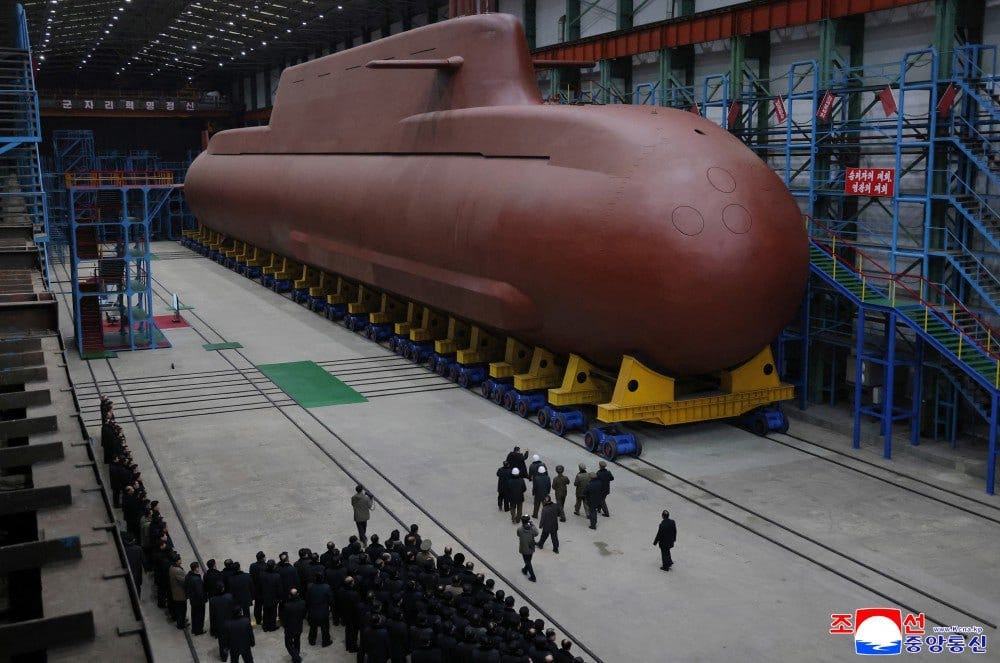
On December 25, Kim Jong-un conducted an inspection of the factory producing what North Korea alleges to be its first ever nuclear-powered submarine. According to Korean Central News Agency (KCNA), the 8,700-ton nuclear-powered submarine will carry numerous nuclear-capable ballistic missiles.
Takeaways:
North Korea’s domestic defense industry has advanced considerably in recent years and its capacity to produce advanced weapons far exceeds its otherwise tiny economy. Still, there is reason to be skeptical about whether the newly announced nuclear submarine is a truly indigenous development. The development of a nuclear submarine would require significant advances in several different technologies to make a miniature nuclear reactor safe and practical to operate as a source of propulsion. A breakthrough of this kind does not track with Pyongyang’s historically incremental development of military technology exhibited in its nuclear and missile programs.
This suggests either the North is exaggerating its accomplishments in light of South Korea’s own move into jointly developing nuclear submarines with the US, or has received external technology transfers from Russia. The latter is a distinct possibility. In October, South Korean Defense Minister Ahn Gyu-back told the South Korean Parliament that Russia was likely providing North Korea with key technologies needed to field a nuclear submarine. As H. I. Sutton has noted, while nuclear propulsion technology would mark a major escalation in Russia's support for North Korea's military, Russia has previously provided similarly transformative submarine modernization assistance.