



This week’s analysis highlights some of the most significant geopolitical developments involving America’s adversaries—China, Russia, Iran, and North Korea—between October 3, 2026 and October 10, 2026.
Executive Summary:
US War with Iran - Significant Activity Related to the US-Iran War
The US withdrew B-1 Bombers from Europe amid new Iranian threats to RAF Fairford and American bases in Germany.
OpenAI announced that it disrupted a sophisticated Iranian AI-generated information operation to advance Iranian narratives in English-language publications.
The Eastern Front - Significant Activity Related to the War in Ukraine and Russian threats to NATO
Russia launched a secretive and likely large-scale response to a possible outbreak of pneumonic plague at the Irkutsk Anti-Plague Research Institute.
Russia secured a US sanctions waiver to resume global diesel exports until April 2027.
Western Pacific Flashpoints - Significant Activity in the Western Pacific and Taiwan
New satellite imagery showed the arrival of Chinese military aircraft at a new overseas military base in Laos.
North Korea conducted a new test of an apparent hypersonic missile.
US WAR WITH IRAN
Significant Activity Related to the US-Iran War
1. NEW IRANIAN THREATS TARGET US BASES IN EUROPE
US Withdraws B-1 Bombers from RAF Fairford
This week the US military announced the withdrawal of 12 B-1 Bombers from RAF Fairford in England. The aircraft were relocated back to bases in the US in response to an advanced Iranian plot to attack the base with armed aerial drones.
The withdrawal is the latest development in response to at least two suspected Iranian plots to target the base, which has been used to launch US bombing missions to the Middle East.
Iranian Intelligence Services Planning Attacks on US Bases in Germany
German media outlet WirtschaftsWoche reported on October 8, 2026, that Western officials have been monitoring potential plots against US military bases in Germany posed by Iranian intelligence services. The disclosure came days after The New York Times reported that Israeli officials shared intelligence with their US and German counterparts of a heightened risk of Iranian attacks on US bases in the country, specifically targeting bases in Spangdahlem and Ramstein.
Takeaways:
The withdrawal of US B-1 Bombers from RAF Fairford is a short-term embarrassment but does not represent a permanent setback to US military force projection. On the one hand, the incident demonstrates the US and allies still wield robust intelligence collection capabilities which have constrained Iranian operations. On the other hand, it reveals a woeful long-term complacency about security at US overseas bases. The forced relocation of US bombers was driven primarily by a lack of shelters to protect the aircraft from unmanned aircraft systems (UAS) threats, representing a shameful lack of preparedness despite years of warnings regarding growing threats posed to US bases from small UAS. The immensity of the threat to US strategic bombers was underscored by the stunning success of Ukraine’s 2025 Operation Spider Web.
The costs of insufficient security for US aircraft at overseas bases were laid bare in a Congressional Research Service (CRS) report released on October 5, 2026. The report identified 81 US aircraft that were either damaged or destroyed by Iranian drones and missiles since the start of major combat operations on February 28, 2026.
2. OPENAI DISRUPTS IRANIAN AI-GENERATED INFORMATION OPERATION
OpenAI announced on October 8, 2026, that it had disrupted a sophisticated Iranian plot to advance Iranian narratives in Western media using generative AI. OpenAI researchers found that between July 2025 and October 2026 Iranian actors developed over 100 English-language op-eds and analytical pieces critical of US policy and sympathetic to Iran which were published in Western media outlets. The publications were submitted under seven AI-generated personas: Ericka Feusier, Sophia Gonzalez, Michael Harrison, Ervin B. Hoskins, Alice Johnson, Noah Lamington, and Jenny Williams. According to OpenAI, these fake personas were made to look legitimate with detailed biographies and social media histories that were similarly crafted by AI.
According to the biographies that were posted online alongside some of these articles, each persona purported to be a Western journalist (usually American, though the Noah Lamington persona’s bio claimed that they were in New Zealand), often with a focus on international politics, the Middle East, human rights, or conflict. For one of the personas, “Michael Harrison,” the operators asked the model to write the bio itself. (Of note, in March Meta disrupted an Iranian IO that also featured a “Michael Harrison” journalist persona.)
Some of these personas were backstopped by accounts across a range of social media platforms. The Michael Harrison persona, for example, was backstopped on Medium, X, and Facebook. The Ervin B. Hoskins persona featured accounts on X, Facebook, Instagram, and Threads. This persona’s bio claimed to be “an American freelance writer”, but social media transparency settings located the accounts in Iran.
The Iranian actors subsequently boosted the reach of the articles with mass inauthentic engagement on social media.

Takeaways:
Marc Owen Jones, an Associate Professor at Northwestern University in Qatar and expert on disinformation and Middle East politics, traced publications by the Iran-linked fake personas of Ericka Feusier, Sophia Gonzalez, Michael Harrison, Ervin B. Hoskins, Alice Johnson, Noah Lamington, and Jenny Williams to the following media websites: Antiwar.com, Asia Times, Black Star News, CounterPunch, Emmitsburg.net, Eurasia Review, Fair Observer, Foreign Policy in Focus, International Policy Digest, LA Progressive, The Libertarian Institute, Middle East Monitor, Modern Diplomacy, NationofChange, News-Register, PeaceVoice, and ZNetwork.
EASTERN FRONT
Significant Activity Related to the War in Ukraine and Russian threats to NATO
3. MYSTERY SURROUNDS POSSIBLE RUSSIAN PLAGUE OUTBREAK
This week Russia launched a secretive and likely large-scale response to a potential outbreak of pneumonic plague in Siberia, after a researcher died under mysterious circumstances at the Irkutsk Anti-Plague Research Institute of Siberia and the Far East. Russia has shared few details of the October 2, 2026 death of institute lab technician Darya Shipilova; however, accounts from local independent media outlets such as “People of Baikal” suggest the 28-year-old died of pneumonia-like symptoms after exposure to plague in a laboratory accident. Early reporting of the incident by local authorities, which corroborated details of this story and suggested a mass response by federal health oversight body Rospotrebnadzor and elements of the Federal Security Service (FSB), was erased from Russian media and denied by the government. Subsequent reports have suggested that hundreds of contacts of Shipilova were placed in isolation following her death, including 60 researchers at the Irkutsk Anti-Plague Research Institute who were quarantined in place at the facility.
On October 6, Russia officially reported to the World Health Organization (WHO) that Shipilova died of “pneumonia of undetermined etiology”. However, follow up Russian reports to the WHO denied the presence of plague and denied that additional hospitals, other than the one Shipilova died in, were placed under observation.
The incident and aftermath currently remain under investigation.
Takeaways:
It is still too early to assess with any certainty the circumstances surrounding the death of Darya Shipilova and whether or not it was the result of plague or of a laboratory accident. However, the seriousness of Russia’s response, indicated in both official reporting (which announced over 5,500 laboratory tests to the WHO) and independent media, indicates that the state believed an outbreak of plague or other serious illness was likely. While it is similarly still too soon to conclude that the outbreak is fully contained, the initial surge of Russian state resources to Irkutsk appears to have passed its peak and restrictions do not appear to have spread outside the region. Both factors suggest a winding down of the government response.
In a noteworthy coincidence, hundreds of Chinese and Russian public health specialists and emergency management officials conducted biosecurity exercises in August and September. According to Senior Jamestown Foundation Fellow Matthew Johnson, the recent exercises involved the director of the Irkutsk Anti-Plague Research Institute and rehearsed a multinational response to plague.
In August, more than 300 personnel from the People’s Republic of China (PRC) joined Russian specialists—including Irkutsk institute director Sergey Balakhonov and the People’s Liberation Army (PLA) Northern Theater Command Disease Control Center—in an exercise rehearsing imported plague, pathogen identification, epidemic notification, joint risk assessment, and cross-border response; on September 29, bilateral health officials again met to discuss infectious disease prevention and disaster medicine.
These exercises should not be viewed as evidence of a conspiracy to release plague, as they are routinely held as part of bilateral cooperation between China and Russia, as well as between other members of the Shanghai Cooperation Organization. The exercises are instead indicative of enduring regional concerns over the potential global threats posed by plague and other contagions that have historically spread from the Eurasian steppe.
4. RUSSIA SECURES SANCTIONS RELIEF FROM THE US WITHOUT PRECONDITIONS
On October 9, 2026, US President Donald Trump announced a deal with Russian President Vladimir Putin to issue a temporary waiver of US sanctions that would allow the sale of Russian diesel on global markets until April 7, 2027. President Trump further suggested that the US would itself import some of the anticipated “3,000,000 Tons of Diesel Fuel” that Russia would be able to sell during the waiver period.
The deal comes less than a month after President Trump signed into law the Lindsey O. Graham Sanctioning Russia and Iran Act of 2026, which expanded authorities for economic sanctions and tariffs to increase economic pressure on Russia.
Takeaways:
The deal is a major coup for Russia, which appears to have secured sanctions relief at a time of growing economic strain without offering any concessions. The deal is also an unforced strategic blunder for the US, which surrendered leverage it could have used to secure verifiable commitments from Russia to end its war in Ukraine, return to strategic arms control agreements, cease threats to US treaty allies, and end support to US adversaries such as Iran.
The deal as announced will also not meaningfully drop the price of diesel. Three million tons of diesel fuel (approximately 22 million barrels), to be delivered by April, is only equivalent to about four days of the US’s own production of diesel (about 5.3 million barrels per day), spread out over six months. The deal will, however, provide Russia with billions of dollars in new funding for its military at a critical juncture in the war in Ukraine, a development that will contribute to increasing disillusionment and distrust in US global leadership.
There is reason to be skeptical that Russia will meet even the paltry promised export targets. Russia has for weeks imposed an export ban on diesel fuel to curb domestic shortages resulting from Ukrainian strikes. Ukraine has signaled it will resist US calls to pause strikes on Russian refineries with an attack on an oil terminal of the Novoshakhtinsk refinery in Rostov Oblast launched hours after the announcement of the Trump-Putin deal. The threat of domestic shortages will continue to impose hard limits on Russia’s ability to actually produce enough diesel to export.
The easing of US pressure on Russia will further weaken deterrence against increasingly unrestrained Russian aggression against Ukraine and US treaty allies in Europe. Russian strikes on Ukrainian cities launched hours after the announcement killed at least 20 civilians. The attack likely serves as a prelude to more intense targeting of civilian to come.
According to documents reviewed by Radio Free Europe/Radio Liberty, Russia has compiled a list of 60 key targets for strategic bombing this winter to maximize the human costs of the war and force Ukrainian capitulation. The list of targets includes “the three operating nuclear power plants that are controlled by Ukraine -- the Zaporizhzhya plant is occupied by Russia -- as well as 10 major hydroelectric power plants and dozens of other facilities. In addition to power plants and other infrastructure, the document indicates that one aim would be to disable substations, transmission lines, and interconnectors near the western border through which electricity is imported from Europe and distributed deeper in Ukraine.”
WESTERN PACIFIC FLASHPOINTS
Significant Activity in the Western Pacific and Taiwan
5. MILITARY AIRCRAFT AND EQUIPMENT APPEAR AT NEW CHINESE OVERSEAS MILITARY BASE IN LAOS
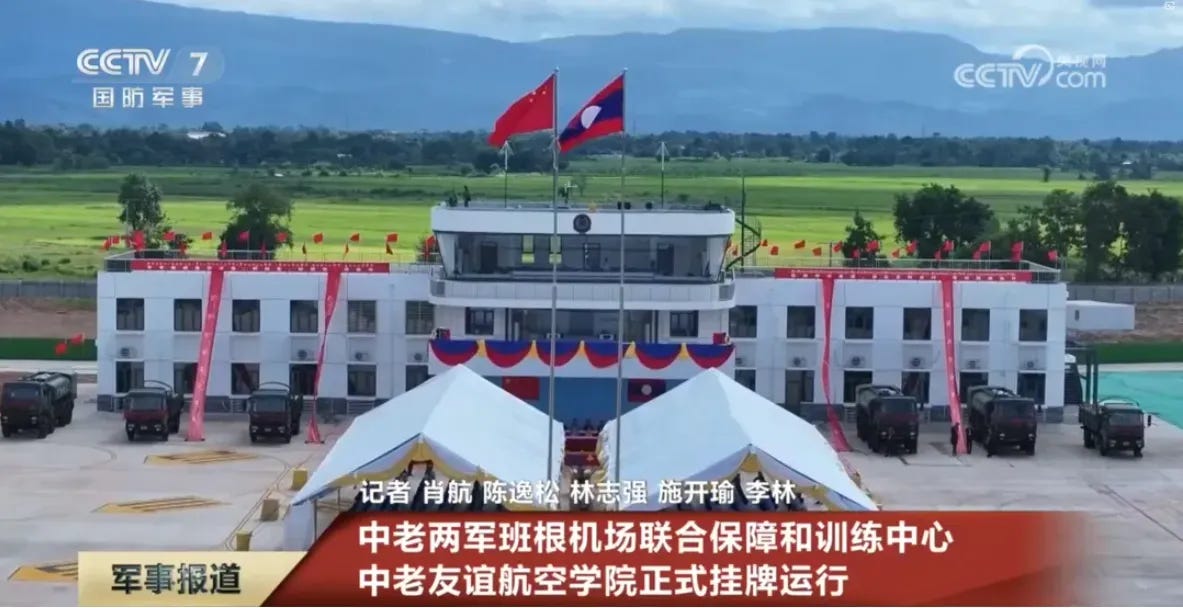
Satellite imagery reviewed this week by Reuters revealed military aircraft at a new Chinese air base in Laos. The aircraft appeared to include at least eight K-8 light attack jets. The new base, located approximately 50 km from the capital of Vientiane at Ban Keun Airport, hosts the China-Laos Joint Support and Training Center and the China-Laos Friendship Aviation Academy.
The base officially opened on September 29, 2026.
Takeaways:
Built on the site of a former US intelligence base from the Vietnam War, the new joint base in Laos symbolizes the literal displacement of US influence in Asia by a rising China. The new air base is the second joint military base China has established in Southeast Asia in the past two years. In April 2025, China opened a joint naval base with Cambodia at Ream Port. These developments are likely to raise deep suspicions in Vietnam, which may view the Chinese move as a direct threat to its own regional influence.
The K-8 jets observed in satellite imagery likely represent combat trainer aircraft that the People’s Liberation Army Air Force will use to train its Laotian counterparts, rather than indicate the presence of forward-deployed combat units.
6. NORTH KOREA CONDUCTS NEW HYPERSONIC MISSILE TEST
On October 3, 2026, North Korea conducted a new test of a ballistic missile carrying an apparent hypersonic glide vehicle (HGV). The missile traveled over 1,000 km before landing in the East Sea (Sea of Japan). The launch was overseen by Kim Jong-un and his 13-year-old daughter Kim Ju-ae.
The launch followed protests by Pyongyang against Seoul and UN Command over blame for an explosion in the DMZ that injured South Korean soldiers on September 21.


Takeaways:
This is the second HGV test North Korea has conducted over the past month. The previous test appears to have been conducted at the same site on September 20, 2026. As with the previous test, described in detail in the Weekly Significant Activity Report - September 26, 2026, it is not clear whether the actual performance of the North Korean missile matches the characteristics generally associated with a HGV.
South Korea tested its own HGV on October 8, 2026, in an apparent response to North Korean tests.
Kim Ju-ae has become a regular observer of tests of advanced North Korean weapon systems over the past year. Her presence is presumably being used to firmly establish her as the heir apparent to Kim Jong-un. Early public appearances by the still young Kim Ju-ae may be important for the succession process as it is unclear if Kim Jong-un has any other children. South Korea’s National Intelligence Service (NIS) reported in 2017 that it assessed that Kim Jong-un had three children, with the eldest being a son approximately three years older than Ju-ae. This has not yet been publicly confirmed and as of September 2026, the NIS was still working to definitively confirm the existence of an eldest son.
NK News reports that this week’s test and other recent tests have occurred at a newly upgraded coastal missile site in Sangum-ri of Anbyon County, just south of the provincial capital of Wonsan. The new construction suggests the site will serve as a proving ground for North Korean weapons for years to come, making it a key location for open source researchers to monitor for future tests.
This briefing was compiled by Dan White. Dan is an independent foreign policy analyst based in the New York Metro Area. Dan is a former member of The Wilson Center and The Kennan Institute. Dan holds masters degrees from the Johns Hopkins University School of Advanced International Studies (SAIS), the Naval Postgraduate School, and the University of Washington. Dan is a former officer in the United States Army and a veteran of the War in Afghanistan.
For more information, corrections, or comments, please contact djwhite155@gmail.com.