



This week’s analysis highlights some of the most significant geopolitical developments involving America’s adversaries—China, Russia, Iran, and North Korea—between June 20, 2026 and June 27, 2026.
Summary:
Update on the war with Iran: Iran ruled out IAEA nuclear inspections and any negotiations over its ballistic missile program, while Iranian and US forces traded strikes for three days after Iran hit two commercial vessels near the Strait of Hormuz. A US pilot also reported an unusual Iranian drone formation before being shot down.
Crimea's Russian-installed government declared a state of emergency over fuel shortages caused by Ukrainian strikes on the peninsula's infrastructure and logistics routes.
South Ossetian President Alan Gagloev resigned to become an advisor to Russian President Vladimir Putin, a move Russian state media suggested foreshadows the annexation of the Georgian breakaway region.
A top Chinese Justice Ministry official announced Beijing will use its new "Ethnic Unity and Progress Promotion Law," to target foreign critics of its treatment of Tibetans and Uyghurs.
Janes reported that the PLA has debuted an upgraded DF-26 ballistic missile with maneuverable warhead fins, alongside the first public appearance of a nuclear-capable DF-17 hypersonic glide vehicle.
Kim Jong-un supervised a test of North Korea's upgraded 240mm multiple launch rocket system, which state media claims now uses AI-assisted terminal guidance to strike targets up to 100km away.
1. IRAN WAR UPDATE
US Pilot Reports Encounter with Unusual Iranian Drone Technology
On June 23, CNN issued an investigative report stating that the pilot of a US F-15 fighter shot down by Iranian forces encountered an unusual interconnected “minefield” of Iranian drones prior to being downed. The report characterized the drone formation as appearing like a jellyfish, with drones moving in unison.
Iran Denies Allowing Return of IAEA Inspectors
This week, Iran’s Foreign Ministry issued numerous denials that it would allow specialists from the International Atomic Energy Agency (IAEA) to return to the country to inspect damaged nuclear sites. The denials followed previous statements by both the US Vice President JD Vance and IAEA Director General Rafael Grossi that inspectors would be given access to Iranian sites as part of any war-ending deal.
Iranian President Rules Out Talks Over Ballistic Missiles
On June 23, Iranian President Masoud Pezeshkian announced that Iran will never engage in any negotiations over its ballistic missile program.
Iran Hopes to Make Billions from Hormuz Administration
A June 25 report by the Wall Street Journal suggests that Iran believes its plan to extract fees from “administering” the Strait of Hormuz could yield up to $40B in annual revenue.
US and Iran Again Trade Blows Over Hormuz Control
On June 25, Iranian forces struck the Singapore-flagged cargo vessel Ever Lovely, exiting the Strait of Hormuz along the Omani coast. The US launched retaliatory strikes on June 26, with US Central Command (CENTCOM) reporting strikes on Iranian missile and drone storage locations and coastal radar sites.
Bahrain was subsequently targeted by a wave of Iranian drones on June 26, seemingly in response to US strikes.
On June 27, the United Kingdom Maritime Trade Operations (UKMTO) Centre reported a second vessel struck by an unknown projectile near the Strait of Hormuz, this time the Panamanian-flagged tanker Kiku. The US responded with a second, broader wave of strikes targeting Iranian air defenses and coastal military sites. Iranian forces then responded with additional strikes against US bases and other targets in Kuwait and Bahrain.
US strikes on Iranian coastal military targets on June 27. Source: US Central Command
Takeaways:
While Iran’s drone technology is remarkably advanced and effective, reports of its use of jellyfish-shaped, airborne minefields of drones should be treated with skepticism. The CNN report suggested the pilot’s recall of the event could have been compromised by a concussion received after being shot down.
The resumption of Iranian attacks on shipping near the Strait of Hormuz appears to have been prompted by an increase in ships following alternatives to routes authorized by Iran’s so-called “Persian Gulf Strait Authority.” Iran likely is using the attacks to ensure it retains coercive control over the Strait throughout negotiations in order to extract maximum concessions from the US. It also wants to normalize an enduring threat of violence to shipping in order to pressure governments and companies into cutting protection deals in order to squeeze as much of its reported goal of $40B in “service fees” for safe passage as possible in the future.
Confusion about the safety of passage through the Strait of Hormuz persists in large part because of ambiguity in the Memorandum of Understanding (MOU) signed between the US and Iran. The MOU specified the following terms for the Strait:
“Upon the signing of this MOU, the Islamic Republic of Iran will make arrangements using its best efforts for the safe passage of commercial vessels with no charge, for 60 days only, from the Persian Gulf to the Sea of Oman and vice versa. The traffic of commercial vessels will immediately start, and considering the need for removing the technical and military obstacles, and demining by the Islamic Republic of Iran will be instated within 30 days. The Islamic Republic of Iran will conduct dialog with the Sultanate of Oman to define the future administration and maritime services in the Strait of Hormuz in discussion with other Persian Gulf littoral states in line with the applicable international law and the sovereign rights of coastal states of the Strait of Hormuz.”
Despite claims of the Trump Administration to the contrary, these terms largely defer authority over maritime traffic through the Strait of Hormuz to Iran in perpetuity.
Nuclear inspections and ballistic missiles are two red lines that will continue to complicate negotiations. While the Trump administration has suggested it will not pressure Iran on its missile program, US allies including the Gulf States and Israel are reportedly pressuring the administration to take a harder line. Iran may ultimately concede on inspections of its damaged nuclear sites, but such concessions are likely to come late in negotiations and in exchange for significant US compromises. Any agreement is likely to be subject to strict Iranian stipulations, and limited to well-known historic sites at Fordow, Natanz, and Isfahan, rather than any blanket authority to inspect new sites like Pickaxe Mountain.
2. RUSSIA DECLARES STATE OF EMERGENCY IN CRIMEA
On June 26, Sergey Aksyonov, the Russian-installed “prime minister” of Crimea declared a state of emergency for the peninsula over deteriorating economic conditions caused by Ukrainian drone strikes on critical infrastructure and supply chains. The state of emergency allows the authorities to control the dwindling fuel supply. The announcement came as government traffic reporting showed a five-hour wait to leave the peninsula over the Kerch bridge.
Miles-long traffic jam of vehicles leaving Crimea at the approach to the Kerch Bridge. Source: Astra on Telegram
Takeaways:
Ukrainian long-range strikes on Crimea’s critical infrastructure, now amounting to as many as 100 per day, combined with a broader campaign of special forces raids and “middle-strike” drone attacks on ferry, train, and road routes supplying Crimea, have effectively imposed a distant blockade on the peninsula starving it of fuel, power, military equipment. The blockade has effectively turned the peninsula into a large wasting asset for the Kremlin which is absorbing precious military resources to keep supplied and defended.
Ukrainian Special Operations Forces destroy the North Crimean Canal Railway Bridge, a major logistics route for the peninsula. Source: Special Operations Forces (SSO) of Ukraine
3. SOUTH OSSETIA’S PRESIDENT RESIGNS TO JOIN PUTIN’S STAFF, SIGNALING POSSIBLE ANNEXATION
On June 23, South Ossetian President Alan Gagloev announced his resignation to become advisor to Russian President Vladimir Putin. Russian media outlet Kommersant suggested the move represented a step toward “unifying” the South Ossetia breakaway region of Georgia with the Russian province of North Ossetia.
Takeaways:
While an internationally recognized part of the Republic of Georgia, South Ossetia has been effectively under Russian control since the early 1990s. The 2008 war between Russia and Georgia was engineered by the Kremlin to consolidate its control over the territory as well as the nearby breakaway region of Abkhazia, in order to exert control over Georgian politics and create obstacles to the country’s entry into European institutions. The Kremlin has previously been hesitant to outright annex the territories due to complex ethnic geopolitics in the region that would challenge integration, and concerns that the move would eliminate their use as leverage over internal Georgian affairs. The calculus on annexation may be changing as Russian influence in the South Caucasus faces continual setbacks.
On June 7, 2026, Armenia re-elected the party of Prime Minister Nikol Pashinyan, who pledged to pivot away from Russian institutions toward Europe and the US after Russian peacekeepers failed to prevent Azerbaijan from seizing the territory of Nagorno-Karabakh in the Fall 2023. The results came despite great efforts by Russian intelligence and security services to try to sway the vote away from Pashinyan’s Civil Contract party to more pro-Russian candidates. Relations with Azerbaijan have also deteriorated since late 2024 after Russian air defenses shot down Azerbaijan Airlines Flight 8243 flying between Baku and Grozny, Chechnya.
The shift away from Russian influence in both countries was symbolized in the August 2025 US-brokered peace deal between the former adversaries and an associated agreement to establish a US-led strategic transportation route through the region. The “Zangezur Corridor” connecting Azerbaijan with its exclave of Nakhchivan through Armenia’s Syunik province would provide faster land-based shipping between China and the European Union and pose a threat to trade corridors running through Russian territory.
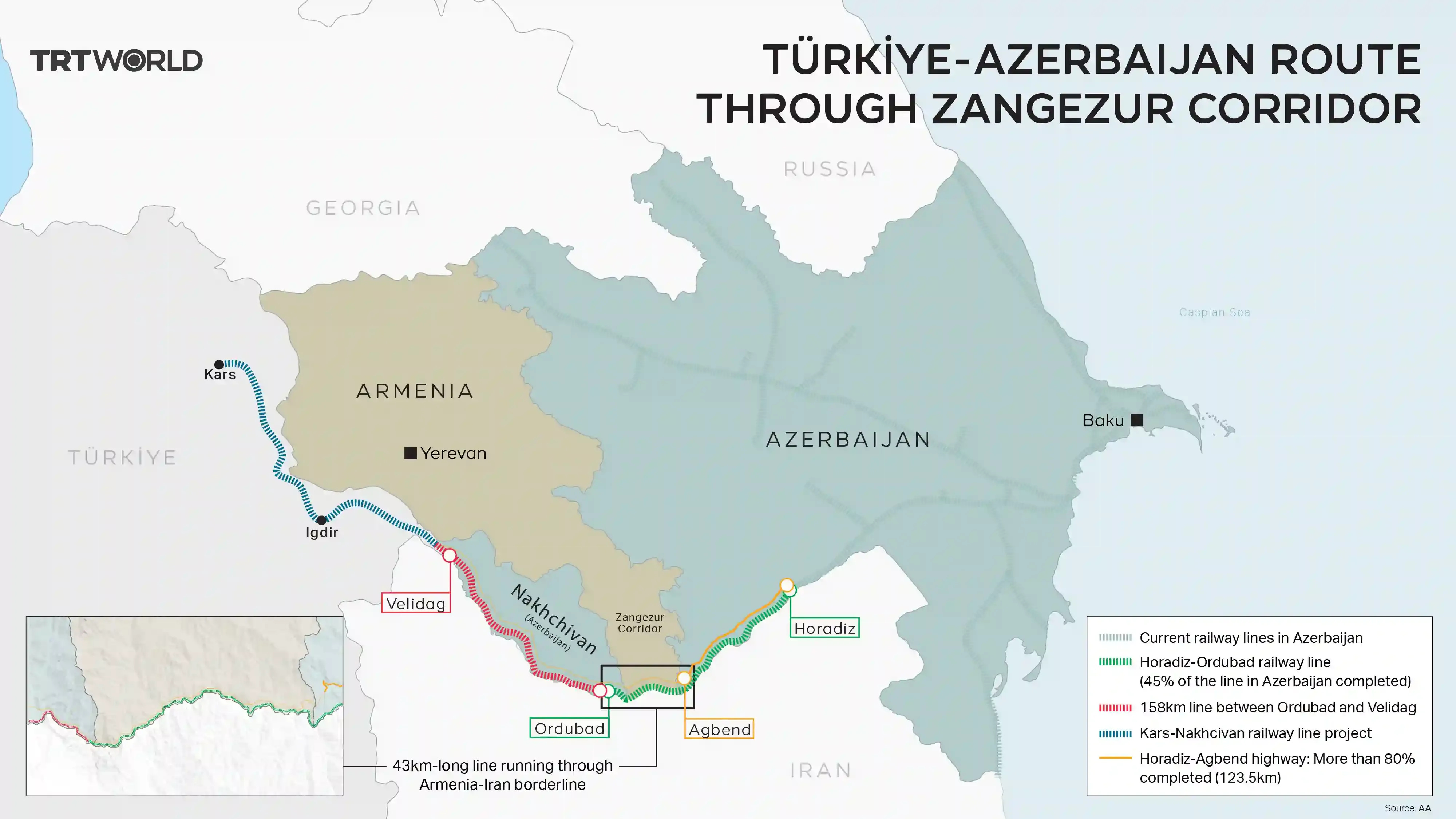
Annexing South Ossetia would shore up Russian influence in the South Caucasus through the threat of further territorial seizures from Georgia (such as Abkhazia) while warning Armenia and Azerbaijan that Moscow is willing to use force to maintain its regional dominance.
4. CHINA TO USE NEW “ETHNIC UNITY” LAW AGAINST OVERSEAS HUMAN RIGHTS CRITICS
China’s Vice Justice Minister, Hu Weilie, announced on June 23 that Beijing would use provisions in the new “Ethnic Unity and Progress Promotion Law” to target foreign individuals and groups who “undermine ethnic unity and progress or incite ethnic separatism.” Passed in March by the National People’s Congress, the new law goes into effect on July 1.
Takeaways:
The new statement appears to signal that Beijing intends to use the law to target foreign critics of its treatment of ethnic minorities—most notably Tibetans and Uyghurs—through Interpol red notices and other lawfare measures. Such measures are used to pressure foreign governments to either extradite foreign critics, or enact entry bans, or other sanctions against them to satisfy Beijing.
China has used similar measures in the past to target overseas Hong Kong dissidents under the city’s National Security Law. On July 25, 2025, the National Security Department of the Hong Kong Police Force issued warrants for the arrest of 19 overseas democratic activists associated with the “Hong Kong Parliament” group, including 15 bounties worth HK$1 million (approximately $127,400). Nathan Law, among the most prominent of the activists targeted, was denied entry into Singapore in September 2025. Singapore defended its decision, saying Law’s presence was not in its national interest due to his outstanding arrest warrant.
5. NEW REPORT HIGHLIGHTS IMPROVEMENTS TO CHINA’S DF-26 AND DF-17 STRATEGIC MISSILES
A June 23 report by Janes found that the People’s Liberation Army debuted an upgraded DF-26 intermediate-range ballistic missile. The new missile has fins on its warhead that according to Janes, “may be intended to enable terminal manoeuvres by adjusting the flight path in both horizontal and vertical planes, improving the ability to engage mobile targets and penetrate missile-defence systems that may provide it greater maneuverability making intercepts more difficult.”
The report also highlighted the first public appearance of a nuclear-capable DF-17 missile equipped with a hypersonic glide vehicle.
Takeaways:
The wars in Ukraine and the Middle East have provided significant feedback on the effectiveness of US anti-ballistic missile systems and how they might be circumvented. The upgraded DF-26 may be inspired by lessons learned from Ukraine in particular where Russian forces have reportedly experimented with features on their ballistic missiles to make their terminal trajectory more unpredictable and harder to intercept by Patriot interceptors.
The DF-17 is China’s answer to the US’s Dark Eagle hypersonic missile system. The Dark Eagle has rotated through Japan and other Indo-Pacific nations for exercises over the past year. It is not clear if these deployments or any other action directly prompted China to highlight the strategic system now, but it is plausible, as China’s relations with its neighbors, especially Japan, have notably deteriorated in recent months.
6. NORTH KOREA TESTS 240MM ROCKET SYSTEM WITH AI-ASSISTED TERMINAL GUIDANCE
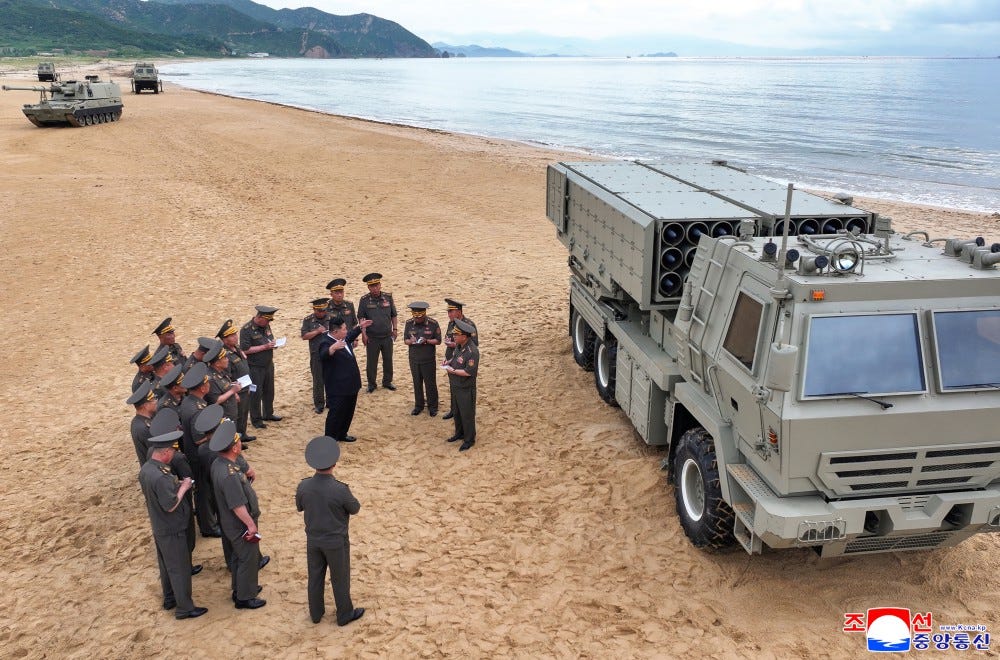
On June 26, Kim Jong-un supervised a test of North Korea’s 240mm multiple launch rocket system, and extended range 155mm artillery shells.
North Korean state-media says the 24-tube, 240mm rocket system has a range of 90km and will be used for Corps-level fire support.
Takeaways:
The 240mm rocket system, a staple of the North Korean military dating back to the Cold War, has undergone years of upgrades under Kim Jong-un. Kim’s personal attendance at two test launches of the system in just over a month, further suggests the rockets represent a significant priority for North Korea’s defense industry.
The 240mm system appears to be moving away from use as an inaccurate area saturation weapon into a more precision strike capability. At the previous launch on May 26, 2026, Korean Central News Agency reported that the rockets utilized an “ultra-precision autonomous navigation system and the TERCOM (terrain contour matching) navigation system and employed an AI terminal guidance function,” to strike targets up to 100km away. While these technological claims are unverifiable, the purported capabilities resemble those of a small cruise missile. Even if the details are accurately portrayed, it is unclear whether North Korea is able to mass manufacture the rockets or whether a small number will serve as special capabilities.
Note: There will be no Weekly Significant Activity Report next week due to the July 4 holiday.
This briefing was compiled by Dan White. Dan is an independent foreign policy analyst based in the New York Metro Area. Dan is a former member of The Wilson Center and The Kennan Institute. Dan holds masters degrees from the Johns Hopkins University School of Advanced International Studies (SAIS), the Naval Postgraduate School, and the University of Washington. Dan is a former officer in the United States Army and a veteran of the War in Afghanistan.
For more information, corrections, or comments, please contact dan@opforjournal.com.