



OPFOR Journal is resuming its regular Weekly Significant Activity Reports after focusing exclusively on the war with Iran since February 28, 2026. While the war has not yet ended, significant developments in Russia, China, and North Korea demand renewed attention. This and future Significant Activity Reports will lead with an update on the state of the war with Iran, as it nevertheless remains the most consequential issue for US national security.
This week’s analysis highlights some of the most significant geopolitical developments involving America’s adversaries—China, Russia, Iran, and North Korea—between April 11, 2026 - April 18, 2026.
Summary:
Update on the war with Iran: new estimates of war damages, country-wide internet shutdown continues, and uncertainty about the Strait of Hormuz.
Russia’s State Duma advanced a new law allowing the President to deploy troops abroad to defend the rights of Russians wrongfully imprisoned, setting up a potential pretext for invading the Baltic States.
Russia intensified its bombing of Ukrainian population centers and critical infrastructure as its ability to conduct large scale ground offensives diminishes amid heavy losses and improved Ukrainian defenses.
New reports suggested that China has been providing Iran with access to high resolution satellite imagery that would enable it to target US forces across the Middle East.
North Korea conducted multiple high profile live-fire exercises.
1. IRAN WAR UPDATE
Iran Provides New Estimate of War Damages
In an interview this week with Russia’s RIA Novosti, spokesperson for the Iranian regime, Fatemeh Mohajerani, claimed that US and Israeli strikes caused over $270B in damage to the country.
Iranian Internet Shutdown Continues
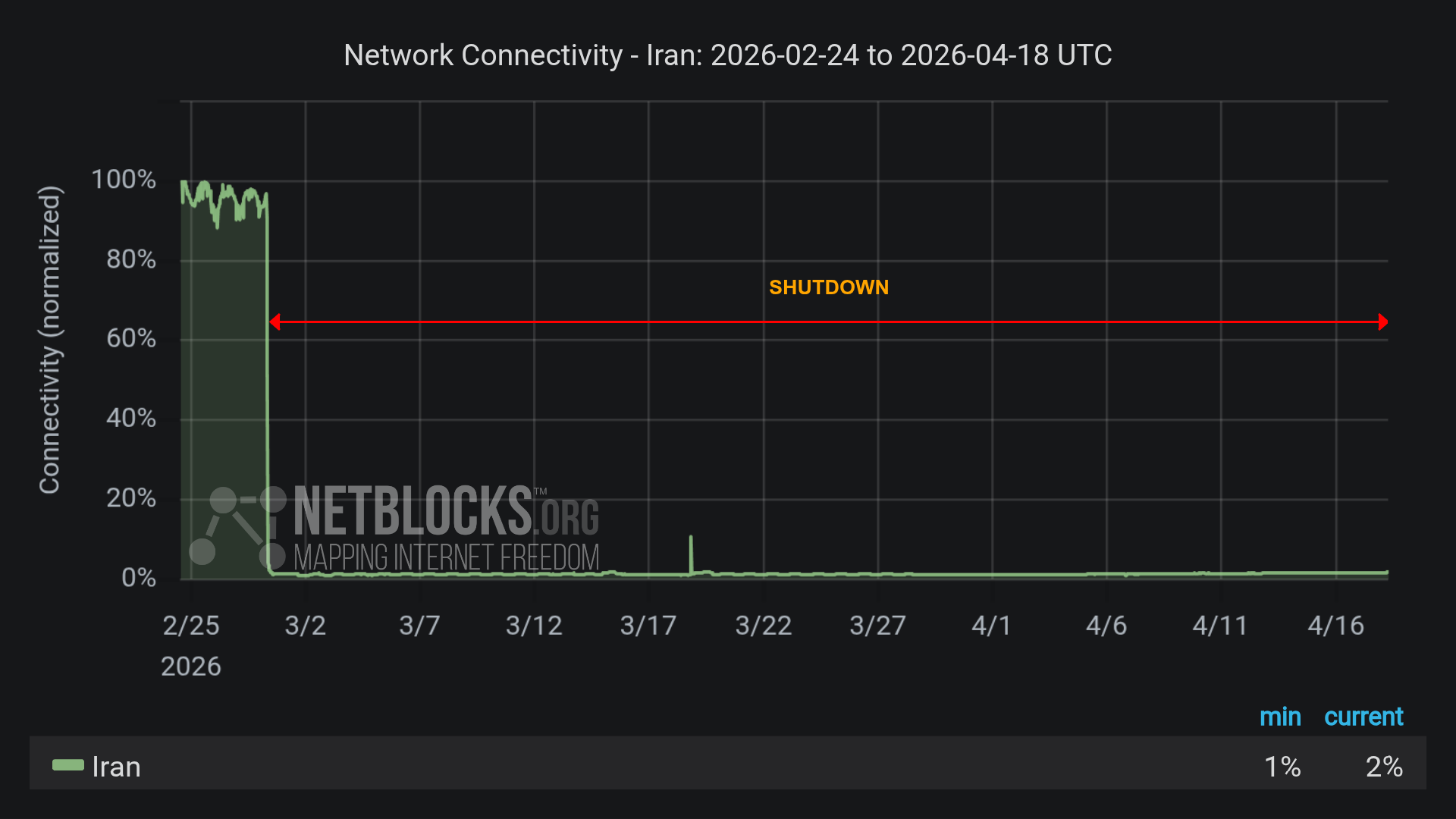
According to internet connectivity monitoring organization Netblocks, April 18 marked 50 days of a near total internet blackout in Iran.
Iran Reopens then Immediately Closes the Strait of Hormuz
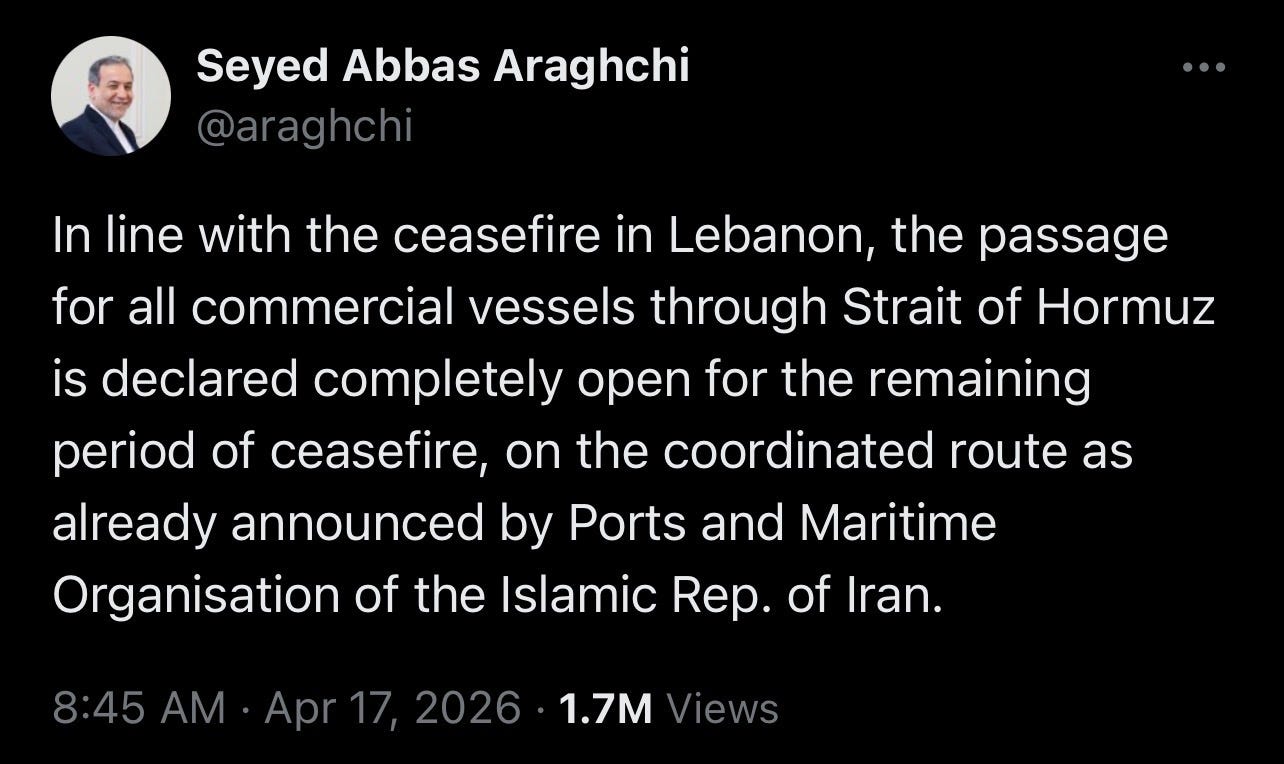
On April 17, Iranian Foreign Minister Abbas Araghchi announced that Iran was ending its blockade of the Strait of Hormuz in the wake of the ceasefire between Israel and Lebanon. The announcement coincided with a similar declaration by US President Trump.
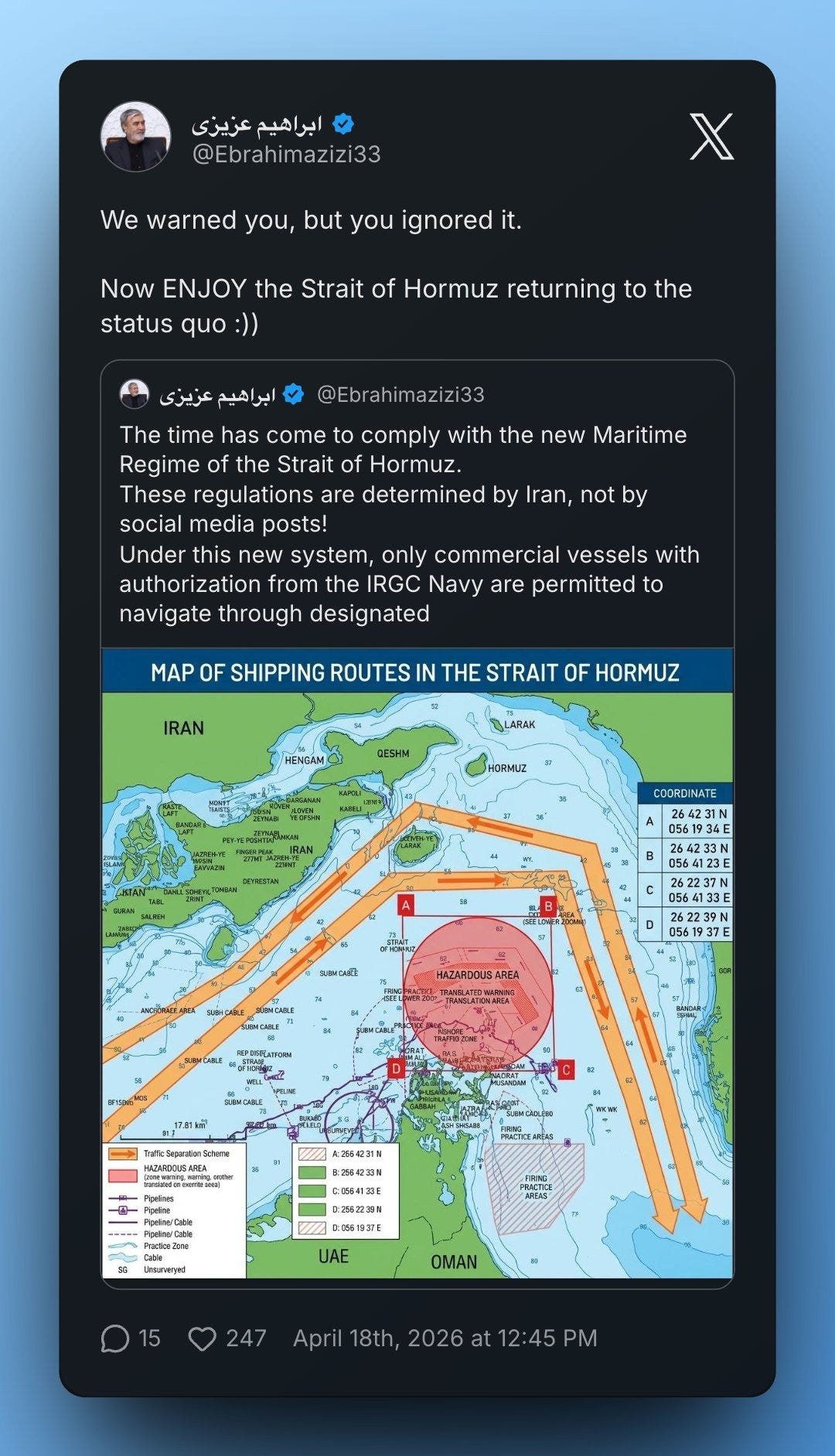
However, the policy was almost immediately thrown into question as other Iranian leaders including Ebrahim Azizi the head of the Iranian Parliament’s National Security Commission stated that the Strait was only open to ships who followed the instructions and approved routes of the Islamic Revolutionary Guard Corps and paid a toll. Azizi posted a map of approved and restricted shipping lanes to drive home his point.
Less than 24 hours later, several Iranian leaders including the Khatam al-Anbiya Central Headquarters announced that Iran was reimposing its blockade of the Strait due to betrayals of trust by the US.1 The IRGC reportedly fired on two Indian flagged ships in the wake of the announcement. The attack drew a formal diplomatic protest from the Indian government.
Takeaways:
The ongoing internet blackout may have cost Iran close to $2B in direct economic losses, based on previous internal government estimates of the cost of the internet shutdown imposed during the December-January anti-government protests. That internet shutdown cost about $35.7M per day according to Iranian Minister of Communications Sattar Hashemi. Afshin Kolahi, head of the Knowledge-Based Commission of the Iran Chamber of Commerce, suggests the total costs could be even higher, as much as $80M per day, when accounting for the indirect effects of lost economic activity.
Iran’s continued internet blackout will further complicate any economic recovery from the war. The figure of $270B in war-related economic costs cited by spokesperson Mohajerani represents over half of Iran’s total annual GDP of $475B. The IMF has further estimated that Iran’s economy will contract over 6% this year. A projection provided by Iran’s central bank estimates that it will take Iran over 12 years to fully recover under these conditions, and that inflation could reach 180% in the interim.
-
The staggering economic toll of the war may be pushing some pragmatic Iranian leaders to seek a compromise settlement that ends the war in exchange for sanctions relief (in addition to concessions that preserve its other interests such as its nuclear program, proxy forces and ballistic missiles). However, hardline elements in the IRGC motivated by ideology and a sense of growing power may be largely indifferent to the material costs of the war.It’s not immediately clear what has led to Iran’s apparent reversal of its announcement to open the Strait of Hormuz. It seems possible that the initial announcement by Foreign Minister Araghchi was a part of a diplomatic process between Iran and the US to end the war. The move may have encountered substantial push back from hardliners who viewed the policy as a capitulation amid a continued US naval blockade and triumphalist statements made by President Trump.
-
Whatever the policy, confusion over Iran’s intent to enforce a blockade is likely enough by itself to continue stalling maritime traffic. The policy reversal and public disagreement over it, voiced in official media outlets associated with the IRGC such as Fars News Agency and Tasnim News, portend the potential for serious discontent with any negotiated end to the war with the US. The new Supreme Leader’s continued public absence will make resolving these disputes more difficult.
2. RUSSIAN PARLIAMENT PAVES THE WAY FOR USE OF MILITARY FORCE TO DEFEND THE RIGHTS OF RUSSIANS ABROAD
On April 14, the Russian Duma advanced a new law (Bill 1181659-8) that would authorize the President to use military force to defend Russians at risk of prosecution and imprisonment abroad. The Chairman of the State Duma Defense Committee, Andrei Kartapolov, promoted the bill as necessary to defend Russians from rampant international Russophobia,
“The State Duma Defense Committee supports the bill's concept, as the proposed regulation will help protect the rights, freedoms, and legitimate interests of Russian citizens, protect Russian organizations from foreign illegal attacks, and counter the rampant Russophobia campaign that continues internationally.”
Takeaways:
The timing of the new law may be seen as a provocation toward the Baltic States and Moldova, which have large Russian-speaking populations that Russia considers Russian nationals. Russia has intensified threats against the Baltic States in recent weeks, accusing the countries of permitting Ukraine to use their airspace for drone attacks on Russia’s Baltic oil and gas infrastructure. Russian affiliated actors appear to have also launched a cognitive warfare campaign suggesting the development of a “Narva People's Republic” in Estonia, alluding to the creation of a separatist Russian region of the country. The idea recalls similar “People’s Republics” announced in Georgia and Ukraine prior to their invasion by Russia in 2008 and 2014 respectively.
The threat implied by these actions is that Russia intends to establish a plausible casus belli for invasion. In the case of the “Narva People’s Republic,” Russia may intend to engineer a crisis between Estonian authorities and the country’s community of Russian speakers, potentially instigated by Russian intelligence services and armed proxies, which then provokes arrests that can be used as a pretext for invasion.
This is not without precedent. Russia engineered a similar crisis in Estonia in April 2007 in response to the removal of a large bronze monument to Soviet soldiers. In that incident, Russian leaders and state media inflamed the passions of the country's Russian-speaking minority for weeks in the lead up to the removal, while the Russian embassy allegedly recruited local criminals to foment unrest. The result was multiple nights of riots between April 26-29, 2007 that resulted in hundreds of arrests, dozens of injuries, and one death. The Russian Duma demanded that the Kremlin “punish” Estonia with economic sanctions in response to the crisis. Estonia then faced weeks of persistent cyberattacks from Russian based/affiliated actors targeting its critical infrastructure.
3. RUSSIA CONTINUES INTENSE WAVE OF BOMBARDMENTS
Russian Forces Strike Critical Dam in Kharkiv
On April 14, Russian forces launched six long-range glide bombs at the Pechenihy Reservoir dam in Ukraine’s Kharkiv oblast. Four of the bombs struck the ground near the dam’s gates while another two impacted the water.
Russia Conducts One of its Deadliest Air Raids of 2026
On April 15, Russia launched a massive bombardment of Ukrainian cities involving 44 missiles and 659 drones. The attack killed 17 and injured as many as 100, making it one of the deadliest attacks on Ukrainian civilians so far this year.
Takeaways:
Russia previously attacked and damaged the dam on multiple occasions including December 2025. The latest attack appears to be an attempt to further weaken the dam and trigger an environmental disaster that forces the displacement of Ukrainian civilians and the abandonment of Ukrainian frontline positions in Kharkiv.
Russia is attempting to intensify its bombardments of Ukrainian population centers and critical infrastructure to force an end to the war on its terms by breaking the will of the Ukrainian people. Ukrainian Foreign Minister Andrii Sybiha announced on April 17 at the Antalya Diplomacy Forum that Russia intends to conduct seven large-scale bombardments per month. While Russia has pursued this scorched earth strategy throughout the war, it appears to be emerging as the Kremlin’s primary theory of victory as alternatives become more difficult.
-
The expansion of Ukraine’s domestic defense industry and its increasingly automated defense in depth have hardened Ukraine’s lines and made continued incremental ground advances by Russian forces extremely costly. Compounding matters, estimated Russian losses have begun to consistently exceed assessed recruitment into the Russian military in recent months. UK Defense Secretary John Healey highlighted this trend during the April 15 meeting of the Ukraine Contact Group, announcing that Russian casualties had increased by more than a third in March 2026 over previous months, and that for the fourth month in a row the total number of Russian soldiers lost in combat had exceeded the number recruited. This persistent negative trend in Russian manpower is a first in the war and a sign that Russia’s offensive potential may be past its peak.
4. REPORTS SUGGEST CHINA PROVIDED IRAN ACCESS TO SATELLITE IMAGERY OF US FORCES
China Sold Iran Spy Satellite it Then Used to Target the US Military
An April 15 investigative report released by the Financial Times alleges that leaked Iranian military documents show that Chinese company Earth Eye Co sold a TEE-01B remote sensing satellite to Iran’s Islamic Revolutionary Guard Corps via “in-orbit delivery” in late 2024.2 The deal also gave Iranian forces access to information from the commercial ground data transmission stations of an additional Chinese company Emposat. The satellite is believed to have been used to surveil and target US military forces in the Middle East.
According to Congress, China Obtained and Then Publicly Distributed Imagery of US Forces in the Middle East from Airbus
On April 16, Senator John Moolenaar, the Chairman of the Select Committee on China, sent a letter to the Pentagon alleging that the committee had obtained compelling evidence that imagery of US military forces in the Middle East and Indo-Pacific were provided to Chinese company MizarVision, by Airbus Space days before the start of Operation Epic Fury. MizarVision subsequently shared many of the images, including of US stealth fighters and carrier groups, on social media.
Takeaways:
This is not the first time the US has been alerted to problematic cooperation between top European aerospace company Airbus and civilian firms tied with the Chinese military industrial complex. A March 16, 2026 letter by the Senate Select Committee on China alleges that the French government has refused multiple requests for information about Airbus’s ties with Chinese entities.
The issues raised with Airbus exemplify a broader problem, how to effectively delineate and enforce redlines with China. As repeatedly noted in prior Significant Activity Reports, the national security threats posed by China are among the most complex for the West to negotiate (or even fully conceptualize) due to China’s pivotal role as a global manufacturing hub and the government-directed integration of its civilian technology sector with its military, a process known as military-civil fusion.
While the US has good reason to attempt to reduce threats to operational security posed by dual-use technology provided by allies and partners, attempting a total global embargo on high resolution satellite imagery is unlikely to be sustainable as such technology is now widely available and increasingly represents a public good. The US military will need to adapt to an increasingly transparent battlefield.
5. NORTH KOREA CONDUCTS MULTIPLE MAJOR MILITARY LIVE-FIRE DRILLS
North Korean Navy Test Fires Newest Destroyer
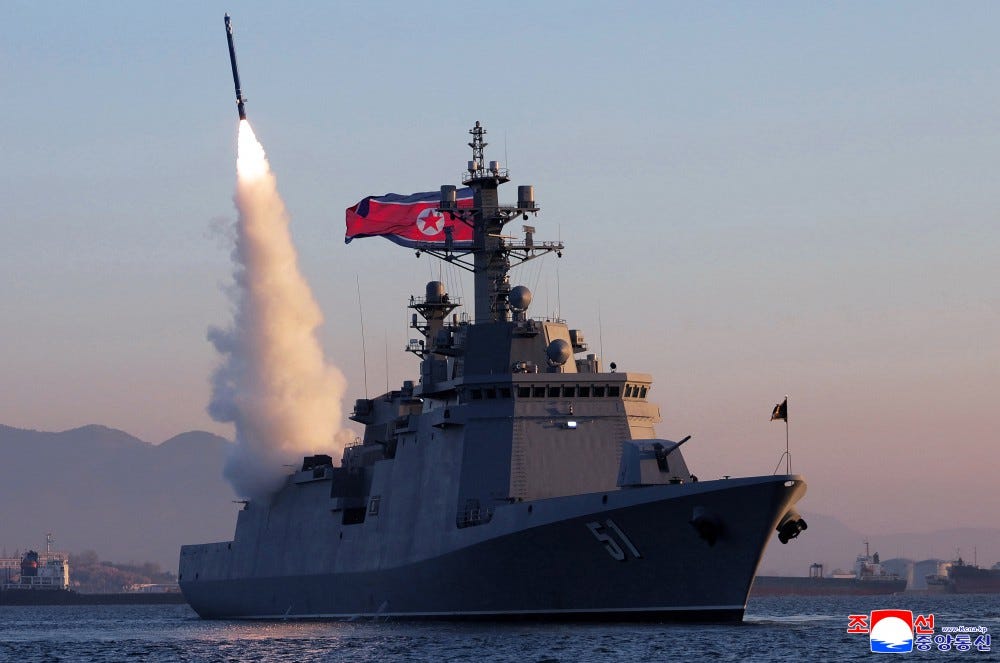
On April 12, North Korea conducted a live-fire exercise involving its newest and most advanced naval destroyer, the Choe Hyon. The Choe Hyon test fired two strategic cruise missiles and three anti-ship cruise missiles. Kim Jong-un personally supervised the exercise.
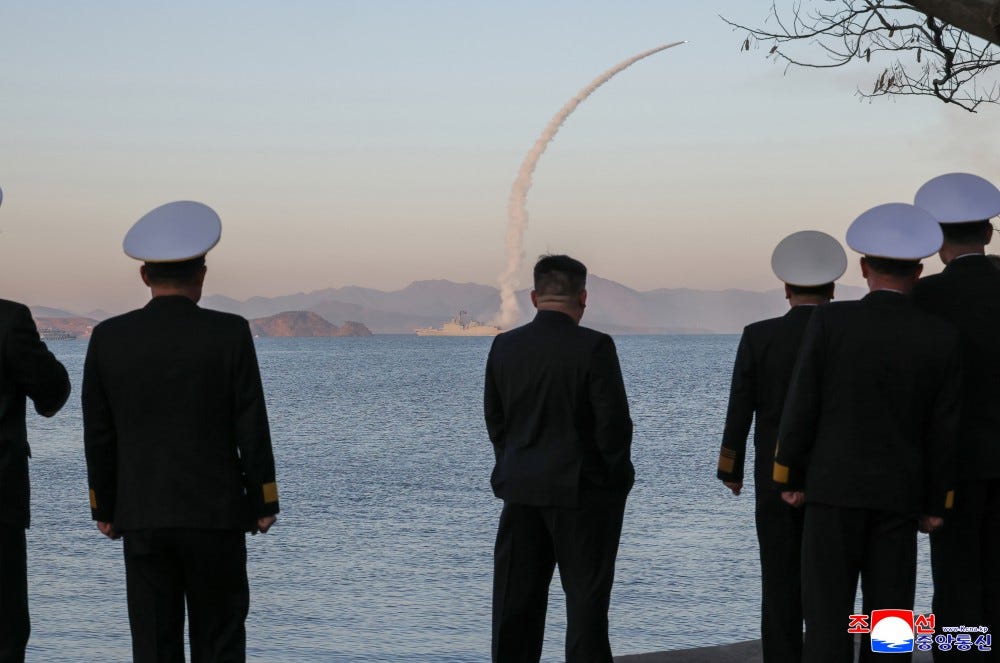
Kim Jong-un Oversees Artillery Contest on Grandfather’s Birthday
On April 16, Kim Jong-un oversaw an artillery firing competition conducted in celebration of the birthday of his grandfather, and nation’s founder, Kim Il-Sung. This was the first time Kim Jong-un attended a military event celebrating either his father or grandfather.
Takeaways:
The latest naval live-fire involving North Korea’s most advanced warship highlights the substantial progress Kim Jong-un has made in modernizing the North Korean military. The capabilities of the ship and its arsenal of precision guided munitions may also serve as an advertisement for potential global arms buyers. While sanctions have largely curbed North Korean arms exports, its sale of missiles and artillery shells to Russia in recent years has helped erode global taboos about doing business with Pyongyang—deals that South Korea's Korea Institute for National Security Strategy estimates are worth nearly $14.4 billion in total. Russia's assistance in subverting sanctions monitoring has set the stage for future growth in illicit North Korean arms deals, and may position Moscow as a key broker.
This briefing was compiled by Dan White. Dan is an independent foreign policy analyst based in the New York Metro Area. Dan is a former member of The Wilson Center and The Kennan Institute. Dan holds masters degrees from the Johns Hopkins University School of Advanced International Studies (SAIS), the Naval Postgraduate School, and the University of Washington. Dan is a former officer in the United States Army and a veteran of the War in Afghanistan.
For more information, corrections, or comments, please contact dan@opforjournal.com.
Khatam al-Anbiya Central Headquarters coordinates Iran’s conventional military, Islamic Revolutionary Guard Corps, and proxy forces. It is comparable in stature and function to a US combined joint task force headquarters.
Meaning the satellite was launched by a Chinese firm and then subsequently sold after in-orbit functional tests are completed.