



This week’s analysis highlights some of the most significant geopolitical developments involving America’s adversaries—China, Russia, Iran, and North Korea—between July 4, 2026 and July 11, 2026.
Summary:
Update on the war with Iran: Iran held a massive six-day funeral for slain Supreme Leader Ali Khamenei; new Supreme Leader Mojtaba Khamenei still unseen despite father’s burial; the US and Iran exchanged blows over continued attacks on ships near the Strait of Hormuz as President Trump announced the ceasefire over.
Russian President Vladimir Putin has refused calls by his advisors to end the war in Ukraine along the current frontline and appears poised to escalate the war.
New reports illuminated the extent of Chinese and North Korean support for Russia’s war effort in Ukraine.
The China Coast Guard rotated vessels deployed in the waters east of Taiwan in a possible move to sustain its presence in the region indefinitely.
China tested a submarine-launched ballistic missile in the South Pacific, alarming regional countries in an apparent violation of the region’s “nuclear-free zone.”
Kim Jong-un oversaw a live-fire exercise of North Korea’s newest naval destroyer involving over a dozen nuclear-capable cruise missiles.
1. IRAN WAR UPDATE
Khamenei Funeral Attracts Huge Crowds with One Notable Absence
This week enormous crowds of mourners attended a six-day funeral procession for former Iranian Supreme Leader Ayatollah Ali Khamenei. Khamenei’s body was carried through Tehran and major Shia holy cities in Iran and Iraq before being buried in the Shrine of Imam Reza in his birthplace of Mashhad on July 9.
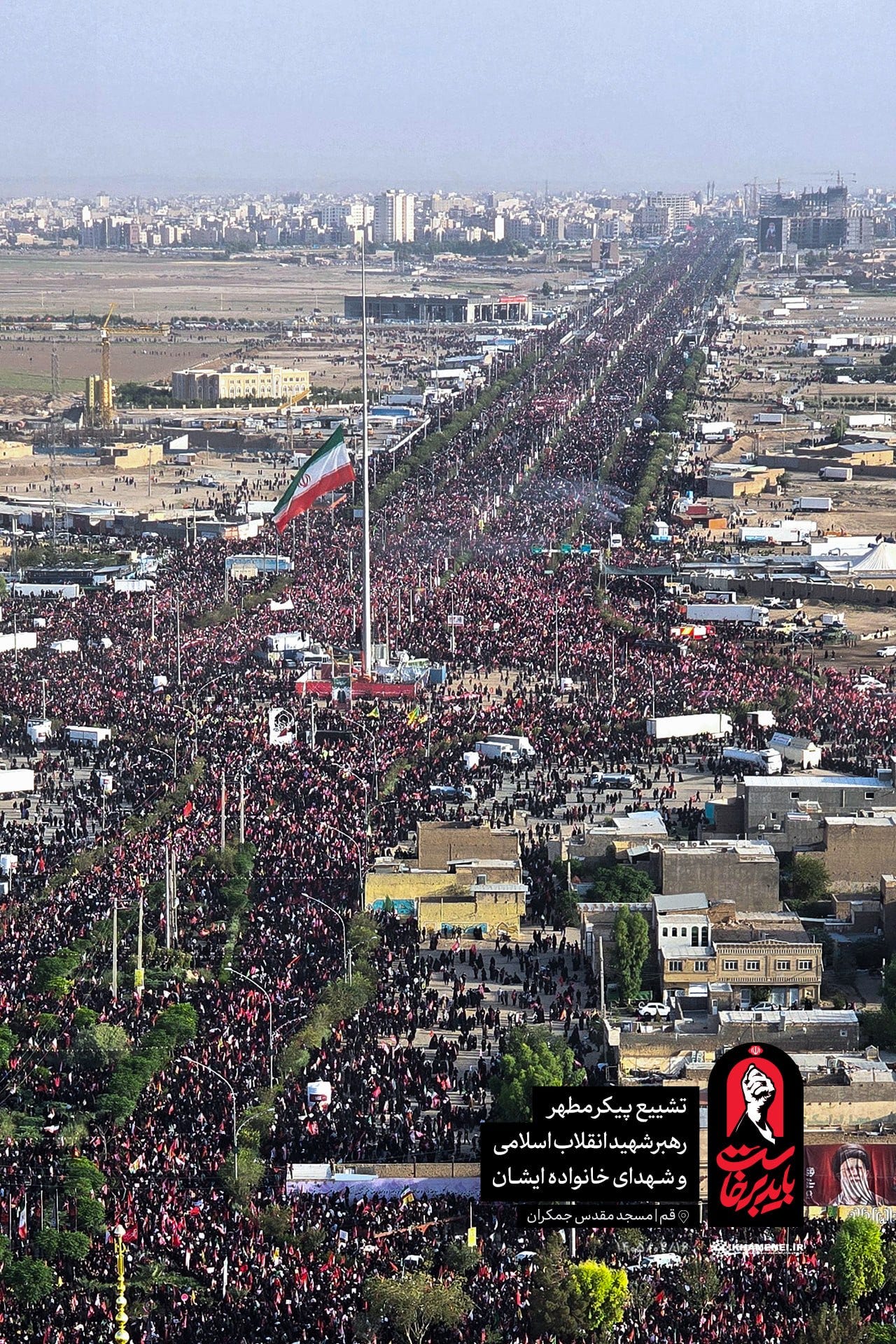
The funeral, which top Iranian leaders attended and which attracted delegations from around the world, was marked by one notable absence, Mojtaba Khamenei, the late Ali’s son and successor as Supreme Leader. While he did not appear in public, Mojtaba released a statement on July 11 declaring the “inevitability” of revenge against the US and Israel.
US and Iran Initiate New Cycle of Attacks Amid Continued Attacks on Shipping
This week, Iran and the US resumed hostilities in response to multiple Iranian attacks on commercial shipping through the Strait of Hormuz.
On July 7, Iran’s Islamic Revolutionary Guard Corps (IRGC) Navy attacked three tanker ships transiting the Strait of Hormuz, resulting in two days of widespread retaliatory US airstrikes. Iran launched several waves of drone and missile attacks targeting US bases in Bahrain, Jordan, Kuwait, and Qatar.
In addition to airstrikes, the Iranian attacks spurred the US to suspend sanctions waivers allowing the sale of Iranian oil, stranding over 60 million barrels of oil already loaded on Iranian tankers. President Trump responded to the continued attacks by declaring the ceasefire “over,” though allowing for talks to continue.
On July 11, the IRGC Navy fired upon and disabled a Cyprus-flagged container ship it accused of using an unauthorized route through the Strait of Hormuz. The group subsequently declared the Strait of Hormuz closed “until further notice.” The US responded to the renewed Iranian aggression with a third round of airstrikes.
Takeaways:
Iran’s PressTV claims the funeral is the largest in recorded history with 43 million people in attendance. The director of the official Islamic Republic News Agency (IRNA) claims 24 million people attended the funeral service in Tehran alone. These estimates are likely an order of magnitude too high. Iranian independent media outlet Factnameh has estimated attendance in Tehran peaked around 300,000 based on crowd sizes with an absolute limit to attendance at 3 million based on the capacity of public transit.
-
Estimates of exact attendance figures aside (and whether all attendees showed up willingly), the massive crowds demonstrated that the Islamic Republic continues to enjoy real support among a segment of Iranians, even amid widespread popular hatred and discontent toward the regime.If there was ever a time for Mojtaba Khamenei to finally appear in public (even if only on video) to put to rest any rumors about his health and fitness to serve as Supreme Leader, it was this week on the occasion of his father and predecessor’s funeral. And yet the only message from Mojtaba Khamenei came in writing, the sole form of communication the new Supreme Leader has engaged in since his appointment in March.
-
The continued absence of the new Supreme Leader is going to become more difficult to pass off as a precautionary war-time measure to defend against assassination and will pose increasing problems for governance as time goes on. The regime will ultimately need some kind of formal head of state to publicly commit to a course of action that ends the war while balancing divergent interests in the country. The absence of a final decision maker, a new development in the country, could lead to disagreements about government policy that fracture the regime over the long-term.
Policy dysfunction is on display now amid continued attacks on commercial shipping through the Strait of Hormuz in violation of the Islamabad Memorandum. Iranian negotiators have conveyed to the US that continued attacks on ships are the result of “rogue elements” of the IRGC who are interested in undermining the broader negotiations between US and Iran in order to seek revenge. This explanation, while likely containing elements of truth, is overly reductive. Iranian attacks on shipping continue for a number of reasons beyond revenge:
-
First, by specifically targeting ships that use alternative routes to the prescribed “toll booth” route administered by the so-called “Persian Gulf Strait Authority,” the IRGC is trying to institutionalize its control over all traffic through the Strait. Second, continued threats to shipping, contrasted with the US’s continued inability to prevent them, reinforce the world’s dependence on Iranian goodwill to allow oil and gas through the Strait of Hormuz, providing Iran with leverage it can use to extract maximum concessions from the US in negotiations. Third, Iran wants to normalize an enduring threat of violence to shipping to create incentives for governments and private companies to cut protection deals for safe passage. Iranian leaders have suggested such deals could amount to a whopping $40B per year.
2. PUTIN REBUFFS ADVICE TO FREEZE FRONTLINES
In a July 9 report by Reuters, Kremlin sources have said that President Vladimir Putin has rebuffed calls by advisors to freeze the frontlines and accept a negotiated end to the war in Ukraine. Putin believes that seizing the remainder of the Donbas is achievable through continued military operations and needs to be accomplished to satisfy Russia’s minimum war aims.
Takeaways:
Sources quoted in the article claim that Putin is likely to “escalate” the war in order to make a battlefield breakthrough. What form this escalation is to take remains unclear. As the Russian military appears to have reached the limit of its current capacity in Ukraine, the Kremlin has three main options for escalation it can attempt to break the deadlock. It can order a partial or general mobilization of Russian society to enlarge the military and commandeer resources for the war effort, use nuclear weapons, or launch an attack on NATO.
None of these are good options. However, of the three, the most viable option appears to be a new partial mobilization coming after State Duma elections in late September. Such action has been the subject of a growing number of rumors in recent weeks. The Kremlin has also been reported to have engaged in preliminary steps to facilitate such a mobilization. Spring efforts by Russian security services to consolidate control over the internet may be seen as an attempt to control the information space in the event of a new mobilization wave to head off the public panic that resulted from the partial mobilization in Fall 2022.
3. NEW REPORTS HIGHLIGHT CHINESE AND NORTH KOREAN CONTRIBUTIONS TO RUSSIA’S WAR EFFORT
China Helping Russia Upgrade its Drones and Battle Starlink
A joint investigation by Russian independent media outlet The Insider, Germany’s Der Spiegel, and France’s Le Monde, released on July 9 has found that China’s support for Russia’s war in Ukraine has gone far beyond what was previously known. China has reportedly been providing Russia with advanced technology to upgrade its drones and air defenses. Most provocatively, China has allegedly been helping the Russian military to combat Ukraine’s use of SpaceX’s Starlink satellite internet.
North Korea Sustaining Russia’s Ammunition Needs
According to a July 8 report by the Kyiv Post, Ukraine’s Military Intelligence (HUR) assesses that North Korea remains a top arms supplier to Russia. HUR estimates that since June 2023, Pyongyang has provided Russia with over 7 million rounds of large caliber munitions (rockets, mortars, artillery, and tank shells), 100 ballistic missiles, and 600 artillery systems. HUR further assesses that North Korea continues to supply up to 40% of Russia’s artillery ammunition needs.
Takeaways:
Both reports underscore the extent to which allied assistance, rather than simply economic resilience and domestic self-sufficiency, has become key to sustaining Russia’s war effort. While they are not a cohesive alliance like NATO and do not share long-term interests, the OPFOR have shown that loosely coordinated mutual aid amid war can present significant problems for global order.
The new investigation into China’s contributions to the Russian war effort is the latest in a string of reports released over the past year drawing on European officials who have grown increasingly skeptical of Beijing. Last July, European officials expressed serious alarm after Chinese Foreign Minister Wang Yi told the EU’s chief diplomat Kaja Kallas that China would not allow Russia to lose the war in Ukraine. And last month, Kallas and other European officials announced they had obtained credible information that China had been training units of the Russian military for specialized combat tasks at military academies in China.
4. CHINA MAKES MOVE TO INSTITUTIONALIZE MARITIME PATROLS EAST OF TAIWAN
On July 4, the China Coast Guard moved to rotate and replace vessels operating in the waters east of Taiwan. The two Coast Guard vessels had been part of a “special maritime law enforcement operation” announced on June 6 in response to plans by Japan and the Philippines to negotiate changes to their maritime borders near Taiwan.
Ryan D. Martinson, an Assistant Professor in the China Maritime Studies Institute (CMSI) at the US Naval War College, notes that the move may signal an attempt to turn the temporary deployment into an enduring presence in the area:
Since early June, the China Coast Guard (CCG) has maintained a continuous presence in waters east of Taiwan. Beijing describes these operations as a response to a joint statement issued by Japan and the Philippines in late May, in which the two countries pledged cooperation to delimit their maritime boundary.
Given their duration, these operations differ from past practice, in which CCG cutters appeared east of Taiwan for short periods of time, ostensibly to signal dissatisfaction with the island’s political leadership.
On 4 July, the original CCG task force deployed after the joint statement was issued was relieved by two new ships, suggesting that Beijing intends to normalize CCG presence in these waters.
Takeaways:
Ray Powell, the Director of the Sealight Foundation at Stanford University, has offered an even more provocative take on the move. Powell has suggested that the attempt to sustain the deployment may be a sign that China is beginning in earnest a slow-moving quarantine of Taiwan. Powell notes that the vessels in the area had been hailing and attempting to direct commercial shipping in the region and could transition into more coercive law enforcement operations.
5. CHINESE SUBMARINE-LAUNCHED MISSILE TEST ALARMS SOUTH PACIFIC NATIONS
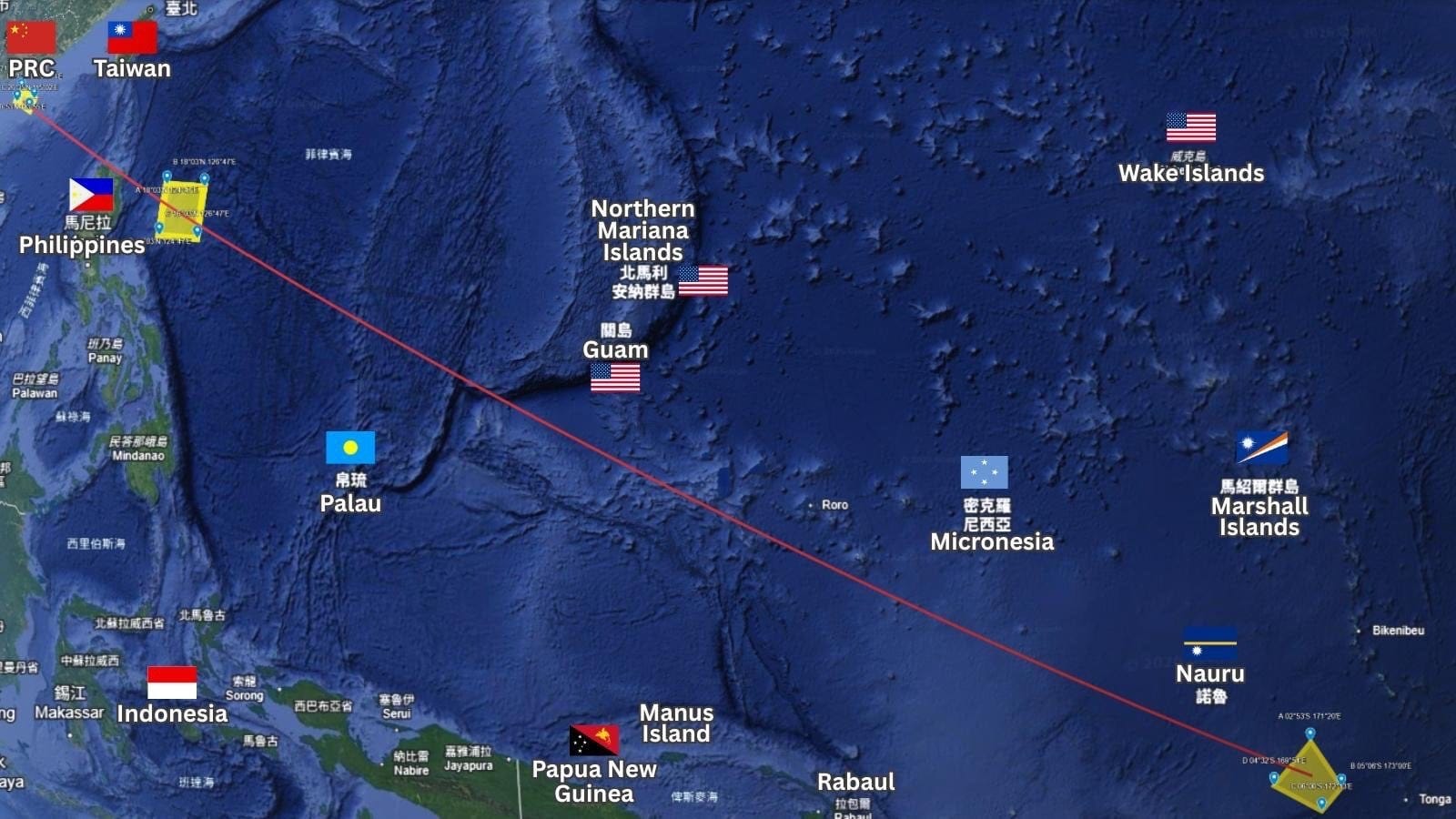
On July 6, the People's Liberation Army Navy (PLAN) conducted a test of a submarine-launched ballistic missile (SLBM) in the Pacific. A statement and map overlay released by Joseph Wu, the Secretary-General of Taiwan’s National Security Council, suggests the missile—a JL-2—was launched from the waters of the South China Sea near Guangdong province and landed in the South Pacific near Tuvalu.
The test triggered substantial alarm among regional nations, with Taiwan, Japan, Australia, New Zealand, the Philippines, and the Solomon Islands protesting the move.
Takeaways:
The rare public test of a SLBM, only the second in two years, coincided with multiple events and anniversaries of significance to China. The launch coincided with the signing of a mutual defense pact between Australia and Fiji and occurred on the opening day of the annual Sino-Russian “Joint Sea-2026” annual naval exercises in Qingdao. However, the most likely trigger for the test is the July 7 anniversary of the Marco Polo Bridge Incident, which began the Second Sino-Japanese War. As US Navy Officer Andrew Orchard, writing in The Diplomat, notes, the developer of China’s SLBMs, the China Aerospace Science and Technology Corporation (CASC), posted an image of a SLBM launch in a graphic commemorating the 89th anniversary of the Incident on Weibo.
It is not entirely clear what missile was fired. As noted above, Taiwanese officials have publicly announced the missile was a JL-2. However, Chinese foreign language media outlet Global Times has suggested the missile was a JL-3. The JL-3 is a new third-generation missile system capable of carrying multiple independently targeted nuclear warheads over 10,000 km. The general anti-Japanese framing of the launch points to this probability as the JL-3 debuted in public at the 80th anniversary celebration of victory over Japan in the Second World War held on September 3, 2025, alongside other land and air based systems composing China’s nuclear triad.
The event was especially alarming to regional nations of the South Pacific as the nuclear-capable missile landed in the middle of the South Pacific Nuclear-Free Zone (SPNFZ) established under the 1985 Treaty of Rarotonga. The treaty prohibits the possession, testing, or use of nuclear weapons and nuclear-capable weapons in the area. China is a signatory to multiple parts of the treaty but did not agree to the provision on testing. The test highlights the risks China’s growing military power presents for those nations despite their efforts to avoid provocation or remain neutral.

6. NORTH KOREA TEST FIRES NUCLEAR-CAPABLE CRUISE MISSILES FROM NEW DESTROYER
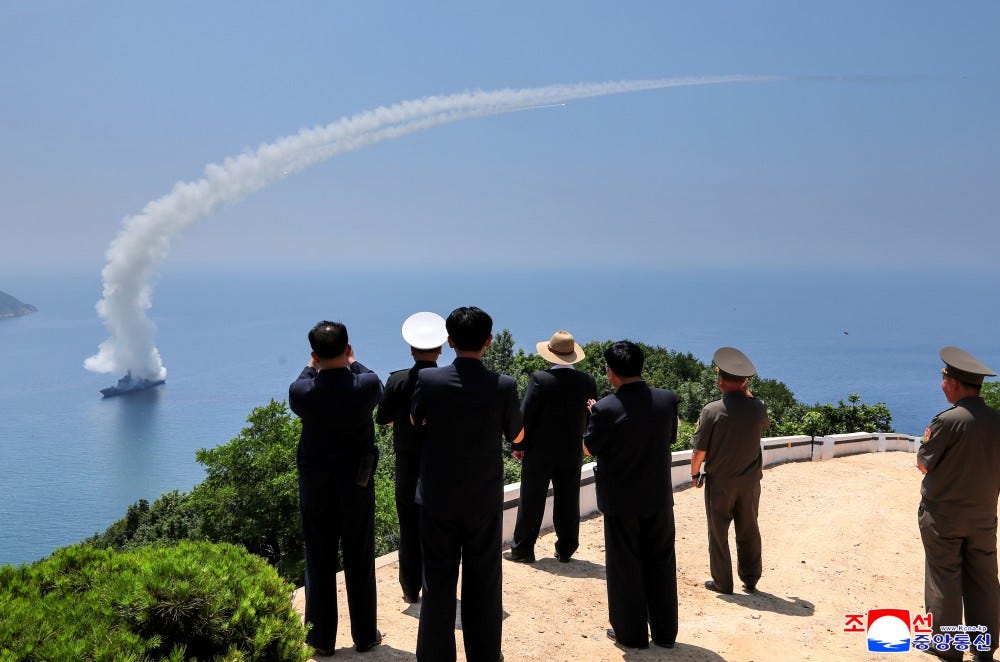
On July 5, Kim Jong-un supervised a live-fire drill involving the Kang Kon, the newest 5,000-ton destroyer constructed for the North Korean Navy. The ship tested a wide variety of weapons, including a dozen “strategic” cruise missiles.
Takeaways:
The 5,000-ton Kang Kon is North Korea’s second Choe Hyon-class destroyer, and one of the most advanced ships in its navy. The first of its class, the eponymous Choe Hyon, was officially commissioned in June. The Kang Kon capsized in a failed launch from Chongjin Shipyard in June 2025 and required months of repairs. The successful live-fire suggests the recovery efforts were successful and the ship is nearly operational.
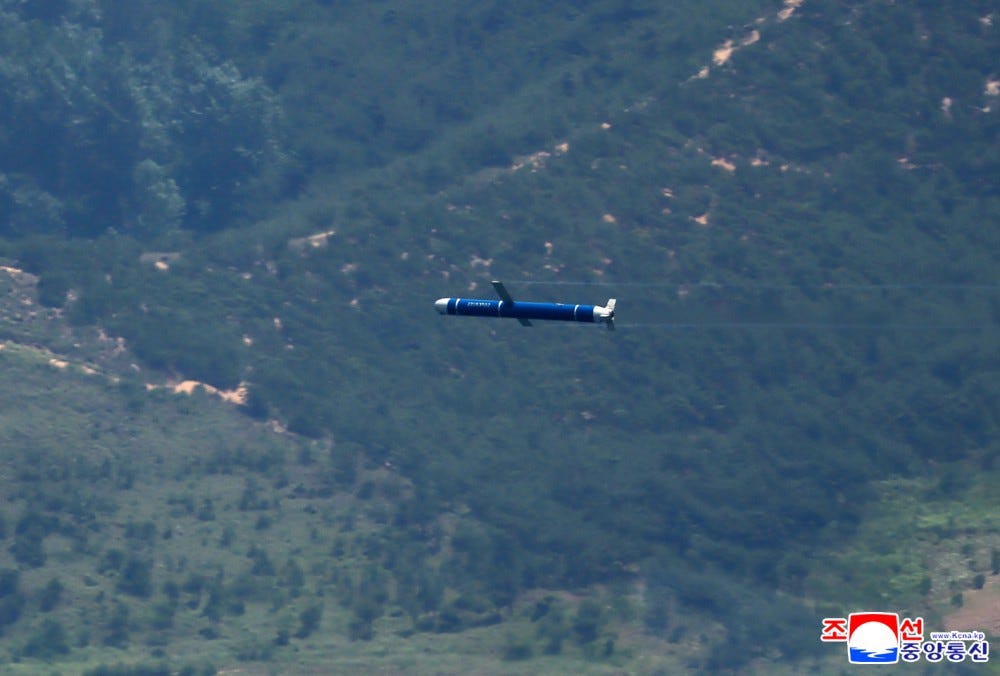
The type of cruise missile tested by the Kang Kon was not announced. It can be inferred, however, that “strategic” means nuclear-capable, indicating the ship could serve as a sea-based component of North Korea’s growing nuclear deterrent. Images of the missile captured from this week’s test resemble those of the Hwasal-2, a land-based nuclear-capable cruise missile.
This briefing was compiled by Dan White. Dan is an independent foreign policy analyst based in the New York Metro Area. Dan is a former member of The Wilson Center and The Kennan Institute. Dan holds masters degrees from the Johns Hopkins University School of Advanced International Studies (SAIS), the Naval Postgraduate School, and the University of Washington. Dan is a former officer in the United States Army and a veteran of the War in Afghanistan.
For more information, corrections, or comments, please contact dan@opforjournal.com.