



This week’s analysis highlights some of the most significant geopolitical developments involving America’s adversaries—China, Russia, Iran, and North Korea—between July 18, 2026 and July 25, 2026.
Executive Summary:
US War with Iran - Significant Activity Related to the US-Iran War
Iran and the US continued intense fighting between July 18 and July 24, as the Trump administration weighed the risks of escalating the war to open the Strait of Hormuz and destroy suspected Iranian nuclear facilities at Pick Axe Mountain.
Russia is providing Iran with satellite imagery and other intelligence to strike US bases in the Middle East.
The Houthis, an Iranian proxy group in Yemen, began an IRGC-supported blockade of the Red Sea, launching attacks on two Saudi oil tankers.
Russia’s War in Ukraine - Significant Activity Related to Russia’s War in Ukraine
Ukrainian drones destroyed at least nine distribution centers for Wildberries, Russia’s largest online retailer.
South China Sea Flashpoints - Significant Activity Related to China’s Military Activity in the South China Sea and Taiwan
According to a new report by The Economist, Russia has been training Chinese units for the military operations it needs to seize Taiwan and defeat the US Navy, including drone operations and submarine warfare, since 2024.
Units of the China Coast Guard clashed with ships of the Philippines near Second Thomas Shoal and Scarborough Shoal.
US WAR WITH IRAN
Significant Activity Related to the US-Iran War
1. INTENSE FIGHTING BETWEEN THE US AND IRAN CONTINUES AS THE WHITE HOUSE WEIGHS ESCALATION
This week, fighting between the US and Iran continued with threats by both sides to expand the intensity and scope of the war.
The US conducted bombing waves targeting the Iranian military and Iranian critical infrastructure on all days but the evening of July 24-25, 2026. Meanwhile, Iran’s Islamic Revolutionary Guard Corps (IRGC) launched drone and missile attacks on US bases and infrastructure of multiple Gulf Cooperation Council Countries, including Jordan, Bahrain, and Kuwait.
The White House announced on July 25 that it had paused strikes due to perceived progress in diplomacy between the US and Iran.
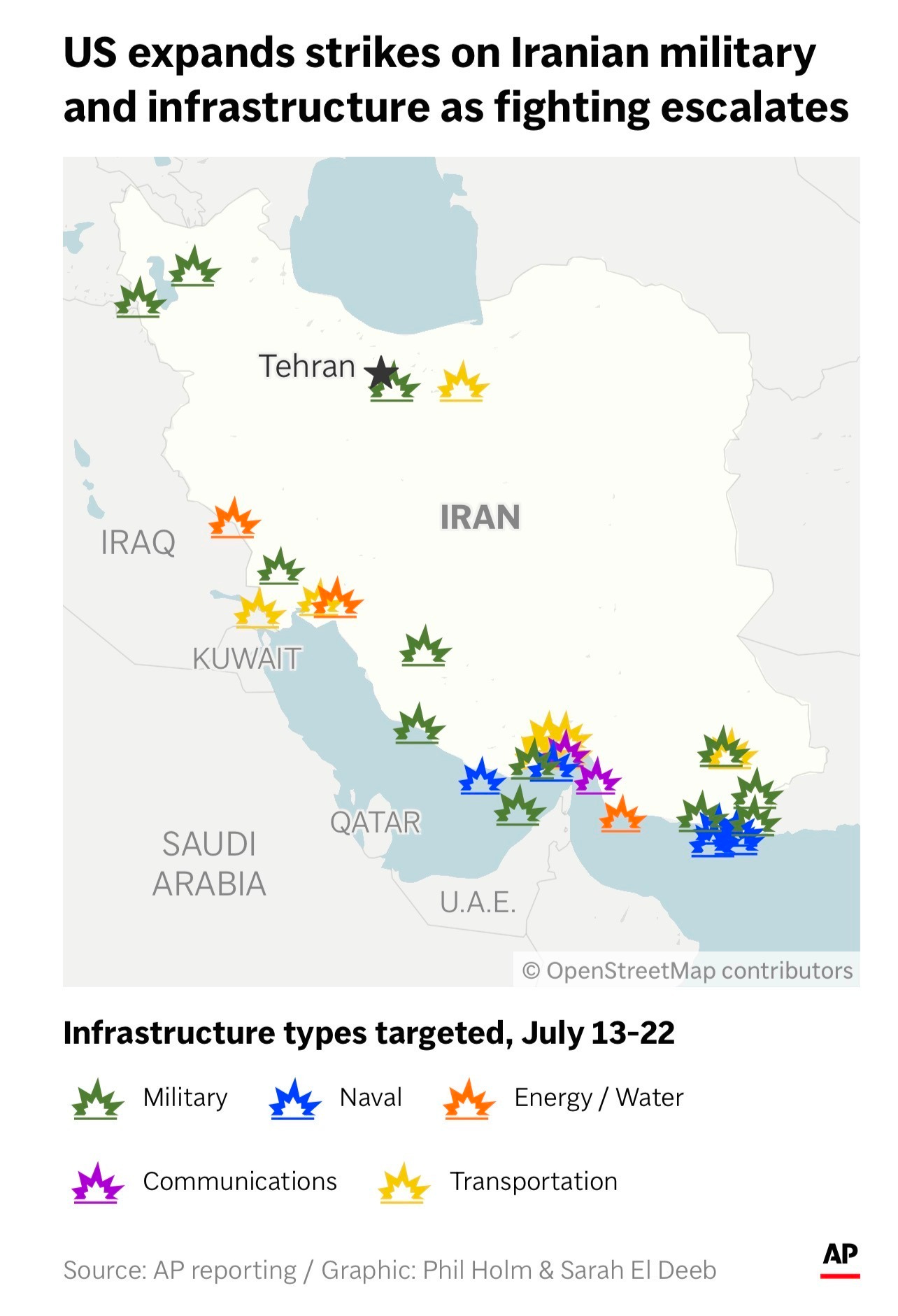
Takeaways:
The pause in US strikes on Iran for the first time in two weeks on July 25, appears tied to a pending decision by the White House to either escalate the war or seek a new diplomatic off ramp. According to Axios, President Trump claimed that the strikes were held off due to recent progress in talks with Iran to reopen the Strait of Hormuz.
The escalation of the war threatened by President Trump this week is likely to consist of a stepped-up bombing campaign involving dozens of newly arrived aircraft in the Middle East this week, as opposed to a ground campaign, though this option has apparently also been considered by the White House. The attacks would potentially focus on destroying Iranian critical infrastructure in order to pressure the Iranian government into negotiations to permanently reopen the Strait of Hormuz. President Trump has also threatened to bomb the suspected Iranian nuclear site at Kuh-e Kolang Gaz La (AKA Pick Axe Mountain) near Natanz, after a new report by The Wall Street Journal released this week said that Israeli intelligence suggested Iran relocated thousands of centrifuges and other technical equipment to the deeply buried site in the Fall 2025.
While the President is currently suggesting that an escalation of the war may not be needed due to new Iranian willingness to negotiate, sources inside the White House have told The New York Times that a decision has not yet been made due to concerns that an escalated military campaign would dangerously diminish US stocks of air defense interceptors without guarantees of producing a substantially improved settlement to the war.
The White House also has good reason to be skeptical of the feasibility of bombing Pick Axe Mountain as well. The nuclear research facilities at the site are potentially more deeply buried than the Fordow Site struck by US B-2 bombers last year during the 12-Day War in 2025. While the US could damage the site by bombing ventilation shafts, entrance tunnels and support facilities, such damage would only temporarily set back operations. And Iran has shown an impressive capacity to dig out its damaged underground missile cities during the current war. Nevertheless, the current impasse in negotiations with Iran, combined with a new assessment by US intelligence that Iranian Supreme Leader Mojtaba Khamenei has a more favorable view of nuclear weapons than his late father, may force the US to attempt complex and dangerous operations to neutralize the site.
2. RUSSIA PROVIDING INTELLIGENCE AND TARGETING SUPPORT FOR IRANIAN STRIKES ON US BASES
US Intelligence Assesses Likely Russian Support for Iranian Strikes
According to a July 22 report by Reuters, US intelligence officials believe that Iran has used Russian intelligence and targeting support as well as enhanced Russian Shahed drone variants to perform strikes on CIA sites in the Gulf.
Ukraine Claims Iran is Using Russian Satellites to Strike US Bases
In a nightly address on July 25, Ukrainian President Volodymyr Zelensky announced that Ukraine’s intelligence service believes Iran has used Russian satellite imagery to conduct attacks on US forces in the Middle East, including attacks on bases in Bahrain, Jordan and Kuwait on July 19 and 20.
Ukraine Strikes Iranian Commercial Ship in the Caspian Sea
On July 25, Ukrainian President Volodymyr Zelensky announced that Ukrainian drones struck a ship involved in transporting military cargo from Iran to Russia. The attacks, which Iran claims killed one Iranian mariner and wounded another, resulted in a formal protest from Tehran and a warning of potential retaliation.
Takeaways:
We should expect that Russian intelligence likely plays some supporting role for Iranian targeting. This support is probably limited to the provision of satellite imagery and technical assistance. As the Reuters report suggests, Russian intelligence agencies may also play a more direct role in supporting attacks on clandestine US intelligence sites. While such cooperation clearly demonstrates hostility toward the US and serves to reinforce ties between the regimes in Moscow and Tehran, its overall effects on the Iranian war effort remain very limited thus far. Iranian attacks have scored some notable successes but have overall done very little to actually degrade the US war effort. Iran’s greatest achievement in the ongoing war has been continuing to maintain a blockade of the Strait of Hormuz by attacking commercial shipping, rather than deterring or degrading the US military.
Iran’s ability to conduct effective strikes on its own should not be underestimated. Iran has considerable human intelligence assets in the region it can call on for targeting information. Iran claims that it received targeting intelligence for deadly strikes on al-Azraq in Jordan from local citizens.1 Iran has also apparently used data collected from the digital exhaust of US soldiers to inform its strikes as well.
Ukraine’s strikes on Iranian shipping in the Caspian Sea underscore the seriousness with which Ukraine views the threat posed by continued Russian and Iranian military cooperation, and the fact that President Zelensky’s warnings are not simply self-serving appeals for US support. (It is also worth considering that Ukrainian strikes may have involved coordination with US intelligence, given the ongoing cooperation on deep strikes inside Russia.)
3. THE HOUTHIS ANNOUNCE IRANIAN-SUPPORTED BLOCKADE OF THE RED SEA
The Houthis Declare a Naval Blockade of Saudi Oil
This week Iranian proxy group the Houthis declared a “naval blockade” of Saudi Arabia in response to the “unjust and oppressive siege on our dear people for nearly 12 years, plundering our resources and imposing a comprehensive blockade on our ports and airports by land, sea, and air.”
The blockade has since struck two Saudi oil tankers and forced others to turn back before approaching the Bab al-Mandeb Strait exiting the Red Sea to the Indian Ocean.
Iranian Military Specialists Flown into Yemen to Support Houthi Attacks on Shipping in the Red Sea
According to a July 23 report by Reuters, Iran allegedly flew between 10 and 21 IRGC operatives and weapons to the Yemeni port of Hodeidah on July 13 to help the Houthis launch a blockade in the Red Sea. Three days after the IRGC operatives arrived in Yemen, Iran formally asked the Houthis to prepare attacks on shipping through the Bab al-Mandeb Strait.
Takeaways:
Attacks on commercial shipping through the Bab al-Mandeb Strait close off two out of the three seaborne routes for Saudi oil. The remaining route through the Suez Canal ensures that oil bound for Asia needs to be shipped through the Mediterranean and around the entirety of Africa, adding time as well as fuel and insurance expenses that drive up the global cost of oil.
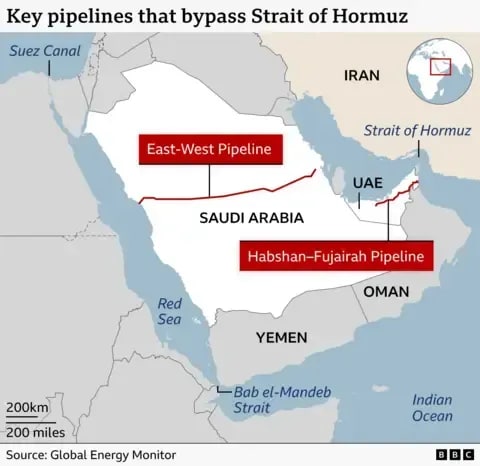
Overview of seaborne routes for Saudi oil. Source: Global Energy Monitor via BBC Attacks by the Houthis on shipping through the Red Sea will continue to roil global energy markets and increase pressure on Saudi Arabia, but a blockade of the Bab al-Mandeb will not be as disruptive as the ongoing closure of the Strait of Hormuz. A comprehensive blockade of the Red Sea will be more difficult for the Houthis to sustain than Iran’s closure of the Strait of Hormuz. The area has more favorable geography for convoy operations, and despite IRGC assistance the Houthis lack the full array of sophisticated land, air, and sea-based military capabilities that Iran can employ near its shores to track and target ships. Additionally, shipping in the Red Sea has already been running at reduced levels with more ships already planning trips around the Cape of Good Hope due to previous Houthi attacks in 2024 and 2025.
OPFOR Journal is a reader-supported publication. Subscribe for free to receive new posts like this one, or consider becoming a paid subscriber to support our work.
RUSSIA’S WAR IN UKRAINE
Significant Activity Related to Russia’s War in Ukraine
4. UKRAINIAN DRONES DISRUPT OPERATIONS OF WILDBERRIES, RUSSIA’S LARGEST ONLINE RETAILER
This week Ukrainian drones struck multiple warehouses and distribution centers of Wildberries. Called “Russia’s Amazon,” Wildberries is the largest Russian E-commerce platform and online retailer. According to Russian independent media outlet Meduza, Ukrainian drones hit at least nine Wildberries facilities on the following dates and locations:
July 18 - Elektrostal, Moscow Oblast.
July 18 - Kotovsk, Tambov Oblast.
July 20 - Koledino, Moscow Oblast.
July 22 - Krasnodar, Krasnodar Krai.
July 22 - Nevinnomyssk, Stavropol Krai.
July 23 - Voronezh, Voronezh Oblast.
July 24 - Simferopol, Russian-occupied Crimea.
July 24 - Shushary, St. Petersburg, Leningrad Oblast.
July 24 - Novosaratovka, Leningrad Oblast.
Takeaways:
Some commentators have suggested the attacks on Russian infrastructure risk backfiring by inflaming Russian public opinion and causing a rally around the flag effect for the Kremlin. This is not a correct view of either the purpose or the execution of the Ukrainian strikes. The strikes on Wildberries are part of a broader cumulative strategy to degrade the Russian war effort by disrupting the country’s logistics networks and economic centers of gravity. Bringing the war closer to home for Russians and piling additional humiliations on the Kremlin are only an added benefit of the campaign and one that lifts Ukrainian morale as much as it sags that of the Russians.
While Wildberries is not a part of the formal Russian military industrial complex, it does serve as dual-use infrastructure supporting the military nonetheless. Tens of thousands of dual-use military goods ranging from first aid packs, to drones, to military kit and body armor are sold on the site. This is significant as a key characteristic of the Russian war effort over the past four years has been the persistence of crowdsourced fundraising campaigns for supplies for frontline units. Russian military bloggers and Telegram channels associated with units and soldiers of the Russian military regularly solicit donations for cash, provisions, and military gear.
SOUTH CHINA SEA FLASHPOINTS
Significant Activity Related to China’s Military Activity in the South China Sea and Taiwan
5. THE RUSSIAN MILITARY IS TRAINING CHINESE UNITS FOR COMBAT OPERATIONS AGAINST TAIWAN AT BASES INSIDE RUSSIA
According to a July 23 report by The Economist, the Russian military has been training units of the Chinese People’s Liberation Army (PLA) in modern combat operations at a military base near Volgograd, Russia since 2024. The training has focused on drone operations and urban combat. The military exchanges are also believed to include substantial elements of knowledge sharing, with Russia helping China improve its submarine warfare capabilities.
Takeaways:
The scope of the training reported by The Economist suggests Russia is preparing China to conduct combat operations on Taiwan as well as counter the US Navy at sea. While the news that the training has taken place at bases inside Russia used to support the war in Ukraine is new, the rest of the story is not exactly a revelation. Russia and China have engaged in highly publicized joint naval training events, including the annual “Joint Sea” exercises held at Qingdao earlier this month and its subsequent joint maritime security patrol. Russia and China have also conducted numerous joint air and sea operations in the Pacific in recent months, including provocative patrols around Japan during the most intense period of China’s feud with Tokyo between December 2025 and January 2026.
While not dismissing the threat of Russian and Chinese military cooperation, observers should be somewhat skeptical that the lessons from Russia’s war in Ukraine can be easily translated to a war in the South China Sea and that the PLA can be made ready for such a war through a limited series of training events. Russia and Ukraine have adapted their militaries to the realities of their current war through years of immense struggle. It is just not true that such adaptations under fire can be easily passed on to outside parties not directly exposed to the unforgiving feedback of combat. (This is a hard reality that European members of NATO also need to confront when preparing for a possible future confrontation with Russia despite attempts to learn from Ukraine.)
6. THE CHINA COAST GUARD CLASHES WITH PHILIPPINE SHIPS AT SECOND THOMAS AND SCARBOROUGH SHOALS
Units of the China Coast Guard and Philippine Navy Skirmish at Second Thomas Shoal
On July 20, small boat units of the China Coast Guard and Philippine Navy clashed at Second Thomas Shoal. The melee left one Filipino sailor with a head injury after being struck by a Chinese rubber truncheon.
The incident occurred in the vicinity of the BRP Sierra Madre, a Philippine ship deliberately stranded on the reef of Second Thomas Shoal in 1997 to form an outpost asserting Manila’s claims to the territory.
The China Coast Guard Attacks Philippine Government Ships Near Scarborough Shoal
On July 23, the China Coast Guard used powerful water cannons to attack a convoy of eight ships of the Philippine Coast Guard and the Bureau of Fisheries and Aquatic Resources near Scarborough Shoal. The Philippine vessels were sailing near the shoal to assert their rights to the territory under international law and to resupply local fishermen.
Takeaways:
The series of clashes comes on the heels of the tenth anniversary of the July 12, 2016 ruling by the UN’s Permanent Court of Arbitration that denied the legitimacy of China’s vast territorial claims to the South China Sea including those at Scarborough Shoal and Second Thomas Shoal. As discussed in greater detail in Weekly Significant Activity Report - July 18, 2026, the anniversary has stoked impassioned feelings in both the Philippines and China, and the violent incidents this week likely resulted from a renewed effort by both sides to assert their control over the waters.
Determination by both the Philippines and China to uphold their territorial claims would have taken on additional urgency this week as the 33rd Meeting of the Regional Forum of the Association of Southeast Asian Nations (ASEAN) was held in Manila on July 23. Neither side would want to appear to be seen backing down from the escalating conflict in front of their regional neighbors. Nevertheless, China’s aggressive maritime behavior in the South China Sea is extremely unpopular among members of ASEAN and the latest violent incident may work against Chinese strategic interests. The State of Southeast Asia 2026 Survey Report conducted by Singapore’s Yusof Ishak Institute ranked aggressive Chinese behavior in the South China Sea as one of the top concerns among ASEAN populations.
China’s encroachments in the Exclusive Economic Zones (EEZs) and continental shelves of Southeast Asia’s littoral states (51.7%), along with the possibility of an accidental conflict between an ASEAN member state and China (45.2%), remain key concerns among regional respondents regarding the South China Sea. These concerns highlight the region’s anxieties surrounding sovereignty, maritime rights, access to resources, and the consistent fear of miscalculation and escalation of tensions at sea.
This briefing was compiled by Dan White. Dan is an independent foreign policy analyst based in the New York Metro Area. Dan is a former member of The Wilson Center and The Kennan Institute. Dan holds masters degrees from the Johns Hopkins University School of Advanced International Studies (SAIS), the Naval Postgraduate School, and the University of Washington. Dan is a former officer in the United States Army and a veteran of the War in Afghanistan.
For more information, corrections, or comments, please contact dan@opforjournal.com.
Thanks for reading! Please subscribe to stay informed on critical developments involving China, Russia, Iran and North Korea.
The veracity of this exact claim is obviously questionable, but Iran’s sway over proxy forces across the Middle East is well known and indisputable.
Thanks for this comprehensive update, Dan. I enjoyed reading your analysis this week.