



This week’s analysis highlights some of the most significant geopolitical developments involving America’s adversaries—China, Russia, Iran, and North Korea—between August 1, 2026 and August 8, 2026.
Executive Summary:
US War with Iran - Significant Activity Related to the US-Iran War
Negotiations to end Iranian attacks on shipping and reopen the Strait of Hormuz were cast into doubt amid a new set of six Iranian demands released on August 8.
The Eastern Front - Significant Activity Related to the War in Ukraine and Russian threats to NATO
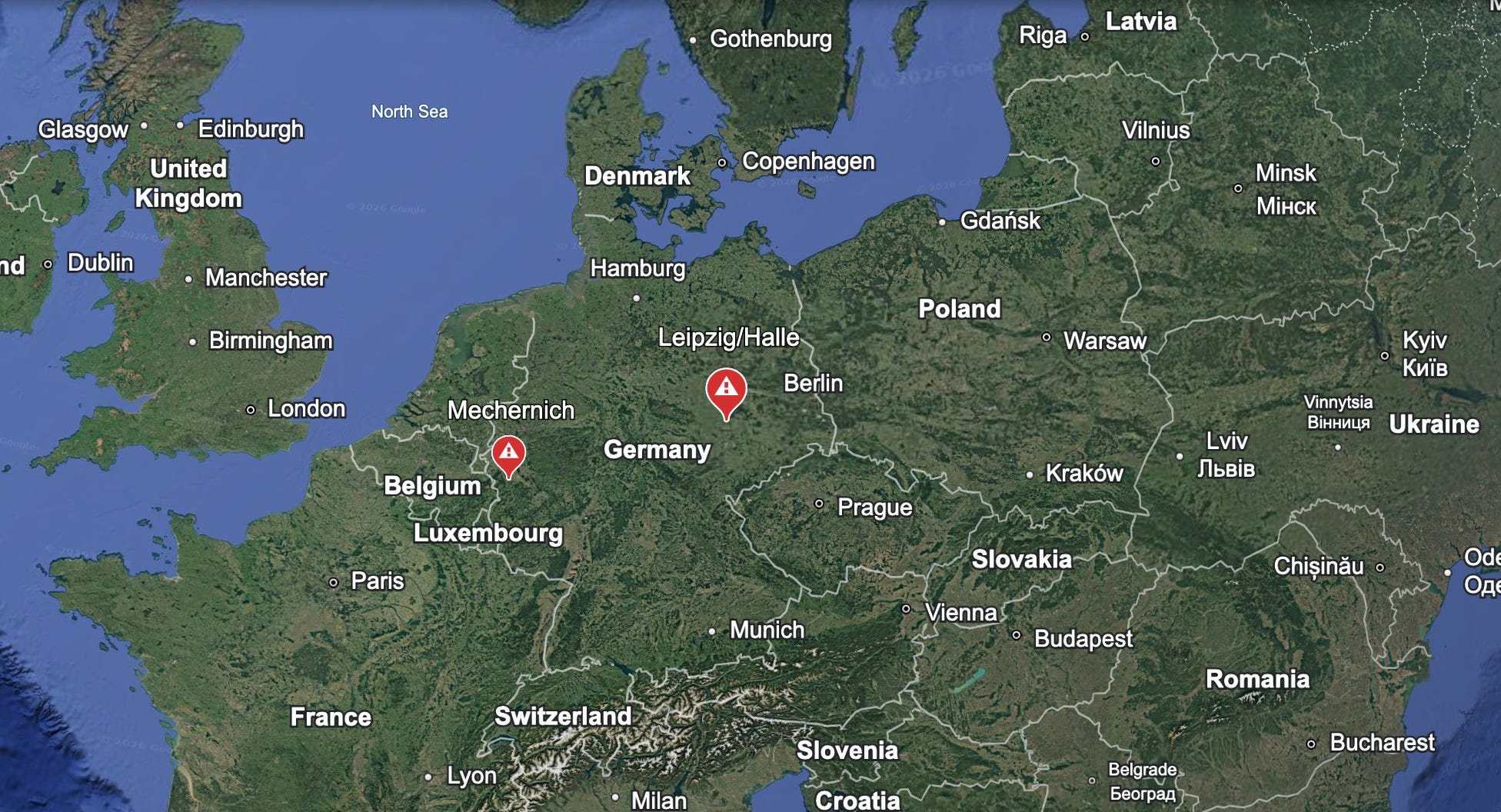
Suspected Russian drones menaced Germany this week, threatening Leipzig/Halle airport and a key German military base near Mechernich.
Ukrainian officials reported information that North Korea plans to deploy six ballistic missile launchers along with as many as 120 missiles to Russia in coming weeks.
South China Sea Flashpoints - Significant Activity Related to China’s Military Activity in the South China Sea and Taiwan
The Chinese People’s Liberation Army and China Coast Guard conducted major military exercises near Scarborough Shoal on August 1 in a show of force to reassert Chinese claims to the Philippine territory.
US WAR WITH IRAN
Significant Activity Related to the US-Iran War
1. DEAL TO REOPEN THE STRAIT OF HORMUZ CAST INTO DOUBT BY NEW MAXIMALIST IRANIAN DEMANDS
This week the US and Iran conducted indirect negotiations through Middle Eastern intermediaries to resume a ceasefire and reopen the Strait of Hormuz to maritime shipping. Discussions reportedly focused on a new temporary deal to reopen the Strait of Hormuz with two lanes of transit, one through mostly Iranian waters where Iran would control inbound traffic and one closer to Oman for outbound traffic. Disputes continued about fees to be collected and whether they would be voluntary contributions as in the Strait of Malacca or a system of tolls.
However, negotiations were upended on August 8, 2026, when Mohammad Bagher Zolghadr, the Secretary of Iran’s Supreme National Security Council appeared to reject the emerging framework in favor of more maximalist conditions for reopening the Strait. Noor News, the state-media outlet affiliated with Iran’s Supreme National Security Council, listed six new demands from Zolghadr:
1- Never threaten Iran with any language or insult the sanctities of this nation.
2- End the war and aggression against Iran and its allies in Lebanon, Palestine, Yemen, and Iraq forever.
3- Lift the naval blockade and withdraw its military forces (naval and air force) from around Iran.
4- Pay the damages for the two wars of aggression and imposition on Iran without any reduction or reduction.
5- Lift the cruel and illegal sanctions against the Iranian nation.
6- Unconditionally release the frozen and stolen assets of the Iranian people.
Iranian attacks on shipping continued throughout the week with at least three vessels struck near the Strait of Hormuz despite a cessation of US bombing.
Takeaways:
Iran continues to press its advantage for several reasons:
First, after years of setbacks, Iran has finally reasserted itself and may feel it has the upper hand. Having survived the initial US-Israeli combined offensive, Iranian officials are likely confident that a more intense bombing campaign is unlikely to come in the near future given limitations on US munitions stockpiles. They are also likely to assume that a ground offensive is equally unlikely given the broad unpopularity of the war among the American public.
Second, Iranian leaders are exerting as much pressure as they can in an attempt to break what they view as a cycle of progressively worsening predations by the US. The continued throttling of traffic through the Strait of Hormuz has created a major strategic dilemma for the US, which Iran may hope will cause it to rethink its entire long-term involvement in the Middle East in order to avoid falling into another “forever war.” As the situation currently stands, the options for US policymakers include: facing public humiliation by accepting maximalist Iranian terms for ending the war, risking a global economic downturn spurred by shortages of petroleum products through a prolonged standoff at the Strait of Hormuz, or gambling on a costly escalation in the conflict. Hawkish Iranian officials, whose strategy to widen the war and close the Strait of Hormuz has thus far been key to a reversal in Iran’s strategic fortunes, may assume it is a matter of time before the US is forced to retreat due to inherent firepower constraints and a desire by the White House to focus on domestic politics in a must win mid-term election. Iran may hope to speed up the US retreat by threatening progressively worsening outcomes the longer the conflict continues.
Finally, hawkish Iranian officials likely relish every opportunity to humiliate the Trump administration and the United States more broadly. The continued frustration Iran is inflicting on the US and its allies is a form of payback for years of perceived humiliation dating back to the 2020 killing of Qasem Soleimani. Iran’s attacks on the US, now from a position of strength, also renew the legitimacy of the Islamic Republic and help it recover from a period of significant weakness following January’s mass public uprisings and the US-Israeli strikes on its top leaders in February and March.
It is also worth considering that the new set of six demands by Mohammad Bagher Zolghadr may be a gambit motivated by complex domestic politics rather than sensible foreign policy considerations. Zolghadr’s position as Secretary of the Supreme National Security Council has been called into question in recent days. IranWire has reported that rumors circulating through Iranian domestic media in the first week of August suggest that Zolghadr may be replaced by Mohsen Rezaei, a top advisor to Iran’s Supreme Leader and former commander of the Islamic Revolutionary Guard Corps (IRGC). Rezaei holds extremely hawkish and uncompromising views, and the new list of demands by Zolghadr may be a gambit to outmaneuver a challenge from him and secure the backing of hardline officials.
OPFOR Journal is a reader-supported publication. Subscribe for free to receive new posts like this one, or consider becoming a paid subscriber to support our work.
EASTERN FRONT
Significant Activity Related to the War in Ukraine and Russian threats to NATO
2. GERMANY MENACED BY SUSPECTED RUSSIAN DRONES
Armed Drone Found Near Ukrainian Cargo Plane in Germany
On August 5, 2026, a drone carrying an explosive device was found next to a Ukrainian An-124 cargo aircraft at Germany’s Leipzig/Halle airport. The incident occurred at roughly the same time that another cargo plane nearby reported colliding with an unidentified object.
US intelligence officials have assessed that the armed drone was most likely Russian in origin. The Russian Embassy in Berlin issued a statement denying responsibility and describing the incident as a “hastily concocted provocation” by Ukraine and Europe to generate public support for continued hostility to Russia.
Drones Spotted Near Germany’s Mechernich Military Base
On August 6, 2026, security personnel at Germany’s Bundeswehr base in Mechernich reported observing two drones flying nearby. The base serves as a key maintenance hub for US Patriot missile systems.
Takeaways:
The suspected Russian drone incidents follow multiple warnings by Western officials this week that the Kremlin is poised to engage in more aggressive actions toward European members of NATO in the near future. On August 6, the Wall Street Journal reported that senior US intelligence officials increasingly believe that Russia may launch an attack or other major provocation directed at one of its European neighbors in the next few years in order to test the resolve of NATO. On the same day, Lithuanian Defense Minister Robertas Kaunas issued a more specific warning suggesting that Russia may be planning to use captured Ukrainian drones to launch attacks on NATO member states.
The intention behind a Russian false flag attack using Ukrainian drones would likely be to increase distrust in Ukraine and in particular the Zelensky government in order to create division among NATO leaders regarding future military assistance. Ukrainian drones have on multiple occasions in recent months violated the airspace of NATO member states, allegedly redirected by Russian electronic warfare. In one instance on May 7, 2026, two Ukrainian drones crashed into a fuel storage facility in eastern Latvia near the city of Rēzeknē. The incident caused significant embarrassment for the Latvian government, which led to the firing of the country’s defense minister, Andris Spruds, followed by the resignation of its prime minister, Evika Silina.
False flag attacks would serve to erode the general presumption in the West that drone and missile incursions into NATO airspace originating from Ukraine are Russian in origin. Confusion over the attribution of future attacks would permit Russia greater leeway in aggressive boundary pushing hybrid attacks on NATO.
The drones spotted near Mechernich may have been conducting surveillance on Patriot missile systems at the base to better understand the status of the future air defense supplies to Ukraine. The drones were likely launched from inside Germany by foreign collaborators with the Russian intelligence services. Russia has relied on a combination of sympathetic German nationals as well as disaffected Ukrainian refugees and Russian migrants as disposable assets to conduct intelligence collection and acts of sabotage inside the country.
3. NORTH KOREA PLANNING TO DEPLOY NEW BALLISTIC MISSILE UNITS TO RUSSIA
Reuters reported on August 5, 2026, that Ukrainian officials believe Moscow and Pyongyang are making plans for a deployment of up to six North Korean ballistic missile launchers equipped with 120 missiles to be deployed to Russia.
Takeaways:
Sensing a period of vulnerability, Russia may be trying to acquire North Korean launchers to maximize its opportunities to land crippling blows against Ukrainian critical infrastructure while Ukraine has limited supplies of air defense interceptors.
Ukrainian authorities have documented the repeated use of North Korean Hwasong-11 ballistic missiles by the Russian military since 2024, suggesting the coming systems may be from the same series. Hwasong-11s are larger and heavier than Russian Iskander-M missiles but are roughly comparable in appearance and functionality, making them an ideal supplement for Russian forces. The most recent Russian attack using a suspected North Korean missile was on July 30 in the village of Radushne near the city of Kryvyi Rih. The attack struck a residence, killing a family of six.
The missile deployment may also be a component of a new wave of North Korean involvement in the war, which Ukrainian officials have been anticipating in recent weeks. During a nightly address on August 8, 2026, Ukrainian President Volodymyr Zelensky announced that Ukraine has information that North Korea recently agreed to station between 30,000 and 50,000 troops in Russia.
SOUTH CHINA SEA FLASHPOINTS
Significant Activity Related to China’s Military Activity in the South China Sea and Taiwan
4. CHINA’S NAVY AND COAST GUARD CONDUCT MAJOR SHOW OF FORCE AT SCARBOROUGH SHOAL
On August 1, 2026, the Southern Theater Command of the Chinese People's Liberation Army (PLA) conducted large-scale military exercises near Scarborough Shoal. The exercises involved at least four warships of the People’s Liberation Army Navy: a Type 052D destroyer, a Type 054A frigate, a Type 056A corvette, and a Type 071 amphibious transport ship, along with two H-6J strategic bombers. The task force carried out a variety of joint naval-air drills demonstrating Chinese power projection capabilities.
On the same day, the China Coast Guard also conducted “rights protection and law enforcement” drills near Scarborough Shoal. The drills, involving “enforcement actions such as boarding and seizure, interception and intrusion, and forced towing,” were intended to assert China’s territorial claims to the area.
Takeaways:
The combination of military and coast guard exercises represents one of the most significant Chinese shows of force near Scarborough Shoal in memory. The exercises are part of an intensifying campaign identified in the Weekly Significant Activity Report - July 18, 2026 to reassert Chinese claims to the territory ten years after they were rejected by the UN Permanent Court of Arbitration. The ten-year anniversary of the ruling on July 12 has recently been heavily touted by the Philippines, which celebrates the day as “West Philippine Sea Victory Day.” The US and Japan along with 11 other nations have also affirmed the ruling, drawing China’s ire.
China may also feel a broader need to assert its territorial claims more forcefully amid more concerted pushback against its bullying from the Philippines, backed by the US, Japan, and Taiwan in recent years. Since 2023, trilateral coast guard and naval patrols between the US, Japan, and the Philippines have helped bolster Filipino territorial sovereignty against Chinese advances. China may sense a moment of opportunity to reassert its dominance in the region while it perceives that US military commitments are overextended by the war with Iran.
Domestic commentary by prominent Chinese military analyst Zhang Xuefeng for The Paper specifically highlighted the significance of the deployment of the H-6J for the exercises. Xuefeng noted the bombers were equipped with YJ-21 hypersonic missiles, a weapon he specifically characterized as capable of destroying aircraft carriers. The messaging around the bomber patrol suggests a pointed warning to the US after the recent deployment of a carrier strike group led by the USS George Washington to the region in late July.
This briefing was compiled by Dan White. Dan is an independent foreign policy analyst based in the New York Metro Area. Dan is a former member of The Wilson Center and The Kennan Institute. Dan holds masters degrees from the Johns Hopkins University School of Advanced International Studies (SAIS), the Naval Postgraduate School, and the University of Washington. Dan is a former officer in the United States Army and a veteran of the War in Afghanistan.
For more information, corrections, or comments, please contact djwhite155@gmail.com.
Thanks for reading! Please subscribe to stay informed on critical developments involving China, Russia, Iran and North Korea.