



This week’s analysis highlights some of the most significant geopolitical developments involving America’s adversaries—China, Russia, Iran, and North Korea—between May 9, 2026 and May 16, 2026.
Summary:
Update on the war with Iran: nationwide internet blackout continued; Iranian attacks threw BRICS+ meeting into disarray; Iranian leaders proposed demanding fees for undersea cables.
Russia held a subdued Victory Day Parade amid Ukrainian drone threats.
Russia demonstrated its offensive strike capability with massive drone attacks on Ukrainian cities, and the successful test of the Sarmat nuclear missile
China hosted a major US state visit.
1. IRAN WAR UPDATE
Internet Blackout Extends into a Twelfth Week with No End in Sight
According to the internet connectivity monitoring organization Netblocks, May 16 marked 78 days of a near-total internet blackout in Iran.
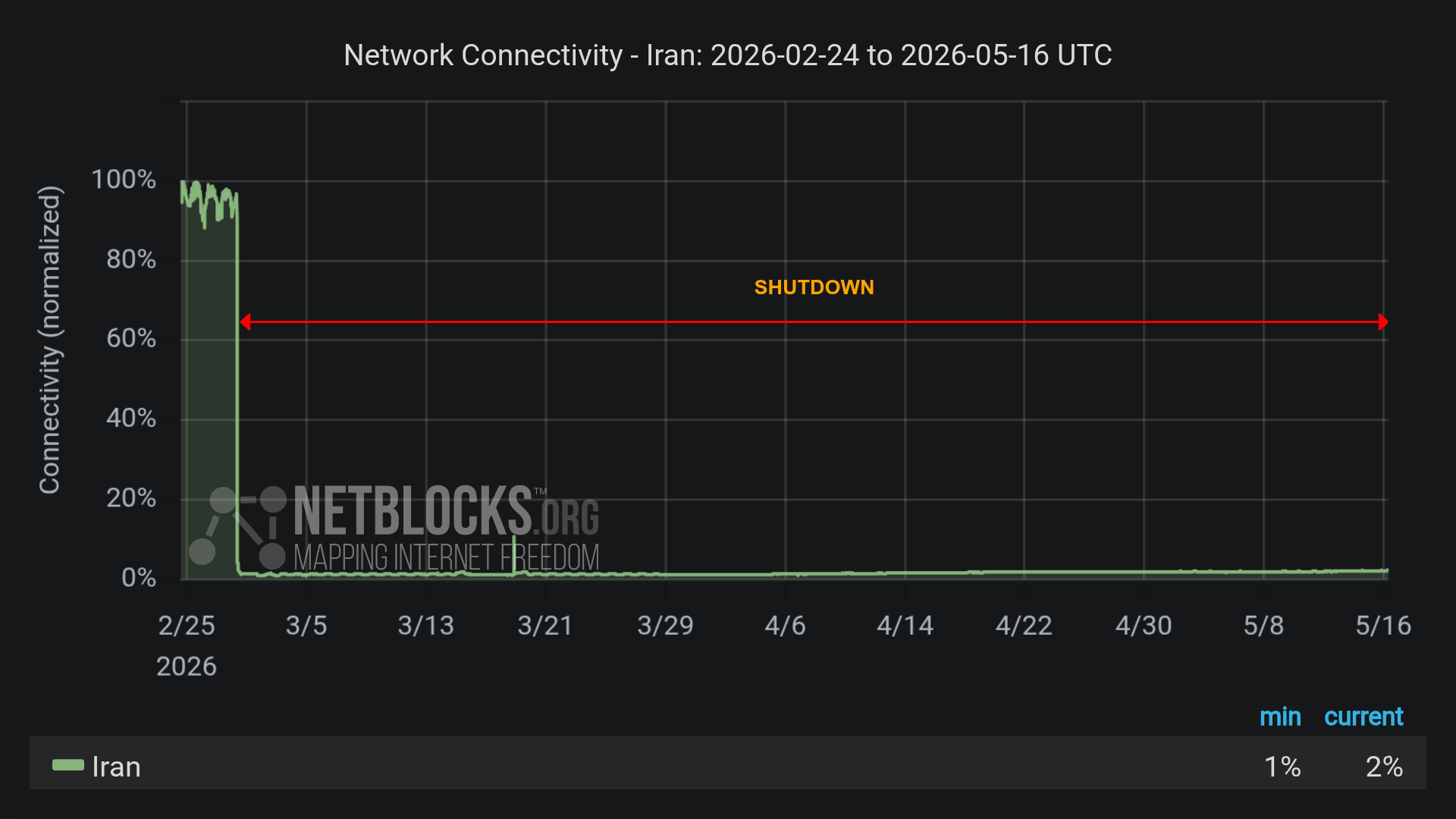
Iranian President Masoud Pezeshkian has ordered a special committee to convene on restoring internet access within the next month. Pezeshkian appointed First Vice President Mohammadreza Aref to lead the new committee.
Iran Sparks Diplomatic Row with India over Attack on Cargo Ship.
On May 14, a suspected Iranian drone attack sank an Indian flagged cargo ship, the MSV Haji Ali BDI 1492, off the coast of Oman. The incident triggered condemnation from New Delhi, which called the attack “unacceptable.” All 14 Indian crew members of the ship were evacuated safely.
Iranian Leaders Suggest Monetizing Submarine Cables Crossing the Strait of Hormuz
Hossein Ali Hajideligani, a member of the Iranian parliament’s presiding board, suggested that Iran should extract fees for data passing through fiber optic cables passing through the Strait of Hormuz under Iran’s new management of the waterway.
Takeaways:
As previously noted on May 2, by risking further damage to the already shattered Iranian economy and exacerbating social stress, the continued internet shutdown, controlled at the highest level of government by the Supreme Council of Cyberspace (SCC), demonstrates more surely than any other public statement that the Iranian regime is uncertain whether it has yet survived the war or has a path to transition to post-war reconstruction. The announcement that Pezeshkian—himself the chair of the SCC—would create a brand new committee for restoring internet access may have inadvertently underscored the fractured state of Iran’s government. Vocal opposition from multiple members of the Iranian parliament to the measure this week suggests the new committee may have been a blunder that undermined the projected unity of the regime and revealed broader confusion over how to govern the country's information environment going forward. Conservative Iranian parliamentarian Alireza Salimi underscored the perceived illegality of the move noting, “How is it possible for the president, who is himself the head of the Supreme Council of Cyberspace, to transfer the council’s authority to a body outside the council?”
-
The appointment of Aref, a reformist, to lead the new committee suggests that the move may have been prompted by obstructionism on the SCC by security hardliners in the IRGC, who may prefer tiered access to the internet based on political loyalty.
Iran’s attacks on an Indian vessel, coming in addition to weeks of indiscriminate attacks on its neighbors, severely complicated the meeting of the BRICS+ Group in India from May 14-15. The UAE, another new member of the group along with Iran, used the occasion to publicly condemn Iranian "terrorist attacks" and to subtly assert the primacy of the US-led international order. It notably did so by invoking decisions by Western-based multilateral institutions including the London-based International Maritime Organization (IMO), the Canada-based International Civil Aviation Organization (ICAO) Council, and Switzerland-based UN Human Rights Council. In another eyebrow-raising statement, the UAE raised the passage of UN Security Council Resolution 2817, a resolution backed by the US condemning Iranian attacks, which BRICS core members Russia and China both abstained from.
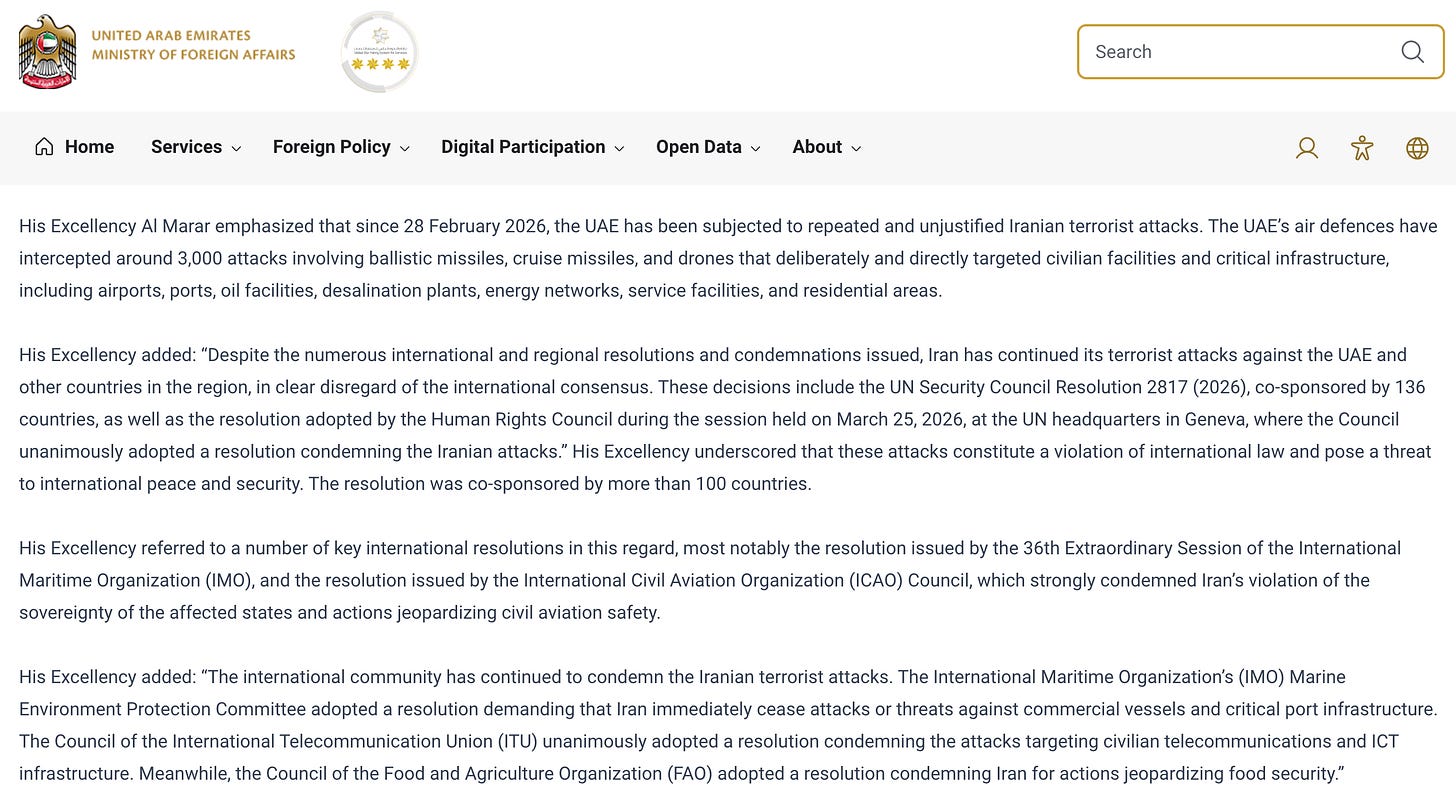
Segment of the UAE Ministry of Foreign Affairs’ statement at the BRICS+ meeting regarding Iranian “terrorist attacks.” Source: UAE MOFA The attacks and their fallout spilling into the BRICS+ meeting highlight serious contradictions at the heart of the group that raise questions about its viability as a coherent platform for constructing durable institutions capable of replacing systems of the current US-led international order. Underscoring these difficulties is the fact that the conference ended without even the signing of a joint statement due to tensions over Iranian behavior.
The suggestion that Iran should charge what amounts to protection money for the continued safety of the region’s fiber optic cables echoes an argument that appeared in the semi-official Islamic Revolutionary Guard Corps (IRGC) media outlet Tasnim News on May 9. The Tasnim News article recommended Iranian leaders extract profit from the undersea cables through licensing deals and exclusive access for maintenance:
“This report, based on Iran’s clear sovereignty over the seabed and water column of the Strait of Hormuz (according to Article 34 of the United Nations Convention on the Law of the Sea), proposes three practical steps: first, charging initial license fees and annual renewals from foreign companies; second, requiring tech giants (Meta, Amazon, Microsoft) to operate under Iranian laws; third, granting exclusive rights for cable repair and maintenance to Iranian companies.”
The recurring idea suggests Iran views the safety of the fiber optic cables as a form of leverage it can use in any future resumption of hostilities to deter attacks from its Arab neighbors and manage escalation with the US.
2. RUSSIA CONDUCTS SUBDUED VICTORY DAY CELEBRATION, HINTS AT WAR END
Russia Held Abbreviated Victory Day Celebration
On May 9, Russia held its 81st annual Victory Day celebrations. The Moscow Victory Day Parade, the hallmark of the state holiday held in Red Square, was substantially reduced in both time and in the scale of military hardware on display. In their place the Moscow parade notably featured the participation of a unit of North Korean soldiers, as well as videos of new Russian military technology including the Geran-5 drone/cruise missile hybrid.
Military parades in other major cities, such as St. Petersburg, were also reduced in scale.
Putin Suggested the War May End “Soon,” and Expressed Willingness to Meet Zelensky
On May 9, in a press conference following his appearance at the Moscow Victory Day Parade, Russian President Vladimir Putin made a heavily caveated statement that the war in Ukraine could be nearing its end and suggested he would be willing to meet Ukrainian President Volodymyr Zelensky, whom he called “Mr. Zelensky,” in a third country to sign a deal. Putin also named former German Chancellor Gerhard Schröder as a potential mediator for future talks between Russia and the European Union.
Takeaways:
This year’s truncated Victory Day Parade is an indisputable sign of weakness by the Kremlin. It is an indication, along with new reports that Russian President Vladimir Putin is spending unprecedented amounts of time in underground bunkers, that the decision making of Russian leaders is increasingly influenced by considerations of security threats emanating from Ukraine.
Vague statements aside, there are no substantive signs that the Kremlin plans to stop the war short of seizing the entirety of the Donbas. While Putin suggested a willingness to meet with Ukrainian President Zelensky, his uncharacteristically polite reference to the Ukrainian leader should not be seen as an extraordinary gesture as it still omits any reference to Zelensky’s legitimacy as leader. Further, Putin’s openness to meeting in a third country to conclude a peace agreement should also be viewed with skepticism as his remarks were quickly followed with a reference to his previous participation in the “Minsk Process,” suggesting Russian vassal state Belarus as the alternative venue for receiving Ukrainian capitulation. Taken together, Putin’s “openness” to ending the war, amid equally bizarre requests for Gerhard Schröder to take over negotiations, appears to be more of an effort to discombobulate Europe’s new push for diplomacy and re-engage with stalled US mediation after Secretary of State Marco Rubio suggested the US would deprioritize its involvement in talks.
Russian President Vladimir Putin ultimately cannot end the war now without appearing to concede defeat. Released a year ago in May 2025, OPFOR Journal’s Situation Report: Ceasefire Negotiations with Russia identifies five of the Kremlin’s most conservative war aims, which still remain largely unachieved.
“Permanently arrest Ukraine’s societal drift toward Europe. Foreclose paths to EU and NATO membership. Incorporation of Ukraine into Russian institutions such as the Eurasian Economic Union, Collective Security Treaty Organization, and Commonwealth of Independent States. (Not achieved)”
“Establish Russian political control of the country through the installation of a puppet regime in Kyiv, (Not achieved)”
“Resolve outstanding issues resulting from the seizure of Crimea and frozen conflict in the Donbas. These include establishing direct Russian annexation and administration of the Donbas territories of Donetsk and Luhansk, and de facto Russian control of Kherson and Zaporizhzhia oblasts to create a land bridge to Crimea, (Partially achieved)”
“Prevent Ukraine from breaking free of Russian rule again through a systematic suppression of Ukrainian nationalism, resulting from a purge of Ukrainian national elites and institutions. (Not achieved)”
“Leverage quick victory in Ukraine to re-assert Russia as an ascendant great power in contrast to declining West. (Partially achieved)”
Remarkably, the Kremlin has made almost no progress on these war aims over the past year. It has arguably even lost ground on victory condition one as Ukrainian defense technology has become increasingly coveted in the West, adding a new dimension to Ukraine’s integration into the European security architecture.
3. RUSSIAN FLEXES ITS LONG-RANGE STRIKE CAPABILITY
Russia Conducted Successful Sarmat ICBM Test
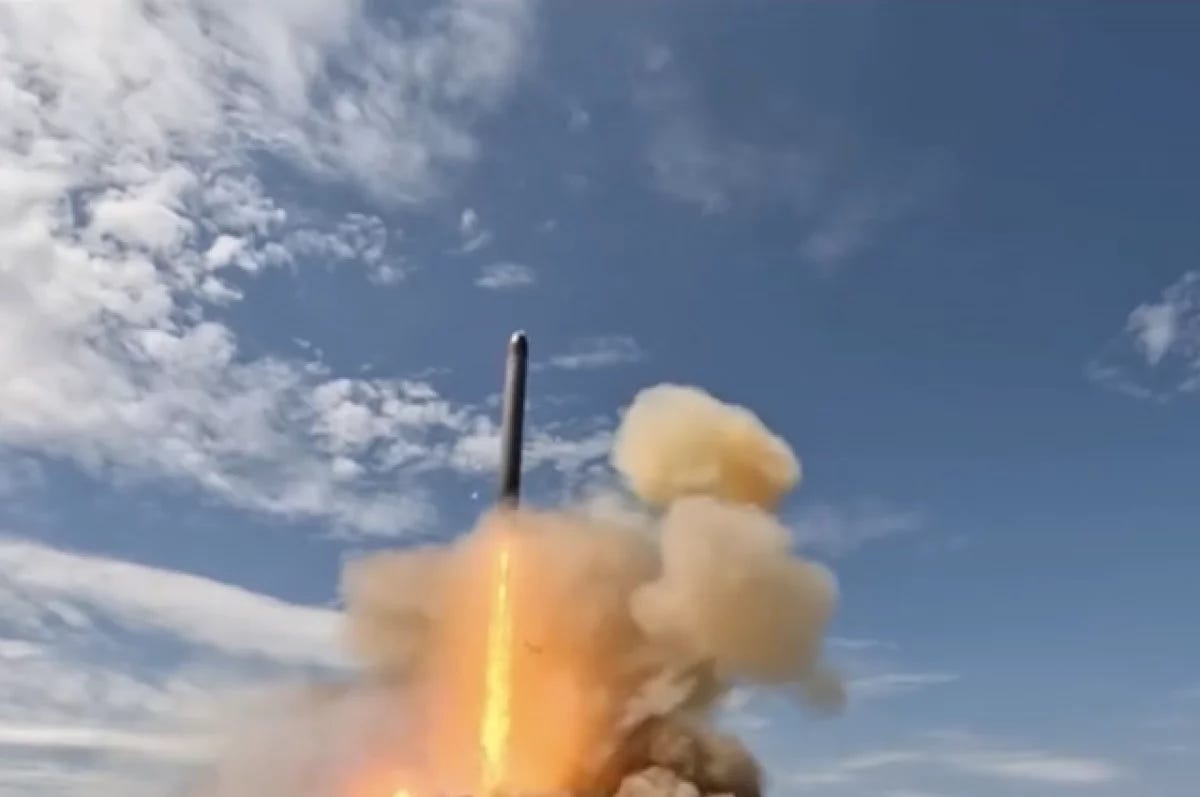
On May 12, the Commander of Russia’s Strategic Missile Forces Sergei Karakayev announced to President Vladimir Putin the successful test launch of the “Sarmat” super heavy intercontinental ballistic missile (ICBM). Karakayev described the missile as the world’s most powerful ICBM, with four times the payload of equivalent US missiles. He further announced that the Sarmat can strike targets at a range of 35,000km from a suborbital trajectory that allows it to evade Western air defenses.
Russia Launches Heaviest Bombardment of the War
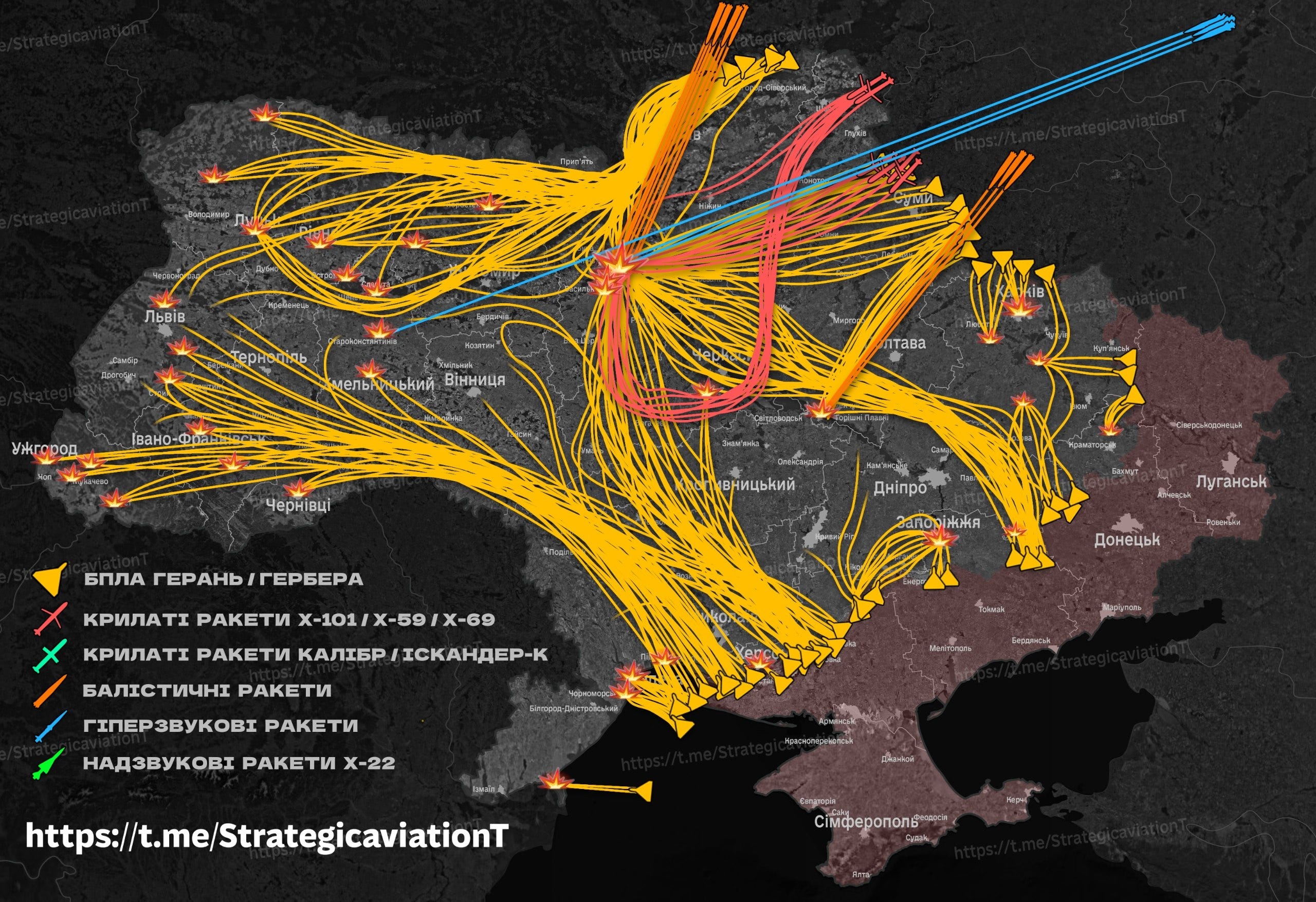
Between May 13 and May 14, Russia launched 1560 drones and 56 missiles at Ukrainian cities in the largest air assault of the war. The attacks resulted in at least 24 deaths.
Takeaways:
As Pavel Podvig notes, this is only the second successful test of the Sarmat ICBM, an achievement that follows a multi-year string of failures including two catastrophic launch disasters in September 2024 and November 2025. The mixed record means, that despite the Kremlin’s assurances of imminent operational deployment, the Sarmat will likely need additional test launches to ensure it can serve as a credible strategic deterrent.
While Russia is still working to expand its drone and missile production, the unprecedented size of the May 13-14 attack is best explained by the fact that it came shortly after a three-day ceasefire between May 9-11, which allowed for the stockpiling of an unusually high number of weapons.
Both moves appear to be efforts by the Kremlin to compensate for increasingly obvious shortcomings in defense exposed by relentless Ukrainian attacks on its critical infrastructure (which influenced decisions to shorten this year’s Victory Day Parade) with a display of offensive firepower. Pro-Kremlin military experts have been particularly keen to highlight the unique capability of the Sarmat to assert that Russia remains a great power despite its conventional military shortcomings. In an interview with Argumenti i Fakti, one such expert, Yuri Knutov, implied that the Sarmat alone could be Russia’s key to maintaining strategic parity with the West in the future.
"A missile like the Sarmat is capable of penetrating the US's advanced Golden Dome missile defense system. If the Sarmat were used against a country like the UK, a single missile would be enough to destroy all major military installations within that country."
4. CHINA HOSTS US STATE VISIT
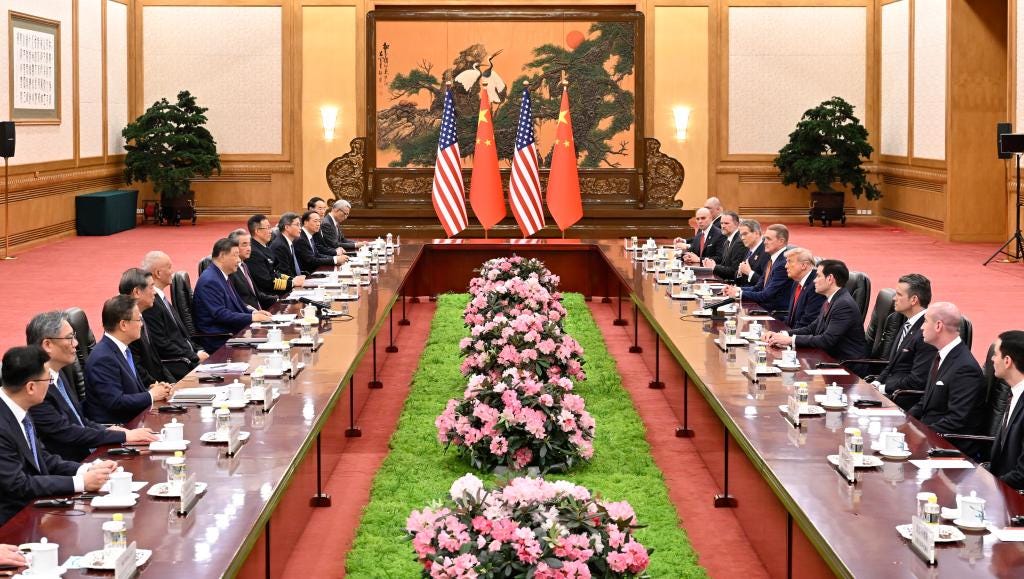
Between May 13-15, China received US President Donald Trump for a state visit. The visit marked President Trump’s first trip to China of his second term. A high-level delegation of political and business leaders joined the President on the visit including: Secretary of State Marco Rubio, War Secretary Pete Hegseth, Treasury Secretary Scott Bessent, Deputy Chief of Staff Stephen Miller, Tesla/Space-X CEO Elon Musk, outgoing Apple CEO Tim Cook, Nvidia CEO Jensen Huang, and Trump family members Eric and Laura Trump.
Meetings between President Trump and President Xi touched on key issues of bilateral relations including the War in Iran, the status of Taiwan, trade issues and AI.
Takeaways:
The details of any trade agreements reached during the state visit remain murky. President Trump announced that China planned to buy “billions of dollars of soybeans,” and between 200-750 Boeing aircraft. Reuters reported that the President has green lit limited exports of Nvidia’s H200 AI chips to a select number of Chinese companies including Alibaba, ByteDance, JD.com and Tencent. Despite the authorization, Trump acknowledged that any deal for the chips is in doubt as China is currently restricting imports of Nvidia chips on national security grounds.1
While statements by both leaders suggest the US and China have a shared interest in resolving major foreign policy challenges over Iran and Taiwan, no clear agreements were reached. Trump claims Xi backed the US’s position that Iran should never have a nuclear weapon and must reopen the Strait of Hormuz. This is not a new achievement as Beijing has repeatedly expressed an interest in countering nuclear non-proliferation and in keeping the Strait of Hormuz “open.” It is not clear, however, that China plans to do anything new to convince Iran to budge on either issue as Iran’s closure of the Strait largely does not target its exports to China, which are however more directly threatened by a US blockade. Trump for his part expressed an understanding of China’s position on Taiwan but his statements that the US did not support Taiwanese independence did not fundamentally alter the US’s position of strategic ambiguity. Trump notably did not pledge to reduce arms sales to Taiwan either.
One of the most consequential outcomes of the visit is an attempt by both sides to achieve strategic stability. As Bill Bishop notes, Chinese press releases paint the visit as an opportunity to reset relations with the US under the recognition that China is a co-equal power whose interests must be given great consideration.
“The PRC leadership wants a period of strategic detente and this concept could realize that on terms favorable to them for the rest of Trump’s second term. Any future U.S. moves to address PRC industrial overcapacity, tighten technology controls, etc. could then be cast by Beijing as violations of the new “constructive China-US relationship of strategic stability” to which the two leaders personally agreed.
“The formulation (tifa 提法) accepts that the US-China relationship is competitive — as Xi did in 2023 with the Biden administration — but it now insists that competition be kept “moderate” (有度) and that differences be “manageable” (可控). This may allow China to get to define what counts as acceptable competition. It also makes Xi and his team look like they have successfully stood their ground against the Trump Administration and are now negotiating from a position of equal strength.”
This briefing was compiled by Dan White. Dan is an independent foreign policy analyst based in the New York Metro Area. Dan is a former member of The Wilson Center and The Kennan Institute. Dan holds masters degrees from the Johns Hopkins University School of Advanced International Studies (SAIS), the Naval Postgraduate School, and the University of Washington. Dan is a former officer in the United States Army and a veteran of the War in Afghanistan.
For more information, corrections, or comments, please contact dan@opforjournal.com.
There is plenty of evidence however that suggests that Chinese companies are nevertheless importing Nvidia’s H200 chips through gray markets.