


On February 28, 2026, the US and Israeli militaries launched a wave of airstrikes on Iran in Operation Epic Fury.
According to US Central Command (CENTCOM), the attacks launched at 1:15 am ET included “precision munitions launched from air, land, and sea,” as well as “low-cost one-way attack drones for the first time in combat,” launched from the “largest regional concentration of American military firepower in a generation.”
According to the Israeli Defense Forces, the initial wave of attacks also involved the largest ever air operation in the history of the Israeli Air Force, involving over 200 aircraft.
Initial wave of US airstrikes on Iran Source: US Central Command
The initial strikes targeted top leaders of the Iranian regime, the leadership of the Islamic Revolutionary Guard Corps, Defense Ministry, and National Security Council as well as other military and intelligence targets. Emerging reporting has suggested that the strikes killed Iran’s Supreme Leader Ayatollah Ali Khamenei.
Iran has responded by attacking US and Israeli targets in the Middle East as well as US regional allies in Saudi Arabia, Qatar, the United Arab Emirates, Bahrain and Kuwait.
While events are still unfolding and their outcome is deeply uncertain, this Situation Report evaluates what led to war and how the preceding events may shape what follows.
WHY DID WAR BREAK OUT?
Anti-Government Protests and Subsequent Crackdown Mobilized US Response
The precipitating factor in the current war appears to be the Iranian anti-government protests which began on December 28, and Iran’s subsequent brutal crackdown.
President Trump signaled as early as January 2 that the US would “come to the rescue” of Iranian protestors, should the Iranian regime suppress them violently.

This statement may have helped set in motion both the regime’s crackdown and ongoing US military strikes.
On January 3, Ayatollah Khamenei seized on Trump’s remarks to declare the protests as riots instigated by foreign forces. On the same day, Iranian security forces began the first of a growing number of attacks on protesters with live ammunition in the Western city of Malekshahi, killing 4 and wounding at least 30.
The protests grew in the subsequent days, reaching their climax on January 8th and 9th, coinciding with calls to action from US-exiled Iranian Prince Reza Pahlavi. On both days, Iran's Islamic Revolutionary Guard Corps (IRGC), the Basij militia, and allied proxy groups carried out widespread massacres of protesters across the country.
The crackdown resulted in a high death toll according to any source. The Iranian regime itself acknowledged over 3,000 deaths, while the leading Iranian human rights group Human Rights Activists in Iran (HRAI) confirmed at least 7,000 with another 11,000-12,000 fatalities under investigation. Some Western estimates placed the possible total as high as 20,000–30,000 deaths.
The massacres presented a direct challenge to President Trump’s credibility. In a January 13 post on Truth Social, the US President doubled down on his support for the protesters, urging them to 'TAKE OVER YOUR INSTITUTIONS!!!' and promising US-led retribution against the regime.
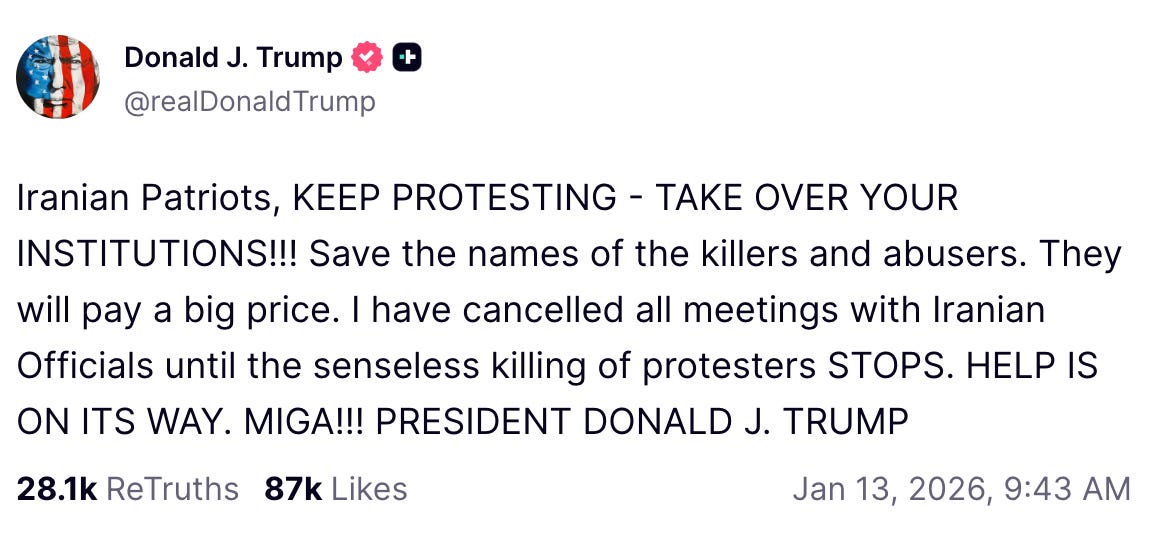
President Trump made a similar call for the Iranian people to “take over your government…The hour of your freedom is at hand,” when announcing the onset of Operation Epic Fury.
The scale and extreme brutality of the crackdown also reinforced broader beliefs in the US that the Iranian regime, while weakened in the short-term, remained an exceptionally dangerous regional power—one with no qualms killing tens of thousands of innocent people—which would not hesitate to target US forces and US allies with proxy groups, ballistic missiles, and potentially one day, nuclear weapons once it reconstituted its power.
The Iranian Regime Could Not Back Down Under Pressure in Negotiations
The US effort to end this perceived long-term threat through negotiations—if sincere—was likely doomed to failure long before they finally broke down on February 27 due to mutually incompatible interests.
The raison d’être for the Iranian regime is resistance to the West, specifically born out of a revolution against the US. The regime ultimately could not concede to any of the US demands to end its domestic uranium enrichment, put limits on its ballistic missile program, or curb its support for proxy organizations such as Hezbollah, Hamas and the Houthis without appearing to surrender the cause for which the Iranian regime serves.
The 86-year old Ayatollah Khamenei, signaled he was unwilling to capitulate in the final days of his rule and had begun hinting that martyrdom would be a means of ensuring his legacy.
The Iranian regime had apparently anticipated the likelihood of resumed hostilities with the US and Israel following the 12-Day War, viewing the reimposition of sanctions in August as the next phase of a broader conflict preceding an eventual return to open warfare. In response, the regime had hardened its inner national security circle, elevating figures such as Ali Larijani, signaling a preference for resistance over accommodation. That preference likely reflected not only the deeply ingrained ideological instincts alluded to above, but also a calculation that the Trump administration was ultimately determined to eventually institute regime change whether through incremental pressure or through direct military action.
The Trump administration probably reinforced these suspicions through suggestions that regime change was "the best thing that could happen" in negotiations, and secret outreach to Reza Pahlavi.
Iran Could Not Credibly Deter US and Israeli Strikes
War ultimately became a possible option for US policymakers to resolve the ongoing perceived threat posed by Iran, because Iran’s obvious internal divisions and diminished military deterrent rendered it vulnerable.
Years of US and Israeli strikes against Iranian proxy organizations across the Middle East, including Hamas, Hezbollah and the Houthis, and the December 2024 toppling of the Assad regime in Syria, reduced many of the Iranian regime’s previous options for waging a regional war.
Iran's previous missile and drone attacks on Israel had also shown significant limits to Iran’s potential for launching long-range retaliatory strikes. Operation True Promise 1, launched in April 2024 following Israel's bombing of the Iranian embassy in Damascus, and Operation True Promise 2, launched in October 2024 in response to Israel's killings of Hamas leader Ismail Haniyeh in Iran, Hezbollah leader Hassan Nasrallah, and IRGC General Abbas Nilforoushan in Lebanon, proved ineffective and were largely repulsed by Israeli air defenses backed by the US and regional allies. Iran’s drone and missile strikes against Israel in the 12-Day War were more effective, but its overall capacity to launch future retaliation, and its ability to defend against US and Israeli air strikes was further degraded in the conflict.
The 12-Day War also demonstrated Israel's ability to conduct clandestine ground operations targeting ballistic missile stockpiles inside Iran, and to carry out precision strikes against senior Iranian leaders, pointing to a deep penetration of the Iranian government by Israeli intelligence and suggesting significant internal divisions within the regime. Those divisions were re-emphasized in the wake of the protest crackdown, as hardline elements of the Iranian judiciary moved to arrest Reformist political leaders aligned with the Iranian president.
This moment of weakness was unlikely to last for long as Iran was making progress in rebuilding its long-range strike capacity and air defenses and may have convinced US policymakers that a unique window for strikes was at hand.
New reports this week showed Iran was bolstering its military with support from China and Russia. The Financial Times reported on February 22 that Iran has agreed to purchase 500 Verba man portable air defenses (MANPADS) from Russia as well as an additional 2,500 rockets for the systems. The deliveries were set to take place between 2027-2029 but some of the rockets may have been able to arrive in Iran sooner. A February 24 report by Reuters, Iran similarly alleged that Iran was in the process of closing a deal to buy CM-302 anti-ship cruise missiles from China. These latest reports followed a broader pattern of growing Russian and Chinese support for Iran in recent months. Notable contributions included Chinese provisions of materials for Iranian ballistic missiles as well as intelligence support to root out Israeli spies and cyber penetration.
WHAT HAPPENS NEXT
It is too early to say with certainty how this war will end, but the road to war points to a more prolonged and deadly conflict with the Iranian regime. The Iranian regime, while weak, still commands a monopoly on violence in the country and is unlikely to be easily dislodged by protestors alone. As noted in the Weekly Significant Activity Report - January 31, 2026, a plausible means of toppling the regime would come from a split between the conventional, conscript-driven Iranian military “Artesh” and the more ideologically loyal Islamic Revolutionary Guard Corps, possibly driven by anger over the January massacres of Iranian civilians. However, this outcome is far from certain as there are no obvious signs of a break between the two military forces.
Another possibility is that US and Israeli strikes eliminate enough Iranian leaders and cripple the regime’s ability to retaliate with ballistic missiles so thoroughly that remaining Iranian leaders opt to surrender. This outcome is still a major gamble however, as the January massacres have likely hardened the resolve of regime members across the board who may fear that loosening their grip on power would leave them vulnerable to reprisals from disaffected members of the Iranian public. Any surviving regime leaders are still likely to view the preservation of Iran’s ballistic missile program and proxy forces as a strategic imperative.
In any case, the Iranian regime is likely to pursue far less restrained retaliation against the US, Israel, and American allies than it has in the past. Facing what it perceives as an existential threat, Tehran may direct proxy forces to carry out cyber attacks and terrorist strikes against civilian targets across the Middle East, Europe, and the US homeland.
This briefing was compiled by Dan White. Dan is an independent foreign policy analyst based in the New York Metro Area. Dan is a former member of The Wilson Center and The Kennan Institute. Dan holds masters degrees from the Johns Hopkins University School of Advanced International Studies (SAIS), the Naval Postgraduate School, and the University of Washington. Dan is a former officer in the United States Army and a veteran of the War in Afghanistan.
For more information, corrections, or comments, please contact dan@opforjournal.com.
Great write up! Your page is always a great resource.